
Translated material
Shishkin and others
A few words about Mikhail Shishkin’s book “Mine. Essay on Russian literature "
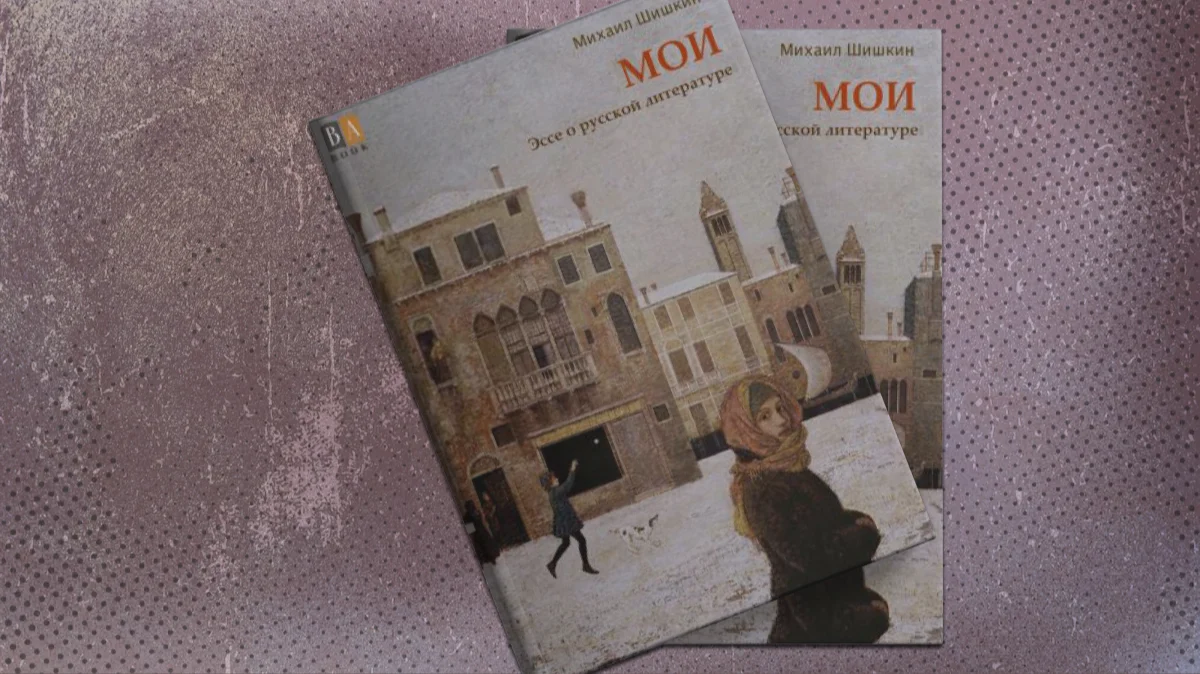
Book cover
Who does not like school literary criticism - do not be afraid. This is not about "what the author wanted to say with his work." Shishkin understands better than others that the author often does not know this himself, and to talk about it - and completely bad tone. The book is not about texts - about people who wrote these texts. But it is not about them, as those who once lived, who were married, who made their careers-not about their biographies. This is about how their talent demanded their correspondence and the “sacred victim”, how sometimes they acted at the same time with their talent, and sometimes they fought with him and even lost to him. The texts about which Shishkin tells about free will, they are as subjective as their authors.
Shishkin writes about texts, but does not set them out. This is not a brief retelling, not the translation of the novel into a comic. Once, surrendering different versions of Marxism, instead of reading the huge and disgustingly written works of V.I. Lenin, we watched the corresponding notes in the philosophical dictionary-this was enough for the exam. However, many of our teachers drew knowledge from the same source. So, this is not a philosophical dictionary. If you have not read the “Karamazov brothers”, then Shishkin’s essay about Dostoevsky will not help you understand the contents of this book. He writes for those who read and re -read.
He offers a tour of a well -known city. You know everything in it, but it shows you a new angle or even the same, but in another light. And this, especially when you love this city, is a discovery.
If, approaching the Yakimanka to the Bolshoi Kamenny, to turn right, and then turn back to the bridge, then a small lane will open to the right of you, and the bell tower of Ivan the Great will be visible on the other side of the river - only it is nothing more. As a picture in a frame. Once, when I already knew Moscow well, they showed me this completely new look for me then. And then I myself found and showed others a view of the Kremlin from the Raushskaya embankment. And in St. Petersburg, where I grew up, such new places appeared for me at all constantly.
But the better you know the city (author), the more likely the conflict is: why didn’t you show this - this is the most important thing! And at this building you must not look from here, but from here. But Shishkin does not insist that you agree with him. He also calls his essay my essay Pushkin, my Prishvin. Subjectivity does not hide behind authorities and quotes, but is declared openly. In the end, each of us has our own . But only when you read him -Goncharov or someone else- yours will remain yours, but will change a little. Or even change a lot.
And about disagreements with Shishkin - so yes, I have them. Most of all - according to Pushkin (listen, by the way, into their surnames). Yes, it never occurred to me that Pushkin established dual power in Russia - the equal power of the poet, genius, the equal power of the poet, was added to the power of the king. I am delighted with this idea, she is one of those who, after someone expresses it, seems obvious. But you try to express it. Shishkin was able! But in many ways I do not agree with him, as well as with a large number of others who wrote about Pushkin. Even the whole situation with Dantes seems to me not at all unambiguous. But how glad I am that I read Pushkin! Preserving, of course, his own .
The texts pour out of Shishkin’s heroes, not always obeying them. They themselves felt that someone was driving them with a pen. The most powerful impression on me was made by the drama described in the essay about Tolstoy, when the author could not defeat Haji Murat: his hero is the embodied denial of Tolstoy, he rejected the system of values of the one who came up with him. Tolstoy's talent defeated his ideology. However, this is only the brightest of the examples: Tolstoy often tried to call his heroes to order with epilogues and others. But they were too alive and independent to obey. By the way, the defeat in the fight against Haji Murat, so brightly stated in the book, made Tolstoy closer to me. His image has become more humane.
The heroes of Shishkin live in an understanding of the inevitability of a disaster.
“And a premonition of close disaster manifests itself in the Russian plain,” Oleg Chukhontsev said this in the next, twentieth century, but this is all about the same. Pushkin is aware of the horror of the Russian rebellion, and in order to not happen, is ready to support the "only European", the government. Gogol, in order to avoid the seemingly inevitable tragedy, is trying to write how everything can be good - to persuade reality. But he is not the secretary of the Union of Soviet Writers - his talent does not allow him to do this - into the fire! Well, those who lived closer to 1917 Tolstoy, Chekhov, Dostoevsky felt that they were approaching the country, although they could, of course, understand the scale of the coming horror-no one could.
What would happen to them with everyone if they lived? There is a terrible episode in the essay about Chekhov. 1936, the artistic meeting dedicated to the Stalinist constitution is held in the artistic. On the Presidium, along with the other seventy -year -old Chekhov. He goes to the rostrum and turning to the portrait of Stalin, says: "Dear Joseph Vissarionovich!"
No, Chekhov would not have done it. Too important for him, as well as for other heroes of the book, was his dignity (maybe because the literature is great, that the preservation of dignity was imperative for Russian writers?). But the Bolsheviks would not give Chekhov to live. “Cherry Garden” by Dodin ends with the execution of everyone - everyone! - Actors of the play. The author, if he had not died, would be set next to them. However, such people like him, Pushkin, Tolstoy, they still do not allow living.
The book has one very significant drawback.
Shishkin is too well owns "the art of put the word after a word." His tongue fascinates. And sometimes you are distracted from the content captured by the beauty of words. We have to re -read.
But he does not seem to be able to write differently.
Read this book. In some ways, you will agree with the author, and in some cases, on the contrary, make sure that your assessments are right. But, be that as it may, you will feel better the greatest Russian word, which by some miracle remains contrary to all those nightmares that have been taking place in our country for several centuries. And with him, with a Russian word, hope is preserved.
The book of Mikhail Shishkin “Mine. Essay on Russian literature ” is available for ordering in an independent publishing house .