
Translated material
In Italy, migrants die in the centers for deportation. They are not allowed to doctors and feed food with worms
On February 8, 2024, DOXA was included in the register of "undesirable organizations."
If you are in Russia or plan to return to it, you can not replace our materials on social networks, refer to them and publish quotes.
Read more about what is possible and impossible, read in the cards .
“Send my body back to Africa so that it rests with the world,”-22-year-old Osman Sille from Guinea left such an inscription in the cell of the Roman center for Migranto: K, where he was kept for further deportation. On February 4, Silla tied a rope from a thin sheet and hanged himself on it. He dreamed of becoming a singer and planned to get to the French city of Toulouse, where his brother lived. However, halfway was detained. Over the past five years, he has become the 14th dead in “black holes”-this is how human rights activists: Tsy call Italian centers Centri Di Permanenza per Il Rimpatrio (CPR), which is literally translated from Italian as centers for repatriation. For the maintenance and further expulsion of Migranto: K. Right now, Italian authorities are building the same complex in Albania and call it an example for the rest of Europe.

Editor
Editor
Sasha NorthIllustrator
Illustrator
Ira GrebenshchikovaIllustrator
Illustrator
Vitya ErshovPublication
July 15, 2024
How to get into "black holes"
These centers look the same: several squat and unremarkable buildings, most often they are on the outskirts of cities and are surrounded by high metal fences. Now in Italy eight active centers Some of the centers are periodically closed for repairs or due to problems with their infrastructure. At the time of the release of the article, centers in Turin and in the Sicilian city of Trapani temporarily do not work. they are located in different regions Two centers in the north (in Lombardy and Veneto), one in the center of the country (in the Lazio region), three in the south (two centers in Apulia and one in the Basilicate), as well as one center of detention in Sicily and Sardinia. And they allow you to contain about 900 people at the same time. Seven of them are accepted only by men, but in the Roman Ponte Galeria there is also a department for women and minors.
The first centers of content appeared in Italy in 1998. The decision on their construction was associated with the country's entry into the Schengen zone, according to the professor of political sciences Giuseppe Campy: "One of the requirements for the reception was to strengthen measures to combat unregulated migration."
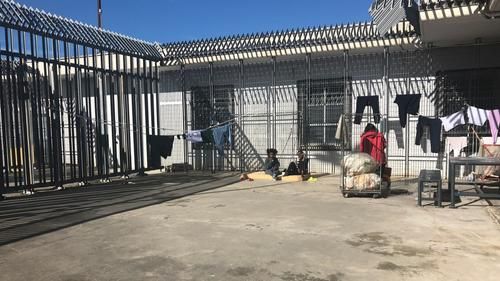
Center for Migranto: K in Rome
Internet
Usually, people fall into the centers of the content due to routine verification of documents on the street: “If they do not have a residence permit or other document certifying that a person can be in Italy,” explains DOXA local human rights activist Nadia Bovino from the Naga association, helping refugees and people who have experienced torture.
It was after such an audit to the Roman center of Ponte Galeria that a man came in whose history was told by the human rights organization Cild. At the time of his arrest, his family members lived in Italy with a residence permit for four years, and the children went to a local school. Despite this, the man was sent to the center of content. “It was terrible, they threw me into the dark room. The light did not work, a naked mattress lay on the floor. I was disoriented, ”he said.
Foreign: OK, who committed crimes, transported to centers from Italian prisons. According to the ActionAid human rights organization, from 2014 to 2021, approximately 4,500 people About 12% of all Migranto: K, held in centers in these years. We got into the centers of the content in this way.
Since 2015, some of the petitioner also fall into these institutions: shelters (but they, by law, cannot keep them there longer than a year). According to Actionaid, from 2018 to 2021 approximately 3600 About 16% of all Migranto: K, held in centers in these years. Processor: The refuge of the shelter fell into these centers.
This is how human rights activist Nadia Bovino described for DOXA the conditions of detention in these centers: “Worse than in prisons. You are completely abandoned. There is little food, and the one that is, can be rotten or even with worms . No activity is organized for people there: days they stretch endlessly. Even books are not issued, because paper is a flammable material. The police beat the detainees with batons to maintain order. ”
Many also take phones from many and do not allow them to contact them: Tsami, but a lawyer: the detainees complain that they cannot get to their clients and provide legal services properly, according to the report of the CILD human rights association. In addition, detainees are practically deprived of the right to medical care.
Why do people die in these centers
“In theory, in order to get to the center, you need to go through the medical board, which will confirm that human health allows you to be there. In practice, doctors are in a hurry, and they do not have tools for diagnostics, ”explains Bovino. As a result, such institutions are also drug -consuming: nits, as well as people with mental characteristics or severe diseases. All of them cannot get proper care there.
There are cases when, due to limited access to medicine, people in these centers performed suicide. In May 2021, a 23-year-old migrant from Guinea Mousse Balde died in the center in Turin. On the day of detention, he was beaten on the street with three people with sticks. While Balda was taken to the hospital with serious injuries of the head, he was drawn up for the exile. Without waiting for recovery, the man was sent to the center of content and placed on a two -week isolation Events took place during the pandemic of coronavirus. to the local medical department.
In isolation, Balda committed suicide by handing over to the lawyer that "he could no longer remain locked up." After the death of the man, the Italian authorities conducted an investigation and admitted that the department, in which the deceased was located, did not meet the requirements for the provision of medical services.
A similar case occurred with a 20-year-old migrant from Nigeria in 2019. For two months in the center in the city of Brindizi, he repeatedly asked him to send him to a psychiatrist, but received refusals. As a result, the man committed suicide.
The poor conditions of detention in such institutions are explained by the fact that their activities are practically not regulated, and the management has been transferred to private companies that are trying to save, says DOXA Nadia Bovino. Among such companies, for example, the Swiss ORS Group - it leads the centers for Migranto: K in Switzerland, Austria, Germany and Italy.
In 2015, this corporation was already accused of bad conditions. The report by Amnesty International said that the Austrian Center under the leadership of the ORS Group simultaneously contained 4600 people with a maximum capacity of 1800 (almost 2.6 times more). In addition, the Swiss company sought to “reduce costs and maximize profits by saving at visits to a doctor, training courses, nutrition and quality of residence,” wrote human rights activists: TSY.
At the same time, ORS Italia Srl Italian "daughter" Ors Group. and other management companies massively purchase psychotropic drugs Among the medicines that the centers purchase are methadone, clonazepam, bromazepam, cerrallin and diazepam. All of them have a sedative effect. - Much more In the Milan center - 160 times more, in Roman - 127 times. than state medical institutions serving about the same number of people. According to one thing: the co -cooperation: C to the center, this is more profitable than spending on improving the conditions:
While they [detained migrant: ki] under the influence of drugs, their requests are reduced: they do not eat, do not suit a mess
At the same time, the careless use of psychotropic drugs in such centers also led to deaths. So, in 2020, in the Italian city of Goricia, a 37-year-old citizen of Georgia died-due to a mixture of drugs and drugs, he began to swelling of the lungs and brain. Two months later, the 28-year-old citizen of Albania was killed there from an overdose of the methadone.
"Inhuman, expensive and ineffective"
In these words, the centers system is described in the report of the ActionAid human rights organization. We talked with one of the authors of this report, a professor of political sciences Giuseppe Campezi.
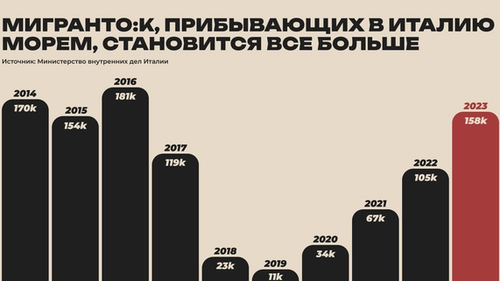
According to him, every year only half of the people contained in these centers are sent from Italy. The number of deported depends solely on the diplomatic agreements between Italy and other states. There is such an agreement, for example, with Tunisia, so Tunisian citizens are actively deported from Italy: OK At the same time, citizens: CI Tunisia make up only 18% of all foreign: OK, who arrived in Italy by sea in 2018-2023. . Those who cannot be returned to the country of origin due to the lack of agreements between states are most often issued by the order to leave Italy, but usually such people remain in the country. “After a while, some of them again fall into the centers of content and again find themselves on the street,” says human rights activist Nadia Bovino.
There are cases when people were “returned” to countries with which practically nothing connects them. So, the report of the Naga association mentions the history of the ethnic Bosnian who was born and lived in Italy without documents (while his children had Italian citizenship). Despite the fact that the man was actually apatride Citizenship person. And he did not know the Bosnian language, he was first sent to the migration center, and then to Bosnia.
Human rights: TSI predicts that the situation will become worse. After coming to power of the extreme right party "Brothers of Italy" The heiress of the neo -fascist "Italian social movement." In 2022, the “brothers of Italy” in a coalition with other right -wing parties received a majority of votes in the parliamentary elections and for the first time in their history formed the government. In 2023, the new government increased Over the years, the authorities changed the maximum deadline for Migranto: K: Initially, he could not exceed 30 days until in 2002 he was increased to 180 days, and in 2011 - up to 18 months. Then the term was reduced again to 180 days, and in 2023 it was again raised to 18 months. The maximum term of stay in centers is up to 18 months and allocated additional funding for these institutions In 2023 - five million euros more than in 2022; In 2024 - for 14 million euros. .

We talk about Russia's military invasion of Ukraine, protests and repression. We believe that now, when dozens of media have closed or ceased to cover the war, access to independent information is more important than ever.
The Prime Minister and Leader of the Italian Brothers Party George Meloni accused the previous government of due to the large stream of Migranto: there are not enough places in the centers of detention. “If you illegally arrive in Italy, you will be detained and sent back,” she said. The Minister of Internal Affairs of Matteo Piantsedozoi even announced the need to build more centers for maintaining and further expulsing Migranto: K - one in each region There are 20 regions in Italy. .
Political scientist Giuseppe Campezi believes that such anti -migrant policy is, on the one hand, part of the marketing strategy of the new government; On the other hand, the investigation of the new agreement The pact was accepted in April. According to the new document, all EU member countries must register and check all the migranto arriving: to the external borders. This audit should reveal whether the migrant is: ki from countries, citizens: whose kama is more often refused asylum (the share of satisfied petitions is less than 20%). Natives from such countries will be sent to closed camps for an “accelerated procedure” consideration of their applications. According to which the countries of the European Union since 2026 will be required to carefully check all the arriving migranto: K. “In order to fulfill these rules, Italy must build a much more powerful infrastructure in itself,” Doxa Campuzi explains.
At the same time, according to him, the regional authorities are not ready to build new centers on their territory due to reputation risks. Even a representative abandoned this: the nits of the extreme right -wing parties, for example, the "League of the North" This right party initially fought for the greater autonomy of the northern regions of Italy. However, in recent years, the League of the North has more often has come from the standpoint of conservatism and Euroskepticism. Representative: Party nits also talk about the need for a strict struggle against migration. The leader of the party of Matteo Salvini stated that he does not exclude any methods of combating the migrant arriving by the sea: Kami, including using a navy. . “Therefore, the authorities decided to build new centers outside the country,” Campuzi concludes.
"A new stage in solving a migration problem"
Now Italy is building In total, in the next five years, the government plans to spend 653 million euros on two centers. Of these, 30 million will go for construction, the remaining expenses include the transportation of Migranto: to and staff, salaries and spending on the maintenance of Migranto: K. Two new centers for Migranto: K in Albania Italy and Albania are shared by the Strando Strait, between the banks of the two countries a little more than 70 kilometers. There are close economic ties between the countries: Italy is one of the main trading partners of Albania. In addition, states are already connected by large infrastructure projects, for example, the construction of a transdriatic gas pipeline. : One for the reception, the other for expulsion. Both should be ready in the fall. On agreements with the Albanian side, Italian personnel will be managed by these centers, and Alban: KI will ensure security along the external perimeter.
Amnesty International has already called an agreement between Italy and Albania “illegal and non -working”, and in the International Rescue Committee - “dehumanizing”. Italian human rights activists: TSIs are also alarmed and feared that all the problems of Italian institutions for the content of Migranto: in the new conditions they will only aggravate. “Even local centers cannot be controlled, especially since it will be impossible to do in Albania,” explains Doxa Nadia Bovino.
In turn, George Melony said that the Albanian decision is an example that the rest of the European countries follow. “We will open a completely new stage in solving a migration problem. The contract [between Albania and Italy] can be reproduced in many other countries and should become part of a structural solution for the entire European Union, ”Melony said during her visit to Albania on June 5.
The project was also supported by the President of the European Commission Ursula von der Lyain, calling the Italo-Albanian agreement "an example of a non-standard decision based on a fair division of responsibility with the third countries." The researcher of the Institute of Migration Policy in Berlin Olga Gulina notes that Italy’s idea was not new, a similar practice was used in the European Union before: “They agreed with all the countries of the Middle East. For example, an agreement was concluded with Turkey In 2016, the European Union countries entered into an agreement with Turkey. According to the document, the Turkish side pledged to return Migranto: K, who are trying to illegally go through the Turkish-Greek border. In return, the European Union pledged to accept the Syrian refugee: OK, which should expect its turn in Turkey. on the restraint of the Syrian migrants, it is still valid. ”
Migration holding - a longtime trend
The researcher believes that the European authorities choose a restraining strategy due to the lack of a long-term migration policy: “Now at the peak right-dressing parties that scare and not act. They do not have a long -playing strategy, all solutions are short -term, for a particular moment and tasks. The laws still do not have a provision on the migration of the masses in the case of humanitarian or environmental disasters, and this is our close future. ”
Environmental changes can really lead to mass migration. According to the Forecast of the World Bank, by 2050 up to 216 million people will be forced to leave their homes due to an increase in sea level, land degradation, erosion The gradual destruction of the upper layers of the Earth. Due to subsidence, the soil can become unsuitable for life, construction and agriculture. Also, due to erosion, dust storms are formed that are dangerous to health. soils and extreme temperatures. However, if world governments take measures to soften the consequences of the climatic crisis, this number can be reduced by as many as 80% to 44 million people.