
Translated material
The killer convinced everyone that he had corrected

Leaving life, he became famous as a writer and was released. Soon in Europe and the United States, a series of murders began with a characteristic handwriting
Jack Unterweger is an Austrian writer, journalist and serial killer. Since the mid-1970s, he was serving a life imprisonment for the murder of an 18-year-old girl. In prison, Unterweger wrote several books that became bestsellers. Having become famous thanks to the literature, he went out at Udo at the request of the Austrian intelligentsia, which called him an excellent example of how the system could re -educate the criminal. Once at large, the Unterweger began to kill again, but for a long time he remained out of suspicion. As he managed to conduct everyone - in the material of the "cold".
In order not to miss the main materials of the "cold", subscribe to our Instagram and telegram .
First blood
On June 1, 1976, the Land Court of Salzburg found the 26-year-old unemployed Jack Unterweger guilty of the murder. According to investigators, in December 1975, the non-winger brutally killed an 18-year-old girl named Margaret Shafer.
The body of Margaret a week after her death was found in the forest a hunter. The police quickly established the identity of the murdered person and went to her friend - Barbaru Sholts. During the interrogation, Sholts said that Margaret killed her boyfriend.
According to the case file, Barbara Scholz began to meet with Jack Unterweger shortly after she escaped from the house. At some point, the couple ran out of money, and Jack invited her to rob the house of her parents, but they never managed to penetrate him.
Returning from an unsuccessful robbery, they met the school girlfriend of Barbara - Margaret. Jack invited her to drink and ride - she agreed and got into their car. The company spent the evening in the forest. Barbara remained in the car, and the Unterweger and Margaret went out for a walk. There, he brutally beat her with a steel rod and strangled her with the same bra.
Unterweger was arrested. In the early stages of the investigation, he denied his guilt, but later admitted to the murder. Having given a confession, the non -stoveger sought to find any explanation for his act, which will help him soften the sentence. He argued that at the time of the attack was under the influence of drugs and alcohol, and during a psychiatric examination he said that he saw in Margaret the image of his mother, whom he hated.
The court did not consider these circumstances to the mitigating: the non -stager was sentenced to life imprisonment and sent to a maximum security prison.
During the investigation, it turned out that Margaret Shafer could not be the first victim of Unterweger. In 1973, under similar circumstances in Salzburg, 22-year-old Maritsa Croat was killed. The unknown beat Croat, tied her hands with a tie and threw it into the water. She could not free herself and drowned.
The involvement of Unterweger in the murder of the investigation was not able to prove . The investigation in which the non -stager became suspected after the detention in the murder of Margaret Shafer was terminated after the non -terrain received a lifelong.
Marginal childhood
Jack Unterweger was born in 1950 in the Austrian town of Yudenburg in the southeast of the country. As he later claimed, his mother met her father, Jack Becker, in the Italian city of Trieste. Becker was an American soldier who served in Europe after World War II, and his mother of Unterweger was a waitress and a prostitute. According to the memoirs of Unterweger himself, his aunt was also engaged in prostitution.
During pregnancy, Unterweger's mother was convicted of theft and was in prison. She was released two weeks before the birth of her son. Soon she again ended up in prison for theft, and two -year -old Jack was transferred to his grandfather’s care. According to Unterweger, his grandfather had alcoholism and he often beat him.
In elementary school, Unterweger was difficult: he lagged behind his peers and they constantly teased him. Instead of school, Unterweger often helped his grandfather steal neighboring cattle.
In 1958, social services drew attention to the dysfunctional family. They deprived the grandfather of the rights to guardianship and sent eight -year -old Jack to the orphanage, and then transferred the foster family. Later, Unterweger recalled that all this time he hoped that one day his mother would return for him, but this never happened.
When Jack was 15 years old, he threw school and began to engage in theft. For this he was sent to the center for minor offenders, which was near Vienna. There he spent about a year.
After the release, the Unterweger spent time with street criminals and began to use drugs. From 1968 to 1975, according to the court card, he had 16 offenses , from theft with a hack and ending with sexualized violence.
Work out the past
While in conclusion, Unterweger gave an interview with the ö1 radio station, in which he explained his outbreaks of anger, which, according to him, led to the murder of the Shafer: “When you see that the other person is trembling with fear, you feel a sense of victory. You cannot find the strength to restrain yourself. ”
In prison, Unterweger completed school education, read a lot and graduated from writing courses. Teachers praised his abilities. He began his literary path by writing poetry: his first works were based on other people's plots taken from textbooks. He sent his texts to the Austrian writers and hoped to get support from them.
By correspondence, Unterweger met the writer Sonya von Aizenstein. Jack invited her to write about his story, but Aizenstein liked the texts that he sent to her, and she invited him to tell his story - so she suggested that he work out her past.
In 1983, the Unterweger published his first book - the autobiographical novel Purgatory, which became a bestseller. In the book, he described his difficult childhood and reflected on the injustice of the judicial system.
In the mid-1980s, the name of Jack Unterweger increasingly appeared on the pages of the Austrian press. Literary magazines and newspapers published excerpts from his novels and stories. At the same time, the country actively discussed the rehabilitation of criminals and their return to society.
The Minister of Justice of Austria Christian Broda dreamed of creating a society without prisons. He often said that the criminal can be reintegrated to society. These ideas responded to many Austrian public intellectuals, including writers, scientists, philosophers and journalists known in Austria. Among them was Elfrid Elinek, an Austrian writer, who in 2004 was awarded the Nobel Prize in Literature.
Soft and kind
One of the supporters of the return of criminals to society, Alfred College, editor of Manuskripte magazine, went to prison Stein, where he was serving lines of Unterweger. He wanted to see the writer lively and listen to how he reads his works.
“He was so soft and kind,” the collector later recalled . “After that meeting, we decided that we would achieve his liberation.”
The campaign to liberate Unterweger was initiated by the Austrian Pen Club. Famous people wrote letters and signed petitions in support of Unterweger. On May 23, 1990, the court granted the petition for early release and, after 15 years of imprisonment, Unterweger was released. According to Austrian laws, this was a minimum period to revise life imprisonment.
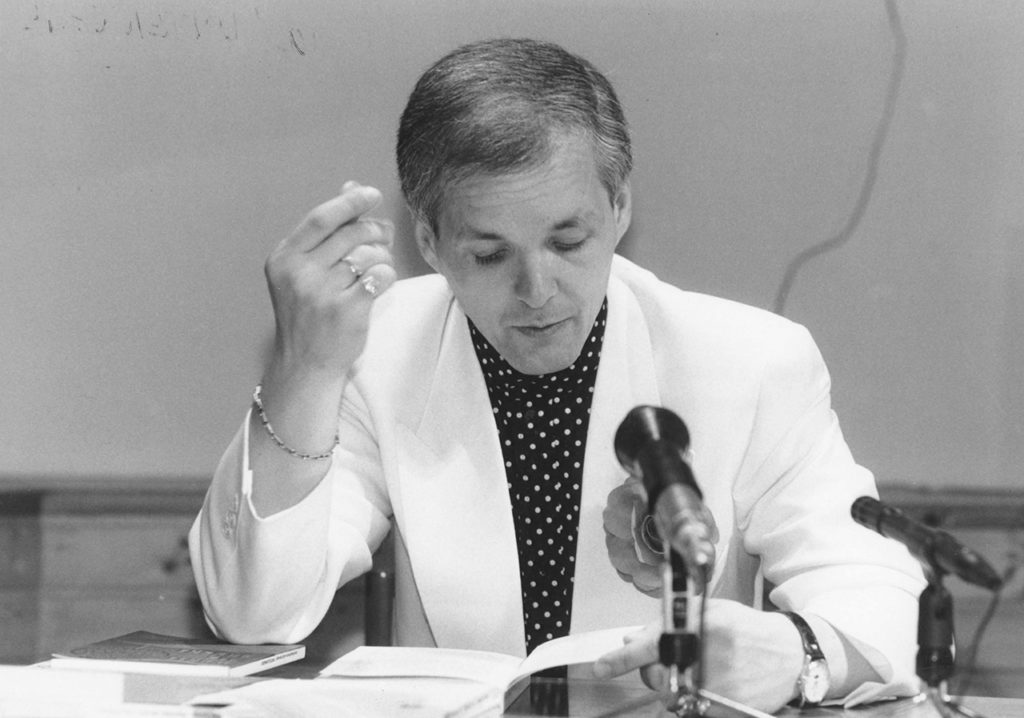
After the liberation, Unterweger began to lead a secular lifestyle and often appeared in public. He wrote articles for glossy magazines, shot reports for television and performed on the radio. Mostly his work was devoted to crime, human trade and prostitution.
In addition to journalistic activities, the non -stager continued to engage in literature. He traveled to different cities with his literary works and held meetings with readers.
Jack Unterweger loved expensive clothes. In public, he most often appeared in an elegant white suit and went to Ford Mustang with the Jack1 number. His reporter salary would hardly have been enough for such a life - the money for the expenses of Unterweiger was given by rich lovers, one of whom rented him an apartment in a prestigious area of Vienna.
In September 1990, just four months after the release, the Unterweger went to Prague to write a report on the life of prostitutes on Red Light Street. At the same time, a harsh murder occurred there.
Exact questions
On September 15, in the suburbs of Prague, the police found the corpse of a 25-year-old sex worker Blanca Bochkova. There were no clothes on it, there were traces of the rope on her neck, and a stab wound on the buttock. Over the next six months, seven more murders of young girls who were engaged in prostitution were committed in Austria - all the victims were strangled.
The link of all the murders was one detail: a sliding knot on the neck of the victims. To investigate the series of murders, they instructed the detective to Ernest Heyeger, the head of the Department of Criminal Investigation of the Vienna Police Max Edelbacher oversized the case.
Austrian forensic scientists could not go on the trail of the killer for a long time. On some bodies, they found traces of sperm, but at that time there were no technologies for the analysis of DNA. In search of the criminal, Geiger and his colleagues interviewed sex workers and pimps, trying to find out if there were aggressive men among their customers who could be involved in the murders.
Information about brutal murders quickly spread in the press. Meanwhile, Jack Unterweger invited his editor to write a report on the progress of the investigation. The editor agreed, and in June 1991, Unterweger interviewed Edelbacher.
According to the investigator, Jack was a pleasant interlocutor and asked many very accurate questions about the progress of the investigation. True, as Edelbacher admitted, the investigation at that moment had very little information on the case, and he really could not tell anything. A week later, Unterweger again asked him for a meeting.
Sliding knot
In a conversation with Edelbacher, Unterweger said that he was going to go to California on the editorial office, and asked that Edelbacher had no years of familiar police officers in Los Angeles. Arriving in the USA, Jack made friends with local investigators. As in Austria, he wrote materials about prostitution and the criminal world.
At the same time, in the summer of 1991, a series of murders occurred in Los Angeles. Three girls who were engaged in sex work were killed: 20-year-old Shannon Exli, 31-year-old Irene Rodriguez and Sherry Long. All of them were found strangled.
In parallel with this, Max Edelbacher was called a policeman from Salzburg named August Shenner. In 1974, he investigated the murder of Maritsa Croat, which was closed back in the 1970s. For many years, Shenner tried to resume the investigation, as he was confident in the guilt of Unterweger. He had no doubt that the current murders were also the work of Jack's hands.
At first, the investigation group did not take this information seriously. They could not understand why the rich, as they thought, and the famous Unterweger to kill street sex workers. Nevertheless, Edelbacher decided to check Alibi Unterweger - and discovered that the places where the crimes were committed coincided with the places where the Unterweger performed.
At the same time, American forensic scientists contacted Edelbacher. They talked about murders in California. All women were strangled in the same way-a loop with a sliding knot-that the sex workers killed in Austria.
On February 14, 1992, the police issued an arrest warrant of Unterweger. One of his friends told him about this, after which the non -flair fled with his girlfriend Bianca Gloom, who at that time was 18 years old. They left for Switzerland, then went to Paris, and then returned to the USA and settled in Miami.
While in the USA, Jack contacted the Austrian police to tell them that he was innocent. He also complained to Austrian journalists about the unjust, in his opinion, accusations.
In Miami, the means of Unterweger quickly ended, and then he contacted his ex -girlfriend who lived in Austria to ask her for money. When Bianca and Jack went for money, the police were already waiting for them. Formally, Unterweger was arrested for a civil offense: he entered the United States on a tourist visa and did not report his criminal record.
Unterweger was extradited to Austria. The police had sufficient evidence to charge him.
Last love
Upon learning that the Unterweger was detained, the Austrian society split into two camps-someone was happy to capture the killer, others advocated his liberation and wrote him letters of support.
In prison, Unterweger made several attempts by suicide, and this was written in great detail in the Austrian press. Soon after the next attempt to take scores with the life of Jack, a girl named Astrid Wagner wrote a letter.
Wagner first learned about Unterweger in the mid-1980s, when she was a student of the law faculty. Even then, she was fond of forensic science and was read out by the books of Unterweger. In 1992, correspondence ensued between them, and soon Astrid visited Jack in prison. Gradually, their relationship grew into a novel.
Twice a week, Astrid visited Unterweger in prison, erased his things and brought programs. Due to the hobby, Unterweigher, she broke up with her boyfriend and quarreled with her family. “At first, I tried to restrain my feelings and did not know what this could lead to,” Astrid recalled . “However, I dreamed of our future.”
According to Astrid, her whole life was concentrated around Unterweger. He convinced her that the case against him was fabricated. For Astrid, he was neither a killer nor a rapist, and during their meetings he showed himself from the best side: he was attentive and caring. He also gave her his car.
During the investigation, Unterweger conducted a number of examinations, according to the results of which he was given three diagnoses: dissocial, narcissistic and sadistic personality disorders. The trial of it began in April 1994. The investigation collected evidence for 11 murders, three of which were committed in the United States. The materials of the criminal case took almost 20 thousand pages.

During the trial, Unterweger insisted on his non -involvement in the murders. However, Gregg McCrary, who acted as a witness to the prosecution, said that all 11 murders have similar characteristics and were committed by one person. The forensic scientists from Los Angeles also confirmed that all the victims were killed with the same node that the Unterweger used.
On the body of one of the victims, forensic scientists found several threads that coincided with the material of the scarf and trousers of Unterweger. In addition, his old car was found in the landfill. Inside the car, investigators found hair belonging to the Blanca Blanca killed in Prague.
On June 28, 1994, the court sentenced: Unterweger found guilty of nine murders, two more murders remained unproven. He was sentenced to life imprisonment as a punishment.
Six hours after the sentence, Jack Unterweger committed suicide in his cell. He made a loop of thin metal wire and lace and strangled himself with the same knot with which he killed his victims.
After the death of Unterweger, Astrid Wagner moved from Graz to Vienna and became a famous criminal lawyer. She is still convinced of the innocence of Unterweger.
In 2019, Astrid was a lawyer of Alfred Ulrich, who was sentenced to 30 years for cannibalism. She also wrote a book about another criminal,Joseph Fritzle , a large father from Austria, who raped and kept one of his daughters in the basement for more than 20 years.