
Translated material
Hinstein on Esim
The authorities promise to close access to the "gray" SIM cards and not to let into messengers without a passport. What to do?
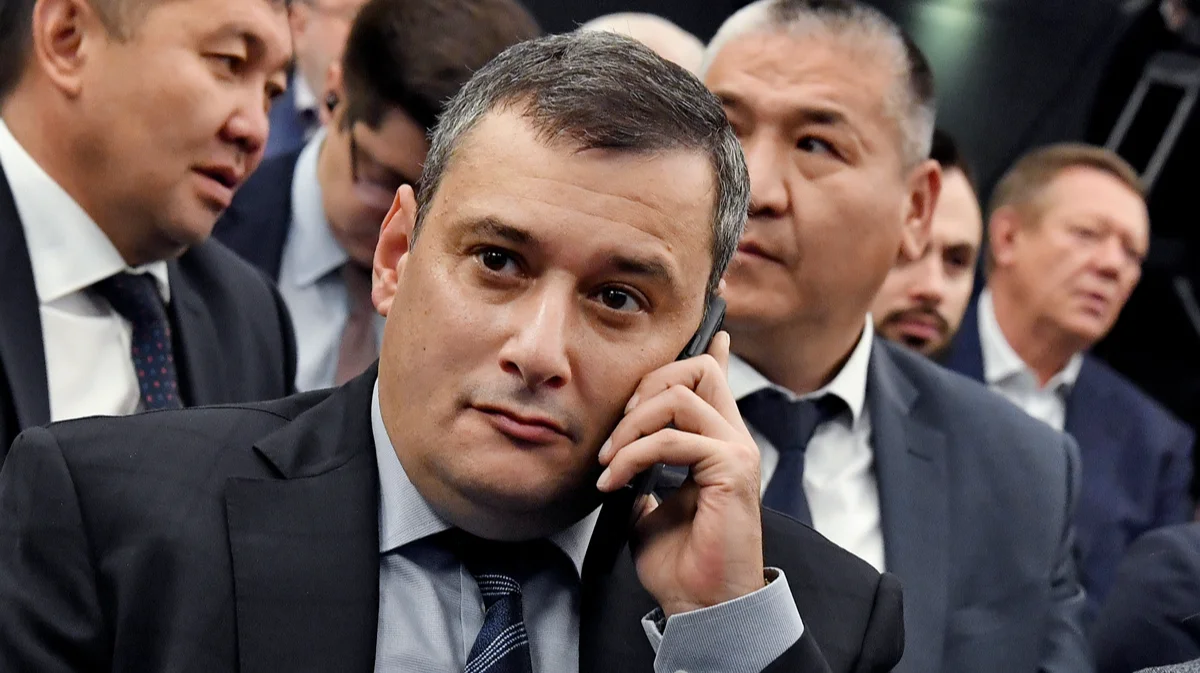
Chairman of the Committee of the State Duma of the Russian Federation on Information Policy, Information Technologies and Communications Alexander Khinshtein. Photo: Irina Buzhor / Kommersant / Sipa USA / Vida Press
The information water for my replica today appeals to practical recommendations to overcome the next Duma non-letters . The placement of the plot in the historical context, in turn, will give optimism to sane compatriots.
I quote a plot from the original source (State Duma deputy A. Khinshtein, spelling and punctuation copyright ):
“I get a lot of calls about the prepared changes in“ coherent ”legislation, including On toughening the work of telecom operators ...
I will explain: now the IT Committee is preparing for the 2nd reading the bill “On Amending the Federal Law“ On Communication ”and the Federal Law“ On the Identification and (or) Authentication of Individuals ... ”There is no final text of the editorial office, but the main directions are already clear.
One of the goals of the law is to restore order with the identification of subscribers.
Let me remind you that the law today obliges communication subscribers (owners of numbers) - to confirm their personal data. Those who refuse autilation, the operator must block the number, but ...
To this day, the market of "gray" SIM cards-remains a huge problem. Anonymity is a nutritious environment, the basis of cybercrime: from telephone fraud to terrorism, extremism and espionage ( italics mine . - approx. S. G. ).
On the eve of Roskomnadzor, eloquent figures released: 256 citizens registered a total of more than a million SIM cards, it turns out that one person accounts for about 40 thousand SIMES. The question is, who and what are they used for?
Our task is to restore order in the operation of communication operators, excluding the possibility of uncontrolled turnover of SIM cards. It is impossible to achieve this without introducing responsibility for unscrupulous operators.
We also consider it right to establish the requirements similar to communication operators, and for instant messengers. Today, voice formations through the messenger - occur almost more often than on cellular communications ( italics mine. - approx. S. G. ). So, it is necessary that the “rules of the game” be the same for everyone.
We will try to submit the final edition of the bill in the very near future. ”
In other words, we are talking about the need to oblige “messengers” to connect users only after checking “personal data” (that is, passports) - by analogy with the current requirement for mobile operators.
What is it for? The primary source with direct text indicates (I repeat, because this is the point): “Anonymity is a nutrient medium, the basis of cybercrime: from telephone fraud to terrorism, extremism and espionage.”
Of course, Khinshtein, of course, came up with a “nutritional environment”, but the bureaucracy of all the states of the planet more than 20 years ago. The watershed, like almost all the most significant in the social life of modern civilization, was held on September 11, 2001.
State against anonymous mobile communications
In post -paper Russia, mobile communications looked especially colorful: a wealthy boy in a red jacket was fully registered (passport, registration, a statement from a commercial structure, permission from all controlling departments), paid from two to five pieces of Green, after which he received the right to hang a ten -kilogram station for mobile communications on his shoulder. With these stations, wealthy boys did not part either in their “six hundredths”, nor in the “metropolis”, nor at discos, or in public restrooms.
Years passed, mobile stations decreased to the size of a simple telephone tube (the limit of dreams is Nokia’s cot, like Neo, that of the skyscraper in the “matrix” that falls out of the window), and the registration requirements were first formalized, and then completely dried up, at least in the countries of the civilized world. In the second half of the 1990s, disposable mobile tubes were sold in the United States at every newspaper kiosk and at the box office of supermarkets. Without any passports, of course.
Then there were strange “arrivals”, and the situation with a mobile freight turned 180 degrees. The state suddenly guessed that the main evil is the possibility of citizens to uncontrollably exchange information .
By the beginning of the century, the state has already suffered a crushing fiasco in the fight against the uncontrolled of electronic correspondence. In 1995, the US Customs Service initiated the criminal prosecution of Phil Zimmerman for the uncontrolled distribution of PGP (Pretty Good Privacy), the most popular and free algorithm for encryption of emails. The government considered cryptography as a variety of weapons (munition), subject to special control. PGP used “strong encryption” inaccessible to hacking, and allowed anyone who wants to encrypt his emails. Accordingly, the government did not have the opportunity to read these letters even after capturing the user's computer.
Then Zimmerman came up with a brilliant output and answered the state with his own pseudo-unit casuistry: in the same 1995, he published a book called “The source code and internal device PGP” (PGP Source Code and Internals), in which in simple words he cited the entire source code of the encryption in the programming language of S. Since the letters, words, or the book are not were the "digital code" (digital code), export restrictions did not apply to them.
The state receded, but did not refuse the idea of monitoring communication of private citizens. A lifesaver was found in terminological nominology after 9/11. The state came up with the hell of the “international terrorism”, which became the greatest discovery in the struggle against civil society in the 21st century. Under the cover of “struggle against international terrorism” with a dizzying speed, all the basic principles of civilian freedoms were destroyed one by one, to conquer for Western civilization for more than three hundred years. Checks on the verge of nudism when crossing state borders, round -the -clock video surveillance in public places, the right to detain without explaining the reasons for a long time (and this is an attempt on the cornerstone principle of Anglo -Saxon freedoms - Habeas Corpus) and so on.
Of course, the freemen with an uncontrolled sale of mobile phones was also stopped: a scan of a passport when buying a SIM card is a reality from Kuala Lumpur to London and Vancouver through Moscow and Riga.
In fairness, it must be said that no one has yet thought of passport control over the “messengers”! So the Russian Federation now has a historical chance to be at the forefront of the struggle of state entities with the anonymity of private citizens.
Technological progress against deputies
The above readers may seem like hyperbola: there are informal opportunities to purchase Prepaid Sim Card (prepaid card) without identification of the individual. This is customary to write off on “unscrupulous sellers” from the kiosks of shopping centers, which joyfully copy and store the data of previous applicants, so as not to “miss the sale”. This also includes the complaints of Khinshtein at “256 citizens”, who registered “40 thousand SIMES” for the soul.
In reality, the deviations from the requirements of KYC (Know Your Customer) are dictated not so much by the all -conquering spirit of commerce, but by uncontrollability of technological progress. Actually, technological progress is the main character of my column today, which I conceived precisely as Panehyris to this “most effective tool for struggle” with state non -ceremonies of any planetary weight.
The fact is that any attempt to stop the unstoppable - the movement of mankind from centralization to decentralization, from identification to anonymity, from control to uncontrolled - in the digital era is doomed to fiasco under an avalanche -like incandes of new technologies that play any prohibitions.
I will illustrate the statement only by a small part of ready -made practical solutions that dispel any naive veriges that are only able to arise in bureaucratic brains.
Let's start with mobile operators who are obliged to conduct KYC when selling SIM cards. It is obvious that the whole structure of coercion is built on the idea of jurisdiction.
That is, the state can force its rules to either national mobile operators, or those who come to the local market through the front door. Accordingly, those mobile operators who are not breaking into any doors, and even more so position their business outside the regional context, are free to provide services without looking back to local repressions.
Where they give a SIM card without a passport
The technological solution to the regional problems of KYC is called Virtual SIM. In a broad sense, virtual SIM cards are technologies that allow the use of mobile services not through a “live” SIM card, but through software, without reference to a specific physical device. That is, this is an ordinary application that can be downloaded to a smartphone and used for subsequent calls to any numbers of mobile and local operators.
Initially, the virtual SIM cards were almost exclusively the Voice Over IP (VOIP) software wrapper-technology that allows you to transmit voice calls through the Internet or other IP networks. Instead of using traditional telephone lines, VOIP transforms voice signals into digital data that can be transmitted over the network.
In practice, the use of VoIP was cool, but not very convenient. VoIP allowed to broadcast a voice, but heavily lost the usual “SIMMANS”, which, in addition to the voice, could provide the opportunity to receive and transfer files, streaming videos and the like, using the entire palette of digital life.
Since 2016, virtual SIM cards have evolved in the Embeded SIM (ESIM)-a full-fledged SIM card that is integrated into a smartphone. ESIM allows you to activate the full range of mobile services (voice communication + “all the Internet”) without the need to use a physical SIM card.
Actually, ESIM is the grave of the Federal Law “On the implementation of identification and (or) authentication of individuals ...” and the like. Today, ESIM services, in addition to local mobile operators, are provided literally by hundreds of transnational business initiatives, which to one degree or another ignore both KYC and AML (Anti-Money Londering) both in terms of providing the services themselves and in the aspect of payments.
Operators free from digital slavery conventions are a simple googling in a few seconds on the request of Esim Cards Without ID: Textresim , Holafly , Zadarma , Esim Chad ... - Almost to infinity.
In all cases, you select the tariff plan and services you need, pay, get ESIM and install it on your smartphone according to the QR code.
However, it is necessary to take into account two technological restrictions.
The first restriction: today, not everyone supports ESIM technology - especially budget - phones. If you are in doubt about your device, check with a list of supported models (for example, here ).
The second technological restriction: most ESIM providers, flaunting passport control, provide only the services of mobile data transfer. That is, you get ESIM, which gives access to the Internet, but does not provide a voice connection.
For little advanced users, such a feature is not a barrier, because-and here Khinshtein is right! -Today you can speak perfectly in a voice in almost any chat mixer. There would be access to the Internet.
For non -passable users, a completely comfortable alternative remains: ESIM providers services, which require formal registration before selling cards. This registration is limited to the provision of a name, surname and email.
True, passport nudism occurs at the next stage - when paying ESIM: in most cases, we pay with a bank card, which in itself is an analogue of a complete identification of the individual.
In this situation, we have a choice: if we have nothing against registration in unknown offshores and are just trying to get rid of the obsessive passport control of our native state, then we accept the conditions of the card payment and in return we get access to the services of providers with the most profitable options - both in monetary relations and in the variety of territorial coverage of the vocal communication and the Internet: Airalo , GomoWorld , Gomodorld. Yesim and with a dozen others.
Unbalanced ESIM union and cryptocurrencies
We have sorted out technical problems. However, there are also others - purely discriminatory.
Due to sanctions, many ESIM service providers do not provide voice communications in Russia and are limited to Data Only-access to the Internet. Of the above, for example, Gomoworld and Yesim. Airalo went even further, and in the list of 200 countries in which their cards operate, Russia is not in principle.
The second discriminatory problem is the inability to use a card of Russian banks to buy SIMKs. None of the international providers certainly accept them. However, His Majesty Progress even plays such a problem: today there are many ESIM providers who accept payments in cryptocurrencies.
I call it offhand: esimsdata (in the Russian Federation only data transfer, payment by cryptoactivists through the BTCPay service), eSimway (in the Russian Federation only data transfer, payment by cryptoactivists through the BTCPAY service or direct payment to the USDT ERC-20), SIMXL (in the Russian Federation only data transfer without voice communication, payment Cryptoactics through the NowPayments service).
Through simple comparisons, we come to the conclusion that today ESIM, provided by transnational services of services that do not require registration and accept payments in cryptoactives, for Russians are limited only by the lack of voice communication. What follows from the impossibility of leasing the mobile voice connection of Russian operators, which, for obvious reasons, are prohibited from such cooperation.
Nevertheless, as I said, to establish voice communication in the presence of the Internet is the question of one tap on the screen. Moreover, the quality of the voice communications via Skype, Telegram, WhatsApp, Signal, Viber and others today is at least no worse than the quality that local mobile operators provide.
And here we directly go to the thematic forming of today's column, because we begin to understand the concern expressed by Kinshtein: the population in a critically dangerous volume goes to voice communication on the Internet through messengers, preferring them to their native mobile operators.
From such an outrageous situation, Duma people make a logical conclusion: it is necessary to oblige “messengers” to check the passports of their users! Just as mobile operators already do.
But the population can calmly exhale: “messengers” all regional legislative non -then -based non -then purely sharaban.
Because all of them, these damned “messengers”, do not stay in the jurisdiction of the Russian Federation, do not plan to be in it and do not consider it necessary to fulfill any regional Federal Law.
Accordingly, we can state that in the current situation, the bill “On Amending the Federal Law“ On Communication ”and the Federal Law“ On the Identification and (or) Authentication of Individuals ... ”” There is one single application : a symbolic designation of the state will .
In the sense that here she is, the will, such as her Duma people formulate. Principal and unshakable. The requirements for “messengers” are a gesture symbolically close to the announcement of the CAI Kallas or Zelensky. Or - from the opposite side - the announcement of the Mus on the wanted list of Putin. These are all signs that demonstrate intention, but (so far) is not potency.
Why still "yet"? Because under certain circumstances, symbolic actions can gain practical implementation not where everyone expects. For example, with a complete disconnection of the external Internet in the Russian Federation, the issue of checking or not checking user passports by “messengers” becomes irrelevant in principle: there will be no instant messengers at all - what with voice communication, without it. There will be one big case with one big messenger and admission through public services.