
Translated material
Learn empathy and kill arrogance in yourself
We need to change as an opposition to get out of the crisis
Timofei Martynenko is a political activist and member of the Platform of Anti -Wenced Initiatives. He worked as an editor at Navalny’s headquarters, collaborated with “open Russia” and conducted a project for assistance to political prisoners in the “Rostov case”. For the past two years, he has been engaged in media work and the organization of shares in the Vesna movement. Especially for the “cold”, he wrote a column about why, in his opinion, the Russian opposition was in a crisis - and what should she do to get out of it.
In order not to miss the main materials of the "cold", subscribe to our Instagram and telegram .
The Russian opposition is in a serious crisis - organizational and semantic, the crisis of identity and the crisis of humanity. I would like to demonstrate the statistics proving this, but it is not. I have only personal impressions and oral evidence of hundreds of democratic and anti -war activists and ordinary Russians with whom I spoke and for whom I watched daily over the past two years of the war. They feel disappointment in weak political and moral leadership; a lack of instruments of participation and influence, as a result - alienation, unsuscitation and inappropriation; resentment against endless accusations, pointing and gaze from top to bottom from opposition speakers; growing gap between the opposition and society; Fatigue from the lack of honest and substantive discussions about errors.
It is worth mentioning right away that I am writing this text not in order to cause another fierce dispute in social networks with the search for guilty and mutual curses, but in order to open a discussion about our weaknesses. Of course, nothing has done more harm to the Russian opposition than the Putin regime. However, we ourselves made many mistakes.
Even in conditions of limited opportunities and under severe pressure, we should not abandon subjectivity - and responsibility for our actions and decisions.
We ourselves - both individuals and organizations - should be the first goal of our own reflection and criticism. We must work on ourselves in order to become better and bring to life those ideals for which we declare. An open, honest, albeit difficult discussion about what we do wrong and what we should change is the first step on the way of leaving the crisis.
We need to (re-) learn to be empathic and stop seeing the world with black and white
Agreeing that there is nothing worse than the war (which is true), many mistakenly added: "So, everything is justified." As a result - joyful statements about terrorist attacks in Russia, signing shells of the Armed Forces of Ukraine, creating bots factories, where “elves” write opposition comments on the salary. Plus, endless talk about collective fault that get to the point of absurdity: accusations of pancakes in supporting war, demonstrative “non -sensitivity” of mobilized and total misunderstanding, and sometimes neglect of the problems of compatriots who cannot leave the country, the famous “teaching python”.
This has many reasons, but the essence of this: unwillingness to educate humanity, cultivate empathy, use social imagination, see and understand others with their weaknesses and mistakes, delve into a complex social context, listen and help, and not judge and teach.
Two years of the war led to universal bitterness, simplifying the picture of the world and the rejection of principles for the sake of establishing "the end justifies the means." But this is the path only to a greater growth and abyss between people.
We are a deeply divided society. We are well able to experience social and political contempt, to be arrogant, to condemn and hate. This is often done by those who consider themselves an alternative to the regime. We refuse to see people and fellow citizens in those who support Putin, in those who go to the front - often, by the way, not of their own free will, but by coercion. Some of these people are really criminals, but not all. With many we can say, many can at least understand - which does not necessarily mean justifying.
All these years, the regime taught us to see us around enemies, because atomization, destroyed connections and total dehumanization is beneficial to him. So easier to manage people. And we need to admit, it is also easier.
Yes, it is difficult to see people even in criminals and those whom we consider “incorrigible” are bad. It is difficult to get into someone else's skin, conduct a dialogue, show compassion, and remember the rights of a person. This requires great courage and self -control, but if we want the best future for Russia and ourselves, we need to learn to be patient and compassionate, reject contempt, condemnation and pride, and remove a white coat. This, it seems to me, is the most reliable way to enlist the support of a wide society.
This does not mean that we must love everyone, never condemn anyone and always agree in everything. But it is worth remembering that we are all people and citizens of the same country.
We need to kill social arrogance in ourselves, learn to recognize mistakes and apologize
This item logically follows from the previous one. A striking example of arrogance and inability to abandon the principle of “never to take back” is a recent scandal on Twitter: the ex-deputy of the Novosibirsk City Council Sergey Boyko mockingly commented on the post of activist that she forced to rent an apartment in Italy without concluding an agreement with the lessor. He later stated that “he did not say anywhere that [himself] always and everywhere removed [housing] for a year and with an agreement”, which, however, did not stop the promoting spiral of hatred - the dispute eventually reached the absurd accusations of “substitution”, although he could end with the banal “sorry, was wrong.”
It would seem that this is an insignificant incident. But this is how almost most of the public communication of large opposition speakers works. Meaningless aggression, arrogance, bringing to absurdity. But the most important thing is the total inability to say “I was mistaken”, even when it is obvious to everyone except the most ardent fanatics.
Oppositionists seemed to have adopted this pattern from the Putin regime, for which the idea “not to bend to do not look weak” is a cornerstone. But this is a non -functional installation: to recognize errors is not weakness. No need to be afraid of this - in fact, it is easier and more pleasant than to disgrace to the end. Thus, many conflicts that lead only to polarization and disappointment could avoid.
Learn how to treat others as equal. Remember that your first and main source of power is society. You are not a teacher, not a judge or shepherd. And one more advice - put the principles above the circular bail and the workshop solidarity. Do not be afraid to criticize your colleagues. Be honest with them at least for the sake of themselves.
We need to return love for the country and its interests to the center of our policy
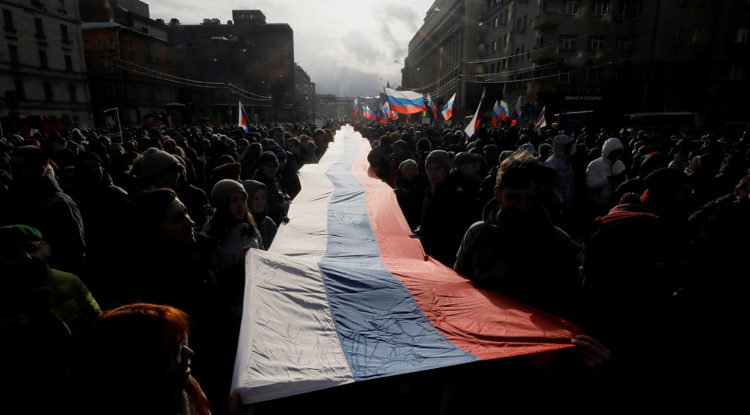
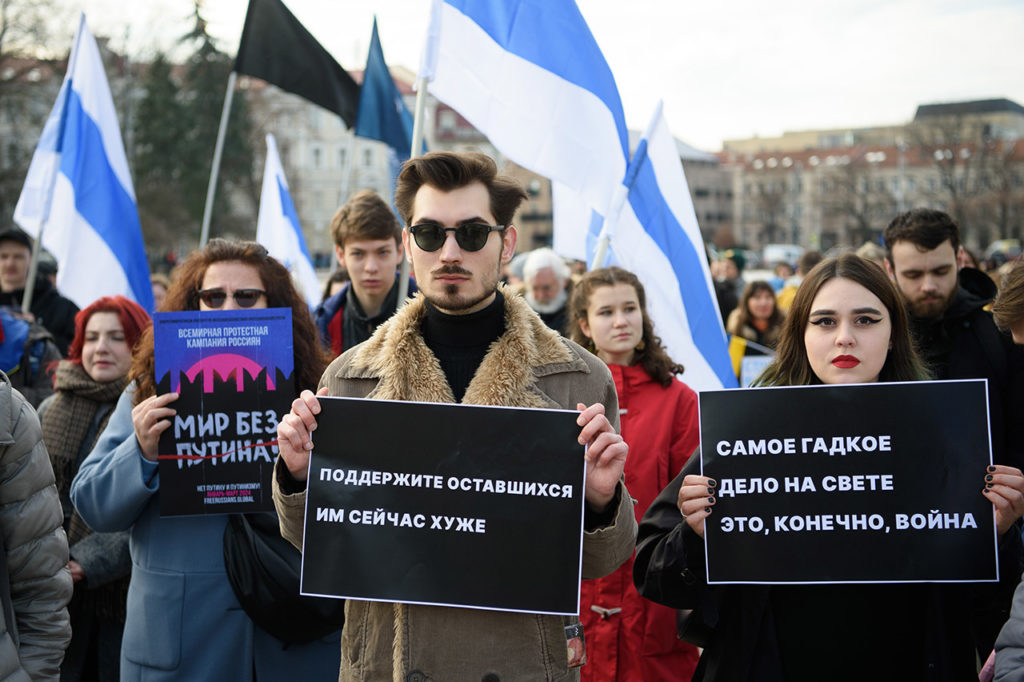
At the level of rhetoric and at the level of symbols. Since the beginning of the war, the Russian opposition by will or bondage has headed for distance from Russia. Take at least a rejection of the national flag with its replacement with a white-blue-white surrogate. It is clear that the purpose of this is to demonstrate your position, but this can be done in a million different ways, including using a real flag, under which, I recall, Nemtsov, Yashin and Navalny stood - and they made it the mainstream symbol of the opposition. They understood that Russia is not Putin, and the flag of Russia is not the flag of Putin.
The refusal of the flag rallied the opposition, but cut it off from a wide society. And the flag is not the only problem. Many under the pressure of guilt (or out of the fear of international condemnation?) Tried everywhere to abandon subjectivity and adopt the political discourse of the Ukrainian political leadership, urging Russia to throw Russia into the Stone Age and impact on its territory.
Here it would be worth considering what ideas our political leaders broadcast to their future potential voters, in whose interests they seem to be acting. How to achieve the declared goal - building democracy in Russia - without society? Or does someone really believe that such statements may sound attractive to a large number of Russians?
If the purpose of the opposition is to conquer the minds and hearts of people and direct this energy to the fight against dictatorship, then we need to talk not about the destruction of our country. I would formulate a more successful narrative like this: the withdrawal of troops and the salvation of lives as a victory of Russia; lifting sanctions and reintegration into the world in order to take a worthy place in it; Freedom, democracy and orientation for the benefit of citizens as the key to a stable and rich future.
The same goals must be declared in international politics. Let us admit that the victory of Ukraine will not automatically lead to democracy in Russia. This requires much more, including much more efforts of the international community to support the struggle for this very democracy. Defend the interests of compatriots, fight primarily for the freedom of Russia - and call on this to European and American politicians. No one except ourselves will help us.
We need to open the doors of our organizations
To date, the significant part of the opposition is represented by individual speakers without any organizational structure behind their backs (Katz, Khodorkovsky), or closed organizations that do not provide opportunities either for entry or for influence (Navalny team).
Now, not only opposition politicians and organizations have been squeezed out of the country, but also thousands, if not tens of thousands of citizens who advocate democracy and want to participate, create meanings, develop solutions, and make projects. The risks of such activities abroad are incomparably lower ( but they are still not zero. For example, this year in Vilnius attacked the comrade -in -arms of Navalny Leonid Volkov. - Approx. “Cold” ), and the possibilities for influence even higher - the doors of the European and American authorities, albeit with a creak, are discovered, including for grassroots activists. An example is the “Anti -Wiral Initiatives Platform”, which helps small projects. Thanks to her work, for example, there was an appeal to EU member countries with a request to protect Russian citizens who refuse to participate in the Putin war against Ukraine.
Of course, you can endlessly be afraid of the shadows of the special services, but for this there are systems for verification and elimination of potential members. There are also successful examples of this - for example, the Vesna movement and feminist anti -war resistance work.
The only thing that, it seems to me, stops the opposition from real democratization is fear. It is also very convenient: it allows you to change anything (and nobody). But this leads to a personnel stagnation and political infertility, stops the process of circulation of opinions, ideas and control methods.
That is why organizational democracy is not a threat, but a source of power. Politicians should change, new leaders-appear, ideas-to discuss, and people-to be truly represented through the mandate. Open doors and democratization of the internal device, I am sure, are able to defeat the political gap between the opposition elite and “ordinary people”. To eliminate the feeling of alienation, disobedience and the inappropriateness that has grown among opposition Russians, at least among those who are abroad. Do not give up their ideas and energy - this is a huge resource.
It is time to end the era of politics “from top to bottom”, when the “sages” from screens and panels tell us what to think, how to act and what to fight for, working according to the scheme “I do, you barking, and since you barking, then I imagine you”. This format frustrates people, because it has no place for participation and self -expression. In it, citizens are consumers, at best - performers. This does not work for the formation of civil society.
In conclusion
This, of course, is only a small part of what we can and should do. They should have been for a long time, but from something you have to start. Just please do not forget to rest, touch the grass and return to ordinary life so as not to lose human appearance.
Want to express an opinion? Offer the topic of the speakers on holod@holod.media
The author’s opinion may not coincide with the opinion of the editorial office.