
Translated material
Two Americans are stuck in space
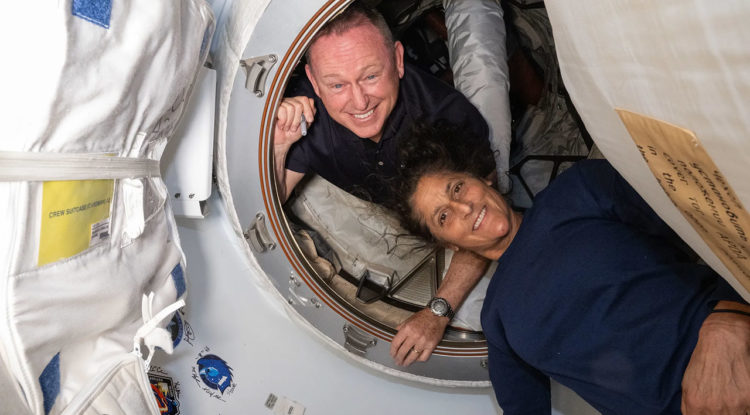
The astronauts had to return a week after the start, but the engines refused the ship, and the mission went not according to plan
American astronauts Barry Wilmore and Sunita Williams have been forced to live at the International Space Station (ISS) for more than 50 days. They became the first astronauts aboard the Starliner spacecraft, which was created by Boeing, which is now criticized due to a scandal with aircraft safety. The mission was very dragged on - it was originally planned that the astronauts would spend about a week in space, and then return to the ground. But Starliner from Boeing has broken, and now they are stuck on the ISS for an indefinite period. "Cold" talks about the Boeing Crew Flight Test mission, the outcome of which now depends on the tests on Earth.
In order not to miss the main materials of the "cold", subscribe to our Instagram and telegram .
Wilmore and Williams went space on June 5. The first piloted launch of Starliner passed from the site of the Kennedy space center in Florida. The start itself was possible only on the third attempt - the previous two were canceled for technical reasons: at first, Starliner did not work in an oxygen valve, and next time the malfunction was found in ground equipment.
Problems with Starliner have arisen throughout the years of preparation of the ship. During the first attempt to launch in May, dispatchers found a leakage of helium in one of the engines. The engineers did not eliminate her, as they did not see a special threat in her. However, a few hours after the start on the ship, two more leaks formed . NASA and Boeing assured that they were not dangerous: helium is not fuel and not toxic, it is used to transport fuel in the ship’s motor system.
Serious problems began when approaching the ISS, when Starliner suddenly turned off five engines at once, which help the ship maneuver in orbit. Due to the problems, Wilmor had to run four engines manually, in parallel, equipment on the ground tried to fix the problem with automatic launch. As a result, they managed to restore the operation of four engines, and Starliner was able to seize the ISS, but it was because of these problems that the astronauts cannot return to Earth.
NASA does not fully understand where the problem with the engines came from. The manager of the NASA commercial flight program Steve Stich is confident that the engine failure is not related to Helia leakage. Mark Nappi, who oversees the Starliner program in Boeing, did not attach much importance to faults. He called Helia leaks and engine failures “rather small problems”, although similar problems were recorded in the previous Starliner test in 2022.
Experiments on the body
The analysis of the problems and attempts to eliminate them with the Boeing and NASA teams on Earth remain the reason why Williams and Wilmore cannot return home. The astronauts themselves are trying to spend time with benefit: they work with other astronauts - together with them there are four more Americans and three Russians on the ISS - and also take part in research.
“We are very busy here, completely integrated into the team. It is like returning home. It's nice to soar in zero gravity and work here with the team of the International Space Station. So yes, it is great to be upstairs here, ”Williams said during a briefing with reporters.
More household work fell on Wilmore: he repairs freezers and serves water pumps at the station. Wilmore is a master of all hands, he had to build sheds and tables in the church, where he is an elder, so he was entrusted with the repair of things and the ISS. Together with Williams, they conducted an inventory of food supplies at the station and repaired the pumping system of urine processing. The toilet on board the ISS provides the crew with drinking, since urine is processed into water.
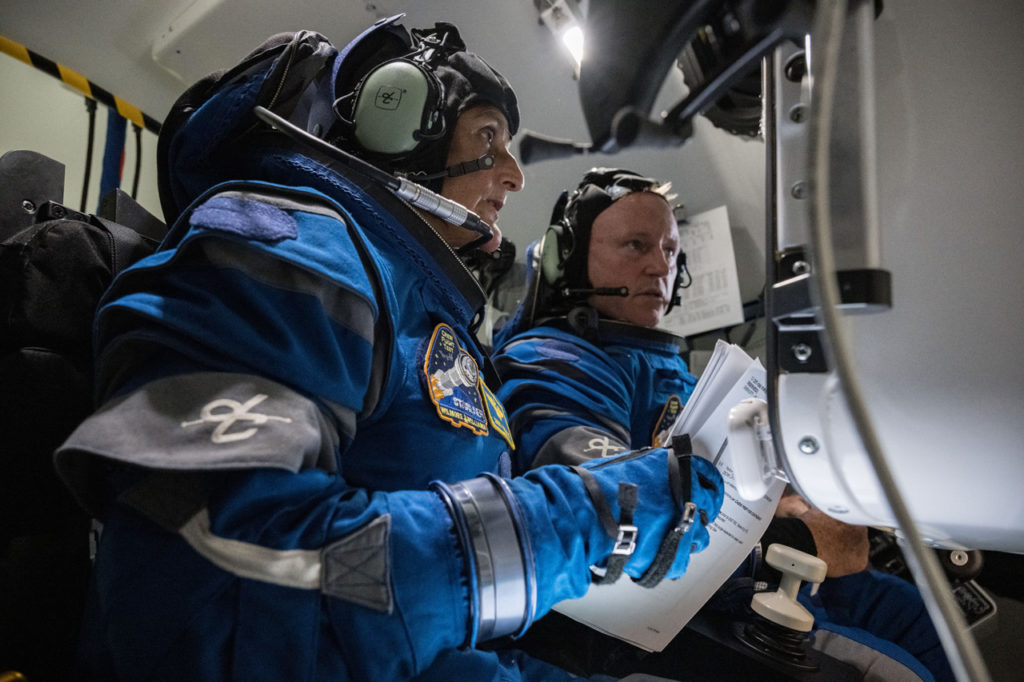
Both astronauts also participate in experiments on their bodies. For example, they scan their veins using a special ultrasonic apparatus. The information obtained is analyzed and helps supplement data on the influence of space on a person. Williams also studies methods of growing plants in the absence of gravity. However, there are also disadvantages - the presence of two extra astronauts affects local food supplies, and the station systems are loaded more than predicted.
The absence of the exact date of the return of the astronauts does not scare . Wilmore even praised Starliner, calling the flight “impressive” on it. In addition, astronauts remain in touch with their families, which facilitates the expectation.
“This is a wonderful place for life, a great place for work,” Wilmore shares his impressions of life in the ISS.
Wilmoru is 61 years old, his wife and two daughters are waiting for him on earth. Before becoming an astronaut, Captain Wilmore served in the Navy and piloted fighters. Williams is also a retired Captain of the Navy, she was a helicopter pilot. She is 58 years old, she is married. Before the flight on Starliner, Williams and Wilmore spent about 500 days in space for two.
Starliner mission
Initially, the flight of Williams and Wilmore had to check how the ship would behave in emergency situations with the crew. In the future, NASA plans to put four astronauts in Starliner and send them to the ISS for six months. Before that, the crew of the ship should make sure that the capsule will fit as a shelter in case of problems for the ISS.
And a similar case introduced himself -in June, the astronauts had to prepare for emergency evacuation with the ISS due to the fragments of the satellite, who fell apart near the station. Williams and Wilmore took refuge in Starliner and even began to prepare for a rally. Such a scenario is provided in case the fragments of the satellite are cut into the station. As a result, everything worked out, and the crew returned to the ISS and continued to sleep .
Now techniques are conducting test tests of Starliner engines on Earth, in New Mexico. The engineers approached the understanding of the root cause of the problem: the accumulation of heat inside the engines leads to the bloating of Teflon seals, which interferes with the fuel flow. Boeing and NASA even plan to ban astronauts manually control Starliner, as some manual maneuvers increase the load on the engines.
The Starliner program has been developed since 2014, and during this time the ship has not committed a single completely trouble -free flight. The first start took place in 2019, but it was transferred several times due to problems with the missile air duct. The ship was unable to fix up with the ISS, but returned to the ground. The second start, in 2022, was also postponed several times, but in the end it went more successfully than the first: Starliner was able to sprinkle to the ISS and return to Earth. The only problem that happened then was a breakdown of two engines.
NASA hopes for Starliner and wants to certify Boeing as the second commercial operator of the United States to deliver crews to the ISS. At the moment, the monopolist in this market is SpaceX Ilona Mask. At the same time, the Mask company received almost half the money from NASA: $ 2.6 billion against $ 4.2 billion allocated for Boeing.
If Starliner successfully undergoes tests, this will enable the United States to abandon cooperation with Russia, which NASA relying for almost 10 years, and also deprive SpaceX monopoly.
As for Williams and Wilmore, NASA still does not know when they can send them home. But, most likely, they will remain at the ISS at least until mid-August, when the Spacex Crew-9 will deliver four new astronauts into orbit. NASA assures that Starliner is ready to fly to the ground, but the decision to return the crew has not yet been made.
“I don’t complain that we are here for a couple of weeks,” says Williams.
Williams and Wilmore are not the first American astronauts stuck in space. The mission of the astronaut Frank Rubio and Cosmonauts Sergei Prokopyev and Dmitry Petelin dragged on on 371 days - this is a record among the participants of the ISS program, which no one had yet beaten. Rubio and his two colleagues from Russia were initially sent to space for six months. But on the Soyuz spacecraft, which was supposed to pick up the astronauts from the ISS, a coolant leak occurred . As a result, Rubiodva of the month was waiting for a working spacecraft to replace Soyuz, and after that they decided to extend its expedition.