
Translated material
Dismissal from the army: how to terminate a contract with the Ministry of Defense?
It’s not easy to leave the Russian army early, but some still manage to do it
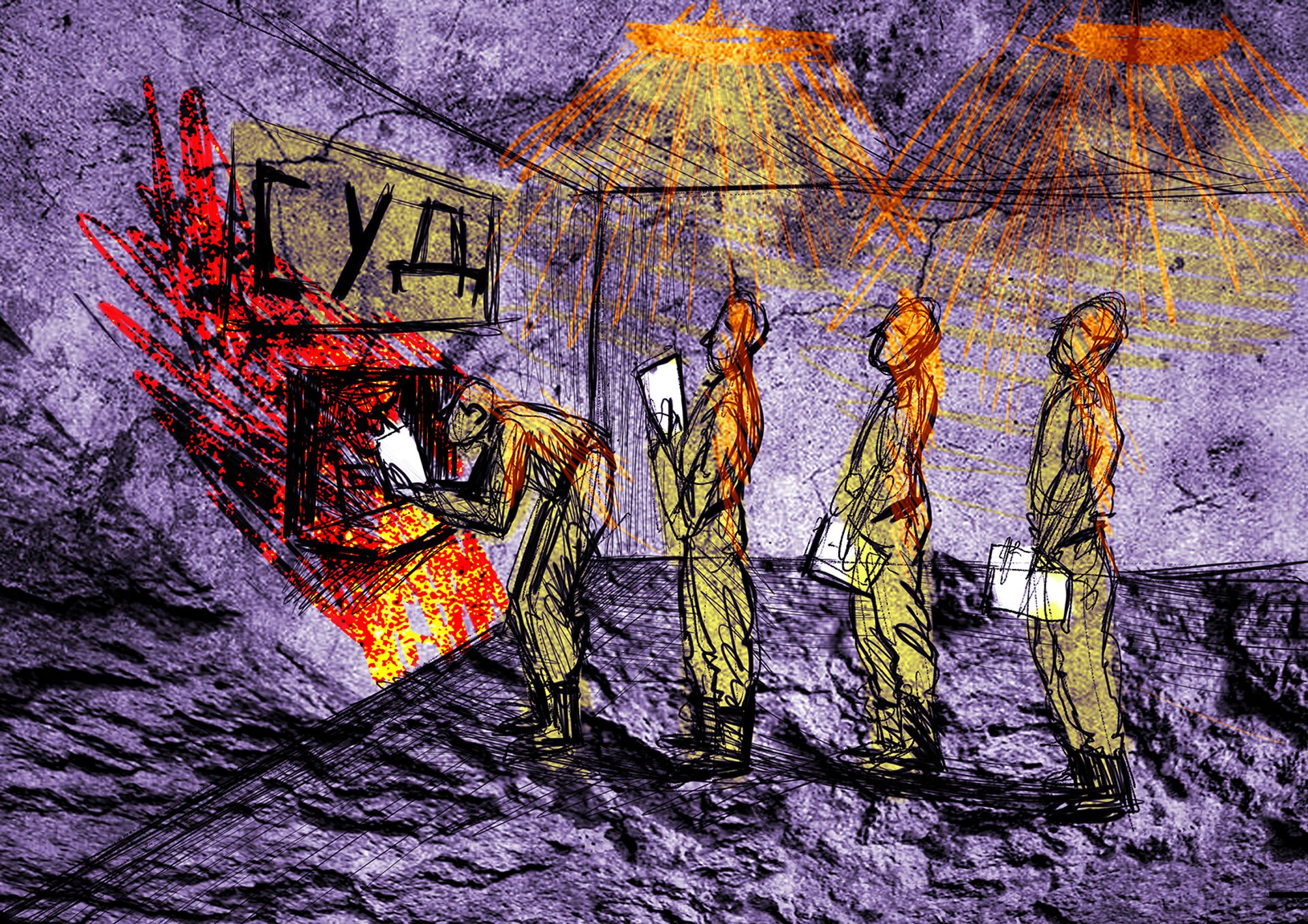
It has always been difficult to leave the Russian armed forces early, and after the announcement of mobilization it became almost impossible. The military rarely tries to resolve such an issue in court, but in 2023 the number of claims for dismissal from service for the first time in five years exceeded the number of requests for reinstatement.
In order not to miss new texts from “Layout”, subscribe to our telegram channel
“Everything is very, very bad. Forget about dismissal and contract expiration. While all this is happening, you will be beaten, thrown into a hole
and send them to assault brigades, from where there are two ways - 200 or 300, but there are places where even 300 are not evacuated. You'll be there as long as you can pull the trigger. There is no legal way to quit. And if there is, then only when this bloody war ends,” deserter Artyom tells Vorstka. He went to the front in 2023, having received a conviction in a criminal case for drug distribution and signed a contract to avoid prison.
Artyom became one of thousands of Russian soldiers who fled the army after the start of a full-scale invasion of Ukraine. It has always been difficult for a military man to resign, but after the announcement of mobilization, when all contracts became indefinite, it became almost impossible, note all the interlocutors of Vestka. Nevertheless, there are cases when Russian military personnel manage to do this legally.
Against the backdrop of the war, military personnel began to more often try to resign through the courts.
Before mobilization, the law “On Military Duty and Military Service” provided Russian military personnel with nine legal grounds for voluntary dismissal. After September 21, 2022, a military man can resign only if he was declared unfit for service, exceeded the age limit, or was imprisoned for a criminal offense.
In practice, as Vorstka’s interlocutors say, military commanders often ignore the health status of military personnel, do not send them to a military medical commission, and ignore the age limit. Some military personnel, disagreeing, write appeals to the prosecutor's office or go to court. During the war, as Vorstka found out, several hundred people tried to get fired this way.
What did we think?
Expand ↓From the websites of Russian garrison courts, “Verstka” downloaded administrative cases challenging decisions on dismissal from military service for the period from January 1, 2019 to July 12, 2024. Two thirds of the decisions on claims for 2019 - 2021 have been published. For claims in 2022 - half, for claims in 2023 - a third. We analyzed these judicial acts to understand what the serviceman asked for - dismissal or reinstatement.
This is not exhaustive data. Garrison courts hear claims for dismissal from service, but if a Russian wants to challenge the decision on his mobilization, he appeals to the district court at his place of residence. In 2023, “Verstka” calculated that almost 800 Russians tried to cancel their conscription to war through the courts.
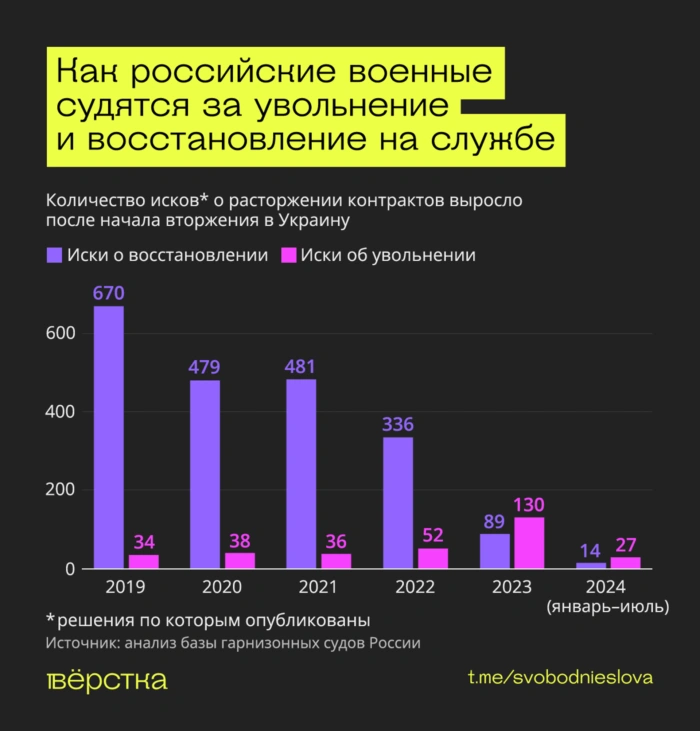
Since 2019, Russians with military status have filed lawsuits over five thousand times for dismissal and reinstatement. In 2019, there were just over a thousand claims, in 2020-2021 - about 900, in 2022 the number again exceeded a thousand, and in 2023 it dropped to 748.
Before February 24, 2022, military personnel rarely went to court to seek dismissal. Basically, they tried to get their jobs reinstated with the help of the court. The war with Ukraine changed this trend. In 2019 - 2021, the number of dismissal claims did not exceed 7% (of the number of cases for which decisions were published). In 2022, it began to grow and reached 11%. After mobilization, in 2023, the number of military personnel trying to resign through the courts exceeded the number of those trying to be reinstated for the first time in five years. The number of dismissal claims was more than 52%.
Only nine people won the dismissal lawsuit
It is extremely difficult to win a dismissal lawsuit in a garrison court. During two and a half years of war, only nine Russians managed to do this. In another five cases, judges ordered employers to take a closer look at dismissal reports.
In the summer and fall of 2022, three people from military units in the Pskov region and Crimea, whose contracts expired before mobilization was announced, proved that they were illegally detained in the army. Representatives of military units explained in court that the servicemen did not submit reports of dismissal, but the court did not agree with these arguments. As the judges noted, according to the law, responsibility for dismissal lies with the unit commander, and the military man himself is not obliged to write a report. According to the law, if four months before the expiration of the contract he did not ask for a new one, the unit commander is obliged to fire him.
Three more servicemen, volunteers and mobilized, managed to prove in court that they had become older than they were required to serve. In the winter and spring of 2023, when they filed their lawsuits, they were already 50 years old and served in the ranks of private, sergeant and junior sergeant. At that time, there was a law in Russia according to which men of lower ranks over 50 years old were not supposed to serve in the army. In the summer of 2023, this law was changed and the age limit was raised by five years.
Despite the fact that family circumstances are one of the main grounds for dismissal under the law on military service, only five military personnel managed to obtain careful attention to their situation through the courts.
Thus, a resident of Dagestan who entered into a contract at the beginning of the war filed a lawsuit in the spring of 2024 with the Makhachkala Garrison Court. The serviceman said in the lawsuit that he divorced his wife and had two young children as his dependents. He asked the commander to release him from service early so that he could take care of the children, but he refused. Through the court, the military man obtained a re-examination of the dismissal report. According to the court decision, the leadership of the military unit must organize a meeting of the certification commission and consider the issue of dismissing the serviceman, taking into account his family circumstances. It is unknown what decision the commission made.
Three more servicemen, women from Moscow and Kaluga, were raising children under 16 years of age at the time of going to court and tried to resign on this basis. One of them worked in the Federal Security Service, and two in the Main Directorate of Special Programs of the President of Russia, which deals with mobilization issues. They did not serve in the Ministry of Defense and did not participate in the war, but were still subject to the mobilization law.
The women asked management to resign, but were refused. The court decision on the claim of the FSO employee states that the command refused to fire her with the wording “early dismissal during the period of mobilization is not provided.” Having gone to court, they attached the children's birth certificates to their statements of claim. Judges of the Kaluga and 235 Moscow garrison courts recognized that according to the law “On mobilization and mobilization training,” female military personnel with children under 16 years of age have the right to a deferment, which means they can be dismissed. The courts ordered employers to re-examine women's reports of dismissal. It is unknown whether they were ultimately fired.
Does it make sense to seek dismissal through court?
“Mobilization has changed the conditions, and the serviceman must understand this. Nevertheless, each case is individual, and if there is even the slightest chance, it must be used. Both in the prosecutor’s office and in court,” says Andrei Komandresov, a lawyer from St. Petersburg, who specializes in protecting the rights of military personnel. Before the announcement of mobilization, he managed to win the case of one of the three servicemen mentioned above, who was retained in service after the expiration of his contract.
Whether it is worth going to the military prosecutor's office and the court to achieve dismissal is a question that causes disagreement between lawyers, human rights activists and the military themselves.
“It is useless to contact them, since everyone refers to the order of “partial mobilization.” Appealing may make the situation worse. They can transfer you somewhere far away or put you on a salary of 16-30 thousand, there’s a lot of leverage,” says Alexander, a former volunteer of one of the Bashkir battalions, who returned home in May 2024. He chose a different path.
An attempt to achieve dismissal through legal means on the front line may end in “a ticket to an assault unit,” says former prisoner Artyom, who deserted from the army: “If you show off, you, as it is fashionable to say now, will be multiplied by zero by your own people. I personally saw how a person is beaten to death with a rifle butt and then shot at point-blank range.”
What other methods do the Russian military resort to?
“If management cooperates, they can fire you for violating the terms of the contract. The procedure is stuffy and long. This is practiced in parts of the Russian Guard, but not in all,” Alexander, a former fighter in one of the Bashkir volunteer battalions, tells Vorstka. According to him, in units that do not fight “on the front lines,” there is a chance of getting fired without going to prison or an assault squad, but for this you need to have a good relationship with the commander.
The battalion in which Alexander served from the summer of 2022 to May 2024 was formed primarily from former law enforcement officers. Basically, Alexander, according to him, accompanied military columns. Due to the fact that the unit is subordinate to the Russian Guard and does not participate in battles on the first lines of the front, internal laws there are simpler, he believes.
“We manage to reach an agreement there. Three delays for work for more than an hour, three severe reprimands - and that’s it. They make an attestation commission, invite you there, ask a couple of questions and, by the decision of the commission, propose to dismiss the unit commander, there the commander already decides whether to dismiss or not,” Alexander recounts the procedure by which you can resign from the Russian Guard unit.
The volunteer claims that he himself did not commit any misconduct, convinced the company commander to “draw” the violations on paper, and was dismissed under the wording “due to loss of trust.”
However, some military personnel from the Russian Guard units manage to resign for negative reasons and without fictitious violations, Alexander claims. “There were active drunks, pot smokers, and salt drinkers too. If they were caught just using, they fired them; if they were caught with something, then criminal cases were opened,” he says.
Those who fail to quit try to somehow improve their service conditions, for example, by transferring to another unit. A contract soldier, Dmitry I, was injured at the front in 2022, was treated in a hospital, and in 2023 was again under threat of being sent to the front.
“In my military unit, because of a conflict situation with my superiors, they threatened to return me to the Northern Military District,” he says. — I provided a certificate stating that I still have category “G” - temporarily unfit. And gradually he began to plan the transfer, fulfilling all his duties at work. After four months I managed to transfer, and in this unit the service is calmer, the risk of returning to the front is much lower.”
According to Dmitry, he is not trying to quit, because “there is no point,” but he is trying to negotiate with his superiors about a transfer to the civil service. Dmitry has a pedagogical education, and he hopes to get a job in this field.
The majority of Russian military personnel who would like to stop participating in hostilities are still unable to legally resign. Some choose to endure and wait for the end of the war, others desert . Since February 24, 2022, the garrison courts, as Vestka calculated, have received 5,897 criminal cases of unauthorized abandonment of a unit (Article 337 of the Criminal Code) and 249 criminal cases of desertion (Article 338 of the Criminal Code).
Deserter Artyom fled Russia after he was wounded at the front and ended up in hospital. He claims that he was able to desert with a “clear conscience”: “I did not take a single life and I am proud of that. I feel sorry for the guys who, although they managed to escape, had to take at least one other person’s life in defense of their own.”
Infographic: El
Illustrations: Michael Scarn
You can support “Layout” from any country in the world - it is still safe and very important. We really need your support now. How to help us →