
Translated material
The memory is filled
"Medusa" published a translation of the book by Jonathan Littlel "Unknown place" about Babi Yar. It is composed of two plots: the violence of the Germans in the 1940s and Russians in the 2020s
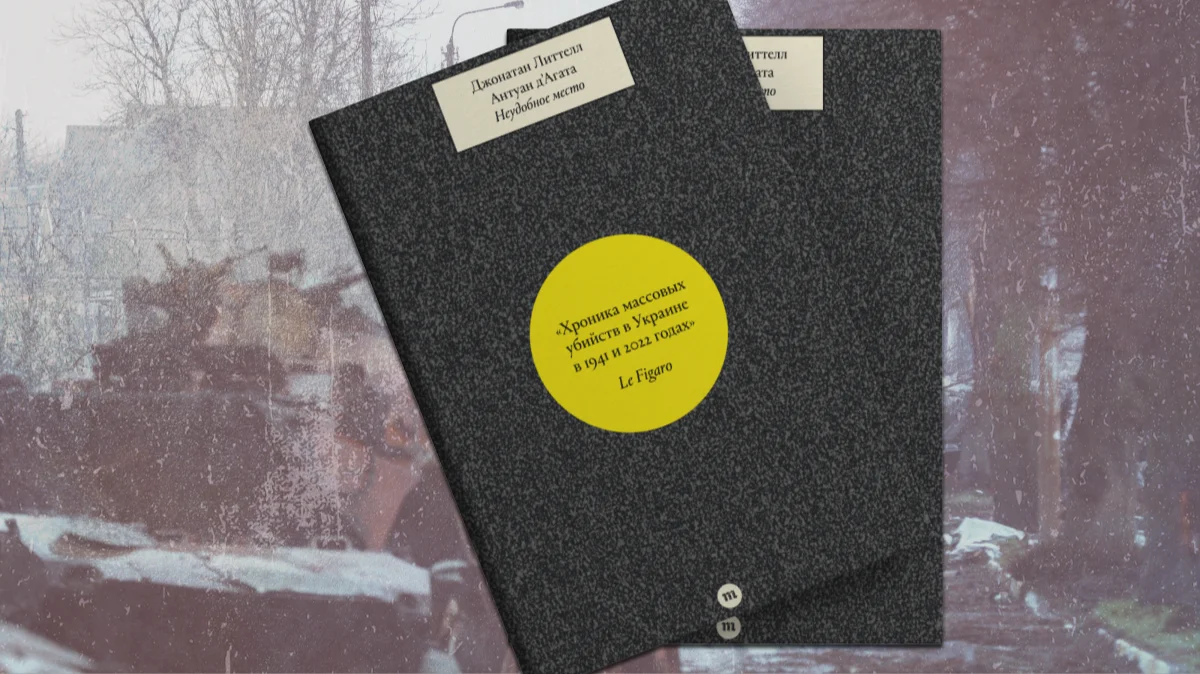
The writer Jonathan Litell became famous by his novel “Frequenter” about the SS Maximilian Aue. AUE complies with the injuries of youth, his identity, and also recalls how he committed war crimes - including in Babi Yar, a ravine on the outskirts of Kyiv, where, according to various estimates, from 70,000 to 200,000 were shot.
Hence the plan of Littlela to write non-fiction about Babi Yare seems consistent: it is one thing to describe a crime on behalf of a person-to-person, and it is completely different to evaluate what Babi Yar looks like now and how the memory of him has changed over time. The writer turns into a witness.
But Littlela was destined to turn into a witness twice. He visits Babi Yar twice-at the end of 2021 and in the middle of 2022-and at the same time on the second visit, he observes the consequences of Russia's full-scale invasion of Ukraine. This, of course, was not included in Littlel's plans. He himself admits that he put an end to the first draft of the book on February 22, 2022, that is, on the day when Vladimir Putin gave the Russians a lecture on how Lenin came up with Ukraine.
But then, according to Littlel, the Nazis again attacked Ukraine, and it seemed to him strange to ignore the modern history of war crimes in the Kyiv area.
This makes the book “An uncomfortable place”, sorry for the pun, uncomfortable. It is difficult to characterize it. On the one hand, Littlel and his research partner photographer Antoine d'Agat collect bit by bit a picture of how the memory of Babi Yar looks now. These notes are fragmentary by definition, as well as the memory of Babi Yar - first intensively hushed up in the USSR, and then divided into parts by different ethnic groups that suffered from Kyiv executions. On the other hand, these are notes of a Russian invasion witness. Litell and d'Agat visit Buch, the Kiev city morgue, talk with local residents, reproduce their monologues. As a result, a single plot of the book does not line up: it breaks up in the reader’s memory into several bright pieces, which are fastened by the reading process and photographs of D'Agat. It seems that this should harm the reading process - and I will not hide it, it is harmful: I have to stop all the time to recall what Littlel wrote about earlier. But on the other hand, each fragment of the text is better remembered - and such a division of an essay into microdes, as if works well for the design of the authors (which below).
And these microdists are really remembered. For example, Littlel considers corpses in the city morgue of Kyiv:
“When I examine the skillfully made up of some recently deceased grandmother or bluish pieces of flesh in rags, which is difficult to extract from the grave, that is what is happening? If this person was familiar to me, I am covered by memories, the same images. If these are strangers, like these nameless bodies, erupted by the war, then I study signs, marks, special signs, things to try to imagine who this person could be, what his life was before it was cut off so cruelly. ”
But he writes the story of a resident of Buchi:
“Katya and her family kept him at home and looked after him, until the“ green corridor ”was opened in Belogorodka; Then they took him for treatment to the boyar, and the rest of the family went abroad. They returned recently to put things in order and open the store again. “In two years, you will have an anniversary!” - exclaimed the girl waiting for her sandwich. “If we live,” Katya answered. Having paid for the beer, Antoine went out to smoke, and I remained to listen to the stories of two women while the sandwich was warming up in the grill. “The Russians ordered people to walk in bright clothes. They threatened to shoot everyone who wears dark jackets!” “Yes, three or four days later they gave the order not to go out at all.” “We were scared, and we were sitting in the basement. There were nine people with children, and, frankly, we had little food. But no one wanted to eat.”
These are only two quotes of those. But I wrote out much more bright and powerful quotes. Realizing that the slender plot of the story about Babi Yar does not work, Littlel relies on a detail. Here will describe how the Kyiv TV tape looks after Russian shelling; Here - as a Ukrainian priest was saved during the occupation of the village of Russian troops. And in another part, he will tell in detail how the Jewish Anti -Fascist Committee fought for the memory of Babier Yar in the Stalinist USSR. All this is with the maximum immersion in the topic, up to the point of conveying the smell of an abandoned building in an overgrown woman in an overwhelming Babi Yara.
“Dirty sex, the smell of dust and mold, graffiti on the walls, bare concrete stairs without railing, a band of white light, piercing the darkness of neighboring rooms, silence, barely violated by birds of birds. The last staircase leading to the roof collapsed, but we managed to rise along it, and then higher to exit and inspect the entire wing. Around us towered the tops of the trees, a little further the roofs of a psychiatric hospital were visible, followed by a city. On the other hand, the building went out onto a long wooded ravine, behind which a tall hill rose, crowned with a giant building in the environment of lifting cranes. ”
To the honor of Littlel, he is not afraid to be unspoken. And it touches on very problematic issues. For example, the responsibility of Ukrainian nationalists for the Holocaust - and the heritage of Ukrainian nationalism in Ukraine is modern. And it turns out without abyss: yes, Ukrainians participated in the Lviv pogrom of 1941, yes, Ukrainians participated in executions in Babi Yar, and even pro -Soviet -in -law Ukrainians acted as carriers of anti -Semitic views. At the same time, Littlela cannot find real Nazis in Ukraine. Even the fighters of the Azov battalion, wearing tattoos with Nazi symbols, perceived them mainly as a beautiful attribute of the past, not at all sharing Nazi ideas. As a result, Littlel comes to an unexpected conclusion:
“In Mariupol, real fascists defeated people who want to look like fascists.”
At this moment, the reader of the review can be completely confused. What then is the book, if there are so many diverse stories about memory in it? And she is just about memory - about her fragmentation, that it is impossible to build a single narrative of memory in principle - how it is not possible to build a single narrative around the woman's Yar. All that remains is to sew individual microdists until a certain kaleidoscope develops and until the memory is filled in the camera. “Is it possible to exist without a simple version of history? And why not, ”says the historian Timothy Snyder in an interview with Littlela. And this unexpected conclusion very strongly contrasts with the attempts of the Putin regime to build a single narrative about the war with Ukraine as a kind of crusad of Russia against Western obscurantism (which, note, it also cannot be created and which breaks up into fakes from the lips of Solovievsky criccins).
“An uncomfortable place” is a complex book, uncomfortable. It is hard to read, and it’s hard to write about her. It is no coincidence that there are almost no reviews about readers like Goodreads or Livelib about her. It cannot be recommended to someone who is looking for a clear story about the war. But this is precisely its value. Litell and d'Agat created a difficult, but honest testimony of the war - past and present. And, probably, in this honesty the whole point.
Translated from French Mikhail Tsivilev