
Translated material
Oppositions need to hold your elections
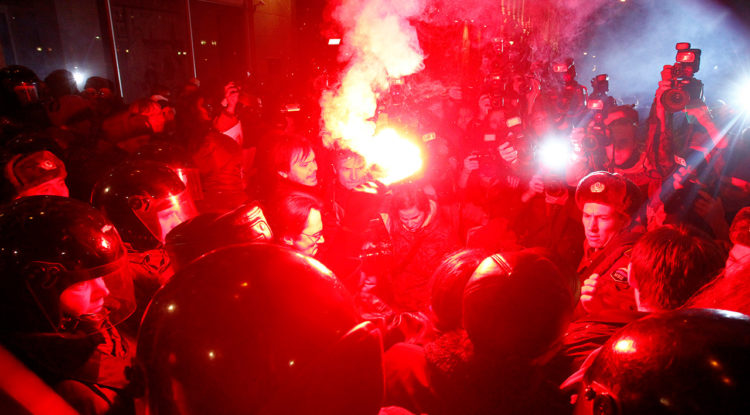
And form a government in exile
Especially for the “cold”, the political scientist and economist Lasha Chargazya wrote a column about why, in his opinion, the Russian opposition is time to stop trying to convince Vladimir Putin’s supporters and abandon the unconditionally legal practices of disobedience.
In order not to miss the main materials of the "cold", subscribe to our Instagram and telegram .
In his recent column for the “cold”, entitled to “learn empathy and kill arrogance”, the political activist Timofey Martynenko proposed to open a discussion about the weaknesses of the Russian opposition. I would like to enter into a dialogue with him - and present a radically opposite look at the situation in which we found ourselves. I believe that over the years of resistance, the Russian opposition has become too understandable and empathic; Especially in relation to those who do not deserve it.
Opposition Russians are brought up at the idea of peaceful protest. In the pre -war period, any call to rallies was necessarily accompanied by comments about their non -violent nature. Various electoral tactics like a “smart vote” or a boycott of the elections were aimed at exclusively peaceful transfer of power in the framework of a normal political process. In 2017, Alexei Navalny said that he would have saved the life of Vladimir Putin if it needed artificial respiration. Then it seemed correct words.
The times of “normality”, however, have come to an end for a long time, but our patterns of political behavior have not changed much: we are ready to continue to regret “our boys” in the hope of coming to civic reconciliation and trying to seek compromises with those who can communicate only in the language of ultimatums.
In my opinion, it was precisely this generosity learned and the humanity instilled in us that became one of the most destructive features of the modern opposition movement.
We need to stop counting on the humanity of our rapists
If it seems to you that this statement is dictated by emotions or the absence of empathy, I would like to reassign you. I urge to think about the functional value of the construction of a dialogue with those of our fellow citizens that are “on the other side of the barricades”.
The apologists of such a dialogue often explain its need through slight manipulation: atomization is beneficial to the regime, therefore, in order to resist the regime, you need to resist the atomization - to overcome yourself and establish communication even with the most convinced supporters of Vladimir Putin. And before, such a logic really made sense. Attracting new supporters meant not only the growth of the protest electorate, but also the growth of the number of participants in opposition demonstrations - and, therefore, a great probability of their success. However, the time has come to look into the face of modern Russia: even the largest peaceful protest is no longer able to lead us to democratization.
The reason lies in the very idea of peaceful protest - he never thought as an instrument of combating cruel and repressive autocracies. It arose in democratic societies and was often aimed not at a radical change in political regimes, but at their improvement .
The political success of any peaceful protest directly depends on the costs that the state will suffer in case of suppression. These costs can be reputation, electoral or banal economic, but it is important to understand that if they are quite high, the state will prefer to avoid confrontation with the opposition. The level of costs, in turn, depends not so much on the number of protesters as on the institutional environment in which the protest occurs.
If the society has honest and free elections, open and public media, the functioning system of retraining and fair courts, the state will pay dearly for wide repressions. In such conditions, the opposition can create convincing threats to the regime, and this is what, for example, explains the success of Gandhi's non -violent movement for the liberation of India from Democratic Great Britain: when the suppression of protests became unprofitable for the colonialist, he had to provide Indian state for independence.
However, this mechanism ceases to work with authoritarianism. The Russian government consistently changed political reality in such a way as to maximize the costs of the ongoing repressions: fought with the media and human rights NPOs, killed journalists and political opponents, carried out non -union reforms and comprehensively limited the freedom of citizens. And if, after protests in Bolotnaya in 2011-2012, she was forced to make some concessions of the opposition, then in 2024 she could kill the main opposition policy and survive the pressure of European sanctions.
A similar process of autocratization occurred in Belarus, where, despite the support of a huge part of the population, the opposition failed to achieve any of its goals. The mass of the peaceful rally and its broad public support could not change anything in the conditions of a state that openly abandoned democratic ethics. Does this mean that it is time for us to sprinkle with ashes and surrender? Of course, no.
But we must admit: attracting new people to the opposition movement no longer has a functional value.
Is it worth it to spend efforts on dialogue with the opposing side, everyone is free to decide for himself, but for the success or failure of the opposition movement, the issue of “reconciliation” is simply not important and should not occupy a central place in public discourse.
Now the Russian opposition must realize itself in a radically changed reality and abandon the unconditionally legal practices of disobedience to which it is used to. She should try to get out of the echo-camera of obvious and standard solutions. Then it turns out that there are still a lot of possibilities for resistance.
Under such opportunities, I in no case mean an armed uprising. All the empirical data that we possess indicate that violent revolutions in autocracies usually lead to the revival of autocracies, just the power is concentrated in new hands. What the opposition needs to strive for is an increase in costs from repressions through any means for which the state is not able to prepare.
We must hold our elections
To move on to a conversation about these means, we will have to take a step back and return to the topic of atomization. The real goal of the regime is atomization within the opposition. At the same time, people, immersed in a political context, may seem that he had already managed to achieve this, but this is not entirely true. The opposition is not in the “crisis of ideas” - on the contrary, it has too many ideas and goals. An opposition Russian can support a dozen of various organizations and fiercely hate a dozen. And since each of them has its own opinion on the fact that “you need to do”, and many of them are not ready for cooperation, a person develops that nothing happens around.
Of course, the problems of coordination are characteristic not only of the Russian opposition. In multi -party systems, dozens of parties compete with each other non -stop, offering fellow citizens various answers to the same questions. Nevertheless, most of these political systems are still capable of self -regulation and effective decision -making. The solution consists in the favorite word of all political scientists - legitimacy.
The legitimate power has a temporary monopoly on the development and implementation of the policy that it considers necessary. Other political actors can criticize or advise, but the final decision always remains with her. This is the foundation on which a healthy political process is held in democratic states.
But the Russians live in an amazing legal opportunity: they no longer have legitimate power - at all. Vladimir Putin is not recognized as a legitimate leader, but the Fund for the fight against corruption, Mikhail Khodorkovsky, Maxim Katz, Ilya Yashin and any other Russian politician or organization remain equally illegitimate.
There are different types of political legitimacy, but the one that opens up the greatest number of opportunities - democratic - can only be acquired with the help of open and competitive elections. Since the “election” of the president in the Russian Federation took place against the backdrop of broad political repressions and was accompanied byunprecedented violations , many European politicians refuse to recognize their results. And this can play into the hands of the Russian opposition. It is the holding of fair elections and the struggle for the international recognition of their legitimacy should become our main goals.
This idea may seem absurd adventure and raise many questions, but we have a lot of examples of democratic governments in exile. Usually, to determine the leaders, they either held elections among the diaspora (for example, the Tibetans did this), or came to a consensus within a democratic establishment (for example, Poles ), but the situation in which we found ourselves has two unique features.
First - we were lucky to live in the era of the Internet. Thanks to this, any Russian in the case of organizing elections will have the opportunity to take part in them: as a voter or candidate. Electronic voting systems are not yet perfect, but the involvement of international blockchain voting experts could protect our fellow citizens around the world, and support and observation from famous and unbiased NGOs-to ensure the honesty and transparency of the election process.
The second unique feature - a legitimate new Russian government, recognized by European states, will be able to afford not only to make decisions, but also to bring them to life. With the outbreak of war in Western countries, impressive assets of the Russian Federation, which are still belonging to the Russians, were frozen. And the legitimate Russian government will have every right to demand their transfer to use in the fight against the Putin regime.
These funds can fundamentally turn over the situation in Russian politics. With their help, you can, for example, organize social support systems for opposition citizens remaining in Russia. In particular, to help financially those who lost their jobs or were expelled from universities because of anti-war views.
In the most radical scenario, the legitimate power will be able to bite off Russian mercenaries who went to the front due to money, or bribe employees of Russian services and judges.
Also, thanks to legitimacy, direct diplomatic contacts with other states are possible: not culuer agreements, but official documents; Not public discussions about how “war should end”, but direct negotiations with Ukraine. This will give the Russians not an abstract and ghostly image of the “beautiful Russia of the future”, but a literal future, the implementation of which is prevented by only one person.
Many of the actions described above may seem deeply unethical, but they directly inflate the costs that the regime bears, and with the right use of funds, they can increase the loyalty of Russian citizens to the opposition. And when the costs of repressions will finally become unbearable and the regime will no longer be able to resist - the time will come for the transit of power and our turn will come to build a new country.
The revolutionaries will have to step aside
The dilemma is that good politicians rarely become successful revolutionaries, and successful revolutionaries become good politicians. And this is not an accident: the competencies that they must have is hardly intersecting. To destroy the authoritarian regime, ingenuity, cunning and flexibility of principles are required; To build a healthy democratic country on its ruins - empathy, tolerance and almost impossible kindness.
That is why any political force should first of all be honest with herself: she wants to be useful now to stop madness, or then to create a new country that we can all be proud of? In the first case, this political force should have the courage to go beyond its natural behavior and dignity in order to give way to someone else after the transfer of power. In the second - determination, so as not to prevent those who are ready to give up ethics for the liberation of the country.
The author’s opinion may not coincide with the opinion of the editorial office.