
Translated material
Break your feet for 7 centimeters of growth
An investment batank from France almost became disabled due to an operation to lengthen the limbs. The popularity of such interventions is growing
49-year-old Ilein Fu complex was complex all her life because of her height. Therefore, in 2016, she decided on a risky operation to lengthen the legs. For the next eight years, she suffered from health problems and even sued the surgeon. About why people decide on such operations and what consequences are faced with the material of the “cold”.
In order not to miss the main materials of the "cold", subscribe to our Instagram and telegram .
In 2010, Ilein Fu moved from Paris to England: she was transferred to the London office of the Merrill Lynch investment bank, the daughter of one of the world's largest financial conglomerates Bank of America. In a new place, colleagues began to mock her because of a small stature-157 centimeters.
Ilen Fu has complex from childhood because of this: at the age of 12, according to her, she was higher than most girls in the class, but by the age of 14, all her out of her overgrown. She became interested in increasing growth in 2016, including because of ridicule at work, decided on a risky and expensive operation. She found in London a private clinic in which the surgeon Jean-Marc Gishe with his patented method surgically increased growth.
What is Hishe's method?
The operation , during which the surgeon cuts the bone, tugs the bone marrow out of it, and inserts the “nail of the Gisha” inside it - the needle with the adjustable length, which is later fixed with two bolts on both parts of the cut bone. As the bone fuses, it is pushed apart to form new fabrics. The Gisha website indicates that this intervention leaves only small scars, and you can stand on your feet almost on the day of the operation.
When Fu turned to Gisha, he honestly warned of the possible consequences of the operation: the bones could not grow to grow, and the nerves could also be damaged, the risk of blood clots also increased. But Fu was still ready for interference, because, as she told reporters, "she studied everything, went to a very expensive doctor and expected appropriate medical care." Only for the first operation, she paid 50 thousand pounds.
Fire test
On July 25, 2016, the first operation took place. “Awakening was exciting,” Fusaid . - [At first] as if nothing had happened, there was no pain. But after an hour and a half, a feeling arose as if someone had set fire to my leg from the inside. The first night after the operation I screamed until six in the morning and turned off, continuing to scream. ”
After that, the patient was sent home, and the process of lengthening bones began. Every day, several times a day she had to go through a painful procedure: she scrolled a special mechanism that stretched the knitting needle in the leg.
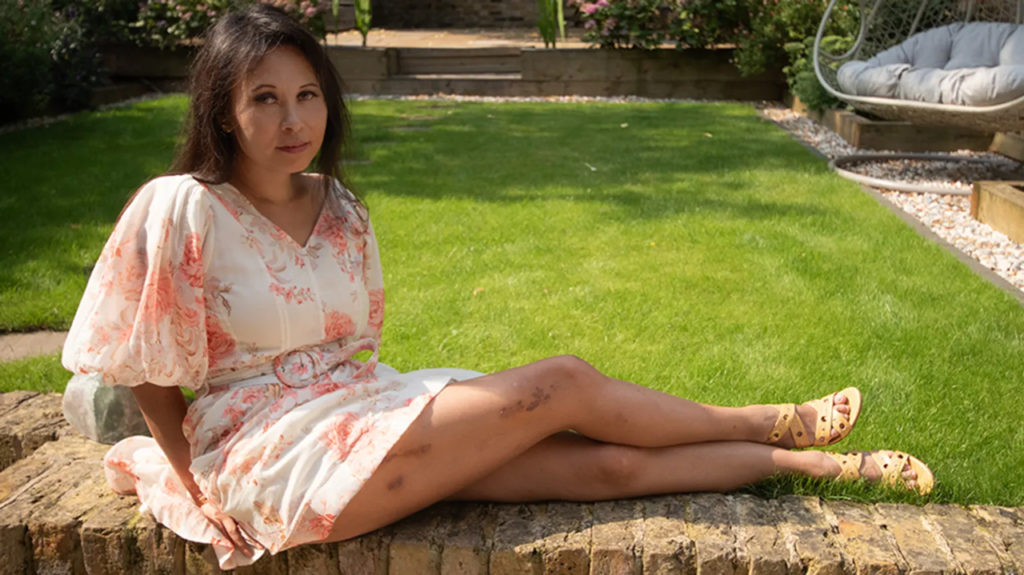
According to Fu, her left leg was more ill. Once, when she was lying in bed, a loud sound was heard-something "cracked in her leg like a kitkat." This was followed by acute pain. She again turned to Dr. Gisha, and the results of the X -ray showed that his “nail” struck the femur - the strongest in the human body.
Gishe convinced Fu that everything was in order, and appointed her another operation worth a few thousand pounds. He invited her to continue to build up her right leg, and leave the left to heal. Then Fu was still convinced that she was doing the right thing - the main thing is that the legs become longer.
As a result, by September 2016, her right leg grew by the desired seven centimeters, but became much longer than the left. Because of this, Fu could not stand evenly, her spine was twisted, and her back began to constantly hurt. Moreover, problems arose with the right foot: despite the fact that it stretched out, the bone did not grow together - these were just two parts of the bone with the interval between them, fastened with a metal knitting needle.
In April 2017, Jean-Marc Gishe invited Fu to Milan (there was one of the clinics in which he worked) to re-start the process of building bone mass in his left leg and conduct an operation on the right. According to his plan, from the foot of the fu had to pull out the connecting knitting needle, make the bone marrow injection to stimulate the growth of new tissues and return it back-but something went wrong again.
According to Fu, when she woke up after the operation, Gishe told her that the spoke was broken while she was pulled out of the bone, and he had to insert another, taken from another patient. She paid for this: the exact amount is unknown, but judging by the Gisha site, the extraction of knitting needles in one of his clinics only in 2013 cost more than seven thousand euros, and the installation of new ones - more than 40 thousand.
After the operation, Fu lived in the Milan hotel and was restored alone: she could not get up, she was bleeding wounds on her feet, but she had to urinate in a glass - Gishe did not look after her.
In July 2017, Fu decided to contact another specialist, an orthopedic surgeon from the National Health Service of Great Britain (NHS), who provides medical care for free. The doctor told her that “the journey will not be short”: to recover after Gishe’s operations, it will take at least five years.
In 2020, Fu sued Gisha - recently she managed to win a lawsuit and receive compensation in the amount of a million pounds. Gishe denies his guilt and claims that the patient did not comply with his instructions: the slow growth of one of the legs was allegedly caused by the fact that she took antidepressants and did not tell him about this, as well as the fact that she lengthened the knitting needles above the approved measure.
This year, Fu continues to recover - both physically and mentally: there are large scars on her leg, she still suffers from limited mobility and treats PTSD.
Ilizarov apparatus
The most common way to increase growth in the world is the use of Ilizarov's apparatus. The Soviet surgeon-orthopedist Gabriel Ilizarov created it in the 1950s to correct bones-for example, in children with congenital deformations of limbs or people with heavy fractures-after he found that human tissues are able to regenerate with gradual stretching.
What is the Ilizarov method?
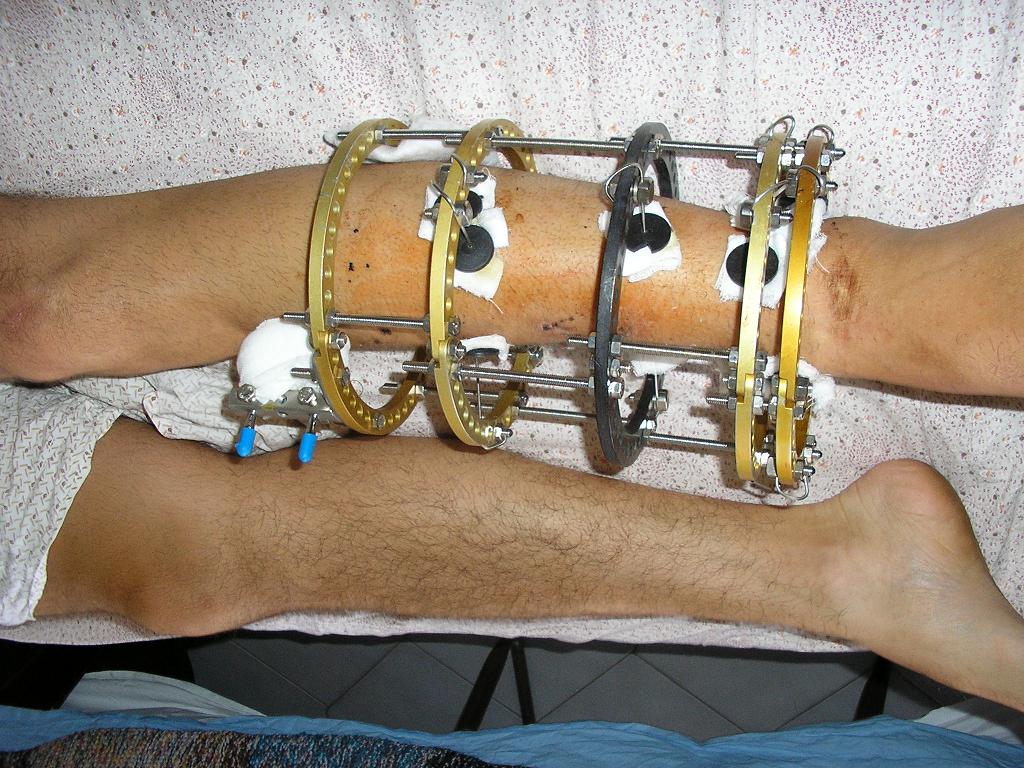
The bone is sawn and fixed on the outer frame of the apparatus using spokes inserted through the skin and muscles. As new fabrics forms, the device is pushed through. The difference from the Gishe method lies only in the fact that Gishe is “seamless” - the needle is installed inside and it is not visible. At the same time, the operation is also painful and can cause complications.
In 2022, a 44-year-old Mukush from India passed through such an operation. The man believed that this was his only chance to increase the status in Indian society: due to small stature-155 centimeters-they laughed at him and refused to admit the country's military forces. He had to marry a girl from a caste below, and they decided not to make children (although interflowing marriages are not prohibited, this is considered by society as a violation of tradition and can affect the fate of the child).
In India, operations to extend the legs are popular , since average growth there is less than in many other countries: 165 centimeters among men and 152 among women. Becoming above, people increase the chances of finding a spouse and making a successful career.
Mukash wanted to increase his height by 14 centimeters, and the operation did not seem risky to him. But after it, complications began: the places in which the knitting needles were attached to the bone were very bleeding, their legs were sick on “nine on a scale of one to ten”, and he could only walk with walkers.
After the first operation, he regretted his decision: the restoration was very tightened, his legs were sick. He said to reporters that he resigned to the fact that the first operation is irreversible, but now he doubts the need for the second that lengthen his legs a few more centimeters.
Growth increase operations are becoming more popular
The operation to lengthen the femoral bones is available in many countries of the world: among them India, Mexico, USA, China, Türkiye, the UAE and even Belarus. The popularity of this manipulation is growing: for example, the Orthoped Poped surgeon Shahab Makhbubian from the USA said that in 2023 he planned 50 such operations, while he did only 20 for 2020.
The fact that the increase in growth is becoming more popular, Michael Assayag, a surgeon-orthopedic surgeon from the International Center for the Ending of the Fexarities in Baltimore, USA, also agree. A couple of years ago, he received requests for consultations to increase growth twice a week, and in 2023 - already five per day.
In Russia, a cosmetic operation to elongate the legs began to be carried out in 1992 - this method was proposed by the followers of Ilizarov. It costs from 82 to 750 thousand rubles. Now there are a lot of clinics that offer the procedure, among them there are state -owned ones . In 2016, the Ilizarov National Medical Research Center ceased to issue permission for such an operation to men above 170 centimeters and women above 165 centimeters.
In 95% of cases, the legs are lengthening and people are successfully restored-however, this statistics can be distorted due to the fact that most of these operations are carried out in private clinics that may not share all the information. At the same time, doctors warn that, although the operation has become safer over the past 20 years, it is still often accompanied by complications - the result largely depends on how quickly doctors manage to recognize and stop them. Because of this, many patients who have gone through orthopedic cosmetology are forced to spend a lot of time in the hospital and sometimes cannot walk for two months.
One of the frequent complications is the infection that the knitting needles of the Ilizarov apparatus (in a study published in 2022, the infection was found in 13 patients out of 277 - that is, in 4.69% of cases). It also happens that soft tissues and blood vessels are seriously injured, and new bone tissues are too fragile and easily break.
Moreover, long -term complications may arise: blood vessels and nerves do not have time to stretch at the same speed as bones and cease to function (in a study published in 2003, nerves were recorded in 9.3% of cases). At the same time, the new muscle tissue can worsen the work of the joints - and the people who have gone through such an operation suffer from limited mobility.
Nevertheless, the loss of the ability to walk is very rare. Largely because a person can move his feet, even if his bones are not fused, but remained fixed with knitting needles. Such a case occurred with a British named Barney - he was removed the last knitting needle from his hip only five years after the operation.
More often, people lose the opportunity to quickly run or jump - bone neoplasms are too fragile for such activities. According to a study published in the journal International OrThopaedics in 2018, out of 125 people who went through lengthening legs, about 31% showed the results below the average in sports of medium and high intensity two years after the operation.