
Translated material
Durov and Politzeki
Leonid Gozman reflects on how to solve issues with Telegram in a legal state
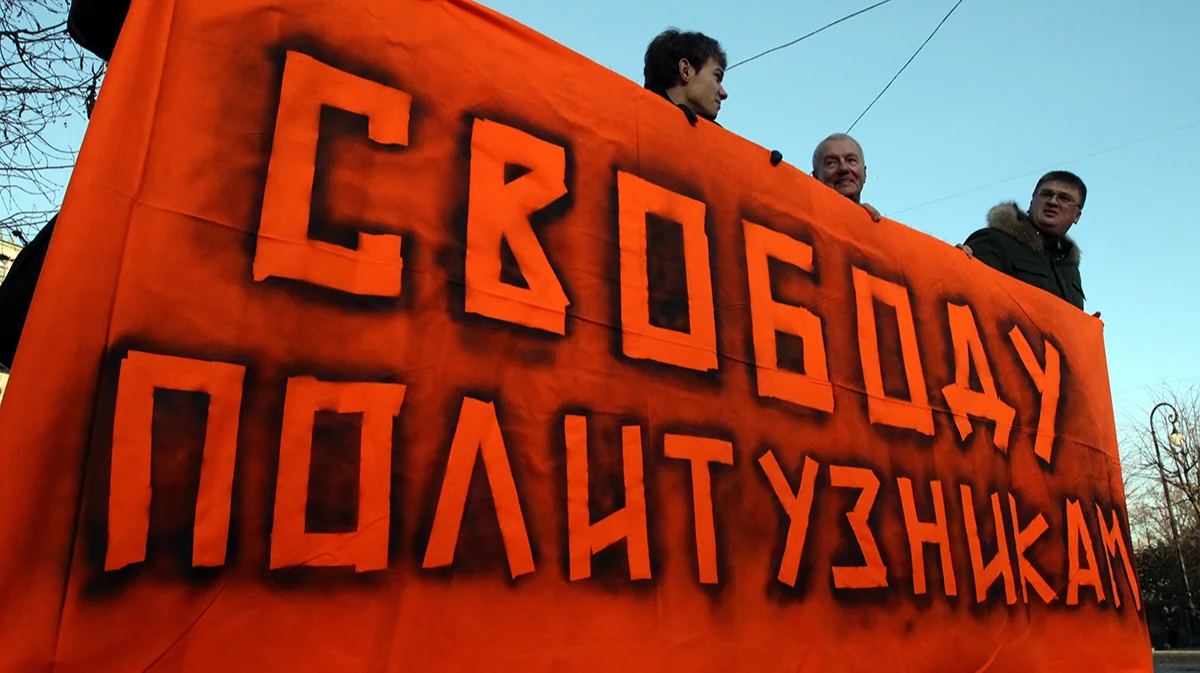
Opposition activists with a “freedom of political prisoner” during the rally in support of Russian political prisoners in St. Petersburg, Russia, November 10, 2012. Photo: Anatoly Maltsev / EPA
Professional people about Durov have already explained everything. And about what Telegram is beautiful, and about what he is terrible. And about Durov’s connections with Putin and with Macron, with drug lords and with a phantom. And about the fact that he was fifty times in Moscow, although he said that he was not, and about why he flew to France, knowing that he would be arrested there. They also explained why it should be immediately released (completely, and not under supervision) and why it was imprisoned for life. I, the amateur, have nothing to add in the very fact of the detention.
But besides the detention itself, there is a reaction to this event and there are problems that it exposes. Problems that go far beyond the situation with Durov and Telegram.
The detention reaction is striking. Maria Zakharova, fearlessly rising into the ranks of the defenders of freedom of speech, which is symbolized by Durov, from the totalitarian dictator Macron, is an impressive sight. Like the Z-patriots who have not yet been offered in revenge to bomb Paris, but tomorrow they will be offered. Like all sorts of wonderful people who explain in this example that they are freely breathing in Russia.
Why do they do all this, I don't know. Either, indeed, the army of the Russian Federation has a lot to be tied to Telegram, and threats arose. Either they just use a reason to shout. Or both together. The reaction of the liberal public is more interesting.
Let's not attribute to those calls of all sorts of calls that asked for permission to rallies near the French embassy. These simply saw the opportunity, preserving, as it seems to them, a person to be on a par with the authorities, to prove that, despite individual criticisms, they are their own.
I'm talking about a real liberal public - and it is in Russia and abroad.
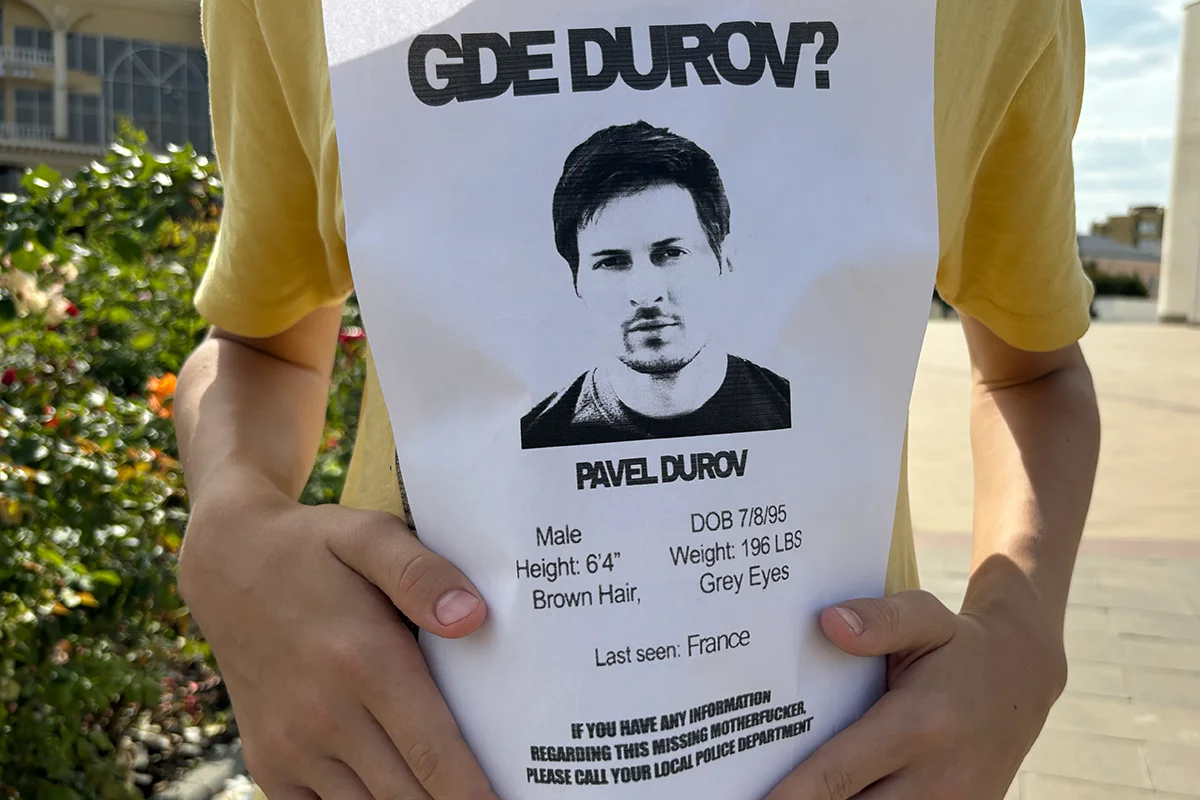
Opinions, of course, are different, but "Freedom to Durov!" It sounds, perhaps, most often. And not to support this slogan seems to be even awkward.
I'll try, however.
For me, it is a priority not “freedom to Durov”, but “freedom by political prisoners.”
About them, unlike Durov, I know for sure that they are not guilty of anything, that they are victims of the inhuman system, that they voluntarily went this procession in the name of their country and each of us. I don’t need the prosecutor’s office to explain to me what and why she accuses them, I don’t need to watch evidence of their guilt - I already know that they are not guilty, but those who keep them in captivity. And I know that none of them have a hope for a fair trial, because there is no court in Russia. I know from my own experience: to say that with the judge, that with the wall is the same thing. If I had a jury in the case of any of them, my verdict is ready: "Invited!"
But if I had a chance to consider Durov as a jury, I would have to carefully watch the evidence, and my position would depend on them. I have no initial point of view about his guilt or innocence.
I do not demand a publicly immediate freedom to Durov for another reason. In the world, injustice in relation to millions and dozens of million people is constantly happening. Dictators around the world throw their opponents into prison. China authorities commit terrible things in relation to Uyghurs. Kim Jong -un, the Taliban, Iranian ayatollah carry out acts of cruelty and lawlessness daily. Putin's friend Maduro holds power by force. The list is endless.
I cannot play for everyone. It is impossible to sign all the petitions, it is impossible to go to all pickets. It is impossible to sacrifice everyone who needs it.
Yes, and if something our voice is worth, then when he is elevated a thousand times a day, he will depreciate. It is necessary, no matter how terrible it sounds, make a choice.
And I choose to speak, firstly, for my own, the situation of which is crystal for me, that is, for our political prisoners, and secondly, for those who, except me and people like me, no one stood. And this, again, is our political prisoners. Durov does not need my support. He is on the territory of the rule of law, he has lawyers, he has the opportunity to organize PR in his defense. Well, if something is really very serious behind him, and he will feel that he will lose in court, he will simply leave Europe-they didn’t even give him a bracelet.
For the demand for immediate freedom to Durov, the idea that this is an attack on freedom, there is also a global distrust of the state - to anyone. Everything that it does is bad, everything is aimed at limiting human freedom. In the case of a modern Russian state, in the case of friendly RF Dictatures, such a point of view is quite justified - after an experience in life in Russia, we will probably always suspect any state machine with suspicion. Nevertheless, I am not sure that, when understanding all imperfections, such a priori distrust is fair in relation to France or, for example, the United States.
The state, ideally, should take care of people's security and providing them with opportunities for self -realization. And for this, it is engaged in a variety of regulation, without which, no matter what the Libertarians say, the joint life of people is impossible (of course, this regulation is very often excessively - but it is not always excessive!).
For example, after the cars became a mass phenomenon, it turned out to be obvious the need to establish some rules of their use-otherwise this heavy iron thing simply kills people. And now the state says that you can not go to the red light, that it is necessary to use a certain side of the street, and it is forbidden to exceed the speed. And then other rules appeared that protect people not from collision, but from damage to the environment - the requirements for the quality of gasoline. Everyone is humbled with this - I never heard that the ban on the passage of Red was talking about the suppression of freedom. Another attitude, of course, if these rules are not for everyone, if there is someone other than salvation services, who can not be observed, but this is the specificity of our Fatherland.
Social networks have changed our lives no less than cars, mobile communications and computers. Billions of people use them.
Personally, I still do not feel the need for their regulation, but I am only an individual user, I don’t know what effect they have on business, on safety, what opportunities give to attackers.
But I understand that a normal state should take care of this problem.
This is more complicated than in the case of traffic rules or even transnational corporations that produce something that can be touched with their hands. Yes, they transfer their plants to convenient countries, but their products are material, it moves and crosses the boundaries. And Facebook or Telegram? We know where they are Head-Quarters, but they themselves are everywhere, in the air. Attempts to regulate inevitably should have begun, maybe they seriously begin right now.
I don’t know if Durov’s case is an attempt on freedom of speech - they talk a lot about this, but so far I have not seen convincing evidence. Even the requirement of cooperation with special services, when it is not about dissidents, but about criminals, does not seem to me, but priori, unacceptable. There are laws in different countries that declare an offense non -information of the police about the fact of the preparation of a crime that has become a well -known fact. To ground: you hear a conversation in which some people discuss how and where they will lie in wait for the girl, then to rape her. Any police are not perfect, but, in my opinion, if you do not inform the police about this conversation, you are an accomplice. I don’t know, of course, whether there is something similar to Durov.
Of course, the devil is in detail. If the messenger is required to open a specific case by court order, this is one. If the state wants to access everything that is interesting to it, and even without special formalities, then if it achieves it, this will become the end of privacy and inevitable arbitrariness.
Even if the authorities have this access to the legal states-firstly, and they are not perfect, and secondly, sooner or later it will appear from the conditional Bastrykin.
But I will say a very terrible thing. Freedom of speech, like any freedom, can also be an object of restrictions. We accept the limits of freedom of action - "the freedom of my fist ends where your nose begins!" But if my words pose a threat to the life of other people, should I not be responsible for them, including before the court. For example, I do not consider it right that some radical preachers openly call for violence and murders, while continuing to be under the protection of the laws of a civilized society. Or that from the screens of Russian televisions there are calls for the murder of Ukrainians, the destruction of European cities, or the destruction of Putin’s policies within Russia. At the same time, I understand and accept, about the first amendment and about the holiness of freedom. But yes, you may not love someone very much-Jews, homosexuals or liberals, you can publicly express your feelings towards them, but as soon as you call for violence, you become a criminal.
It is impossible to establish comprehensive formal rules - there will always be borderline cases. But for that, the court, and, is not a computer, but a court that people version. And Durov and all of us good luck - so that there is no injustice, so that our rights to self -expression and obtaining information are not affected. And thanks again to Pavel Durov for Telegram.