
Translated material
Inhuman humanism
Ivan Davydov - about Olga Elina’s book “Pictures at an Exhibition: Science and Technology in the Early USSR”
The All-Russian Agricultural and Handicraft Exhibition of 1923 was conceived as a breakthrough through the post-war devastation into the world of science and technology. After reviewing the research dedicated to this exhibition, Ivan Davydov discusses the paradoxes of the early Soviet project.
All of us, since February 24, 2022, have found ourselves in the face of advancing barbarism, violence and lies. In this situation, it is extremely important to preserve at least the remnants of culture and support the values of humanism - including for the sake of the future of Russia. Therefore, the editors of Gorky will continue to talk about books, reminding our readers that there is still a place for thought and fiction in the world.
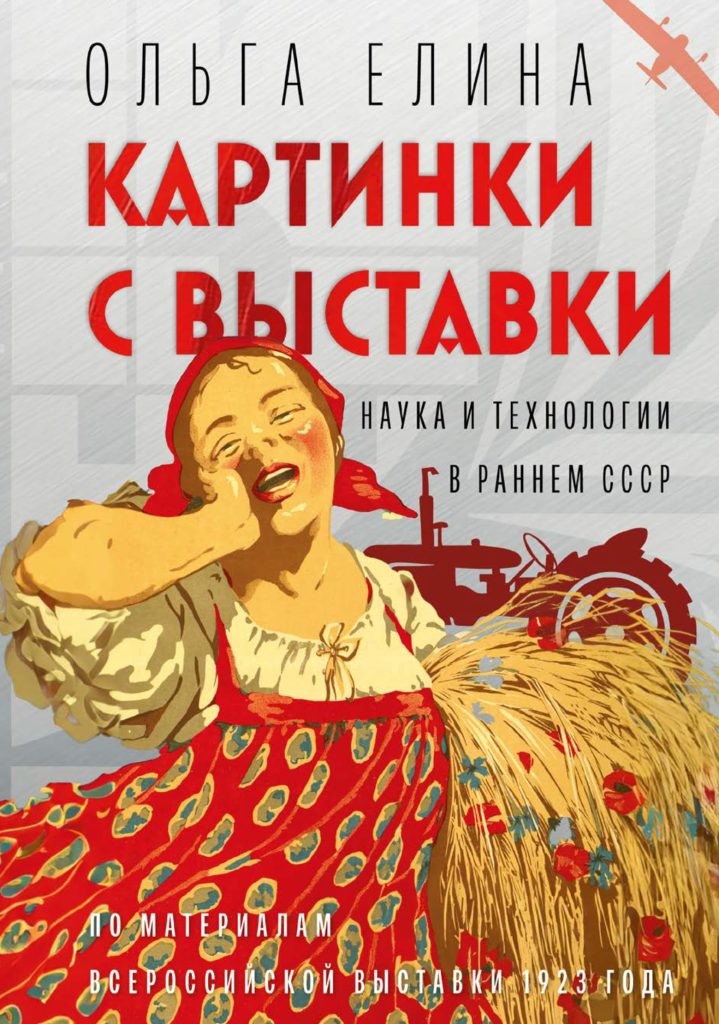
Olga Elina. Pictures from the exhibition: science and technology in the early USSR (based on materials from the All-Russian exhibition of 1923). M.: Ruthenia, 2024. Contents . Fragment
It's fun to be Curzon
There is no reason at all:
Our factory to the village
I went out to the viewing party.
Hackwork, of course, is just a way to make money for an experienced versifier, but how can one resist when the smell of barbecue emanates from the restaurants? And a young reporter wanders along the verandas, sniffing the air. A certain Bulgakov M.A., on an editorial assignment, is writing a report on the All-Russian Agricultural Exhibition.
Olga Elina, the author of the monograph “Pictures at an Exhibition,” is a specialist in the history of agriculture, honest and scrupulous, and demonstratively avoids sweeping, near-philosophical conclusions. Behind almost every word is long work in the archives, the utmost achievable accuracy and balance. But this is precisely why the book turns out to be alive, and the reader, as if in reality, together with Moscow onlookers from 1923, can look at the huge exhibition town: from approximately the place where the New Tretyakov Gallery is now, and to the Neskuchny Garden itself. And at the same time think about the paradoxical essence of the early Soviet project.
This scope is positivist, scientistic, but at the same time not completely devoid of humanitarian pathos: you just need to pull the peasant out of the centuries-old darkness, arm him with advanced achievements of science - and abundance will immediately come. Sincere faith in the power of propaganda: it is worth showing (by attracting advanced artistic forces to the work - futurist poets, avant-garde artists, constructivist architects) what is good and what is bad - and immediately things will become good.
The country is in ruins, the war has only recently ended, the terrible famine has not yet been forgotten, the international situation, it seems, cannot be called calm - to the sad modern pragmatist, to whom this scope is alien, it seems that the republic definitely has more important things to do. But no: impressive forces and funds are allocated to organize a gigantic agricultural exhibition in the center of Moscow, which has not yet fully adapted to its capital status. To show the world that Bolshevik Russia is not only alive, but has already rushed towards prosperity, and to teach the Russian peasant what, in fact, to do to make prosperity become a reality.
Commissions are organized, committees are established where professional revolutionaries sit next to elderly professors who, even before any revolution, created model farms, experimental grain stations and introduced peasants to the basics of agronomy. In fifteen years, some will be imprisoned, and some will simply be killed, but no one, of course, thinks about this while everyone is immersed in work, getting a salary, couriers, and company cars. Bureaucracy is flourishing, piles of papers are growing (to the delight of future historians), circulars are flying to the provinces demanding the mobilization of participants and spectators... Intrigues are being woven: until the very end it is unclear, for example, whether Comrade Trotsky will speak at the exhibition. And Comrade Shchusev gives Mr. Shekhtel some work to do: even a decadent modernist can be useful in this matter. Thousands of people go to work, pavilions grow, the space in the center of Moscow is sown with exclusive varieties of grains and vegetables... Poets write poems about the exhibition, newspapers print speeches of leaders and journalists' reports about what can be seen and eaten at the exhibition. The opening turns into a grandiose show, and then visitors flow along the river like a river - pioneers, Komsomol members, proletarians, Soviet employees, city idlers and progressive peasants who somehow got from afar to find out the main Soviet secret and finally live in happy abundance.
At the exhibition - this has already been said somewhere above - there are two mini-villages. One reproduces (perhaps slightly exaggerating) traditional peasant life, with a torch and a plow. The other one shows new life, with a light bulb and a tractor. Viewers should be convinced that it is better with a light bulb. By the way, it’s true: it’s better with a light bulb. The peasants promised prizes and bonuses. But they themselves get into trouble from time to time because they are not always fed well or even regularly.
Quite in the spirit of the era: almost a human zoo.
In general, this is a rare case: a historical work, the author of which does not indulge in any fashionable tricks, pushes the reader into the living elements, literally into the crowd of visitors to an exhibition organized a hundred years ago. But the reader, unlike other visitors, already knows what will happen next. What will happen to the peasantry in the state of workers and peasants, what will happen to abundance... And so on.
The exhibition, which is not particularly typical for Soviet propaganda events, concentrates on the positive. There are no enemies here, only the road from the almost bright present to the dazzling future. The peasants are taught to sow rye, and not to exterminate the kulaks as a class. But for some reason this is precisely what makes it clear what was not there even in the early Soviet project. There was no man. The place of a person was taken by the average worker with typical characteristics. You can do whatever you want with it, you don’t feel sorry for it. Well, they did. And they did. It's just material. Consumables.
The great Rodchenko has a photograph “Street”. Shot from above. Pavement, human shadows on the pavement. And instead of people there are lines under the shadows. People are like stands for their own shadows. It turned out to be real horror, although the author didn’t think of anything like that, of course. And this is the essence of Soviet enthusiasm. In the future, perhaps, there will be heaven on Earth, but instead of people in this paradise there will be some kind of athletes.
Elina’s book is as honest as a photograph, and the story of one scientific and propaganda event helps to consider this. It also has a huge number of excellent illustrations.
The exhibition is organized in order to
To
YOU-STAY-UP,
On! Look! Admire it!
But our Exhibition is -
Not a lady with a made-up face.
Our Exhibition is equipment.
Our Exhibition -
GOING TO BATTLE!
This is Alexey Gastev, poet, revolutionary, Proletkult theorist, who greeted the exhibition with delight and wrote poetic editorials about it for newspapers. In 1939 he was shot in Kommunarka.