
Translated material
Black holes in African space
About the novel by Mohamed Sarra "In the Hacks of Memory"
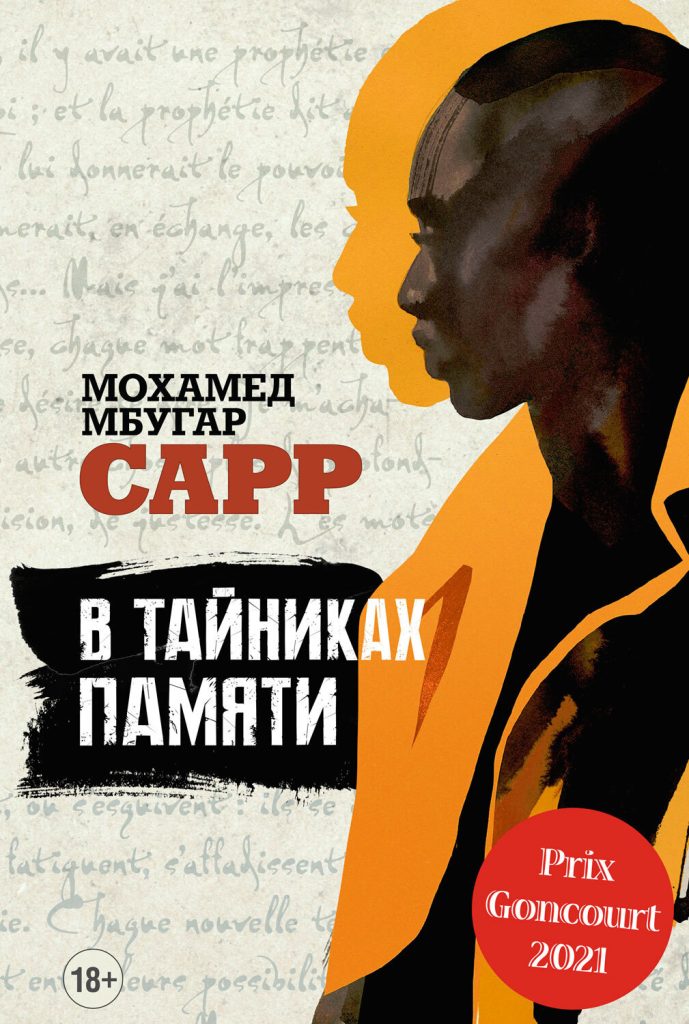
For his fourth novel “In the Baces of Memory”, the French writer of Senegal origin, Mohamed Sarr in 2021, received the Goncurovsky Prize. Last year, his book was translated into Russian. Julia Savikovskaya read her and shares her impressions with readers of Gorky.Mohamed Sarr. In memory caches. M.: Sinbad, 2023. Translation from French Nina Kulish
 In 1997, the British playwright Martin Crimp wrote a play with an intentionally multi -digit name - “Attempts at Her Life”, which can be translated as “approaches to her life”, “attempts to understand her life”, and as “attempt on her life”. The play consists of 20 monologues, and who exactly pronounces each of them is unknown. But in every monologue an attempt is made to tell about a certain Anna (Annushka, Ana). And at the same time, each monologue draws a completely new image in front of the viewer or reader, unlike the rest. We cannot understand whether Anna is a victim of a civil conflict, or a pornstar, or a terrorist, or not a person at all, but a car. So about a quarter of a century ago in dramaturgy, the idea that was long-known for philosopher-phenomenologists was artistically designed that our perception is splitting the identity of each person or an object into many pieces. In the modern world of holistic knowledge about the phenomenon - a person or object of his activity - there can be no, our knowledge of him is mediated by the goals of those who observe it, and those media, methods, and observation tools that they use.
Such unexpected associations are caused by the fourth novel of the Senegal writer Mohamed Mbugar Sarra “In the Original Memory” (in the original: “La Plus Secrète Mémoire des Hommes”), published in France in 2021. In it, as in the play of Crimp, one person is constantly being discussed - a mysterious Senegal writer named T. Sh. Eliman - and his, as it is repeatedly declared, a brilliant book called “Infinity Labyrinth”, “published” in 1938. Many heroes of the novel by Sarra will read it and express their opinion about her in the text, but we, readers, will get acquainted with only one of her fragment - with a detailed quote from the first page, which speaks of a bloodthirsty king, growing a whole forest from the remains of his many victims.
The novel “In the Tempens of Memory” was published at once by two publishers - the independent Parisian édings Philippe Rey and the Senegal édings Jimsaan. In the same 2021, he was awarded the Gonkurov Prize. Sarr, born in Dakar in 1990, became the first writer from the region located south of Sakhara, as well as one of the youngest writers who received this prestigious literary award. In France, his book also entered the Long List of the Medici Prize and in short lists of the Femin and Renodo Prizes, and in Russia, where it was published in 2023 in the excellent translation of Nina Kulish, it was included in the short list of the Yasnaya Polyana literary prize in 2024.
A reader familiar with such postmodern works as, for example, the “name of the rose” by Umberto Eco, the “endless joke” of David Foster Wallace or the recently released “2666” of the Argentinean Roberto Bolano (a quote from his “wild detectives” appears as an epigraph to Roman Sarra), will notice some kind of kinship with them in the text “in the text” in the text memory caches. " Like there, here, too, everything revolves around the book, one of almost a sacred text, to get acquainted with which we have no opportunity; The people associated with him die; And the protagonist of Sarra - the young Senegal writer Diegan Latir Faye, who lives in France, continues to search for this book and explore the secret of its author. But the fact of the matter is that it is impossible to collect his image together-everyone who knew him describes him in a completely different way, this “in the hiding places of memory” and causes associations with the play of Crimp.
Another interesting aspect of the novel by Sarra is his reusableness - according to the plot, the Diegan is met by the writer Sigu D, and now her story is woven into the text, and she, in turn, talks about a meeting with a French journalist who studied the Labyrinth of Infinity, and also introduces the death story of her father, closest to the Eliman of man. We get to the truth as these stories read, but suddenly the story of the storyteller leading the search is interrupted, and “biographers” appear in the text, informing us what no one can know from the plot, except for the author who invented this story, for example, the story of the first wife of Siga, Eliman’s mother, who left for his studies in France. And he stopped writing letters to her, went crazy with grief.
There are many references to the various works of philosophers, poets and writers in the novel, but their selection is very francocetric (including post -colonial authors), as if other literature and philosophy does not exist. In this sense, the work of Sarra does not at all seek to incorporate the whole literature created before him, but ascribes such a desire to the author of a fictional object of all searches - Eliman, who wrote the “labyrinth of infinity” by including quotes from other books; It was due to this, according to the plot, that he managed to create a brilliant work.
The search for the lost biographical facts and individual faces of Eliman is not a detective in the style of the "name of the rose", because the whole line, in fact, is secondary and revealing new facts only to the reader unfamiliar to the circumstances of the appearance of the African branch of French literature. The fate of Eliman in Sarra’s novel was largely built in the footsteps of the real biography of the Mali writer Yambo Ulogem, who in 1968 received the Renodo Prize for his novel “The need for cruelty”, but was later accused by Graham Green of Plagiah - the British filed a lawsuit against the Maline and won the process. After that, he left France by the Ulogi, but continued to write, and at the end of his life he became a spiritual mentor and healer. The fictional biography of Eliman also includes the detailed story of the writer's revenge to all those who once responded poorly about his book (the dream of the Bulgakov Margarita), and the novel is given the history of the Holocaust in France and later events in Argentina. You can even say that this is a common set of topics for a writer of African origin, writing in French, who wants to overcome the difficult heritage of colonialism, find a voice and be heard. This obvious political agenda does not in many ways allow Sarra to free its text from excessive emotionality, make it a real game of beads.
It is not easy for readers to immerse yourself in the novel by Sarah because of its multi-tyed nature and not always a carefully built structure, but in general it is more like a complex mechanism, but to incorrectly, but original and whimsically developing plant. This can be seen even by table of contents: among the chapters, strange inserts-biographers flash, the penultimate part has a reverse alphanumer-to-digital countdown. “In the Testament of Memory” there is also a feature that is often inherent in the first large works of many writers, namely, partly the naive-lyrical, partly a very ambitious desire to cover all the topics that excite the author. Here is a voluminous statement about the relationship between literature and reality, and the confession of a professional writer with his ambiguous attitude towards himself and his books, and immersion in the history of his native to the author of Senegal, and the story of the oppression of dissent, and, finally, reflections on the cultural identity of those who, having mastered the language of metropolis, are leaving for France. In addition to events related to the painful topic of exile and return, the plot also includes bold and sincere episodes associated with relations between men and women, sex, desire, love, passion, jealousy, marital fidelity. There is also magical realism, and without its conscious removal or deconstruction: it seems that the author introduces scenes associated with communication with dead souls, witchcraft for revenge, without doubt about the reliability of their existence.
Another important property of this novel, with all its eclecticism and uneven structure (especially by the end, when the narrator himself goes to Senegal) is his passionate sincerity. The author, apparently, is obsessed with literature, the desire to be a writer, the desire to understand his country and the place of authors and just immigrants from Africa in the Eurocentric environment. True, sometimes it seems that his personal knowledge about Africa is no longer so authentic and not so deep: having sent his storyteller to engage in the search for Eliman (their finale, in my opinion, is banal and can even disappoint the reader), he himself, “infected” with French culture, tries first of all to find himself, his roots and traditions, to understand his passions, ambities, desires. This is a novel about what his heart hurts and, possibly, the hearts of many of his compatriots, and hurts hard, responding to us readers.
But in this excessive sincerity and hidden auto -fractionality (of course, this is primarily a story about the Sarra himself, whose biography is similar to the life of the narrator) lies some weakness of the text. Author's impulses and ideas sometimes seem to be worn out due to their multiple repeatability. Sarra wants to infect us with a feeling that all the heroes of his books are obsessed with a brilliant novel called “Infinity Labyrinth”, they almost know his text by heart, but these verbose ranting about him can be necessary - we will not learn anything about this romance. We are interested in Africa, but the idea of the cultural emancipation of former colonies from France also becomes obsessive and also does not lead to any resolution. We can deeply sympathize with the narrator's desire to become a famous writer, but nowhere in the text we see that he tried to realize this desire.
The scenes of passionate nights conducted with women, descriptions of night strip clubs, as well as an episode of love to Usin Kumakh and Mosana, convince here. They are just not hidden pretentiousness and obsessive ideologies like “writing”, “liberation of Africa” and the like. They have something truly human, natural, vital. And probably, the path of Sarra to himself as a writer and man will consist in the opening of his true author’s voice and his liberation from imposed European attitudes. And we, the readers of the novel “In the Tempens of Memory”, with great interest and sympathy for its author, we can watch how he tries to unravel this complex ball in ourselves, honestly suggesting that we look at him from the inside of his own optics and from the side at the same time. It is as difficult to get out of the text “In the Baces of Memory” as it was difficult to enter it. And this is a sure sign that a lot has been invested in him and he has something to share with readers.