
Translated material
Why do men die young in Russia?
Why in Russia men die young and how war exacerbates this problem
Briefly
Russia is one of the countries of the world in which there are much more women than men. For many decades, this trend has not improved in the 21st century: according to the 2020 census, women make up 54% of the population of the Russian Federation, and men - 46%. And since 2022, the gender gap could increase even more: more than 120 thousand men have already died in the war in Ukraine. The “line” figured out why in Russia there are stably few men, what consequences the death of tens of thousands of them at the front will lead to and whether it would be possible to correct the current situation.About 100 girls are born for 105 boys in the world , but the first death from early childhood is higher than that of the latter. As a result, even taking into account the small “advantage” at the start of men in every generation, there are fewer less. By some age, the number of women is not only compared with the number of men, but also begins to exceed it. But if in Japan this happens from 56 years, then in Russia - already from 30.
The life expectancy of men is lower than in women in almost all countries of the world the opposite situation is only in poorly developed countries, where high maternal mortality and there is no access to medicine (Syria, Somalia, Zimbabwe). . However, in some states, the difference can be three to four years and be almost invisible, while in others it is colossal and reaches 10 or more years. As, for example, in many countries of the post -Soviet space.
In 2022, it was Russia who came out in the world in the world in the life expectancy of people: men here live almost 11 years less than women. The result was a gap of 10 million: 68.4 million versus 78.8 million.
Why in Russia there are fewer men than women
It is impossible to talk about the influence of men and women of the tragic events of the first half of the 20th century (the First World War and the Civil War, Terror, the repressions of the 1930s and the Great Patriotic War), the demograph Alexei Raksha explains. Then men were massively dying, but the youngest participants in those events are now over 95 years old. And in the second half of the 20th century of wars, which significantly influenced the demography of the country, there were no. Afghan and two Chechen wars carried away a relatively small Afghan war claimed 15 thousand out of 275 million populations of the USSR. And two Chechen wars 13-20 thousand out of 145 million population of the Russian Federation. The share of the population.
Today's imbalance is explained precisely by the high level of domestic mortality of men compared to women. Often the death of Russian men is explained by external reasons : murders, suicides, accidents and other accidents. The mortality rate of men from chronic diseases is very high. The lifestyle that many of them leads often leads to the early progression of these diseases, the demographer explains. For example, in Russia, mortality factor from cardiovascular diseases in men 16-59 years old is 3.1 times higher than in women.
“A large role is played by toxic masculinity - the type of male behavior, common in some countries, including Russia,” says sociologist Irina Tartakovskaya. - Men in such states often pay less attention to their health, because this is not included in their idea of the “real man”: you need to be strong and ignore any ailments. The same model gives rise to the risky behavior of men: criminal showdowns, aggressive driving and, as a result, an accident - all this also increases mortality among men. ”
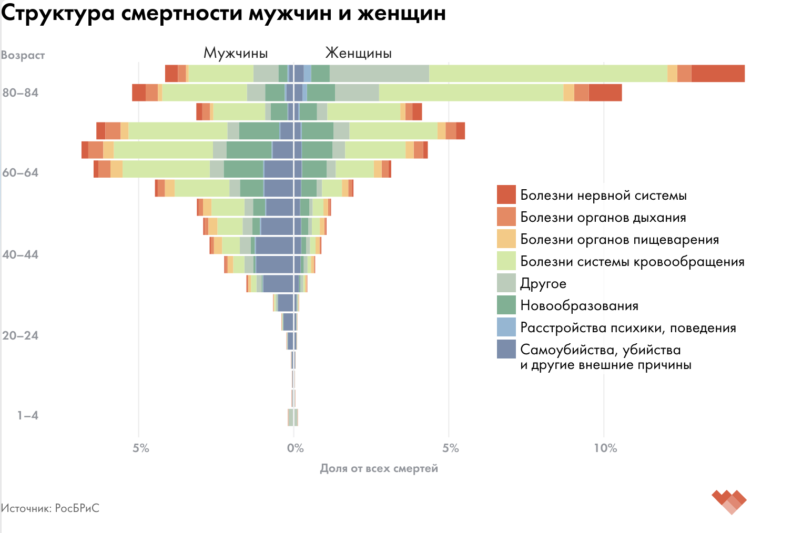
But the main cause of the high mortality of men is alcohol abuse .
“In total, in Russia, due to alcohol, at least 150-200 thousand people , official statistics of mortality from alcohol, gives a figure of 47.3 thousand per year, but this figure reflects the death that occurred directly from alcohol poisoning. Mortality from diseases or situations caused by alcohol, according to various estimates, can reach up to 400 thousand people a year , and about 80% of them are men. Alcohol causes the development of various diseases with death (from liver cirrhosis to diseases of the circulatory system), and also often provokes external causes of death. For example, most murders are committed precisely in a state of intoxication, ” explains Alexei Raksha. -It is significant that the Gorbachevsky anti-alcohol campaign of 1985-1990 led to a record jump in the life expectancy of men-for 3.5 years. And over these 5 years, their mortality has decreased by almost a million people "
“Here a huge role is played by a cultural factor - what alcohol it is customary to drink in society . In Russia, vodka was almost always the most popular alcoholic drink. From 2006 to 2018, the consumption of life -threatening, drinks was reduced: people began to switch to “weak” alcohol , ”says Alexei Raksha. -But the situation was fundamentally changed by the “vodka lobby” : in the 2010s, on beer and other low-alcohol drinks, they began to “tighten the nuts”, introducing new duties and increasing excise taxes on them, but not strong. By 2024, the situation was aggravated: the entire power of the sharp growth of excise taxes and duties, as well as further legislative restrictions, fell on the circulation of wine, beer and low -alcohol drinks, and the duties even decreased on a cheap imported strong alcohol. As a result, people gradually began to move back to strong drinks, for example, to domestic whiskey, which inevitably leads to an increase in mortality. ”
The habit of smoking the habit of smoking among men also leads to an increase in the death of the circulatory system and neoplasms , the analysts of the Date Project “to be precise” say. Before the anti -tobacco law in Russia, 41% of people smoked , now about 30%, and most of them are men. The share of smoking men of middle age over the same period decreased from 60% to 40%. The share of smoking among young people, and this is encouraging statistics, decreased. Today, many of them switch from cigarettes to wards and other electronic devices, the negative effect of which is smaller for health, but the number of smokers is still too large and greatly affects the expected life expectancy (OPG) in the country.
The prevalence of alcohol and tobacco dependence in Russia is explained by the social position of people, according to Irina Tartakovskaya. For most of them, there are not many social elevators and ways to maintain a good lifestyle in the country - and as a result, destructive behavior remains for people the only way to distract from what is happening and cope with stress.
What does the socialist past have to do with it
In the 1960s, the mortality of men began to grow in all socialist countries, while the mortality of women, if it grew, is much slower. The gap began to increase, and this trend has been preserved for decades. According to the 1996 British study , the difference in East European and Western European countries was primarily affected by the difference in behavioral patterns. The neglect of oneself and their health, addiction to alcohol and tobacco were characteristic precisely for men from the social block states.
In these countries, destructive behavior could provoke several factors, analysts are sure “to be precise”:
- Ideological norms that put public interests above personal and convincing that "in life there should be a place for a feat." The consequence of this is neglect of health;
- Employment of a harmful work and poor working conditions in enterprises . All this could provoke health problems and stress;
- The popularization of the image of an ideal man in the media - strong and unpretentious. Under the pressure of this propaganda, boys and men are ashamed to complain about their health and see a doctor.
“The idea of masculinity in socialist and capitalist countries was different. In the latter, a man could affirm himself, opening a business, building a career, earning well. Such a person took care of his health, because this is one of the instruments of his success, ”says Irina Tartakovskaya. - The socialist society did not suggest anything like this: the desire for personal success and good earnings were condemned - this is “careerism”, the denial of social norms and values. As a result, a man could affirm his masculinity only through the service of the state, and in this matter he should not regret himself. ”
At the same time, the desire to overcome something, to prove that it is better than others, you cannot suppress the collectivist system, Tartakovskaya is sure. Unable to do this through a career and earnings, some Soviet men expressed their masculinity through sports. However, in many cases, alcohol became “outlet” for people . The addiction to him not only worsened their health, but since the 1970s it became one of the main causes of male suicides.
The socialist system did not affect women so adversely, because they were given the role of working mothers. To prove her personal viability and earn the approval of society, it was enough for a woman to fulfill her family role. In addition, all concern for the child, as a rule, fell on the shoulders of a woman (after all, a man is too busy, serving the state), and this motivated her to take care of her health.
The patterns of those times were “absorbed” into the demographic culture and lifestyle of people in the former countries of the social block and still affect them: men live in almost all of these states much less women. Getting rid of these patterns is a long and difficult process: “The behavior models do not change so easily, and 30-40 years short for this,” explain analysts of the Date project “To be precise”. - For example, a rather large part of the population of modern Russia are people whose life has passed even in the days of the USSR. And the new generations, born already in modern Russia, partially inherited the behavioral attitudes of the elders. "
How gender gap affects society
In modern society, problems often arise when there are fewer women than men, Irina Tartakovskaya says: “The deficit of brides and many young people who cannot create a family, as a rule, create social stress and greater frustration in society. It often arises in the movements of the Incels - men who are not able to find a sexual partner, despite the desire to do it. Incels are entirely guilt for involuntary abstinence on women, they are treated with neglect, hatred, and in some cases they even call for rape, ”the expert explains.
The advantage towards women creates other problems. In a traditional society, he leads to a lack of workers in production and the subordinate position of women who are forced to fight for the attention of men and the opportunity to have a family and children: “With a lack of men , many women remained unmarried, and in such a society they treated them with neglect and contempt. Women provided for the role of a wife and mother, so lonely girls were called “defective”, “old virgins”, ”explains Irina Tartakovskaya.
There are no such problems in modern society. Such a society does not require a woman to have a family. And a woman can give birth to a child, and without marrying-the role of a single mother is also already indemnity with society. As for the labor market, earlier it was mainly focused on hard physical labor, but in the modern economy there are almost no “male” professions left and women can replace men with almost any production.
“The modern world really smooths out the problems of any imbalances. And no matter how much we ironic about 124 genders and are indignant gay marriages - all this creates that system of relations of people where demographic imbalances are smoothed out and do not put pressure on people and economics, ”says gender researcher of one of the Moscow universities in Russia, gender studies are perceived as“ enemy propaganda ”and are resolved, therefore For the safety of experts, we decided not only the name, but also the university where the expert works, not to call. .
Nevertheless, the researcher sees a big problem in a demographic skew: “Whatever modern world we live, traditional systems affect us and our idea of the world. In our society, girls from an early age realize that they will have to fight for the attention of men and compete for this “limited resource” with other women. All this leads to increased anxiety, psychological and even mental problems of women , and at the level of society complicates any processes of interaction and solidarity. ”
And all these problems are intensified if traditionalism, as in Russia, is supported by state propaganda. Moreover, the economy also still lives in a system oriented to the patriarchal model - for many works in Russia there is a list of professions prohibited for women, which is called “a list of hard work and work with harmful or dangerous working conditions, which limits the use of women.” This list was revised in 2021 and significantly - reduced from 456 to 100 points. These include: ship repair; printing; oil production; underground work; food industry; production of cardboard and paper; service of aircraft; Textile industry and other specialties. Women simply do not take. And given that there are few men, as a result, a shortage of personnel is created.
Another problem associated with the lack of men and their early mortality: a huge number of single mothers . There are now 4 million 850 thousand in Russia , that is, almost 40% of all families with children. Society does not condemn women without a husband, but they remain one of the most socially vulnerable groups: they must contain both themselves and children, while it is difficult for them to find full -fledged work.
“The state is forced to spend a lot of money on their support, but in most cases it is unable to protect these women or make up for the loss of breadwinners, ” the analyst explains “to be precise”. -There are a lot of manuals and programs for their support, but the volume of help provided for them with so many single mothers is insufficient in 2024 on the occasion of the loss of the breadwinner is 7689.85 rubles (who lost one parent). In order to allow the family that one woman provides, to live normally. ”
How the war affects and what will happen after the death of thousands of men
Since 2006, Russia began to catch up with developed countries by expected life expectancy ( OPG), and a record gap of 13.5 years between men and women began to contract, says Alexei Raksha. As a result, by the beginning of 2020, the gap in OPGs of men and women decreased to a little less than 10 years. But then the situation was worsened by the pandemic of Covid, with which Russia and, on the whole, all Eastern Europe coped worse than the Western one. And in 2022, a full -scale war in Ukraine began. Today, OPGU in Russia is lower than it was in 2018-2019, and the difference between the durations of the lives of men and women has again increased to almost 11 years.
About 2-3% of the male population of Russia aged 18 to 60 years are involved in the war. This figure only seems insignificant: the number of dead and wounded among them is completely rather large losses, notes Irina Tartakovka. In addition, this is not just a few percent of the able-bodied male population, mainly young men-the average age of 35 years perish at the front-precisely at the age when they are ready to have children, that is, their “reproductive value” is significantly higher than these 2-3% .
“The context greatly affects the life strategies of those families and individuals who are not involved in military operations. Someone plans to leave the country, someone puts off their reproductive plans due to a feeling of instability. As a result, fewer children are born, including boys. All this can also negatively affect the demographic situation and reduce the already small number of male people in the country, ”the expert explains.
At the same time, judging by the market reviews, sales of alcohol have significantly increased in Russia, and, accordingly, its use, says Irina Tartakovskaya. This also affects OPG and can lead to premature deaths over the years in the future, especially men. Alcohol, like the war, takes the young. And in the near future, the situation with a high degree of probability will become worse precisely because of the war, Aleksey Raksha suggests: "Alcohol consumption and mortality due to it can increase from the front from the front."
The war and death of young able -bodied ones already leads to a lack of labor resources , explains Irina Tartakovskaya. And how to reimburse this drawback is incomprehensible: it will most likely be impossible to do at the expense of migrants, said Alexei Raksha.
“To attract a large number of migrants is politically disadvantageous for the state: an excess of migrants provoke the growth of xenophobia, cause bitterness of the local population. К тому же сами мигранты все меньше стремятся в Россию: здесь становится опасно для них, а зарплаты в рублях теряют конкурентоспособность на международном рынке труда, даже несмотря на заметный рост. Из-за сложностей с переводами и непредсказуемых падений курса рубля», — рассказывает Алексей.
При этом высокая смертность мужчин может спровоцировать д ополнительную нагрузку на государство и на его систему социальной политики , считают аналитики «Если быть точным»: «Высокая смертность мужчин может привести к еще большему числу вдов и матерей-одиночек, а в случае бездействия государства и отсутствия их поддержки — к росту количества бедных людей».
How to improve the situation
Наиболее актуальная мера сегодня — как можно быстрее закончить военные действия в Украине , которые остаются источником большого количества смертей по внешним причинам и причиной нестабильности в обществе, уверены эксперты. Вместе с этим важно развивать медицину в стране и серьезно увеличивать расходы на здравоохранение , чтобы каждый гражданин мог своевременно получить необходимую ему помощь.
Государству также стоит пропагандировать здоровый образ жизни , особенно профилактику сердечно-сосудистых заболеваний, уверен Алексей Ракша. Могут сработать социальные кампании, в которых людям будут рассказывать о правильном питании и важности посещения врачей, занятий спортом. Влиять на образ жизни людей можно также внешними факторами: например, повышать акцизы на соль и сахар, чтобы производителям было невыгодно добавлять большое их количество в продукты.
Особое внимание стоит уделить ограничению доступа к алкоголю и сигаретам , считает Алексей. Можно повысить акцизы на них, сократить количество точек продаж этих продуктов — допустим, один магазин на 50 тысяч человек; сделать график их работы менее удобным — например, открывать точки продаж только в рабочее время по будним дням.
В некоторых случаях мужчинам необходимы отдельные программы поддержки . Например, на ряде предприятий должны работать профессиональные психологи. А для людей, занятых на опасных работах, необходимо внедрять добровольное медицинское страхование, которое будет оплачиваться работодателем и покрывать рецептурные лекарства, дорогостоящие операции. Такие программы уже действуют, например, во Франции или Германии, рассказывают аналитики «Если быть точным».
А для того чтобы решить проблему на глубинном уровне, необходимо искоренять культуру насилия : «Сейчас она сопровождает российского мужчину всю жизнь: его с детства убеждают, что терпеть и совершать насилие не просто норма, но и его обязанность, — говорит анонимный демограф. — Низкая ценность собственной жизни и готовность убивать и умирать в итоге порождает высокий уровень мужской смертности от внешних причин и повторение этого цикла насилия в каждом новом поколении».
Мальчикам с детства надо объяснять, что не надо ориентироваться на деструктивные модели поведения , связанные с неоправданными рисками, и что важно беречь свое здоровье — как физическое, так и ментальное, считают аналитики «Если быть точным». Например, можно включать подобную информацию в курс обществознания или список тем, которые необходимо обсуждать на классных часах, либо же вводить отдельный предмет, посвященный гендерной культуре.
Не менее важно искоренять гендерное неравенство , уверена Ирина Тартаковская: чем меньше будет навязанных различий между двумя полами, тем меньше будет склонность мужчин к рискованному поведению. Например, мужчина не должен чувствовать себя единолично ответственным за семью, «кормильцем» и «добытчиком» — если эти роли будут переложены на обоих супругов, давления на мужчин будет меньше. А женщина не должна чувствовать себя единственной ответственной за детей: если отцовство играет большую роль для мужчины, он будет внимательнее относиться к своему здоровью и с гораздо меньшей вероятностью вести себя деструктивно.
«Сегодня в России, с точки зрения демографии, главные жертвы гендерного неравенства — мужчины, — уверен анонимный демограф. — Ценность мужской жизни должна быть не ниже женской. Но даже при содействии государства на исправление этой беды в России уйдут еще десятилетия».