
Translated material
Halo over the cap
Soviet people were driven to heaven alive. Now the call is to enter it dead
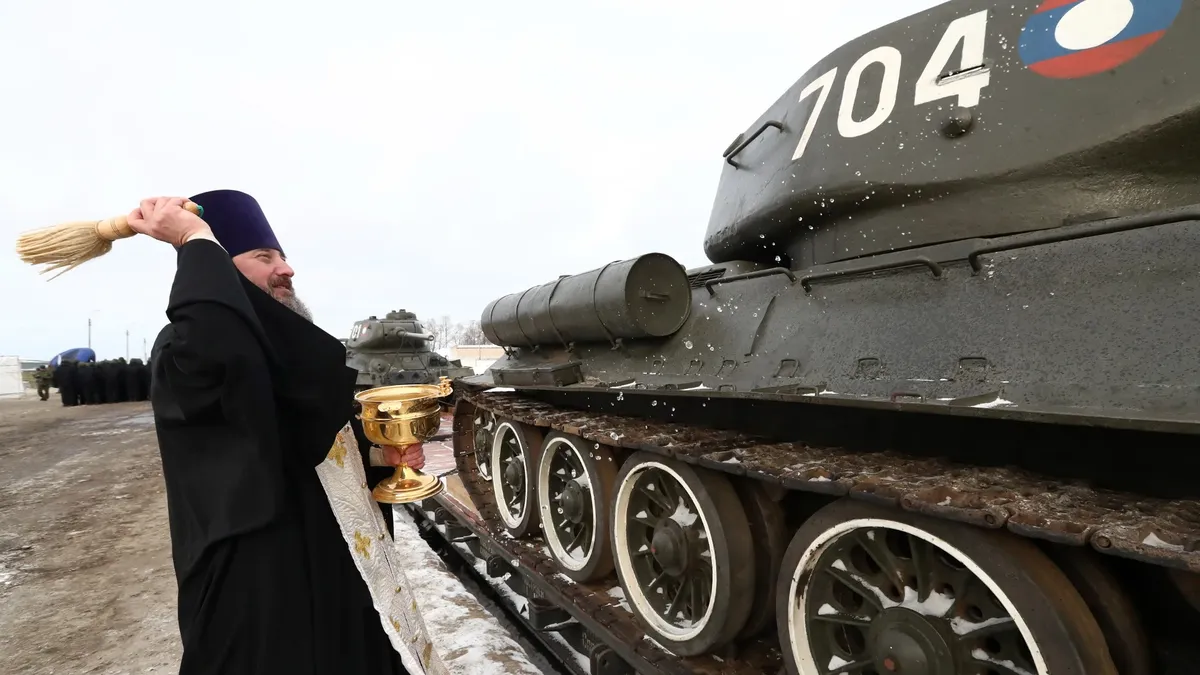
Photo: Stanislav Krasilnikov / TASS
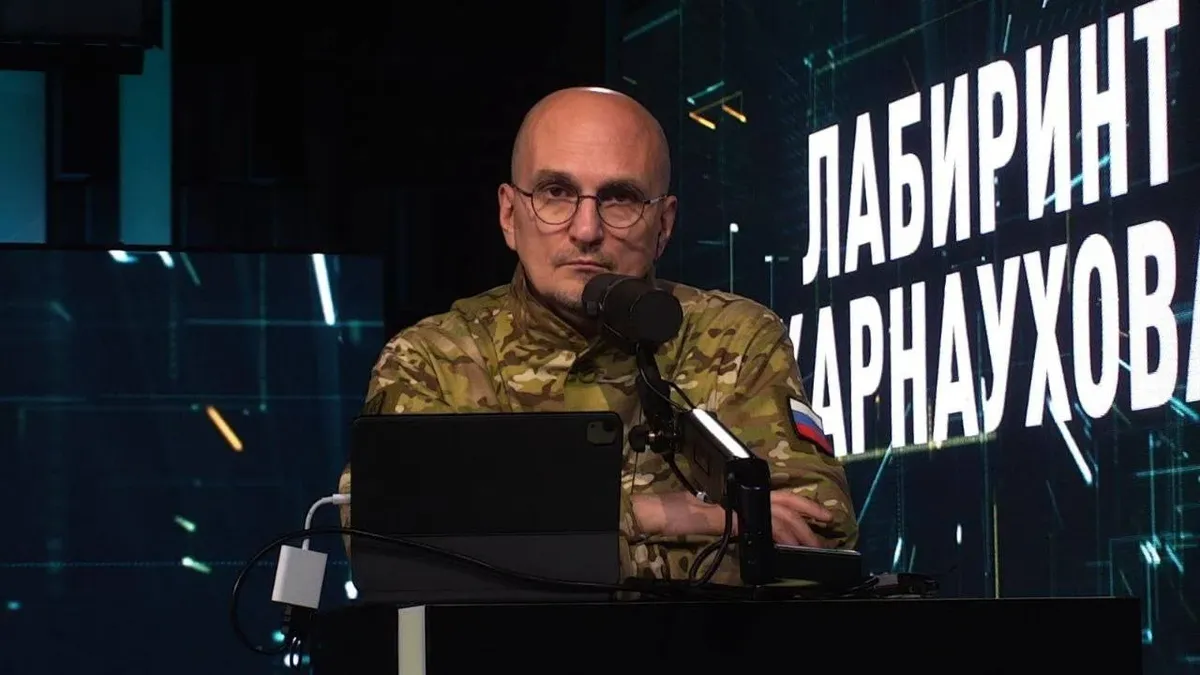
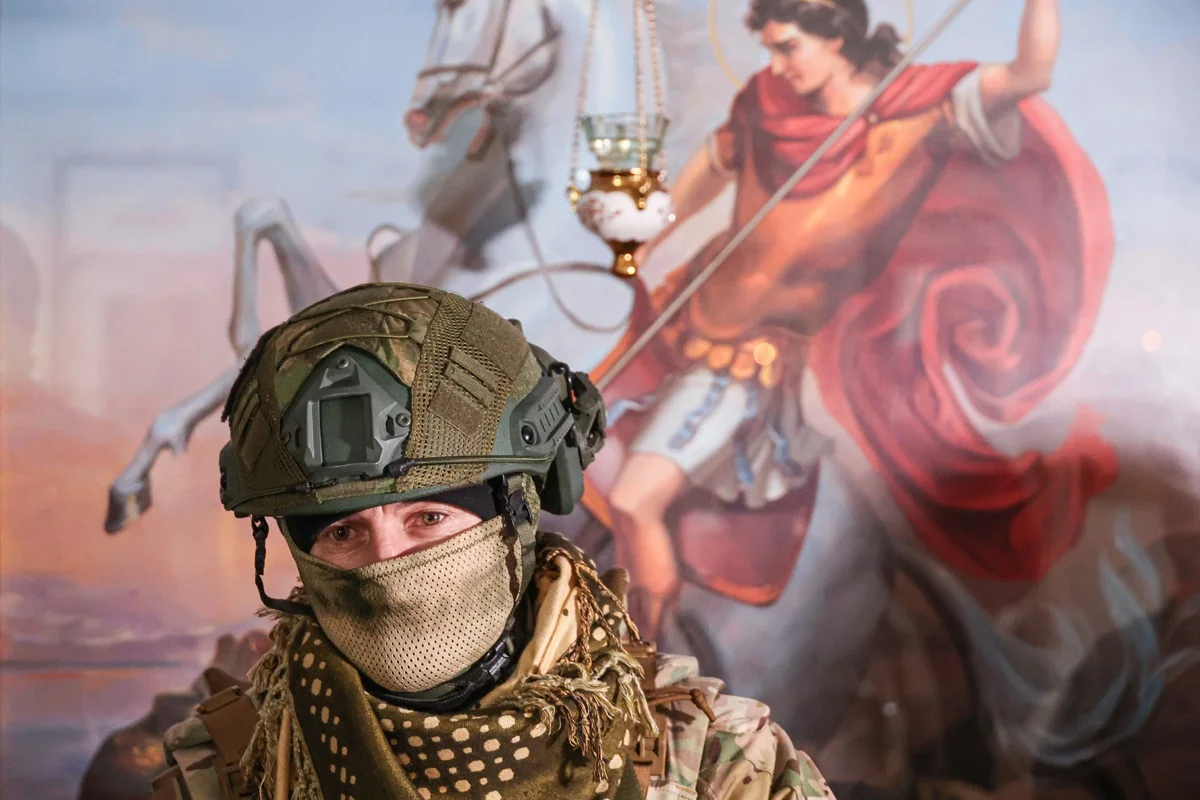
On the air of the program “Karnaukhov’s Labyrinth” on May 10, 2024 on the Solovyov TV channel. Live” Sergei Karnaukhov stated that “a guy who walks with a machine gun and storms a trench is a man who is going to the Kingdom of Heaven. He is a saint... When he lies and waits for the FPV drone to arrive, then let him shoot himself... This is not suicide, Christ also could not have gone to the cross. This is a sacrifice." This is an important remark that has gone unnoticed by many. Why were these words said and why?
I see several meanings in this call.
The first is historical. One of the most shameful pages in the history of the Great Patriotic War is being restored - the attitude towards prisoners of war as traitors. The USSR was unique in this regard, and this topic is discussed exhaustively in the book “The Stigma” by Oksana Dvornichenko. Article of the Criminal Code 352.1 “Voluntary surrender”, adopted in September 2022, is included in the same piggy bank, since the degree of “voluntariness” can be considered with a high degree of arbitrariness.
The second is ideological , namely the idea of the identity of holiness and heroism, which Karnaukhov brings to its logical conclusion in his call for suicide. We will dwell on this topic.
Heroism VS Holiness
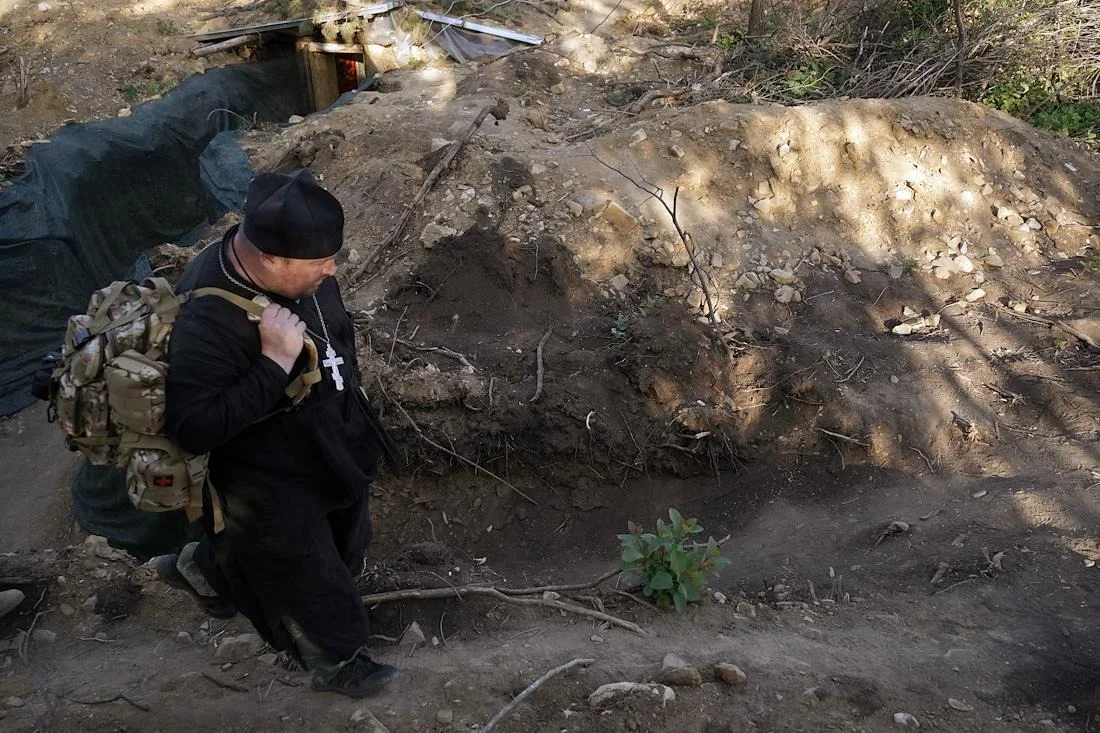
On another occasion, the same Sergei Karnaukhov (Novaya reported in detail who he was and where he came from on television) told a story about how a priest wanted to perform the Divine Liturgy for soldiers going on an assault, but could not, since he did not have an antimension ( this is a plate into which a particle of the relics of a saint is sewn and without which the liturgy cannot be celebrated). But here, says the priest, “I see that the earth is shining, the bones of our children, who died on different days, they filled this whole field, these little bones are white, they sparkle in the sun. At some point I realized that each of these boys, they didn’t just die, they were saints.” Then he performed the liturgy right on the ground. Therefore, according to Karanaukhov, war is sacred, since there is “holy land” and “holy guys.”
Probably the most striking statement on this topic belongs to Patriarch Kirill. They were told that “if someone, driven by a sense of duty, the need to fulfill the oath, remains faithful to his calling and dies in the performance of military duty, then he undoubtedly commits an act tantamount to sacrifice. He sacrifices himself for others. And therefore we believe that this sacrifice washes away all the sins that a person has committed.” Visiting wounded soldiers and officers in a hospital near Moscow, Kirill said : “Holy people are often called ascetics... In a certain sense, you are all ascetics. You didn’t run away, you didn’t hide - you moved forward... Where there is movement forward, where there is feat, there is life and there is victory. This happens on the battlefield, in family life, in relationships with other people, and in many other circumstances. I would like to wish you, despite the difficulties you have gone through, to maintain the ability to move forward and be ascetics.”
This teaching, new to Orthodoxy, spread quickly.According to Archbishop Pitirim of Syktyvkar,
“Warriors from time immemorial, regardless of where they fight - in Syria, Afghanistan or Ukraine, it doesn’t matter - they are all saints if they follow the regulations, military engineering, military science”
(literal quote). Metropolitan Mitrofan of Murmansk said that someone who dies at the front becomes a saint of God who will take care of his family and offspring. Metropolitan Matthew of Pskov said in his sermon that “our soldiers go into battle with faith, and if they die, then as martyrs who gave their lives for their friends, they find themselves in heavenly abodes.”
The same narrative is broadcast in modern Russian Islam. Thus, Apty Alaudinov, commander of the Akhmat unit, addressing the mothers of Russian servicemen, said : “If you die defending your Fatherland, your faith in God, then you will go to heaven, and what could be better for a person than heaven on the ways of the Almighty? Nothing". Whether the Gurias in paradise will please Orthodox soldiers along with Muslim ones is not specified, as is the eternal fate of those who defend their Fatherland on the other side of the front.
Total mobilization of the saints
Not only do heroes become saints, but saints are also called to the front. The very first on this list are those who were warriors themselves: George the Victorious, Alexander Nevsky. Someone is called to be the patron of the army, relying on legends - for example, St. Sergius of Radonezh. The opinion of historians that there was no meeting between Sergius and Dimitri on the eve of the Battle of Kulikovo, and Peresvet and Oslyabya were not monks, is as far out of the equation as the conclusions of Academician Shakhmatov that Prince Vladimir was baptized in Kiev, and not in Chersonesos.
Saints obey orders like other citizens of the country and are appointed to positions of responsibility. So, for example, Andrei Bogolyubsky became the patron of the radiation, chemical and biological protection troops, and Joseph Volotsky became the patron of the logistics troops.
It is difficult to imagine a more peace-loving saint than St. Seraphim of Sarov, but he too is taken into account. Alexander Prokhanov wrote about the nuclear laboratories set up in his monastery: “Reverend Seraphim, without leaving his destroyed monastery, invisibly inspired selfless scientists, hurried them, and they managed to create Soviet nuclear weapons, preventing the outbreak of the last hour by their appearance.” Later, Patriarch Kirill himself stated that “according to the ineffable Providence of God, this weapon was created in the monastery of St. Seraphim. Thanks to this force, Russia remained independent and free.”
The militarization of Orthodoxy is happening like an avalanche: if 20 years ago the canonization of Alexander Suvorov was unthinkable, now the Holy Synod of the Russian Orthodox Church has ordered to consider the issue of his canonization.
There has never been any veneration of Suvorov among the Russian people; canonization is an initiative of the Ministry of Defense, which is not hidden.
My guess that Georgy Zhukov will be next is only partly sarcastic: “Foma” and “Pravoslavie.ru” have already published songs of praise, where the marshal appears as a pious Orthodox man, and the central Moscow Danilov Monastery compares his equestrian image at the 1945 parade with the icon of George Victorious. There is no reason why it cannot take its rightful place in the iconostasis of the new post-Soviet civil religion.
Eight years ago, Vladimir Medinsky said that the lives of the heroes of the Great Patriotic War can only be treated as the lives of saints, and those who doubt their exploits, contrary to archival documents, will burn in hell. Where have we been for eight years?
Within the framework of an essentially godless “civil religion,” religion itself is useful and acceptable only to the extent that it can be mobilized. Thus, the Ministry of Defense of the Russian Federation released an advertising video where Orthodox, Buddhist and Muslim soldiers on the battlefield each pray in their own way, and at the end the words appear: “We are Russian - God is with us” - and a call to serve under a contract. “And like wings behind my back, both my Christ and your Allah,” sings an unknown talent to the accordion .
Under the rhyme “mentality - nationality”, either ecumenical militarism or militaristic ecumenism is born, which very recently few could imagine.
Not a country, but a sacred power
In light of Patriarch Kirill’s statement about the forgiveness of the sins of killed soldiers, many recalled the episode described by the Byzantine official and chronicler John Skylitzes. Emperor Nikephoros Phocas (963–969) “planned to pass a law so that those soldiers who died in the war should be canonized only because they died in the war, without taking into account anything else. He forced the Patriarch and the bishops to accept this as a dogma. The patriarch and bishops, bravely resisting, restrained the emperor from this intention, emphasizing the canon of Basil the Great, which states that a soldier who kills an enemy in war should be excommunicated for three years from communion.” All this has ceased to be relevant. At a meeting of the Moscow clergy, in response to a question about the permissibility of giving communion to soldiers returning from the front, Patriarch Kirill asked : “Why does the question of non-admission arise?” “Because of their involvement in murders in the recent past.” “There was no problem with Alexander Nevsky after the Battle of Peipus - whether to allow him to take communion or not to allow him.”
It is curious that parallels with the teaching about the holiness of dying soldiers are easier to find in the history of the Catholic West than in the Orthodox East. Thus, announcing the first crusade to the Holy Land, Pope Urban proclaimed: “If anyone, having gone there, ends his life, struck by death, whether on a dry road, or at sea, or in battle against the pagans, from now on let his sins be forgiven . I promise this to those who go on a campaign, for I have been endowed with such mercy by the Lord himself.”
Similar words were heard again during World War II. Thus, T. Brody in his book “German Catholicism at War, 1939–1945” talks about a meeting of the clergy in Gangelt near Aachen on October 1, 1940. The meeting participants had a lively discussion about heroism in its modern and Christian understanding, about its manifestations in modernity and in Christian thought, about the similarities between the manifestations of heroism in National Socialism and in Christianity (saints, martyrs, heroes of labor and duty even in the face of death) . The Bishop of Münster, Clemens August von Galen, proclaimed in March 1942 that the German soldiers who died fighting Bolshevism had fallen as Christian martyrs in a “crusade” against a “satanic ideological system.” A year later, in February 1943, he stated that “the death of a soldier in the line of duty is very close in value and dignity to martyrdom for the faith.” In October 1945, when the war was already over, he said that “the death of a soldier stands in honor and dignity next to the death of a martyr.”
However, it was not only in the West that heroism was equated with holiness. The word "shahid", like the word "martyr", literally means "witness". When Palestine buried its first female suicide bomber in 2004, Hamas leader Mahmoud al-Zahar said: “Calling her a hero is not enough. Calling her a hero doesn't convey the whole truth. This woman left her husband and children to conquer heaven.” In the eyes of their admirers, Palestinian suicide bombers die not only for their faith, but also for their people, for the sacred land on which the Al-Aqsa Mosque stands.
If a country is not just one of the countries, but a “sacred power,” then the line between the sacred and the secular is erased, and national heroes also become martyrs.
In this light, the sympathies of “patriots” for Hamas become clearer, and Putin’s idea that Orthodoxy is closer to Islam than to Catholicism takes on new colors. Indeed, in both cases, “we will die as martyrs, and they will simply die.”
***
Why is all this needed? Why, or better yet, why is the difference between heroism and holiness being erased?
The first reason is simple - it is the sacralization of war. If those who fight are saints, and the saints fight with us, then military actions are sacred.
The second reason is also simple - motivational and mobilization. The hero is surrounded by honor. A martyr is venerated, but this is a completely different matter. Becoming a saint is something more than a contract payment and a social lift.
The third reason is somewhat more complex, and is that the cult and veneration of martyrs - religious and civil, regardless of religion, country and time - creates a new collective identity. Their reverence is what unites members of the community. This does not necessarily have to be political technology. It may well happen by itself, because there were no puppeteers behind the veneration of martyrs in the ancient church. However, the heroic narrative is ideal for cleansing society of social antagonisms. Heroes and their veneration become the binding mass of a like-minded society. It is no coincidence that in an interview with Evening Moscow, the director of the Victory Museum in Moscow, Alexander Shkolnik, said that the main result of the special operation was “the unification of people, the consolidation of society.” In this sense, victories or defeats on the battlefield become completely unimportant. Changes within Russian society cease to be a consequence of the SVO, but actually become their goal. The new, reformatted society, as conceived by its creators, should be different from the Soviet one - even if some components are similar. Soviet people were driven to heaven alive. Now they are being invited to enter it dead. No one is promising a bright future in the country, and for those who do not want to play by the new rules, the conditions being created are by no means heavenly.