
Translated material
Unscrewed
In the three districts of Moscow, United Russia lost to other candidates. We show how the authorities tried to “pull out” them with falsifications through DEG - but could not
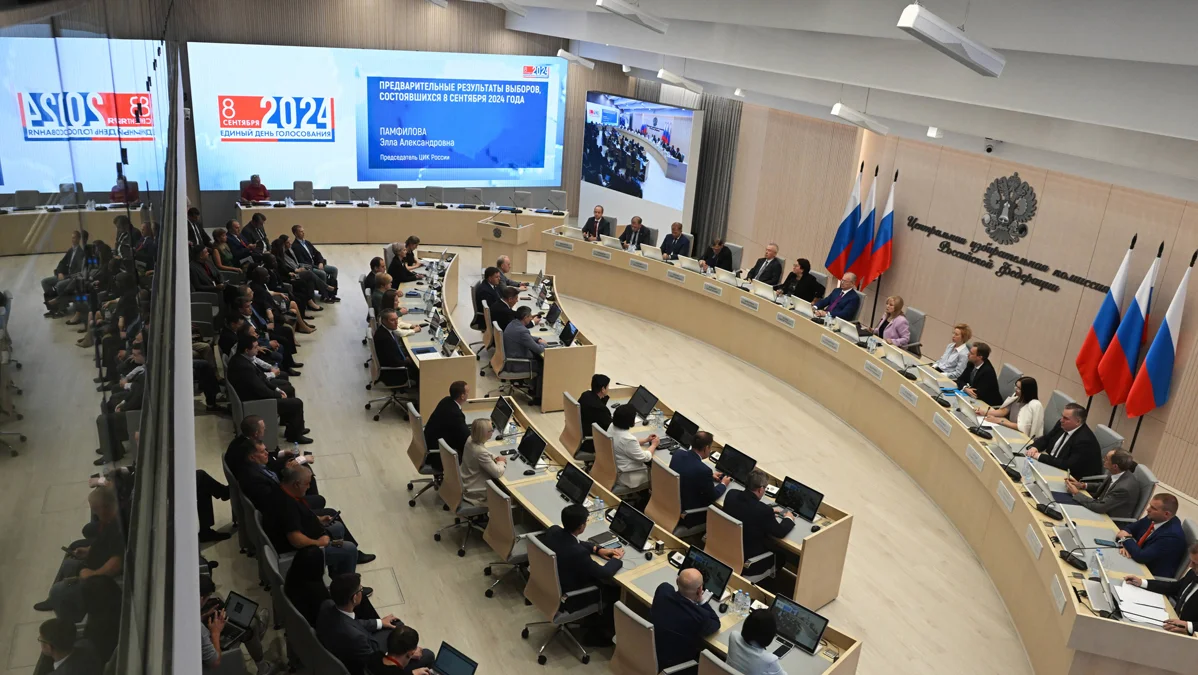
The Chairman of the CEC of Russia Ella Pamfilova holds a meeting on preliminary results of three days of regional and municipal elections in Moscow, September 9, 2024. Photo: Kirill Kallinikov / satellite / Imago Images / SNA / Scanpix / Leta
On Sunday, the elections to the Moscow City Duma ended. In 38 out of 45 districts, the mandates went to United Russia - against 24 in the last composition. In the three districts of United Russia, candidates from other system parties bypassed. Novyevropa found out that the authorities tried to falsify the elections in these districts using electronic voting, but did not calculate the scale of the wrappers necessary for victory.
For the first time, Moscow elections were almost completely held online - to receive a paper ballot, it was necessary to submit an application in advance.
Remote electronic voting (DEG) radically reduces the transparency of the process. The only source of information about the progress and results of voting (except for the official statements of the authorities) - the data on the surveillance portal is incomplete and can be distorted. For example, in the first hour after the start of the elections, data from a test vote was posted there instead of the present. In the final database available to observers, the numbers of the constituencies do not coincide with the numbers on the CEC website. This year, the observers also hid information about the number of electronic voting (TEGs) that voted through the terminals.
How DEG works
The algorithm of the Moscow DEG system consists of three main stages:
The voice given to the DEG website is encrypted in a browser using a public key;
The encrypted voice is recorded in the database on the blockchain;
After the vote, the voice is deciphered using the key separated between the members of the Unified Moscow Electoral Commission, and the system calculates the results.
It is impossible to recalculate the results independently: the system uses an additional encryption layer, the key to which is available only to the Department of Information Technology (DIT) of Moscow. Only the results deciphered by the Deit are available to observers.
Until 2022, the voter could check that his voice in the Moscow DEG system was counted correctly, although it was difficult to implement this opportunity without special technical skills. After this option was added to the interface - in order to use it, the voter must put a checkmark in the corresponding checkbox. This allows falsifiers without the risk of detecting to replace the voices of those voters who did not apply for voice verification.
We cannot make sure that all data available to observers are related to the real voices of Muscovites. But even in them you can notice distinct traces of falsifications.
In three constituencies, where by the evening of Saturday the candidate from system parties (the Communist Party and "New People") won,
On Sunday night, the dynamics of votes changed mirrorly: the results of the “alternative” candidates and representatives of United Russia literally changed places.
This anomaly continued during the day. Our conclusion that she testifies to falsifications was confirmed by DEG experts Peter Zhizhin and Maxim Gongalsky.
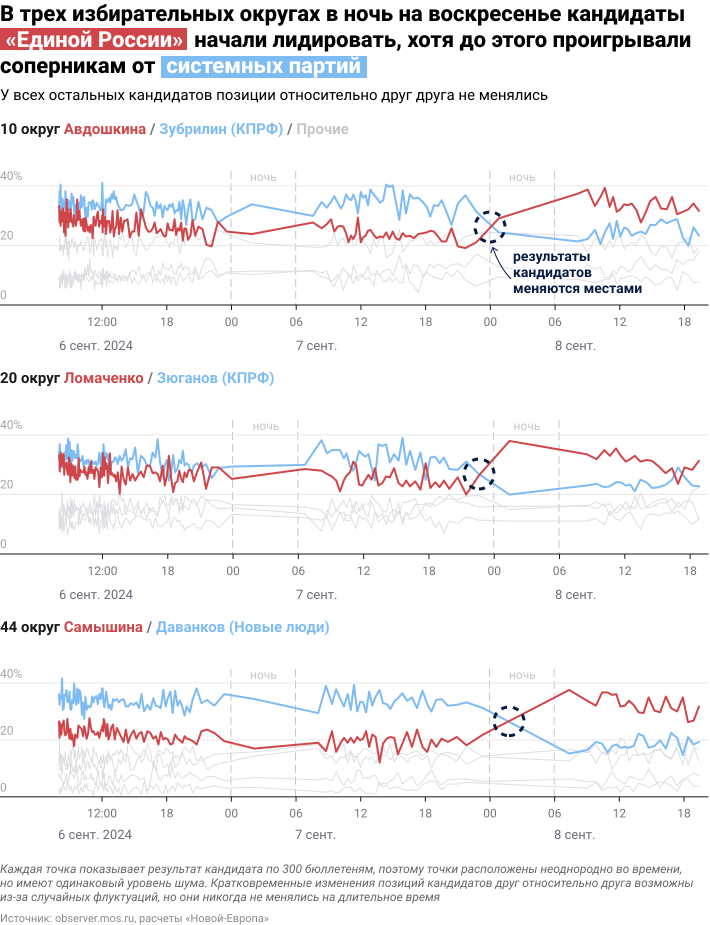
Such falsifications are an analogue of transferring ballots from one pile to another in paper voting (about other methods of manipulations through DEG, we talked in detail in our previous material ). Technically, this could be implemented using the substitution of identifiers of candidates in the DEG system at night from Saturday to Sunday.
In the internal database, candidate identifiers differ for different voters. For example, if both you and your friend voted for candidate A, then in the database your voice can be recorded as a voice for a candidate with number 1234, and your friend - for candidate 5678. To determine who a specific voice has been given for, identifiers are compared with an internal, not much published table.
Apparently
DEG administrators changed this table late in the evening on Saturday, when they realized that the votes for the “necessary” candidate are not enough.
Therefore, during Sunday, almost all the votes, in reality filed for “alternative” candidates, were recorded in favor of the candidate from United Russia, and vice versa. The likely exception is the votes from voters who requested the address of an encrypted transaction to check their voice.
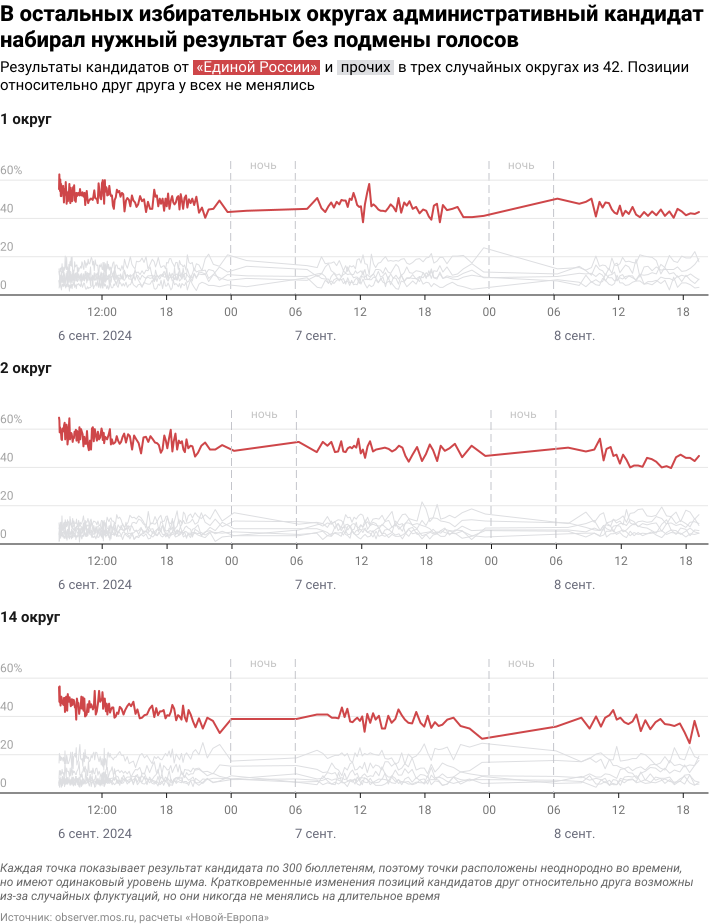
We discovered such wrappers in all three districts, where the candidate from the party of power lost. In the remaining 42 constituencies of sharp jumps, no results are observed. It seems that they were not needed in them by replacing votes - the administrative candidate and so gained the desired result (at least, according to the data on the observation portal).
In this case, the manipulations did not change the outcome of the elections - representatives of the system parties still won.
Perhaps the voting organizers underestimated the gap between the representative of the EP and other parties - it turned out to be too big.
And the script used to replace the votes could not be modified during the voting process, or it was completely launched in advance and did not require manual intervention. The authorities expected that the substitutions of Sunday votes would be enough, but this turned out to be not so.
Technically, nothing prevented the same script from starting on Sunday, but on Friday or Saturday. Nothing interferes with the launch of the replacement algorithm even from the very beginning of the vote - then it will not work to find any anomalies at all. It cannot be ruled out that in some districts it happened, and the results in them are completely replaced - neither to prove or refute this.
***
The official representatives have already appreciated the “success” of the electronic elections to the Moscow City Duma: Moscow mayor Sergei Sobyanin called them "innovations that proved their effectiveness." The Chairman of the CEC Ella Pamfilova said that she did not understand the position of opponents of DEG, since the decision to vote online is voluntary: "Do not like it - do not vote."
Due to the opacity and complete control of the authorities, DEG makes any form of violations possible. It is impossible to establish whether other falsification mechanisms, for example, stuffing were used in these electronic elections. In the elections of 2023, votes on the Moscow DEG were recorded by anomalies during failures.
This time there were no mass failures, so it is impossible to verify the absence of such a mechanism of falsifications.
In addition, electronic voting simplifies pressure on state employees, the scale of which, it seems, were again unprecedented. The maximum votes entered the system in the second minute of voting, and on Friday during the working day (from 8 to 18 hours), more than three times more people voted than in the same hours on Saturday. On the graph, peaks in round hours are visible in which state employees could force to vote.
The official appearance in the elections amounted to 39%, while in the past similar elections in 2019 it was only 22%. At the same time, the 2019 elections were much more competitive, they were preceded by protests in Moscow and wide public attention. An abnormally high turnout this year indicates either mass throwings or a huge scale of coercion of state employees.
But the most effective violation is the lack of political competition: they did not allow independent candidates to the elections and completely deprived voters of the real alternative.
In total, this is arsenal-complete opacity, coercive voters and lack of competition-apparently not enough. The authorities still resorted to the substitution of votes with programmatic ways - even taking into account that the loss of these three mandates did not carry any threats: “United Russia” would still receive a majority.
If our explanation of the technical mechanism of the wraps is true, then nothing prevents the falsifiers in the next election to take into account their mistakes and replace much more votes.
Data from the observation portal and the code that we used for research are available on GITHUB .