
Translated material
“How to live” returns!
Oh, excuse me, we were sealed. In fact, this is “how to sew” - an instruction for those who want to learn how to sew clothes (and how to live, we do not understand at all)
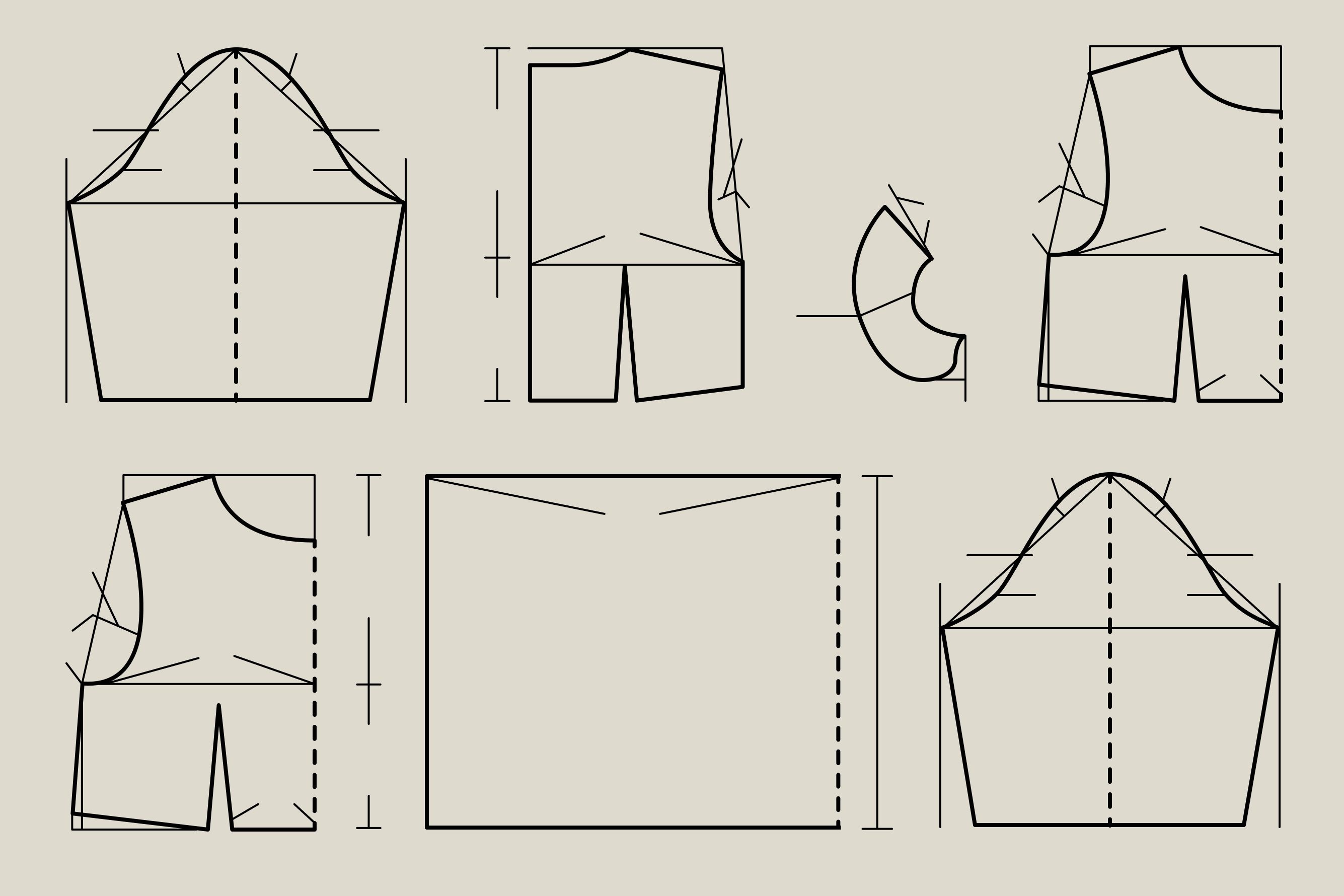
"Medusa" alreadytold how to start knitting. This time, the publication “Shore” prepared instructions on how to start sewing if you were the last time you did it on a sewing machine at school. Where to look for courses and people with whom it is not scary to try new? Is it necessary to immediately buy a sewing machine? And what else will need to master this hobby? We publish the text "Bereg" entirely (with minor editors).
The main thing is to start. To follow the rules at the same time does not necessarily
Experts with whom the “shore” spoke far from always started with courses and purchases of expensive equipment. If you want to sew, you can use the resources that are already at your disposal.
“As far as I can remember, I always wanted to sew something for myself, but I did not know how to teach,” recalls Petersburger, the creator of the Kookaburra brand Alfia Aisitulina. - Our family did not have the opportunity to give me to the courses - this question was not even raised. But periodically relatives gave us old bad sewing machines. When I sat down for them, I didn’t succeed, and the devices were breaking. ” According to the designer’s memoirs, "it was exhausted, it seemed that all this was simply not mine."
In school years, she did not forget the hobby: she made various accessories from improvised materials - “cut everything” that came to hand. In the years after the collapse of the USSR, European and American humanitarian organizations often sent clothes to Russian children. Alfiya remade these things for herself - with her hands, without using a machine.
In the first courses of the university, she began to try to sew more complex things - without patterns, by eye. For example, a coat: Aisitulina wondered how it would look unfolded, circled the pattern on the fabric, cut out and awl with her hands.
In 2009, Alfiya graduated from a university with a specialty of a linguist. After that, she entered the school and first began to sew on an industrial machine. But it was boring: I had to learn to scribble, make patterns. She often skipped classes - and she was expelled. Then Alfiya began to sew a sweater and sweatshirts with funny prints. And over time, I moved to the dresses, thanks to which I created my brand.
The St. Petersburg seamstress Lara Kovrigina recalls that she began to sew when she graduated from the 11th grade and felt fatigue from preparing for the exam (she planned to enter the architect). As a result, Kovrigina opened lessons on Utube and sewed the first set of underwear. For subsequent products, she just wondered what a thing should look like, for example, a T -shirt, and made it based on her ideas.
As a result, Kovrigina changed her mind to be an architect and entered the clothing designer. She has a sister who sews professionally - together they began to invent models. As a result, they launched their brand of clothing - “another look”. All things for him were sewn in free coworking "Angar" (the project closed at the end of 2023). At the same time, Kovrigina taught there for wards of non -profit organizations.
Select the training format and find support
If you want to take courses or get advice from an experienced master, there are many opportunities for this - offline and online.
Finding sewing courses can be found in sewing coworking. For example, the project “Switching” and under the “Second Play” fund in Moscow.
Many teaching videos are available online: for example, on YouTube. It is enough to score in the search line “How to sew [the name of a thing]” or “neck tutorial”. Автор проекта CASH FOR TRASHHH Мария Глушановская среди прочего советует канал швеи Tailor Girl , а еще рекомендует искать видео как на русском, так и на английском языке.
Here are a few more options where you can undergo training for a fee or free:
- Courses “cut and sewing” , “sewing underwear and swimwear” and “sewing clothes from zero to Pro” on the Skillbox website;
- Online cutting and sewing course on the website IRS.ACADEMY;
- online sewing course and a course on the felt sewing on the ONSKILLS website;
- The course on sewing a dress with a straight sleeve from Alfia Aisitulina;
- Free online courses of cut and sewing on the website of the Burda Academy.
Alfiya Aisitulina notes that many people like to constantly improve their qualifications. She decided for herself that she did not want to know the different rules by which the products are sewn, so she does everything to her taste:
There are many different methods. But from the sewing community it often flies to me that I sew incorrectly, I do not fade, I do not overtake with soap. This is a personal matter for everyone. But if a beginner sewing collides [with criticism], he will be very unpleasant.
For those who have long want to start sewing, but do not reach their hands, there are sewing clubs. Usually they share different courses and webinars for the development of skills and lead a chat so that everyone can boast of the results and ask the advice of the participants. Such a club, for example, is at Selftailor and SOK schools.
Find a machine on which it will be convenient to work. And buy useful accessories
To start sewing, it is not necessary to have a sewing machine, says Lara Kovrigina. There are sewing coworking - equipped workshops, where there is already everything for cutting, modeling and sewing. An hour of work in coworking in St. Petersburg will cost 200 rubles. There are sewing coworking in Moscow. Also in the capital there is a free workshop from the Second Spanning Foundation.
You can rent the first machine: for example, on Avito or on the Polka website . “You can check on a rented typewriter or coworking how much it is [sewing],” says Kovrigina. “But then usually begins to want to have his own machine.”
Lara Kovrigina and Alfia Aisitulina has a favorite brand of cars - Bernina, but they cost at least 20 thousand rubles. Alfiya also advises the PFAFF brand - the price is from 17 thousand rubles. She also recommends buying a machine on Ozone and other marketplaces, since there is a month there to return the goods. The machine can be returned if it does not work or it will work badly. Aisitulina herself does not recommend taking a device cheaper than 10-12 thousand rubles, since it will most likely use cheap details with a high risk of breakdown. “I am for a good car, because this is an important point to get pleasure and enjoy experience from interacting with the device,” the expert says.
The experience of Aisitulina shows that you can start sewing even without a machine - with your hands. And Kovrigina notes that even an old Zinger is suitable for starters. Isitulin does not agree with this: she does not advise starting to sew on old cars, since such experience can demotivate someone, like her. Maria Glushanovskaya from Cash for Trashhh holds the same opinion:
Of course, you can also sit down for the Babushkin “Zinger”, but if it is difficult to sew on it, it can simply discourage a person from a person. After all, it is important for beginners that the result is quick. Therefore, in my opinion, it is best to get the first experience of sewing in coworking.
I also do not advise you to take a machine for Avito, because you can easily buy a "scrap metal".
Lara Kovrigina advises to buy a machine in an offline store so that sellers show basic functions. But it adds: this is not necessary, because on Utube now you can find many training videos for each model. In addition, on all devices, it is available by arrows on how and where to refuel the threads and how to change the length of the line.
In addition to the machine, at the first stage you will need tailor scissors: according to Kovrigina, you can buy inexpensive ones - even for 200 rubles, and good ones will cost from 1000. The expert notes that for a start, even ordinary scissors can be used - for paper. Glushanovskaya advises to buy the first scissors in the store to choose those that will be better lying in the hand.
In addition, needles, threads, pins, a piece of soap, a centimeter ribbon and a regular line will be needed - all this can be ordered online on marketplaces. Alfiya Aisitulina says that a pure powerful iron that will not get fabric will still be useful for sewing. According to her, the first time you can do with an ordinary iron that is at home - Maria Glushanovskaya agrees with this. Then it will be possible to choose the device more powerful, which will be well stitched by the seams.
“As I understood from experience, nothing is needed except desire. You can cut with manicure scissors, if you really want to. This is inconvenient, crooked, but it is possible. You can draw with a pencil, not chalk. You can use the book instead of a ruler, ”says Aisitulina. She does not advise buying Overlock to beginners, because, according to her experience, at the initial stage there is enough zigzag function on a conventional sewing machine.
Sew the first product
According to Maria Glushanovskaya, usually beginners make a straight skirt as the first product. Lara Kovrigina believes that the easiest way to sew the first thing that is most of all:
Of course, the easiest way will be to do what is sewn in a straight line without complex lines: for example, eco -fitting. Or shorten your pants. But for greater motivation, you can immediately begin to sew things that you want to wear. The first clothes that I sewed was a coat, and it was wildly difficult. I did not even know how to process my pockets, but just looked at similar products and tried to figure out something. In principle, this coat can still be worn.
Kovrigina advises to start sewing with non -slip fabrics: for example, flax, cotton, nettles. Among those fabrics with which it is difficult to work as a beginner, she calls viscose and chiffon. At the same time, she began with lace - when she sewed underwear, so she recommends "easier to relate to everything." Glushanovskaya also advises starting with cotton or jeans - fabrics that are not very deformed when sewing. Lastly, she recommends for beginners villing fabrics (for example, velvet) and silk, since they are “capricious” in sewing.
Alfiya Aisitulina says that the first of her products at a conscious age was sewn from knitwear: “Many call it not the simplest fabric, but it went. It was possible to sew from it without patterns: if something was cut off somewhere, the fabric could be torn in the process. ”
Where can you get fabrics
Alfiya Aisitulina recalls that she once bought fabrics for her products on the remains of production. Later, platforms like “Avito” appeared, where it was simply possible to enter the word “fabric of the USSR flanel” into the search engine. As a result, she found many materials with geometric shapes or pencils. Then she made contact with a woman who sold more other fabrics with an interesting pattern. She sent Aisitulina photography of materials that could potentially interest her. The design of simple dresses with an eccentric pattern liked the customers - now Alfiya has more than 20 thousand subscribers on Instagram, and the prices for products vary from 80 to 160 euros. In 2022, Aisitulina moved to Berlin and finds fabrics already there-in second-hand.
Glushanovskaya says that many teachers advise first to sew a product from cheap fabric before taking up the dear. She also recommends, for a start, to try to change something from what a person no longer wears-this will just be practice at the initial stage. As the first fabrics, Lara Kovrigina also advises to take old clothes that can be overtaken.
Remove the measurements and use patterns if you do not feel confident
Alfiya Aisitulina believes that it is not difficult to remove the basic standards on his own, but it all depends on the style: “If the landing goes strictly in figure with many parts, such as tuck and buttons, then it must be adjusted on a mannequin built under its size. And only then on yourself, during examples. ” And she also recommends to measure one of her things, which you easily fit into.
Now there are patterns for any product on the Internet: for example, on the sites of Vikisews , Grasser , Schynivers , Patterns , “First Tillage” , Selftailor . On these and other sites you can download templates both free and paid. They have patterns for men's, women's and children's clothing of different sizes and styles. There is also an approximate fabric consumption. It is better to take with a margin. Usually, according to Aisitulina, the skill of counting the amount of fabric comes with experience.
After downloading, the template can be printed on a regular printer, glue its parts with each other and transferred everything with chalk to the fabric.
Also, patterns can be found in printed magazines. The most popular is Burda, which still has a site where you can buy patterns. Lara Kovrigina says that in old issues it was very difficult for her to figure out how to fit the patterns for herself, but in modern things everything became much more understandable.
At Aisitulina, the first patterns appeared only in 2019, when she ceased to cope with the queue of those who wanted to buy her dresses. Her assistant is now sewing on them, Alfia herself continues to ignore them.
Be patient
Maria Glushanovskaya believes that each person will take a different time to get an ideal product-someone will have enough day, but someone will be not enough for someone and a year:
Someone simply does not have the makings for this, since he is strong in another. If there is a desire, you can learn everything. The main thing is to practice regularly.
According to Alfia Aisitulina, in the sewing environment you can find a high level of toxicity. Because of this, many after the learning process, it is difficult to afford to sew poorly, “not what they taught” and fantasize.
Follow the safety regulations
The main such rule, Lara Kovrigina calls the need to monitor the pedal of the machine when working with the needle. Since otherwise you can accidentally pierce your finger.
Maria Glushanovskaya adds: in production, you usually have to wear special glasses so that nothing accidentally gets into the eyes. But, according to her, at home, usually no one bothers about this.
In addition, it is worth cleaning the extra things away from the sewing machine. Do not put water and food nearby.
Use your skills in charity
You can learn to sew and benefit others with charitable foundations.
For example, in Moscow there is a Film of Joy, which helps people in a difficult life situation. In his project “Cozy” three times a week, master classes are held on various types of needlework, including sewing. They can, for example, sew bedding, night shirts, towels and other products that will pass the wards to regional nursing homes. You can pick up the product for yourself - it is enough to leave the donation that will be sent to the aid of the elderly.
“From scratch, we learn to sew, knit, hold a needle in our hands, use a machine,” says Polina Artemyeva, the “Prostvas shops”, the Fandraise Manager and the communications. - Any volunteer can join. The goal of “comfort” is to make people live more comfortable in a vulnerable position, and the elderly houses become at least a little like their home. ”
You can sign up for master classes here . The number of places is limited. Also, the project always needs fabric: the most important thing is that these are whole pieces that are suitable for sewing bed and night linen.
In the “second wind” fund, brands convey things with small defects: for example, a little broken with lightning, an unengated loop or diverging seam. These things are repaired by volunteers in the workshop of the Fund in Moscow on special master classes-the repair can take from five to 20 minutes.
“The future of this thing is changing significantly: instead of being at the [garbage] training ground, it gets to our well -being - people who need clothing. At the same time, quite a few resources are spent on this, ”said the PR manager of the fund Daniil Zhdanov.
Everyone can become a volunteer-follow the announcements in the telegram channel of the fund or workshop .
"Shore"