
Translated material
People will be able to live under water
At the beginning of 2022, a diving center in a flooded career was suddenly closed in Bristol. Only two years later, lovers of scuba diving learned about the reasons. In September last year, the British company Deep, specializing in the development of underwater technologies, spoke about the purchase of this place and plans to "make people waterfowl." "Cold" talks about how they plan to achieve this.
For this, the British company is developing a special habitat
Like ISS, but under water
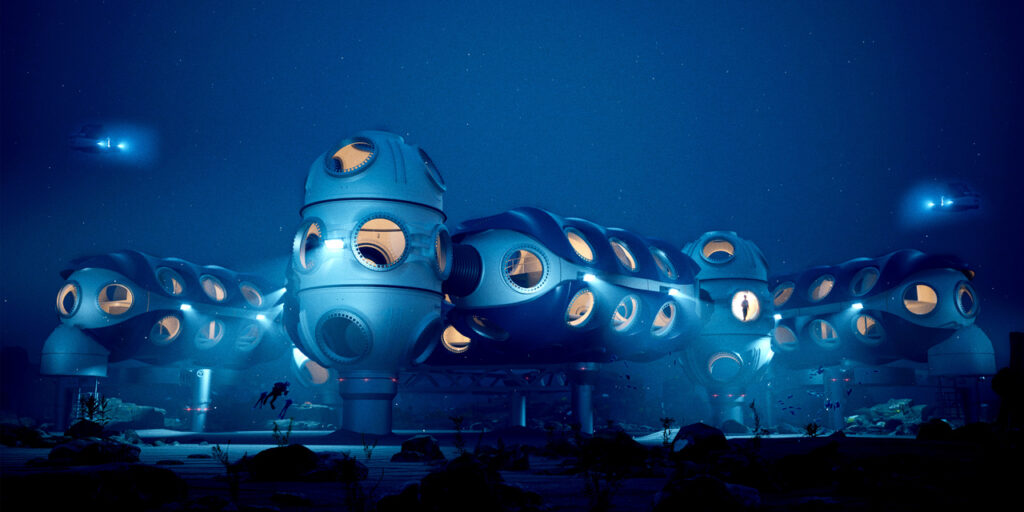
The company develops an underwater habitat called Sentinel, which, according to DEP representatives, will allow people to live and work at a depth of 200 meters for a month.
The Sentinel system should consist of interconnected modules and can be used for a variety of purposes: from collecting data on the chemical composition of oceans to expeditions to sunken ships. The creators promise to make the size and shape of the system changed, which, according to them, will allow the habitat of both the mission of six people, and become a research base for 50 people.
The company hopes that thanks to this, people will be able to live under water for a long time, like an international space station (ISS), which since 2000 allows people to be in space for months.
To date, there is only one current underwater research laboratory controlled by the International University of Florida in the world. People of various professions use the laboratory: from researchers studying corals to NASA astronauts, undergoing training in extreme conditions.
Sentinel is planned to be launched by 2027 and delivered to different parts of the planet. At the same time, Deep recognizes that to achieve the goals you will need great efforts.
The prototype will be ready next year
Before proceeding with the development of the declared system, Deep plans to release its reduced analogue called Vanguard. It will be used both for the development of Sentinel, and as an independent product.
Vanguard is an underwater habitat size of 12x7.5 meters, which can accommodate three people and allows them to be under water for a week. They plan to send it under water in early 2025.
Deep President Sean Volpert believes that the experimental habitat can be useful in cases where rapid deployment is necessary, as, for example, when searching for a superchote survivors off the coast of Sicily. Such an environment could serve as a base for divers, and they would not have to come up every 12 minutes during a rescue operation, says Volpert.
“The environment developed by Deep is a change in paradigm for scientific diving operations. Its safety, efficiency and opportunities for the interaction of the ocean and the person that it provides is something enormous, ” added ED O'Brien, a diving operator at the Woods-Houl Oceanographic Institute.
Communication from Starlink and soundproof rooms
Sentinel modules will be created using 3D printing with the participation of six robots. In production, they plan to use steel, reinforced by the InConel Nickel-Chroma, which was used in the development of Space Shuttle and SpaceX and withstands extreme conditions.
Depending on what depth and at what pressure the Sentinel system will operate, access to it can be carried out either using an submarine that joins the habitat, or through a hole at the bottom, where scubales can get on their own.
The system will be equipped with an auxiliary buoy that remains on the surface of the water. It is assumed that it will be equipped with a Starlink interface to ensure communication, and the habitat itself will receive energy from renewable sources, for example, from winding turbines and solar panels.
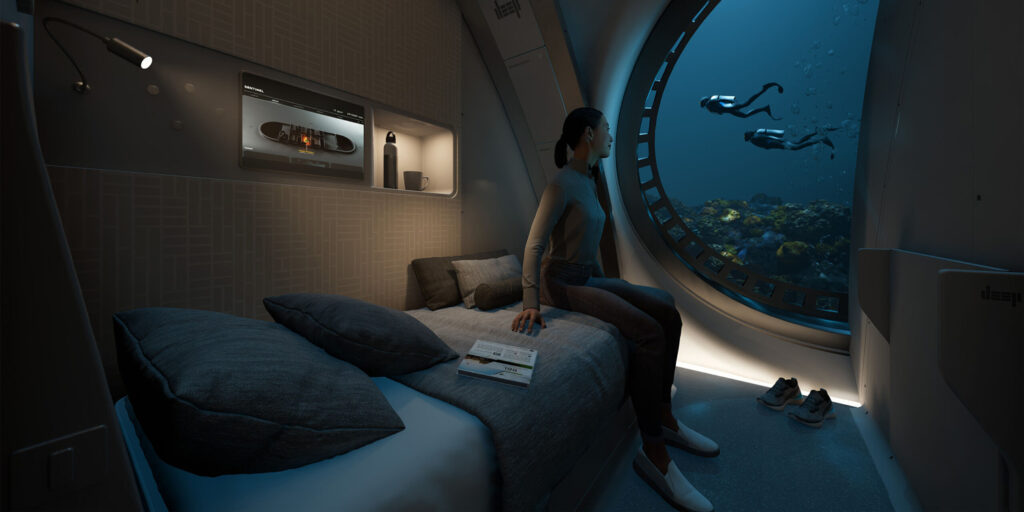
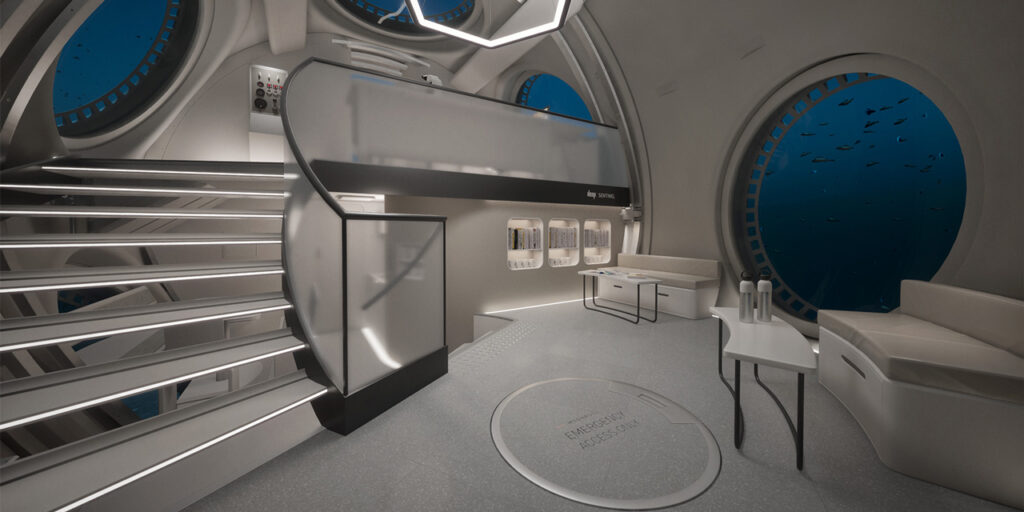
Inside Sentinel plan to equip soundproof sleeping places, as well as a common room for eating and communication. “This does not look like a Four Seasons (Canadian network of luxury hotels. - Approx.“ Cold ”) , but when you come out of it, you will want to return,” said Volpert.
The ground could have a ring, as in Saturn it could change life on the planet and influence the ice period of the world 5 minutes of reading
From tourism to coral restoration
According to Volpert, Deep is already negotiating with organizations and governments around the world. Customers can rent, buy and use space depending on their needs.
The system can be used in monitoring and repairing a critical underwater infrastructure, tourism, in preparation for work in space, restoration of corals, training in diving sailors and in medical research. At the end of the work, the habitat can be redrawn to another place.
At the same time, the project can allow marine biologists to get an idea of the ocean, which is impossible during short visits using scuba divers or underwater devices.
It all started with Jacques-Ava Cousteau
The French oceanographer for the first time aroused interest in creating underwater infrastructure, one of the inventors of the scuba gear Jacques-Yve Kousto, who in the 1960s tried to find out whether the oceanavets will be able to live and work in the water. His missions for the construction of "Underwater villages" are called Conshelf.
In 1970, the US National Oceanic and Atmospheric Research Administration commissioned Hydrolab - its first underwater laboratory. It lasted until 1985.
Another laboratory, Aquarius, was deployed in 1988 on St. Crois, one of the Virgin Islands. In this small laboratory the size of a slightly larger school bus, there are six sleeping places, a microwave oven, a toilet, a refrigerator, a shower and Internet access. At the moment, it is located in the National Marine Reserve of Florida-Chis, where the only existing underwater laboratory intended for research remains.
In 2020, Proteus Ocean Group, which specializes in ocean technologies and founded by the grandson of the legendary researcher Fabyen Coustea, announced the creation of the ocean observatory. There, its inhabitants can, in particular, grow plants suitable for food.
In order not to miss the main materials of the "cold", subscribe to our social networks!


Author: editors of "cold" photo: deep.com