
Translated material
The day after the election
Georgia is on the eve of the “next fateful” expression of will. Should we wait for a revolution?
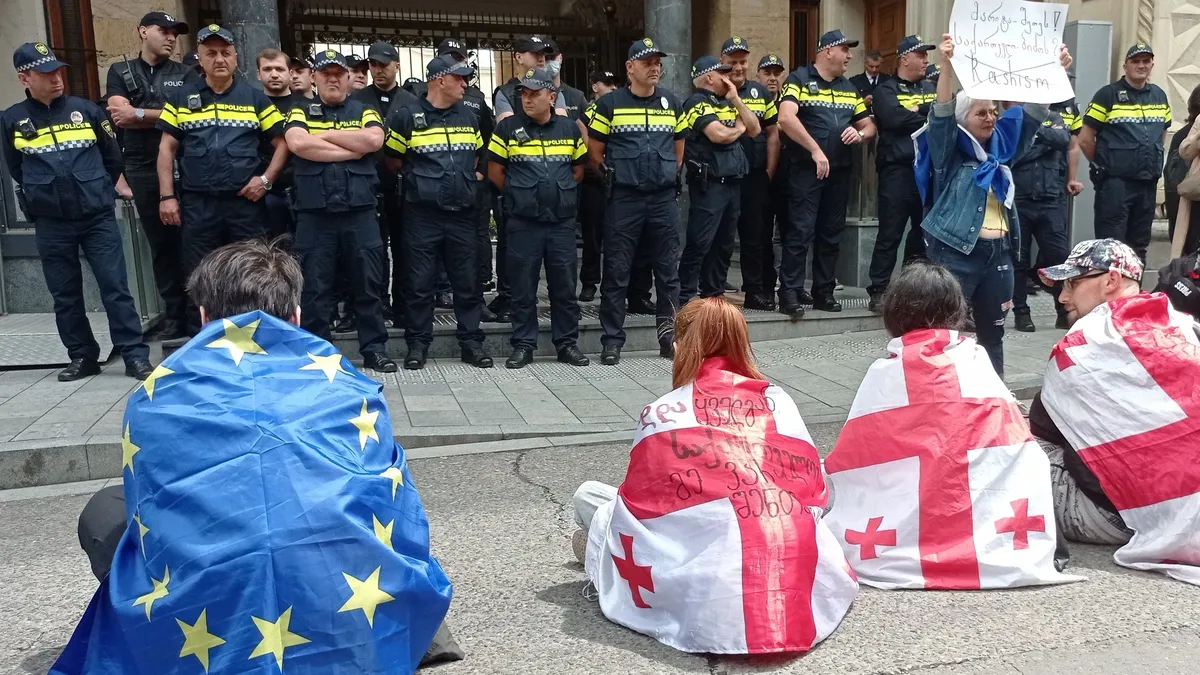
Protests in Georgia due to parliamentary support for the law “On Transparency of Foreign Influence.” Photo: Inna Kukudzhanova / TASS
Parliamentary elections will take place in Georgia on October 26. Considering that Georgia is a unitary parliamentary republic, in which the president has approximately the same set of powers as the president of the Federal Republic of Germany, the question of full power in the Caucasian country will be decided during a future vote.
The upcoming elections are unique in Georgian history in that for the first time citizens will elect a legislative body exclusively through a proportional system. Previously, for 34 years, elections were held according to a mixed majoritarian-proportional system, when some of the deputies in the 150-seat parliament were elected according to party lists, and the other part - in single-mandate majoritarian districts. And as is usual in most post-Soviet states with a weak democratic and electoral tradition, majoritarian deputies, the same single-mandate members representing the interests of provincial elites and local princelings, as a rule, became the most important resource of the party in power as a whole.
Thus, elections under a fully proportional system are more beneficial to the opposition, and not to the ruling Georgian Dream (GM) party of billionaire Bidzina Ivanishvili. If only the local multi-subject opposition can consolidate and overcome its own systemic weaknesses.
The West has made its choice in Georgia
The future elections are also unique in that for the first time in the history of the country since October 11, 1992 - the first elections after independence - the West not only does not demonstrate a willingness to support the current government or, at least, maintain an equidistant position from the ruling party and the opposition, as this happened during all the previous seven parliamentary elections, but on the contrary, it actively supports the opposition and demonstrates by all means the desirability of a change of power in the country.
Following the adoption of the Law on Transparency of Foreign Influence (dubbed the “Russian Law” for its similarity to Russian legislation against “foreign agents”) in May of this year by the ruling Georgian Dream (GD) party of billionaire Bidzina Ivanishvili, violent clashes in Tbilisi, as well as With the recent approval of a medieval anti-LGBT* “code” under the general title “In Defense of Family Values and Minors,” the United States imposed visa and financial sanctions on hundreds of Georgian officials, froze budget aid, canceled the traditional joint “Worthy Partner” exercise with the Georgian army, and organized a leak a draft document on the imminent introduction of financial sanctions against Ivanishvili and his inner circle.
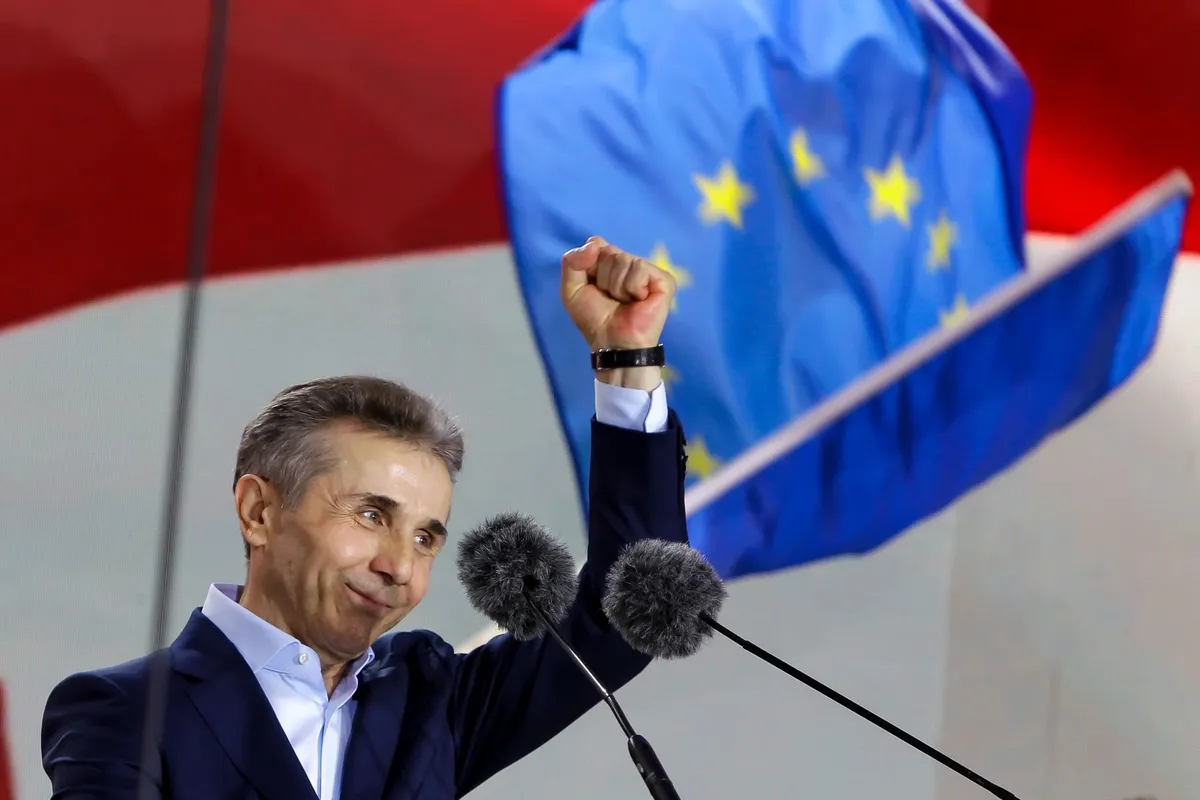
There is no more transparent hint about the unacceptability for Washington of keeping the GM in power in the diplomatic toolkit, even theoretically: the speakers of the White House or the State Department cannot speak before the elections and directly call on Georgian voters to vote against the current authorities and for the opposition.
The hints from Brussels are no less transparent: the leadership of the European Commission and the European Council promises to consider the issue of suspending the visa-free regime with Georgia immediately after the elections, that is, to make a decision on “visa-free travel” in accordance with whether the GM with its “undemocratic trajectory” will remain in power, as top EU leaders have repeatedly said.
The GM leaders understand all the hints, responding by strengthening the narrative about the “Global War Party,” which is allegedly “trying to open a second front in Georgia against the Russian Federation.”
Delayed apology
It was as part of the fight against the aforementioned “Global Party” that billionaire Ivanishvili, speaking at an election rally in Gori, placed full responsibility for the 2008 war on the main rival, the United National Movement (UNM) Mikheil Saakashvili.
In addition, Ivanishvili promised “immediately after the Nuremberg trial of the ex-president and his party” to apologize “to the Ossetian brothers and sisters” for the fact that the former authorities (that is, the current opposition) “enveloped them in the flames of fire” by bombing Tskhinvali on August 8 2008.
In South Ossetia itself, as one would expect, the “delayed apology” from the Georgian authorities was met with more than a cold shoulder. The general opinion of the South Ossetian elite was expressed by former President Eduard Kokoity, who led the republic during the “Five-Day War”: Georgia must recognize the independence of South Ossetia and return to it the territories taken by the Bolsheviks. Including the Trusovskoe and Gud gorges, including the winter resort of Gudauri and the Kazbegi region near the Russian-Georgian border.
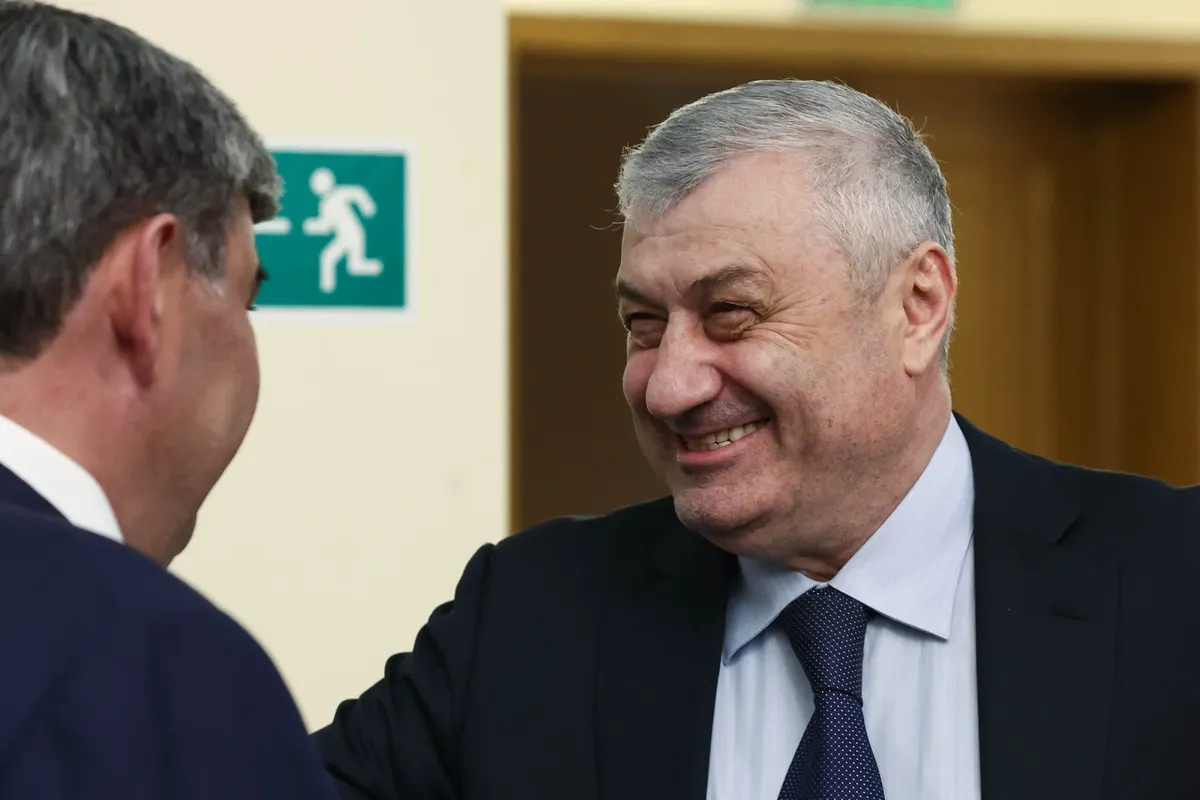
It is unlikely that such a reaction from Tskhinvali came as a surprise to Ivanishvili himself, members of his team and their PR engineers. In fact, the “informal ruler of Georgia” speaking in Gori from behind bulletproof glass was speaking primarily for a domestic audience. And secondly - for the attention of Moscow partners.
Ivanishvili’s phrase and his promise to “apologize” on behalf of Georgia became the last “strap” of the main mega-message with which the Georgian Dream is going to the elections on October 26: “We are the Party of Peace.” We are the world. Saakashvili, his party and the opposition as a whole are a new war.”
Thus, the authorities and their experienced foreign political strategists are offering Georgians on October 26 to choose “between war and peace.” While the opposition as a whole proposes to choose “between Russia and Europe”,
warning that if the GM remains in power, the “centuries-old dream of the Georgian people of membership in the European family of nations” will turn into the “Georgian dream” and become a thing of history.
It is not difficult to notice that Moscow, supposedly indifferent to internal Georgian affairs, is trying in every possible way to play along with the message proposed by Ivanishvili’s party. This is evidenced by the laudatory responses to the statements of the Georgian leader from the Russian Foreign Ministry and other iconic figures. For example, Russian senator Grigory Karasin, who for many years oversaw the Tbilisi direction of Russian foreign policy.
At the same time, it is quite obvious that Tbilisi should not expect any real significant progress in “restoring the territorial integrity of Georgia” either before or after the elections. But the Georgian authorities do not count on this. Their goal is to win the fateful elections and prevent Saakashvili’s party from returning to power in any form. Including in the form of leadership in a multi-party opposition coalition with their common program: immediate adherence to all anti-Russian sanctions of the West, full support for Ukraine, resumption of negotiations with the EU on full membership in it, as well as negotiations with NATO on joining the alliance.
Both processes have been suspended, but not stopped completely. There is an opinion that, judging by the increasingly radical anti-Western rhetoric of the GM, the only thing that prevents the ruling party from finally “turning north” is the entry in the constitution: Article 78 of the Basic Law obliges “all constitutional authorities” to “do everything” within the framework of their powers for the integration of Georgia into the EU and the North Atlantic Alliance." Opponents of the authorities have a question: is this why the GM leaders are seeking a “constitutional majority” in the future parliament (that is, 113 mandates out of 150) in order to “remove” this provision from the constitution?
However, independent observers consider these suspicions to be unfounded: Article 78 is the main guarantee of maintaining a balance between Russia and the West, unless, of course, the West itself completely abandons its former role in the “Caucasian chalk circle.”
Apparently, such a turn is increasingly realistic if the Georgian Dream wins the elections, since the relations of Brussels, as well as other Western capitals, with the current Georgian authorities have already passed the point of no return and are irreparable in principle.

Election solitaire
The ruling Georgian Dream party, allied with the openly anti-Western Power of the People party, is facing four opposition groups in the current elections. Mikheil Saakashvili failed to form a “united front against the Russian oligarch” with a joint electoral list: the personal ambitions and mutual grievances of the leaders of medium and small caliber were too great.
The UNM of the former president, who is serving a six-year sentence for abuse of power, remains the most influential and rated in the opposition coalition. She is participating in the elections in alliance with the “Strategy Builder” party of the former adviser to the President of Ukraine Petro Poroshenko, Georgy Vashadze, the main author of the successful reform of public services in 2006 based on the “one window” principle.
Secondly, the association “Strong Georgia” (“Lelo” by the successful banker Mamuka Khazaradze, “For the People”, “Citizens”, “Freedom Square”).
In addition, the For Georgia party of ex-Prime Minister Giorgi Gakharia and the Coalition for Change (Akhali, Droa, Girchi) still have a chance to overcome the 5% barrier.
Since public opinion polls in Georgia have always been and remain part of the election struggle, and there is practically no objective data, voters’ preferences can be judged only approximately by trying to “verify and compare” the data of two sociological services: “Gorbi”, which conducts pre-election measurements of electoral sentiments on request GM, and Edison Research, hired by the opposition coalition. Judging by these data,
The opposition as a whole is still slightly ahead of the party in power, but the opposition coalition will win only if none of the four opposition forces is left behind the pre-election threshold of 5%.
In this case, the GM can add to its results the percentage received by the unsuccessful opposition force and receive at least 50% + 1 deputy mandate in the new parliament.
However, even if events develop according to this scenario, it could become a disaster for the authorities: the West and its structures are unlikely to recognize elections that were held not against the backdrop of the law on “foreign agents” as fair and free, that is, as legitimate, but any critical remarks Moreover, radical assessments of the elections in the final documents of international missions will become an argument for the opposition to organize a new revolution and change of power against the backdrop of rallies, demonstrations and “peaceful breakthroughs” into the parliament building. As happened during the Rose Revolution of 2003 under the same pretext of “election fraud.”
The day after the elections
The Prime Minister, the Speaker of Parliament and MPs from the GM directly say that the opposition is “preparing not for October 26, but for the 27th,” expecting to begin the revolutionary process the day after the vote.
The only opportunity (more precisely, a chance, but not a guarantee) for the party in power to avoid such a scenario is to achieve an overwhelming advantage during the elections. That is, get approximately twice as many votes as the opposition as a whole.
According to unbiased experts, such an outcome is unlikely, although not completely excluded, given that more than half of the citizens surveyed by sociologists refuse to answer the question about their preferences and are classified as “undecided.”
Their choice will depend on how frightened they are by the propaganda about the inevitability of a new war with Russia and its allies (the former Georgian autonomies of Abkhazia and South Ossetia) in the event of a change of power.
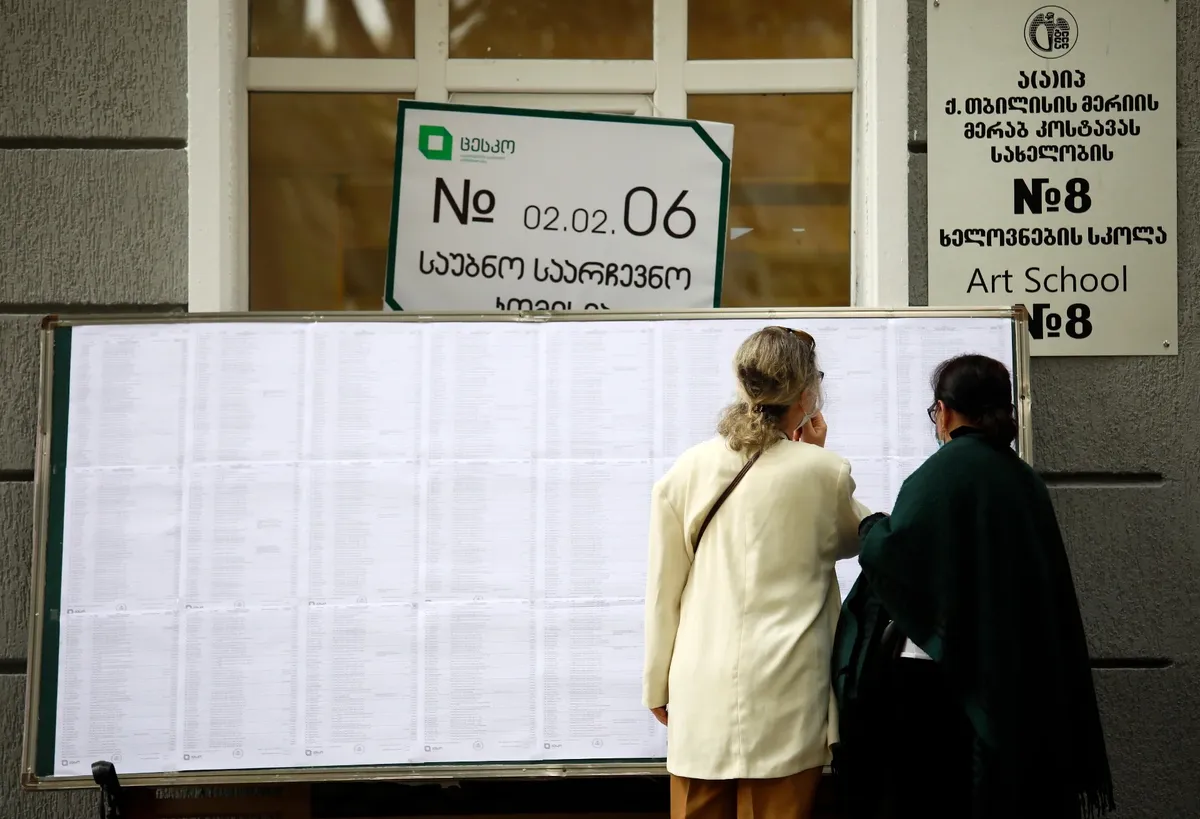
Will Ivanishvili and his team recognize the outcome of the elections if they lose? Most likely yes. Bidzina Ivanishvili is not Alexander Lukashenko,
and Georgia and Georgian society with its free media are still different from some other post-Soviet states, although the opposition is convinced of the inevitability of the most traumatic development of events in the event of a GM loss.
For example, former Georgian Defense Minister Georgiy Baramidze, known as the most loyal ally of ex-President Saakashvili, is convinced that if Ivanishvili “feels the danger of losing power,” he allegedly “will inevitably call on the Russian army for help to suppress the opposition that won the elections "
Another thing is that that army now definitely has no time for Georgian “showdowns,” even if they promise imaginary or real geopolitical bonuses in the South Caucasus.
Georgiy Pagava, Tbilisi