
Translated material
Black September
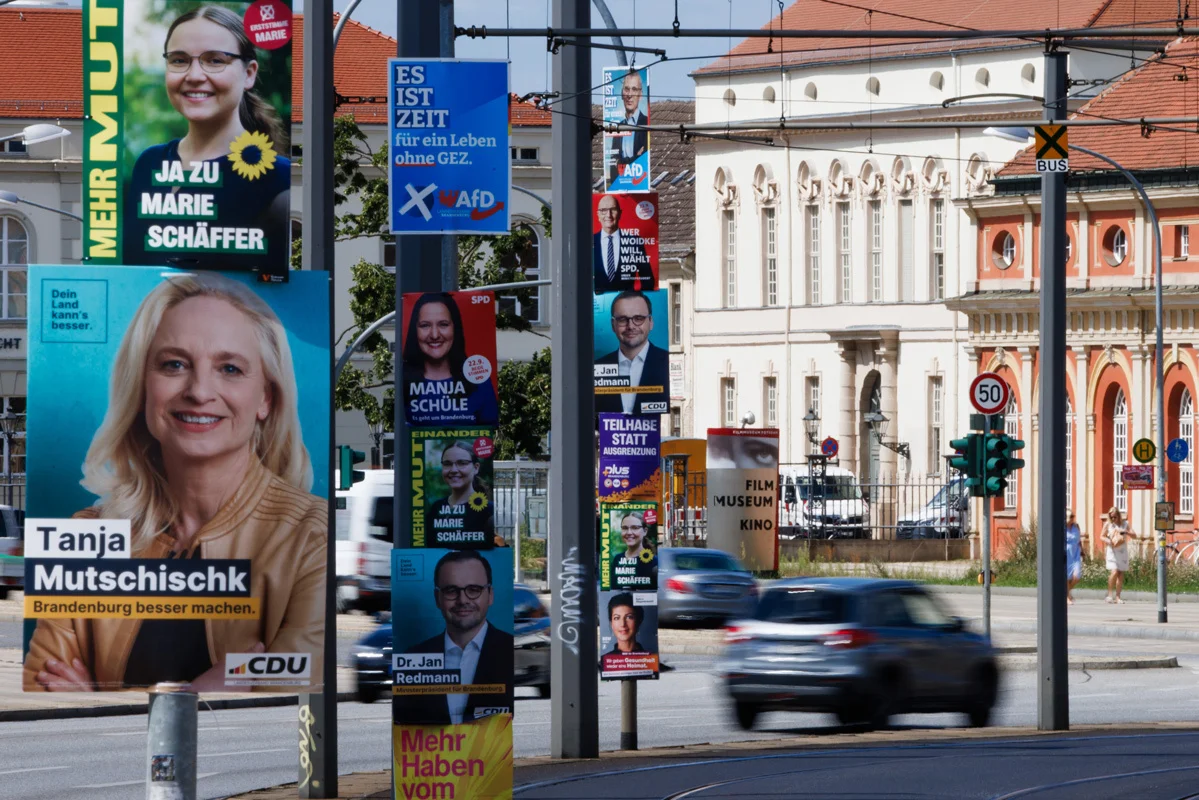
The Alternative for Germany stopped a step away from the victory in the land elections in Brandenburg. We figure out what is already behind the third success of German ultra -right

Candidate from “Alternative for Germany” (AFD) in the regional elections in Brandenburg Hans-Cristof Berndt (right) and AFD chairman Alisa Vaidel at a party’s press conference in Berlin, September 23, 2024. Photo: Filip Singer / EPA-EFE
On September 22, the Social Democratic Party of Germany (SDPG), which also includes the Chancellor of the country Olaf Scholz, won the symbolically important victory in the elections to the regional parliament of the land of Brandenburg, surrounding Berlin.
The intrigue was preserved to the very end of the race: Brandenburg is a real SDPG citadel, where the Social Democrats have been ruleing for thirty years in a row, and the press itself was considered as a “referendum on trust in the Scholts government”. As a result, SDPG received 30.9% of the vote, bypassing the ultra -right “alternative to Germany” (AFD), which gained 29.2%. Sarah Wagenknecht (13.5%), who left Die Linke and the beginning of the “solo career” last year, founding its personalized left -wing party Sarah Wagenknecht - for Mind and Justice (BSW), were in third place. The “left”, “green” and liberals who could not overcome the five percent barrier failed with a bang, which means they will not fall into the land parliament. Christian democrats (HDS) also fell. They received a record low 12.1%. Despite the fact that the Parties of the Scholtsa managed to hold Brandenburg, the elections themselves became a triumph for the AFD, which strengthened their position in this region by almost 6%. The electoral successes of the Alternatives this year began with a 16% result in June in the Elector of the European Parliament, and continued in early September the party’s victory in the regional elections in Thuringia and the second place in Saxony, and now a repetition of this result in Brandenburg. Why German voters are increasingly casting their votes with ultra-right and whether it is possible to see in this march the signs of a repetition of the event of the 1930s in Germany-in an interview with a political scientist, a specialist in legal populism in Europe Alexander Tavda-Barmuli.
The text was first published in Novaya Gazeta - Baltic
- Polls predicted an alternative to Germany (AFD) victory in Brandenburg, and the party supporters were more than ever mobilized and inspired by a historical victory in Tyurinia, where AFD gained more than 30%. Nevertheless, they failed to replace the Social Democratic Party (SDPG). Why?
-Yes, the Social Democrats saved the situation, and the federal government, led by Olaf Sholts, will now feel more stable. But to a greater extent, this merit is not the chancellor himself, but the head of the local government, Ditmar Voddeka (SDPG), who is considered very popular and charismatic. In a sense, he even is in opposition and criticizes his federal chief Olaf Sholts. However, this victory can hardly be called confident. The difference between the "alternative" and the Social Democrats in the area of statistical error (1.7%), so there is especially nothing to be proud of the SDPG. Now they can finally exhale. The ghost retreated for a while, but the trend remains, so there is nothing to rejoice here.
- How is the electoral successes of the AFD in Thuringia (32%), Saxony (30%) and Brandenburg (29%) will affect the general situation in Germany, especially at the federal level?
- For this assessment, you need to look at the land governments, how they will be formed. Probably, other parties will continue to boycott the AFD and try to create coalition land governments without the participation of the Alternative. Their result in 30% can really be leveling, creating a tricolor coalition, which has already been done many times. It was just before that such a coalition was built, for example, with "green", and now - with the deputies of Sarah Wagenknecht.
At the same time, at the federal level [AFD’s victory] indicates a crisis in which Christian democrats (CDS) are located, but primarily the traffic coalition ( social democrats, “green” and liberals formed the current government.- approx. Ed. ). Probably, the main blow will have to be on the SDPG, which leads the “traffic light”, but will go to Christian democrats. The CDS and SDPG are the main beneficiaries of the modern party-political system of Germany, which means that the main risks in this system will be distributed between these two batches.
- AFD has not been allowed to power for many years. This gives them a good argument: if we, legally elected representatives of the people, are ignored, then democracy does not work. It looks like the truth?
- Parties that are in power today often tell their voters almost the same thing, they become indistinguishable. In political science, there is such a term “Catch -ll Party” , or “carting parties”, that is, parties that strive to harvest from all over the political spectrum. They tend to negotiate with other political forces and create a monopoly “cartel” control along with them. Then these parties are “mowing” in the political deck an infinite number of years. Germany is just a classic case.
They do it honestly, but with every decade it becomes more and more complicated. To maintain a constantly growing request for changes, they need to come up with more and more complex coalitions. For example, in the Brandenburg Landtag, the situation is characteristic: the government jointly meet social democrats, Christian democrats and green, the so-called “Kenyan coalition” (the name refers to the colors of the flag of Kenya, which repeat the basic party colors of the Coalition of Black (CDS), red (SDPG) and green . The coalition that is now sitting in Berlin at the federal level.
And this idea is so -so. In order to persist as a stable coalition, mainstream
German parties have to discard most of their recognizable program requirements. This leads to compromises on the lower bar - the parties abandon their own identity, individuality. And this is even more annoying the population.
Therefore, such a natural fear of allowing non -systemic competitors to power is political cautiousness: we [the mainstream parties] want to keep new people away from power at all costs. Thus, the mainstream parties of the parties are ready to be blocked with their long -famous partners/rivals, and not to solve the sore problems, which again annoys the voter. But I do not see the prospects of this strategy. She is ostrich.
- It seems that in Germany they are tired not only from the “traffic light”, but also from traditional parties in general. Is that so?
- Minor mainstream parties are in a deep crisis, since they cannot answer the challenges that excite their voters. In particular, this applies to migration. Liberals lose their voice, not being able to convince their electorate in the prospects of their value project, which allows the introduction of the anti -liberal, essentially Islamic narrative into European societies. Social Democrats, remaining consistent internationalists, lose sight of the fact that migrants pose a threat to the socio-economic situation of their voter, not only because they compete for jobs with indigenous people, but are also contenders for a social bag. The voter begins to look for another party.
And this is not a new trend. If you look at the 2019 land elections, you will see similar results. In Saxony and Thuringia, AFD previously stably ranked second. We see the growth of the popularity of ultra -right in other European countries, especially for a long time in France. So the right populism on the rise is already 15 years old, if not more.
- How long did it start in Germany?
-After the Second World War, when creating Germany in 1947-1948, the right part of the political spectrum was deliberately cut: it ended on Christian democrats, that is, on the right-centers, and all the other right-conservatives and reactionaries-were cut off from political activity by special laws directed against the revival of Nazism.
This led to the fact that
Some problems, from the point of view of the voter, the government of the left and centrists, cannot solve in principle. This is, first of all, migration, as well as the “excessive” responsibility of Germany for pan -European affairs.
Only the right ones can give some decisive answer to these challenges, and this implies some isolationism, combined with the revival of national priorities to the detriment of pan-European ones. And even more so, to the detriment of multiculturalism, which today is part of the mainstream agenda. For many decades, this “right answer” simply has not been, because German right -wing radicalism was under pressure from the relevant legislation and a five percent barrier, which prevented them from realizing in the elections.
But in the 1990s this scheme collapsed. After the unification of Germany, a request for renationalization, restoration of sovereignty arose in society. It must be understood that the joy associated with the collapse of the Berlin Wall is a nationalist joy. It involves a certain national loyalty, which was taboo in West Germany. In general, this is a taboo and is preserved, at least, the mainstream is trying to preserve it. In addition, a wave of migration began in the 1990s, which could no longer be able to cope with traditional means.

- But the “right answer” did not shoot right away?
-Despite the fact that the soil for right-wing populists was ready, the 1990s were ready, they really broke into great politics only in the 2010s, as the answer of Islamic cultural expansion. The pace of immigration from Muslim countries, primarily from Turkey, bothered the German population since the 1990s, but in recent years, tension has been growing.
At the level of society in Germany, such an expansion occurs in waves: the first generation of the Turks who arrived in the country, who professed the Sunni Islam, was very restrained. And by the 1990s, the third generation of migrants was born, which are now integrated worse because they are more closed inside their community. After many of them received German passports, they began to more actively manifest their identity, part of which is Islam. The longer this process is on, the more in Germany the sociocultural practices inherent in Islam spread. And this causes rejection, at least in part of the German electorate, primarily the right.
Already in 2010, Angel Merkel recognized the failure of the concept of multiculturalism, and in 2011 the German prosecutor's office investigated a series of murders of the Fastfood merchants, which was called “Kebabish killings” . In 2014, PEGIDA, the law -Populistic movement of PEGIDA appeared in Dresden, which in 2021 recognized as an extremist organization. And then in her footsteps a “alternative to Germany” followed, although at first it was a party of intellectual-Europeancaps.
As a result, not only traditional, “hardcore” right, typical “Redneks”, but also moderate, liberals, liberals, who were scared by the threat of dominance of the traditionalist narrative, emanating from Muslim migrants, picked up.
The right populists were added to the right-wing populists that the mainstream liberals, socialists and legalists such as Christian democrats did not want or could not stop the new wave of migration boom that began in the mid-2010s.

- How did the voter react?
- The voter, unlike a politician, can quickly switch. Yesterday he voted for the “left” (Die Linke) or Social Democrats, and today he votes for Sarah Wagenknecht. A similar situation in France, where the “National Front” (the current “national association”) since the time of Jean-Mari Le Pen suddenly became a party of the working class. If the politician deliberately does not want to solve a painful problem, then people perceive it so that their mainstream social democratic or liberal candidate threw them.
Therefore, when the guys appear who build their discourse on anti -migrant and anti -European pathos, the simple voter migrates to them, and has been doing this for many years. And the mainstream is trying to restrain it with all his might. In France, Macron takes a variety of moves, sometimes playing on the verge of a foul to isolate the ultra -right. All this fits into existing national legal norms, but it must be understood that in fact, almost 30% of the population did not realize their vote. They vote for the ultra -right, but this voice is wasted, since their candidates are not allowed to power.
- At the same time, AFD offers nothing special except the expulsion of migrants in his political program. Then where does such a success come from?
- A person is always looking for lost keys to the lantern. The average voter will not read the details of the program, he has problems, and he wants to solve them. Before him, medicines are to choose from: on the one hand, a multi -component mix, which is already forced to swallow every four years, and this does not help; On the other hand, a remedy in a beautiful wrapper with a skull and crossed bones, on which it is written: "heals from all diseases." Why not try?
The voter also votes, as if choosing a medicine:
For many years he gives his vote for the mainstream party, but it does not become better. Then he votes for the right-wing populists and hopes that they will strike at some evil, and their social package will automatically go to him as a “true German”.
Of course, in fact, everything will be wrong, but when we are talking about politics, we are talking about images.
- Why did this become especially relevant in the east of Germany?
- Eastern Germany has double specificity in this regard. Firstly, this is a region that has a large economic gap with West Germany. Only in the 1990s only in the 1990s 1.3 trillion euros were invested in his economy, but a significant gap in the welfare of the East and West is still preserved . During the unification of Germany in the east, some restructuring of industry occurred: a tanned East German industry died out, and this aggravated the situation in the labor market. In addition, now in Germany, as in Europe in general, the socio-economic situation is not quite prosperous. See how Volkswagen production is closed in Germany. And in the east of the country, economic decline is even more noticeable.
Secondly,
In East Germany there was no "experience of repentance." This is a cultural and psychological thing. What was taboo in West Germany, in East Germany, it existed calmly: by the 1960s, a triumphant, victorious narrative formed, by the 1960s,
In the framework of which the GDR-the first state of workers and peasants in German land-was among the winning countries after the war. Yes, in the late 1940s they had a completely relevant idea of German wine, even earlier than the Western Germans, but soon all this was forgotten. There were no processes in the GDR [according to the politics of historical memory], which filled the West German politics. Therefore, part of the current Eastern Germans grew without it. They do not have such a taboo, and they are more susceptible to the right populism.
In this sense, Eastern Germany is similar to Austria. So, the “Austrian Freedom Party”, created after the Second World War officers, successfully took place in 1999 to the Austrian parliament, came to power, but could not resist, and in the next extraordinary elections received about 10%. We see that nothing tragic happened. Because as soon as the radical party enters power, it is immediately made more moderate, changes its rhetoric and forced to compromise with her colleagues in the coalition. After that, the electorate ceases to trust her and perceives her as the “sold” [mainstream] political force.
If we are talking about a democratic process, then there are only two alternatives: either you transfer power to those who declare the readiness to solve the issue significant for the voter, or you solve the issue yourself.
Therefore, for the mainstream German parties, the classical way to defeat the AFD and the like now is to play long. Just transfer the course of the enemy, let him steal.
As a rule, the enemy, with rare exceptions, loses its popularity on this and fails in the next electoral cycle. This is in the spirit of classical democracy, classical parliamentarism. And this is politically practical. You can not live in the position of the great dumb. There is a request from the company, and this request is not reduced.
- They will object to you: a hundred years ago, the NSDAP also came to power as a result of honest elections. Can everything be repeated?
-It would be wrong to compare the current situation with what happened in the 1930s. Firstly, Germany, although not all equally, received an incredibly powerful vaccine from totalitarianism and xenophobia. Второй раз на этот путь она уже не встанет.
Во-вторых, невозможно демонтировать политические институты, оставаясь частью ЕС. Страна так или иначе находится в рамках общеевропейских политических и правовых норм, под контролем европейских институтов. Тут уже сложно «вильнуть хвостом» какому-нибудь диктатору и выйти из ЕС. Пойти другим путем. Это не та эпоха. Посмотрите на Орбана, он активно пытается сделать это, но ничего не получается.
— И все-таки, что будет, если допустить AfD к власти?
— Вероятно, то же, что в Австрии. И вообще, если так посмотреть, то у нас есть пример Баварии, где уже давно правит идейный союзник христианских демократов (ХДС) — Христанский социальной союз (ХСС). Они тоже считаются правыми центристами, но на деле это совсем не центристы, они гораздо правее.
Так, председатель ХСС и премьер-министр Баварии Маркус Зёдер критиковал политику Меркель во время миграционного кризиса 2015 года, а через несколько лет заявил , что «с туризмом в поисках убежища […] необходимо покончить», намекая на прибывающих по морю мигрантов из Африки и Ближнего Востока. Так что Зёдер и ХСС — это, в общем, умеренный вариант AfD. Получается, что все это в Баварии уже есть, и давно. Но никто не рвет на себе волосы. В целом и Бавария гораздо в большей степени адаптивна к мигрантам, чем, например, восточные земли.
— Накануне выборов в Потсдаме состоялась закрытая встреча сторонников AfD, во время которой они будто бы обсуждали «революцию справа». What was it?
— В целом это укладывается в наше представление об ультраправых. В отличие от консерваторов, полностью встроенных в систему, правые радикалы все-таки более революционны, хотя ситуативно система может быть для них выгодна. Не случайно приход Гитлера к власти довольно быстро стал называться национальной революцией. Например, сейчас — когда AfD получают в рамках этой политической системы все больше голосов — зачем ее менять, если можно встроиться в мейнстрим? Потом, если они все-таки придут во власть, то могут попытаться эту систему изменить изнутри, но вряд ли у них это получится. Также нужно разделять интересы партии и интересы конкретных политиков. Отдельный человек попадает во власть, и теперь партийные интересы могут значить для него гораздо меньше, чем интересы личной политической карьеры. Он будет и дальше врастать в систему и чувствовать себя хорошо.
Кроме того, взаимодействие правых радикалов и умеренных — это дорога с двусторонним движением: первые влияют на вторых, и наоборот. Умеренные правые, как показывает практика 1970–80-х годов прошлого века, могут потерять свою идентичность и часть электората, заигрывая с крайне правыми.
Так что пока у AfD больше оснований надеяться на системную победу, чем на революцию, и эти тайные встречи можно расценивать лишь как побочный, но яркий элемент партийного имиджа.

— На фоне кризиса мейнстримных партий растут не только ультраправые, но крайне левые во главе с Сарой Вагенкнехт. Они уже завоевали неплохие результаты в трех федеральных землях: 15% в Тюрингии, 11% в Саксонии и 13% в Бранденбурге. Чем они похожи на AfD и что партию Вагенкнехт ждет дальше?
— Союз Сары Вагенкнехт (BSW) — это партия персоналистского типа, в отличие от AfD, которая никогда не была партией отдельных людей. А такие персоналистские партии более мобильны, чем институализированные партии, а потому путь их более загадочен.
Программа ее партии еще более странная и противоречивая, чем у AfD. Как и положено популистским программам, она сочетает малосочетаемое. Левые идеи там вполне уживаются с либеральными лозунгами меритократии и апологией среднего предпринимательства в духе христианско-демократических теоретиков германского социального государства.
За этот же возврат к старым добрым временам немецкого социального государства и капитализма, просто на новый лад, выступает и AfD. Обе популистские партии хотят государство для немцев, где есть патриархальность,
солидарность, государственный суверенитет и базирующаяся на немецкой рабочей силе экономика.

При этом у BSW есть два серьезных отличия от AfD. Во-первых, Сара Вагенкнехт как политик более ярка, харизматична — и за ее партией не тянется шлейф подозрений в национализме, фатальный для почти любой немецкой политической силы вплоть до сегодняшнего дня.
Во-вторых, Вагенкнехт от мейнстрима находится гораздо дальше, чем AfD. Она — антисистемный фактор, революционер, создавшая себе имидж на отрицании существующих структур, в том числе и Левой партии, в которой она ранее состояла. В отдельных землях BSW все-таки могут пригласить в коалицию на правах младшего партнера. Но дальше будет развилка: если BSW берут в коалицию, Вагенкнехт рискует потерять популярность, поскольку ее программные установки в коалиционном правительстве будут учитываться по минимуму. В результате она получит имидж серьезной партии, но избиратель-то голосовал за ее несистемность, за протест. Если она ничего не сделает один раз, а потом и второй раз, то ее рейтинг рухнет. Ее партия просто сойдёт со сцены.
Автор: Павел Кузнецов, журналист, Германия