
Translated material
Bring it to a low and earn money
How the new “Strategy of State Cultural Policy” proves that the Ministry of Culture is not just an atavism, but a toxic threat
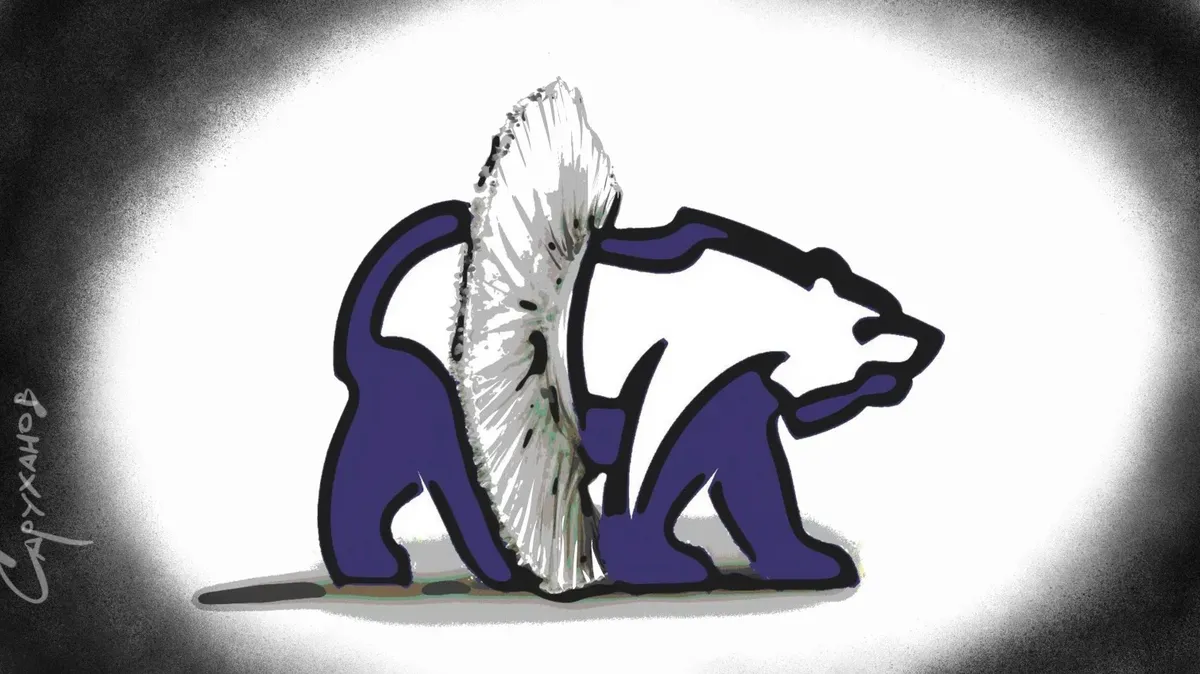
Illustration: Petr Sarukhanov / Novaya Gazeta
If you look at the official public declaration of the goals and objectives of the Ministry of Culture for 2024, you can find a number of vague but ambitious provisions in it: from preserving historical heritage and ensuring access to cultural goods to “strengthening the all-Russian civic identity” and passing on “traditional values” from generation to generation to a generation. When in 2004, former Minister of Culture Mikhail Shvydkoy tried to explain the purpose of his department more succinctly, he noted that against the backdrop of a “global trend” to simplify life and its perception, it was very important “not to reduce the idea of the world to a moo.”
And twenty years after the announcement of this lofty goal, the government issues a decree according to which the Ministry of Culture must, within three months, submit to the Cabinet of Ministers “a draft action plan for the implementation of the strategy” - that is, to bring the very idea of the world to a low moo. No, of course, this document is called a little differently: “Strategy of state cultural policy for the period until 2030,” but it is about confronting “global trends.” And this is a case where, despite its content, the government's strategy should be taken truly seriously. Since it is she who claims to determine the development and financing of state programs in the field of culture throughout the country in the next six years.
The main difference between the new strategy and its predecessor, adopted by Medvedev’s cabinet in 2016 (and also expected to last until 2030), is that the eight-year-old version still retained some external decency. It contained alarming remarks about “attempts to falsify Russian history” and “erosion of spiritual and moral values,” but they were carefully collected into a short part about “threats to national security” and were not repeated as an annoying refrain throughout the entire text.
The latest edition consists almost entirely of threats, listing external enemies and calls for the actual introduction of state qualifications in culture. Literally the very first paragraph after the introductory formalities sounds the alarm: humanity, having reached a high level of socio-economic development, “is faced with the threat of losing traditional spiritual and moral guidelines and stable moral principles.”
They are subject to the destructive influence, in particular, of the cult of consumption and pleasure, the legalization of drugs and the “absolutization of personal freedom.”
It is in this formulation, without any clarifications or explanations, that the desire for individual freedom in its entirety is considered by the Russian government in 2024 as a destructive trend. The 2016 strategy contained a similar fragment, where “the growth of individualism and disregard for the rights of others” was considered as a factor in the atomization of society, but still the old document did not question individual freedom. And he also did not list the forces trying to “undermine the global influence of Russian culture.” These are, of course, “unfriendly states” - and the USA and Ukraine are mentioned separately. The latter is accused of “derussification of the cultural sphere” and damage to monuments and cultural institutions in territories that Russian authorities call “new subjects” and whose integration is considered the “most important task” of the entire strategy.
Another more abstract opponent of Russian culture is neoliberalism. His ideology creates “a threat to the security and sovereignty of the country in the field of cultural development,” how it is not specified. However, almost all “foreign information and psychological influence” is described in the document as purely destructive and in need of decisive counteraction,
which does not at all prevent the authors from discussing the inseparability of Russia from the “global cultural space” and ways to promote its image (“the priority of the spiritual over the material, humanism, mercy, justice, collectivism ...”) in the international arena.
This whole forty-page witch hunt is needed not only to demonstrate devotion to the “general line of the party,” but also for a completely primitive extortion by the Ministry of Culture of funding for “conducted events.” In the harsh conditions of a besieged fortress, they require significant budgetary expenditures, as the authors of the document state quite directly in the chapter “Scenarios for the implementation of the strategy.” There are three scenarios, and all of them involve a significant increase in funding - except for the first, “inertial”, whose description half consists of fears about the loss of cultural heritage sites due to lack of money.
If the Ministry of Culture nevertheless receives the required amount and undertakes to implement the “most realistic” basic scenario, Russian society will be able to enjoy the state order for the production of literature and art that corresponds to the Kremlin narratives about “spiritual and moral values.” As well as government orders for content in the media, cinema, improving the quality of content on the Internet (to what extent this is technically possible - again, not specified) and increasing the prestige of service in the army and police. And, obviously, as a bonus, measures to “counter the spread” of books that use profanity and “excessive” foreign vocabulary. In other words, further “counteraction to the spread” of modern foreign literature in Russia.
Let's call a spade a spade: the intention of a government agency to limit audience access to certain books, films and content is censorship.
The intention to encourage selected “creators” and their especially “spiritual and moral” works, to adjust the cultural agenda to the dictates of the Kremlin and push everything else aside is propaganda.
The intention to carry out the generational transmission of “traditional values” is an unconstitutional implantation of a specific ideology in society. In other words, the Ministry of Culture is increasingly beginning to resemble the Ministry of Public Education and Propaganda, which existed under one well-known regime. It is reminiscent of the ministry of the times of Ekaterina Alekseevna Furtseva, who single-handedly decided which artist to add to the blacklist and deprive of the future, that there is no place for The Rolling Stones and The Beatles to tour in the USSR, and Nobel laureate Boris Pasternak is a subject quite worthy of public persecution.

The danger of such a degeneration of any “Ministry of Culture” was realized by the Founding Fathers of the United States, who in 1787 ignored the proposal of the Governor of South Carolina, Charles Pinckney, to give the new federal government the authority to create “seminaries for the promotion of literature, arts and sciences.” Because to the delegates of the Philadelphia Convention, state patronage of the arts seemed a relic of the Old World, where artists enjoyed royal favor, which was always too dangerously close to surveillance and censorship.
To this day, the structure most similar to the American Ministry of Culture we are accustomed to is the National Endowment for the Arts - an independent agency within the US government, whose functions are more like a private grant giver with a rather modest budget ($236 million in 2024). In France, for example, under the name “Ministry of Culture” there is an influential government department dealing primarily with the past -
that is, the preservation of museums, monuments, libraries and archives, the issuance of permits for the construction of new architectural objects, and so on. There is no talk of any aggressive ideological confrontations here.
It seems absurd that in a huge country trying to position itself as a multinational federation, there is a toxic dictatorial ministry with a single agenda and the intention to resist any manifestations of dissent. But this is a logical result of the fact that in an authoritarian regime, power over culture was undivided in the hands of the government, for which, in turn, culture is not a way “not to reduce the idea of the world to a low”, but the territory of a purely Stalinist “engineering of human souls” . And howling to these souls or reciting Brodsky’s poems depends on the situation and the whim of the Kremlin.