
Translated material
Red tie VS military sweatshirt
Trump wants a “fair deal” between Russia and Ukraine. Zelensky too. However, they understand it too differently
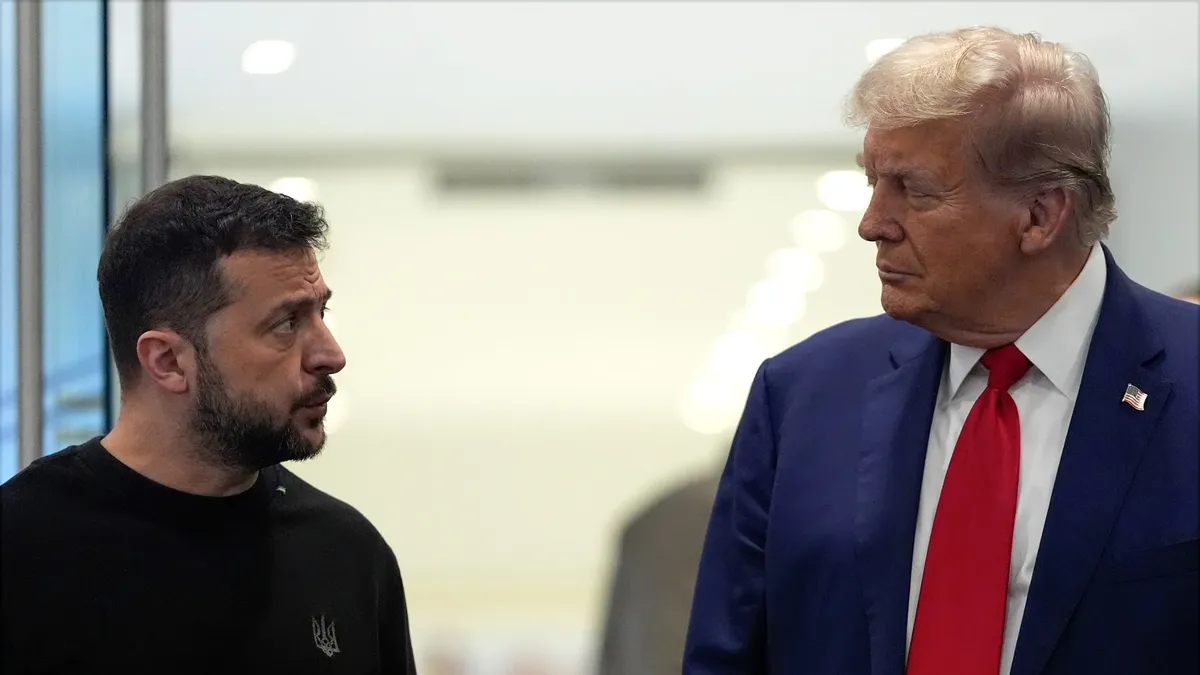
Meeting between US presidential candidate Donald Trump and Ukrainian President Vladimir Zelensky in New York. Photo: AP / TASS
Donald Trump once again demonstrated political unpredictability by meeting with Ukrainian President Vladimir Zelensky, whom the day before at his rallies he called the most successful “trader”, each time taking away “billions of dollars” from trips to America, “the person who spreads about me, your beloved president, petty dirty slander."
Interlude
Six weeks before the elections in America, it was fundamentally important for Vladimir Zelensky to meet with two candidates. And if he has no problems at all with Kamala Harris (this was their seventh meeting in total, Kamala counted) (not counting the fact that the Democrats are still stubbornly refusing Kyiv permission to use American weapons to strike long-range targets on Russian territory), then “everything is complicated” with Trump, dating back to the times when he was the 45th sitting president of the United States.
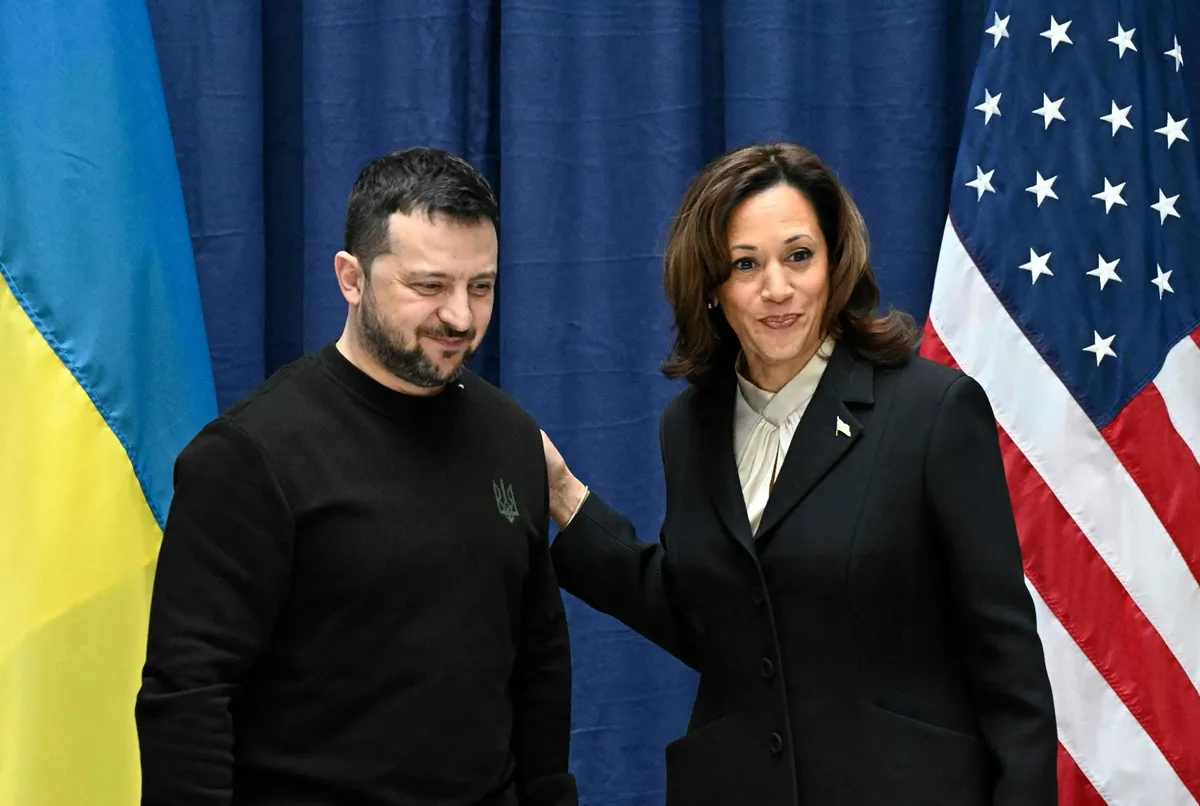
Kamala Harris promised Zelensky that US support for Ukraine and her personal support would remain “unchanged” as part of an overall strategy to maintain the US as a “global leader” on the world stage. “The United States supports Ukraine not out of charity, but because it is in our strategic interests.” Standing next to Zelensky on Thursday, Kamala said the insistence of "some people in the United States" (clearly referring to Trump) for Ukraine to quickly reach a deal to end hostilities while losing significant territory and giving up NATO membership was " not a peace proposal,” but a “surrender proposal.”
Trump, as local media reported, citing his inner circle, was angry with Zelensky for two reasons. In an interview with the New Yorker on the eve of the visit, the President of Ukraine called his partner J.D. Vance “too radical” for his proposal to make peace within the boundaries of the current situation at the front (by the way, it is not clear what Vance thinks about the part of the territory of the Kursk region, where units of the Armed Forces of Ukraine are now located). About Trump, who constantly promises voters, if he wins the election, to stop the fighting in Ukraine - first within 24 hours, and now - before taking office as president in early January 2025; Zelensky spoke in that interview, as usual, cautiously, but quite clearly. "I have a feeling Trump doesn't really know how to stop the s***, even though he may think he knows how." This was enough for Trump to dismiss the criticism as “dirty little smears.”
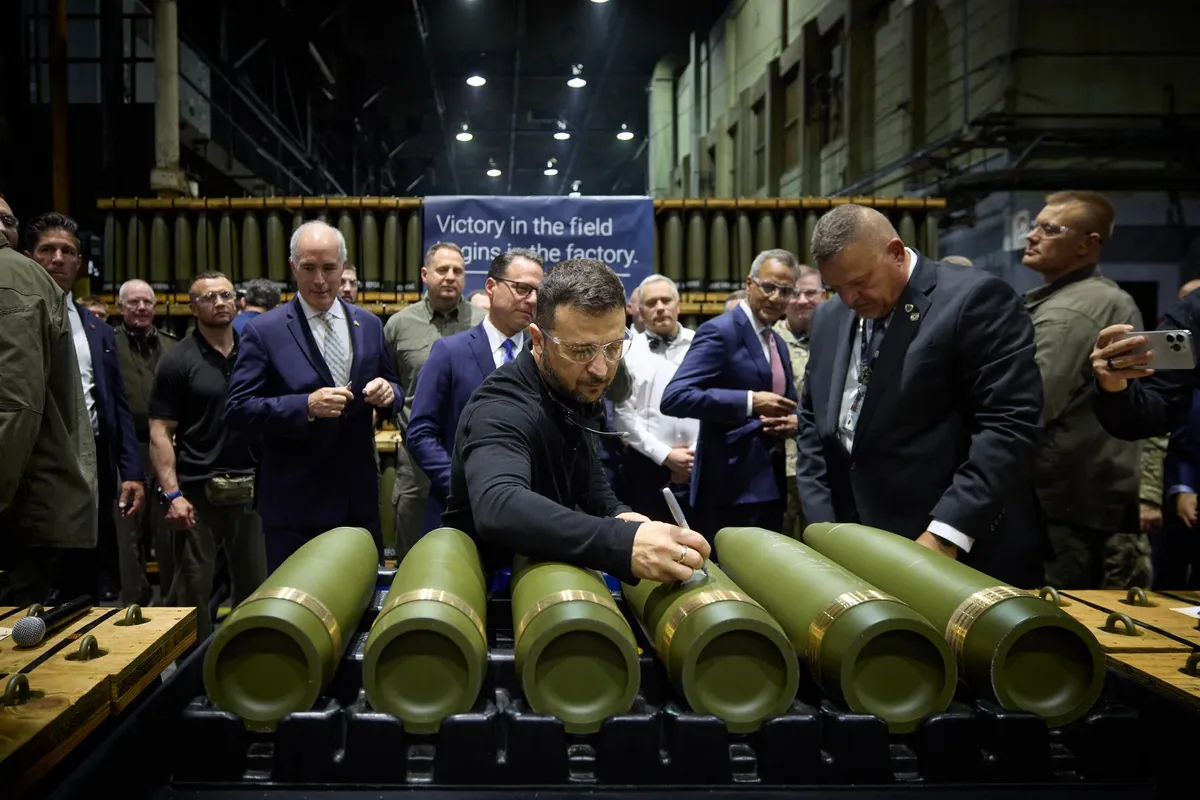
The Ukrainian president's first event in the United States added fuel to the fire - a visit to a weapons factory in Pennsylvania, in the city of Scranton (in the homeland of Joseph Biden), where 155-mm artillery shells supplied to Ukraine are produced. All accompanying persons (note, in addition to official representatives of the Pentagon): the local mayor, state governor Shapiro, senator and congressman are members of the Democratic Party. “Zelensky is playing on the side of Harris,” Trump’s supporters categorically concluded, although the Ukrainian president, during his visit to the plant, did not say anything about Harris or Trump, but only asked for “more shells.”
In the following days, Trump seemed to take his anti-Green rhetoric to a new level. He accused the Ukrainian president of being unwilling to agree to a peace deal while his country “no longer exists.”
Yet on Thursday evening, Trump said he was ready to meet with Zelensky on Friday morning in New York at Trump Tower, the name of the skyscraper in midtown Manhattan.
This could have been influenced by Harris’s assertion that her rival is seeking Ukraine’s capitulation. “I don’t want capitulation, I want peace,” Trump responded immediately. But, most importantly, Zelensky sent him a “warm personal message” in an attempt to restore relations, writing to Trump that “it is important for us to have personal contact and understand each other 100 percent.” After receiving it, Trump agreed to meet, but he also posted a private message on his social media site, Truth Social, on Thursday evening. As noted by the media, the 45th president has a history of publishing “personal” messages that are not intended for publicity when he believes they are “politically advantageous.” In this case, the message showed that it was Zelensky who was looking for a meeting with Trump, who, apparently, for purely psychological reasons, always benefits from looking like a “dominator.”
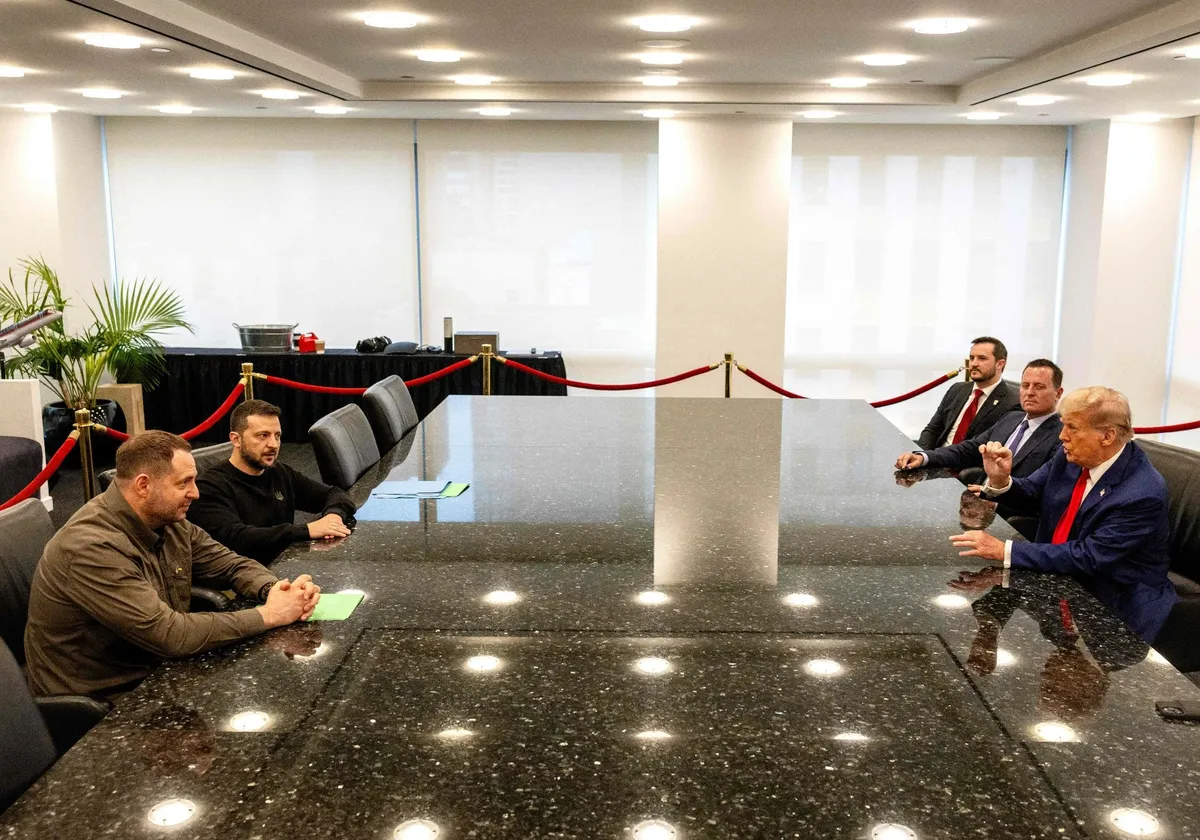
Meeting details
The meeting took place on the 25th floor of Trump Tower and lasted 40 minutes. Trump wore shiny shoes, a blue suit and a long red tie - his usual "outfit". Zelensky is in his usual military style: cargo pants and an olive-colored sweatshirt, writes the New York Times. Ukrainian Ambassador Oksana Markarova, whose dismissal for organizing a trip to a plant in Pennsylvania was demanded from Zelensky by US Congress Speaker Mike Johnson, was not present at the meeting on Friday, but the Ukrainian president was accompanied by Andriy Yermak, the head of his office. Trump was accompanied by Richard Grenell, Mr. Trump's acting director of national intelligence, and top campaign political advisers Susie Wiles and Chris LaCivita.
Trump sat in the center of a table surrounded by American flags. There was no Ukrainian flag, an exception, as noted by the American media, which would have been out of the ordinary if this had been an official state visit.
They haven't met for five years. In the past, Trump has called Putin's actions in Ukraine an "act of genius." But, on the other hand, it was Trump who, after the events in Crimea in 2014, canceled President Barack Obama’s policy of not providing lethal weapons to Ukraine. Trump has softened his opposition to more U.S. aid to Ukraine, giving Republican members of Congress the opportunity to vote on a $61 billion military package after six months of effectively blocking it. His position on Ukraine is, to say the least, “ambiguous.” As Zelensky has repeatedly noted, he is ready to work with the Trump administration.
Before the meeting, Trump and Zelensky made brief remarks to reporters. “I hope that we will have better relations,” Zelensky told the press. Trump responded: “You know, it takes two to tango.
We will have a good meeting today. And I think the fact that we’re even together today is a very good sign.” As the American media noted, while Zelensky stood silently next to him (and the New York Times even saw the “gloomy expression” of the Ukrainian president), Trump presented “what is happening between Russia and Ukraine” as *** that both sides would like stop, including Vladimir Putin. Trump did not blame the Russian leader. Instead, the former president framed the situation as if it were a dispute between two parties acting in good faith that could be resolved with a "fair deal" but only if he returned to the White House, experts said. This *** should not have started, Zelensky noted: “it is important to remember that he (Putin) is on our territory.” A peace deal must be “fair.” It is obvious that Trump and Zelensky understand its content differently.
The last time these politicians spoke, in September 2019, Trump was at the center of a scandal over a phone call he made to Zelensky in which he pressured the Ukrainian leader to investigate his political rival Joe Biden. As the Washington Post notes, based on a draft recording of the conversation (which was published at the request of Democrats in Congress) and witness testimony, Trump then asked Zelensky eight times to help his lawyer Rudy Giuliani and open an investigation against Biden’s son Hunter, who worked for Burisma. , and corruption in the Biden family.
This time, unexpectedly for Zelensky, Trump told reporters that the Ukrainian president was “like a piece of steel” five years ago during the scandal that led to Trump’s first impeachment. Then Trump froze the delivery of $250 million in military aid from the Pentagon and $141 million from the State Department, although it had already been announced. Democrats called it “blackmail” against Zelensky to launch an investigation into corruption in the Biden family.
Zelensky walked a fine line, not taking sides. In fact, he publicly stated that he did not feel any blackmail or pressure during the call, a statement that Trump stressed to reporters formed the basis of his “warm feelings” for the Ukrainian president. “He said, ‘President Trump has done absolutely nothing wrong,’” Trump told reporters about Zelensky, who stood nearby silently and, as some media reported, “feeling awkward.” “He (Zelensky) said it loud and clear, and the impeachment hoax died right there.” Why did Trump remember this story? It seems that he cannot help but remember that he was impeached unfairly, the 2020 elections were also counted unfairly, and all the criminal cases against him (four of them) were also opened unfairly. This is the kind of person he is.
This time, the Washington Post awarded the ex-president “four Pinocchios” for gross distortion bordering on outright lies. After all, Carl Collodi's Pinocchio grew a larger nose when he lied. That's why the Washington Post's fact-checking team is assessing the false statements made by politicians and public figures in "Pinocchio." Trump got four.
Following the meeting, the 45th president said in an interview with Fox News that he "learned a lot" and that he was "open to meeting again." Zelensky took the opportunity to invite Trump to visit Ukraine. “I will do it,” the ex-president promised. After the meeting, he wrote on his social network Truth Social: “If I am elected president, the *** of Russia and Ukraine will quickly end.” “If not, it will never end and will develop into WORLD WAR THIRD. Comrade Harris ( that’s what Tump calls his rival. - A.P. ) WILL NEVER BE ABLE TO FINISH *** and couldn’t.”
In turn, on the social network X, Zelensky described the meeting as “very productive.” “I presented him with our ‘victory plan’ and we carefully considered the situation and the consequences *** for our people.” “Many details were discussed. I am grateful for this meeting. We need a just world. We share the general opinion that *** must be stopped. Putin cannot win. Ukrainians must win." Zelensky's comments to Biden, Harris and Trump during the visit that Ukraine should win, but Putin should not win, were repeated by Biden and Harris, but Trump never said this publicly.