
Translated material
Ryumann lessons
As a popular German actor, he became a propagandist, was silent about the war, and after the fall of the regime he calmly continued his career and did not regret anything
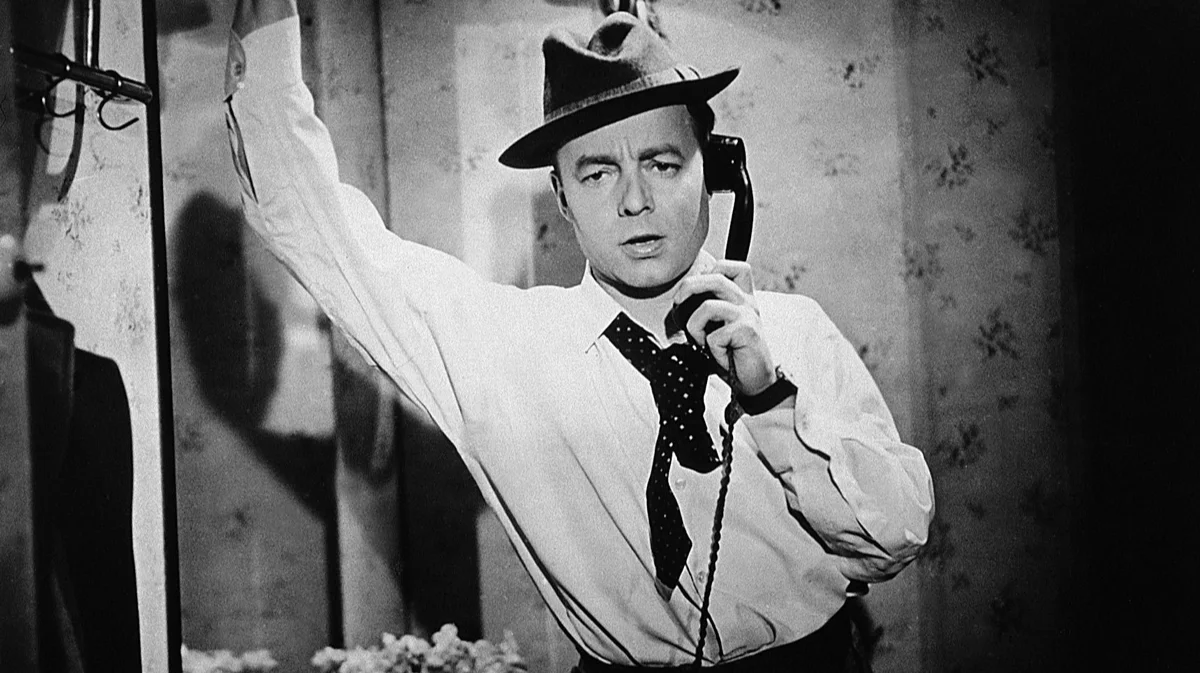
Hinz Ryumann in the film "Hauptsache Glücklich!", 1941. Photo: DDP / Vida Press
On October 3, he has been the thirty years of the death of Hinets Ryumann, a German artist who lived a long life, he died in 92. He was noticeable as the actor, but his fate deserves the attention of the Russian-speaking reader because of his career from 1933 to 1945 and what happened later. In the discussion of the silence and wirely statements of Russian "cultural figures" during the Russian invasion of Russia, the case of Hinets Ryumann should be kept in mind.
The interwar period of the interwar period, those interested in the German stage, know the song of 1938 Ich Brech Die Herzen Der Stolzesten Frau'n (“I break my hearts to the most proud women”). Most of all, this song is known for Hinets Ryumann - this is the classic appearance, voice and timbre of those times.
Who was he, Hinz Ryumann? The interest in the scene of Hainz manifested itself from early childhood: he read and sang for guests, and then for visitors to his father's restaurant. As a result, Ryumann decided to become an actor. He entered one of Munich’s amateur theaters, then survived several refusals and failures associated primarily with his non -heroic appearance for theatrical roles: Ryumann was low and emphasized by a boyish face.
While working in one of the theaters in Bremen, he met Maria Bernhaim (pseudonym Herbot), which he married in 1924. For the sake of Ryumann, Bernhaim left his career as an artist, becoming his impressario.
The actor finally went uphill: he played in theaters, then he began to act in the cinema (at first in the dumb, then in the sound) and eventually moved to Berlin, which was an acting capital, if not all of Europe, then the whole German -speaking world for sure. National glory came to Ryumann, which was affected by dating and earnings. The welfare was so large that Ryumann even bought a private plane and received a pilot’s license, which he had long dreamed.
He was a very charming, talented, but outwardly an average guy - no one could portray so successfully a simple person before him. Ryumann wrapped his drawback in his favor: he did not play heroes, heroes and without him were enough, he offered to the public with whom he could associate himself. And even his performance of the mentioned song “I break my hearts” perceived many ironically: a person with such an appearance could hardly fall in love with “the most proud women”.
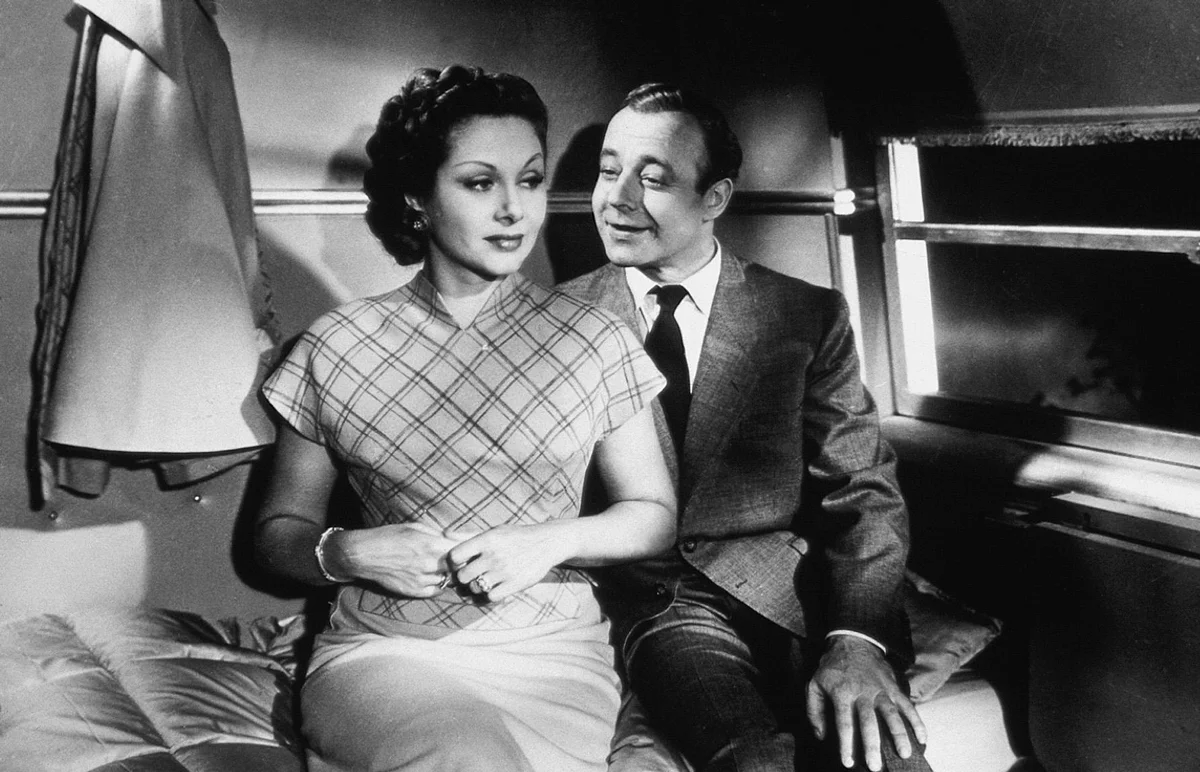
"Ryumann complains about his suffering in marriage with a Jew"
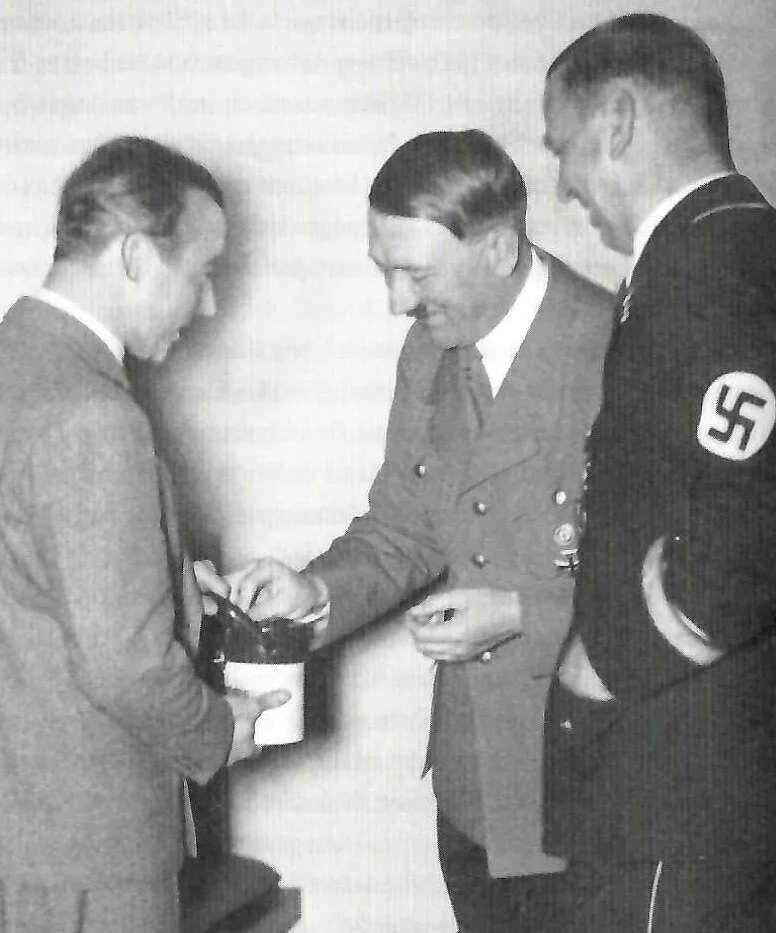
After the Nazis came to power, Ryumann did not interfere in politics and did not publicly comment on it, while entering the near circle of Joseph Goebbels (the circumstances of their acquaintance are unclear) and appearing at Hitler's techniques. And then it was “suddenly” that Maria Bernheim was a Jewish. Ryumann began problems: under the cannibal laws of the Reich as a husband, Jews also extended racial restrictions on him, which threatened with an exception to the imperial ward of cinematography (Reichsfilmkammer). It was a direct ban on work.
Ryumann turned to Goebbels.
A record was preserved from the Goebbels diary of November 6, 1936: “Hinz Ryumann complains about his suffering in marriage with the Jewish [Eheleid Mit Einer Jüdin]. I will help him. He deserves this because he is a really big actor. ” Ryumann was provided with special permission so that he could work further. But the problems did not disappear, the claims resumed, the permission was withdrawn, and Goebbels no longer wanted to help him.
Then Ryumann went to Herman Goering. He advised him to divorce his wife, and she-to quickly marry some foreigner in order to receive protection from the persecution.
This is not to say that the marriage of Ryumann and Bernheim by that time was strong and friendly. He was shaken a lot: for example, Bernhaim first lived in Bavaria, and Ryumann often went to Berlin, where he played in the German theater (only then the couple finally moved to the capital). Disagreements on artistic issues also influenced: Bernheim believed that Ryumann “too uncritically” approached the proposed roles and was guided to a much greater extent by his own vanity than creative motives. But the main thing is that by that time, Ryumann was in a love relationship with the artist Leni Marenbach, with whom he also starred together.
However, they did not think about the divorce of Hinz and Maria before that time, at least none of them were a divorce as a specific action mentioned. But when Goering gave his recommendation, Ryumann immediately set to work, and the divorce was issued on November 19, 1938, ten days after the November pogroms, which in Russian -speaking sources are called "crystal night."
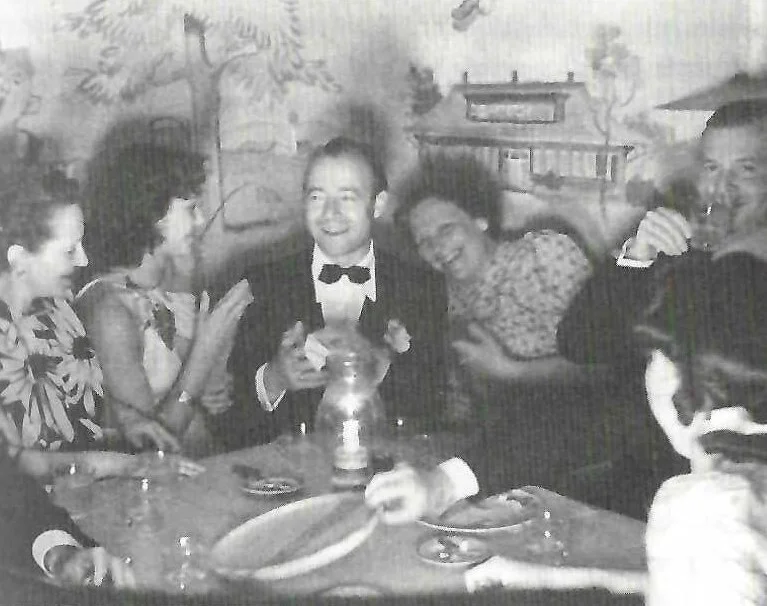
Later, Ryumann himself claimed that marriage with Bernhaim broke up for creative, and not for political reasons, although he did not deny that he had underestimated his wife’s fear of possible persecution of Jews from the National Socialists. On the other hand, the pressure on Ryumann also existed. For example, in one of the pro-government newspapers they wrote that the artist married on a Jew is “puts forward itself to the foreground” of National Socialist art. "Is this a lack of tact or wisdom?" - asked the observer of the newspaper "Black Corps".
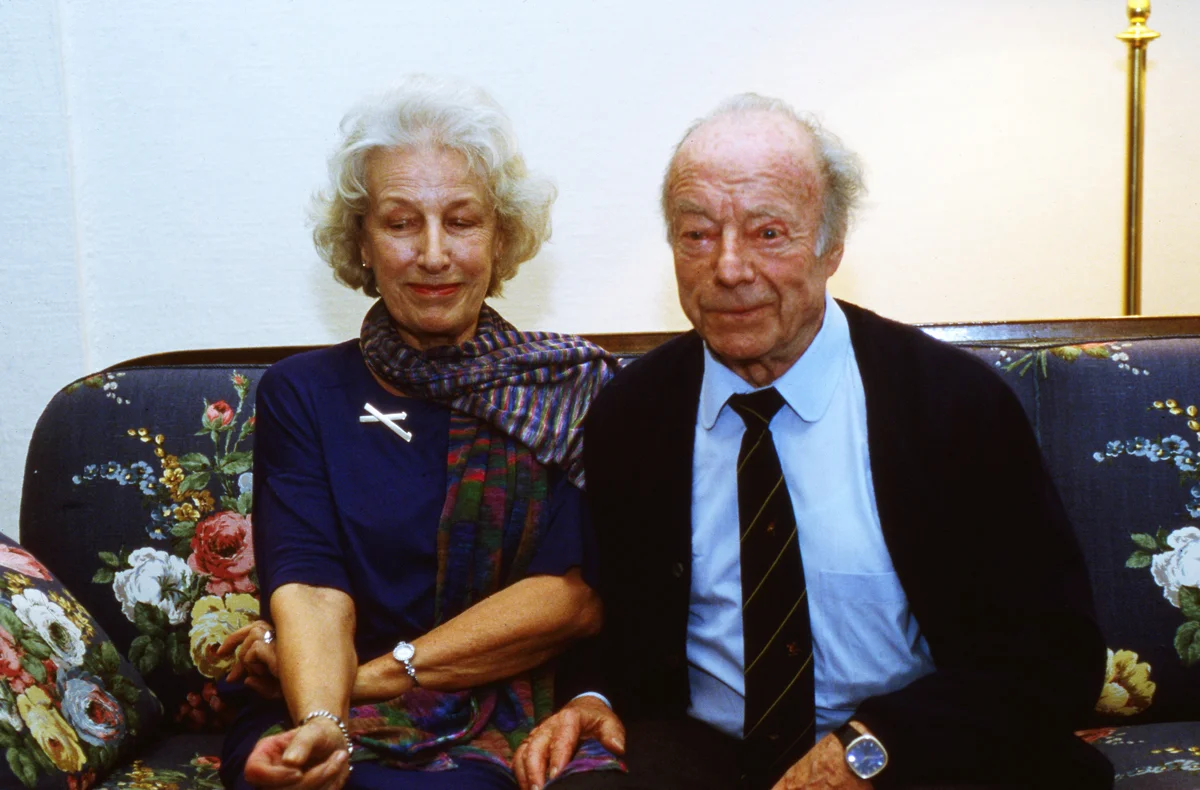
Probably, Bernhaim and Ryumann still retained good relations, since she was even present at his second wedding-with the Vienna artist Gertha Fayler (the only preserved photograph of Maria Bernhaim was taken there). And there is evidence that Ryumann supported Bernhaim for some time with money. But the fact of a divorce from his wife in 1938 due to the fact that she is a Jewish, and even on the advice of Goering, everyone can evaluate on their own.
The story of Maria Bernhaim ended without tragedies. Already in May 1939, she married the Swedish actor Rolf von Scientific, who constantly lived in Germany and starred in Ryumann's film “Loud Lie”. This marriage was absolutely fictitious: Bernheim received Swedish citizenship, divorced Rolf in 1942 and managed to go to Sweden a year later. Maria Bernhaim died early, in 1957, but she relied on wartime.
Add more strokes. The questionnaire was preserved, in 1933, filled with Ryumann, when admitting to the Imperial Chamber of Culture, and he did not indicate the nationality of his wife there only by inscribing that she "did not belong to any religious community." Subsequently, this questionnaire was introduced to the Ryumann case during the denacing process, but the artist himself said that he discussed this particular filling out the questionnaire with Maria Bernhaim. Ryumann was believed, since there was no evidence of the opposite.
For a long time after the war, Gerthler was officially called the first wife of Hinets Ryumann. Many learned about the existence of Maria Bernhaim and about the history of their divorce only decades later.
Villa with a discount for the propagandist
In 1939, Ryumann was restored in Kinopalat, no longer in need of special permission to work. A year later, Ryumann already led the production of the film, which the UFA film studio annually made Goebbels's birthday. In that year, the film talked about the children of the Minister of Propaganda, and he really liked the picture.
At the same time, Hertha Fayler, whom Hinz also met on the set of “loud lies”, like Bernheim and her second husband, was also a Jew, but only a quarter, which, coupled with her trustworthy behavior and the status of Ryumann’s wife, also allowed her to become a member of the film Palace. Of course, Hertha's Jewry was thoroughly hidden.
The film was not perceived by Ryumann as a business card of the National Socialist regime, which fits perfectly into Goebbels's policy. He tried to lead a flexible line of propaganda in the cinema:
The actor was given a variety of roles, from purely comic to tragic, but always with a subtle calculation.
These Rumann and his wife continued to play in life, obediently starring at the request of the Nazi elite for newspapers and magazines (the then analogues of the current gloss) as an exemplary pair. The German public was supposed to have a perfect successful family before my eyes, for which Hinz and Hertha were perfect.

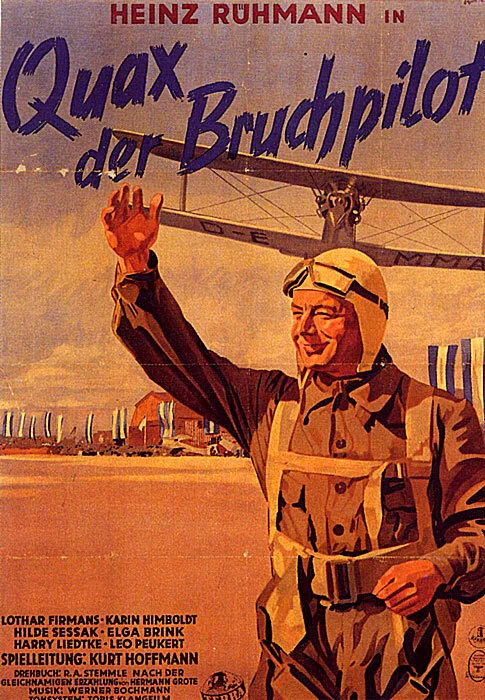
Ryumann appeared in the classic propaganda film “Concert on the request” (1940, sang one song), and also played a pilot in a comedy but glorifying military training for the film “Kvax, an unlucky pilot” (1941). Hitler loved this film very much and was happy to review him. Two years later, Ryumann shot the continuation of the film - Kvax in Africa, the comedy turned out to be so racist that after the end of the war was forever prohibited by the Allies.
All this is nothing more than indirect propaganda in which Ryumann participated. However, it was not so indirect: in the “unlucky pilot” it was clearly said that each member of society (with the exception of, of course, Jews and the like) can go a glorious path from a brainless brake to a national hero.
Probably the most famous film work of Ryumann of those years is the film “Punch from Zhenya Sugar” (1944). In this film, the main character was only allowed to resist the existing social system. The plot was a systematic and inevitable taming of a thinking person. “Punch” exactly corresponded to the expectations of the Nazi regime from entertainment cinema, the purpose of which was to counteract the possible dissatisfaction of the population and its direction back to the “right” path.
Of course, Ryumann was not called into the Wehrmacht, although the basic training as a pilot passed. And in August 1944, he and his wife Gerth Fayler were included in Gottbegnadeten-Liste (“List of gifted by God”), which included the correct artists, writers, scientists and others. As a result, Ryumann received considerable money from Hitler's secret fund.
Back in 1938, Ryumann at a very low price acquired a villa in Vanze, the then suburbs of Berlin (now the prestigious area of the city). The seller was the widow of Jewish entrepreneur Adolf Yandorf, who founded the famous Kadewe department store. Yandorf himself died his death, and rather, admitted, on time (in 1932, at the age of 61), but his widow Helena, escaping from almost guaranteed persecution, emigrated. Before that, she sold her house to Ryumann for 40% of the real value of the house, which automatically made Ryumann the beneficiary from the persecution of Jews. By the way, the villa during shelling in March 1945 was destroyed and completely burned down. Ryumann and his wife in the last weeks of the war had to constantly change their places of residence.
"Art will now be freed from all shackles"
In the spring of 1940, against the backdrop of the Wehrmacht’s invasion of Denmark and Norway, Ryumann still thought about his reputation and was not unreasonably afraid that he would be used as an influentor (then the word Stimmungsmacher, “mood creator”) to support the actions of the Nazis. Ryumann wrote several letters of support to Danish friends - but this “resistance” was limited to this.
A little later, Goebbels reported that Ryumann and his wife supposedly want to emigrate. The case was investigated, Ryumann did not go anywhere, and Goebbels wrote on April 10, 1940 in his diary: “Ryumann spoke positively” (Rühmann Hat Sich Positiv Erklärt). Most likely, it was about his loyalty to the regime. And there was no evidence of Ryumann’s further statements against the actions of Nazi Germany - it seems that there were no such statements.
But in history there was something else: the indifference of Ryumann to the Jewish colleagues in kinematographic craft. There were not so few of them, then they completely disappeared from the sets, but Ryumann seemed to not notice this. He ignored the fate of his good friend Otto Wallburg, also an actor. Wallburg, Berlin Jew, after Hitler came to power, moved to the Netherlands, but this did not save him: he was deported to Auschwitz and killed in a gas chamber. At first, Wallburg was in custody and hoped that Ryumann would put a word for him or at least come to him. But, as the surviving son of Wallburg said, Ryumann did nothing for a friend.
We summarize:
Ryumann for cheap bought a luxurious villa from the widow of a Jewish entrepreneur, forced to flee.
Ryumann, with all the mentioned “but”, unfortunately divorced his wife-Jew in the sake of continuing his professional career. (But everyone on the lips had reverse examples, when both men and celebrities, including celebrities, refused, contrary to the powerful pressure, to get divorced with their Jewish spouses. So the actor Albert Baserman, who eventually emigrated, and the dumb movie, Henny Porten, went to work with the Nazis.)
Ryumann met with Hitler, was friends with Goebbels, was entering the highest cabinets, accepting the same Goebbels on his villa in Vanzeia and did not feel any discomfort during these contacts, considering them part of the working obligations.
Ryumann as a director and actor worked in propaganda cinema, and with his second wife was photographed for the press, personifying the “perfect German marriage” for a simple public.
And immediately after the end of the war, all this by some miracle came off from him like a goose of water!
The Soviet occupation authorities who wanted to discuss the “future of German cinema” were associated with Ryumann. In the very first issue of the German-speaking newspaper Berliner Zeitung, on May 21, 1945, which was published in the Soviet zone, it was indicated that during one of the performances, Ryumann promised: he and all popular artists will work with more joy and zeal than ever before, to offer the joy of art they needed to restore and rest.
“This task is all the more beautiful for us,” said Ryumann, “that art will now be freed from all the oppression and shackles from which it suffered a few days ago.”
Fragment of notes from the newspaper Berliner Zeitung, May 21, 1945
After other speakers at the meeting, the famous film actor and director Hinz Ryumann took the word. He, who, like many other outstanding artists, immediately expressed his readiness to his personality and his skill to serve the restoration of Germany, said approximately the following: “Serious, passionate work on the future does not exclude joy and humor. On the contrary: those who really work deserve even more joy and rest. ”He promised under the stormy applause of those present that he and all popular artists would work with even greater joy and zeal than ever before, to deliver the joy and rest he needed to restore Germany through art. “This task is all the more beautiful for us,” concluded Hinz Ryumann, “that art will now be freed from all the oppression and shackles from which it suffered a few days ago.”
At the beginning of the spring of 1946, as part of denazification, it was announced that "there is no objections to the further creative activity of Mr. Ryumann." Before that he was not allowed to speak, but then they immediately gave the opportunity to stand up and tour with a small group of artists. Yes, at first he did not star in German films about the war in which other actors shone - but this is only because the time of the average heroes, whom Ryumann remained and remained, had not yet come (more precisely, has not yet returned).
We will not describe his further life in detail: he was all right. He starred in the cinema, played in the theater, performed on the stage, staged films and performances, worked as a receiver, recorded gramplasts, taught. He received awards, in particular the Order for Merit to Germany, as well as posthumously, in 1995, was called the “greatest German actor of the century” and received the Golden Camera award. The audience met him with applause and considered him a luggage.
After the death of Hertha, Fayler in 1970, Ryumann married for the third time. The last time he appeared in public in January 1994 - as part of the television show, and the audience welcomed him standing. In October of the same year, Ryumann died.
The perfect conformist?
Obviously, for Ryumann, beliefs and the current political situation were neither important nor anything determining. For example, in recent decades, it has become known that in 1945, Ryumann collaborated with the Ulbrikht Communist group almost as a consultant ( the Ulbrichta group is an organization created by the future first head of the GDR for the post -war device of Germany. - Ed. ).
Ryumann was most important to work, play, go up the career ladder, which he was doing. В каких политических условиях это происходит, для него было не так важно. Потому сложно ответить на вопрос, думал ли он на самом деле, что в нацистской Германии дела идут как надо, или всё-таки был убежден в обратном.
Как артист — остался собой: он не изображал героев, он показывал немецкому среднему классу первой половины 1940-х его посредственность и буржуазный конформизм настолько блестяще, что примирил людей с действительностью
и позволил им чувствовать себя максимально удобно в тогдашних обстоятельствах. Всё это, разумеется, играло на руку нацистской пропаганде. Понимал ли это сам Хайнц Рюманн?
В мемуарах самые болезненные темы Рюманн не комментирует вовсе или касается их лишь в самых общих словах, оправдывая свои действия (или бездействие) существовавшими правилами. Конечно, не указывая, что было много людей, которые в подобных обстоятельствах действовали иначе, и никак не рефлексируя, не осознавая и не перерабатывая свое прошлое. Впрочем, возможно также, что Рюманн просто потакал публике, которая неизменно его любила вне зависимости от политической конъюнктуры XX века. Ну а публике рефлексии Рюманна явно не требовались.
Артист не столкнулся с массовым осуждением. Почему — давно понятно: людей с подобным бэкграундом в самых разных сферах деятельности после Второй мировой войны было слишком много. Что нужно было с ним и со всеми остальными делать? Вопрос, который до сих пор обсуждается, но история уже дала свой ответ: люстрация в Германии фактически провалилась из-за отсутствия достаточной информации, перегрузки ведомств, плохо сформулированных правил и массовой круговой поруки.
***
Нет сомнений, что многие из поддержавших нынешнюю кремлевскую войну российских артистов или усердно молчащие по этому поводу знаменитости точно так же сумеют выйти сухими из воды и безбедно жить до глубокой старости, едва ли терзаясь угрызениями совести: они ведь «просто» играют в театрах или в оркестрах (поют, ведут телепередачи). Они будут чувствовать себя весьма уверенно.
Пример из истории у них есть.