
Translated material
Physicists, lyricists and state secrets
Physicists are now monitoring the reliability of the scientific works of philologists from Moscow State University - and are looking for state secrets in these works
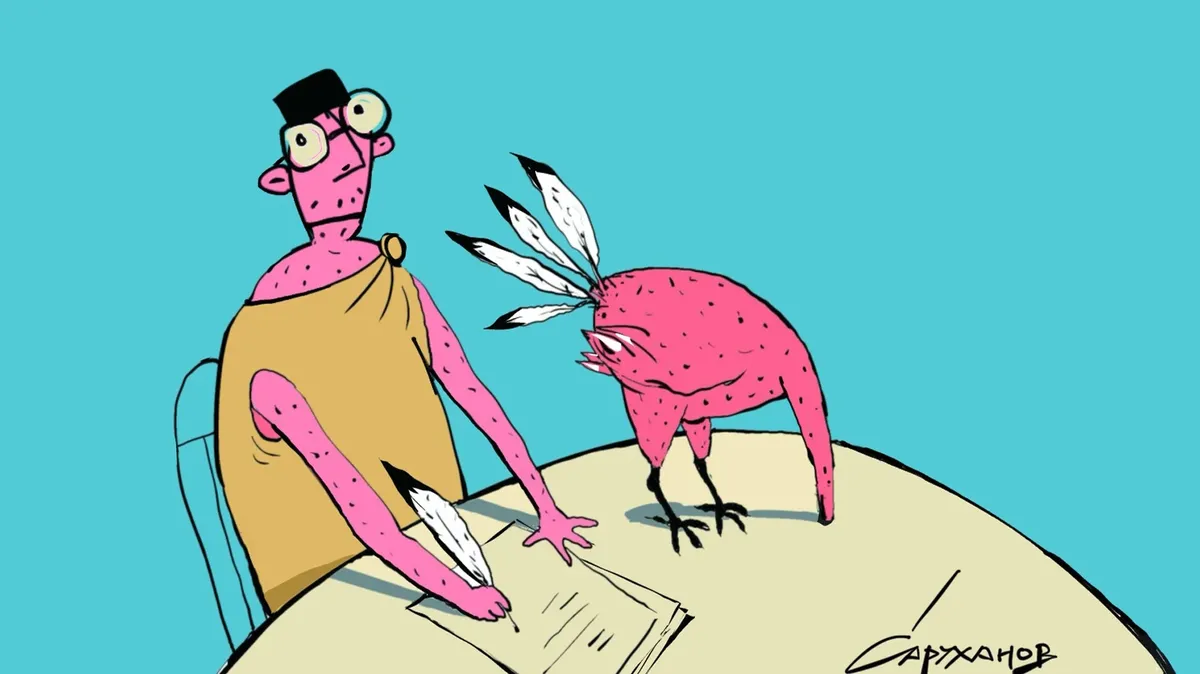
Petr Sarukhanov / Novaya Gazeta
There is another innovation at Moscow State University. From now on, employees of the Faculty of Philology are required to endorse everything they write in the rector’s office. The examination to identify state secrets in works about Lermontov and the aorists was entrusted to physicists.
Immediately after the start of the new academic year, teachers and graduate students of the Faculty of Philology of Moscow State University named after M.V. Lomonosov was informed about the introduction of preliminary censorship at the faculty. Now they will have to submit all prepared monographs, articles, dissertations and abstracts in printed form to the dean’s office. Two-page summaries of reports that scientists are going to present at conferences should also be sent there. Of course, a new position has already been introduced for those responsible for the collection and delivery of materials.
From the dean's office, the work is forwarded to the rector's office, and after a few days, philologists receive an expert opinion:
“The information contained in the materials in question is
are not subject to the List of information constituting state secrets (Article 5 of the Law of the Russian Federation “On State Secrets”),
do not belong to the List of information classified as state secrets, approved by Decree of the President of the Russian Federation of November 30, 1995 No. 1203,
are not subject to classification,
and these materials can be openly published.”
Date, visa of the vice-rector (so illegible that despite all efforts it was not possible to identify him), official seal. But the printout sent to the administration is not returned to the author. Together with the second copy of the conclusion, it remains for storage in a place inaccessible to enemies.
Publications that have not passed the examination will not be added to the Intelligent System of Thematic Research of Scientometric Data (abbreviated as Truth), in which every MSU employee is registered. Information from Truth determines the amount of bonuses for publication activity, which constitute a significant part of the salary. Teachers have not yet been warned about other sanctions for attempts to publish bypassing censorship, but it is unlikely that there will be many who want to experiment on themselves, risking their jobs and money.
The names of the experts are not publicly available. According to rumors, there are about 30 of them, but no one knows anything for sure. All the conclusions known to me have the same three signatures - employees of the physics department. Supervision of philologists is called upon to be carried out by:
Acting Head of the Department of Photonics and Microwave Physics Anatoly Fedorovich Korolev ,
leading electronics engineer of the same department Dmitry Aleksandrovich Tishchenko ,
leading researcher at the Center for Hydrophysical Research Alexander Aleksandrovich Potapov .
The sixties dispute between physicists and lyricists began to sparkle with new colors.
Why were physicists included as experts, and not lawyers, whom one would seem to reasonably expect to see on such a commission? The fact is, explains Dmitry Dubrovsky*, a researcher of academic freedom, a member of the Faculty of Social Sciences at Charles University in Prague*, that
the authors of such conclusions themselves must have some degree of “clearance” and the right to consult the list of state secrets.
The presence of such examinations in itself is not new. They have existed for many years in academic institutes and universities engaged, for example, in research in the field of physics or fulfilling orders from the military-industrial complex. In some establishments this practice has not been interrupted since Soviet times. And some Russian magazines, even in the 2000s, required their authors to provide statements from their places of work about the absence of state secrets in articles proposed for publication.
In 2009, the Vice-Rector of St. Petersburg State University Igor Gorlinskyissued an order requiring that all international activities of employees (receipt of foreign grants, publications in foreign journals, reports at international conferences, etc.) be coordinated with a special commission. Gorlinsky explained the need for this by the requirements of the Export Control Law. In those days, the public had not yet lost the ability to be amazed at the decisions of their superiors, so the order caused quite a heated discussion. Even the New York Times wrote about the initiative of the St. Petersburg administration.
In 2015, something similar to what has now been introduced at the Faculty of Philology appeared at Moscow State University. The deans of at least two faculties—geography and mechanics—simultaneously issued orders “On the examination of materials intended for open publication.” Geofak, as Dmitry Dubrovsky explains, appeared here for a reason: Russian intelligence services traditionally show increased interest in everything related to cartography and geodesy. However, nine years ago the atmosphere in Russian universities was significantly different from the current one, so it seems that the leadership’s initiative was then smoothly put on hold.
What is really new is the transfer of such practices to the Faculty of Philology.
According to the editor-in-chief of the T-Invariant project (included in the register of “foreign agents”) Olga Orlova, this kind of examination has always depended on a specific boss - somewhere they were diligently implemented, and somewhere they were not heard of at all. But humanities scholars, Orlova adds, were almost never affected by this. So the Faculty of Philology of Moscow State University had the honor of becoming a pioneer in this matter.
Why Mr. Sadovnichy’s office decided to start with the philology department is completely unclear (we did not receive an official comment from the dean’s office). It would seem that, given the Supreme Commander-in-Chief's obsession with history, it would be reasonable to pay special attention to the history department. Or the Faculty of Philosophy - there is the Russian idea and other metaphysics of the national spirit. Or the journalism department with its liberal reputation. But no, the other humanities faculties of Moscow State University have not heard of anything like this. Perhaps we haven’t heard it yet, but nonetheless. So poor philologists, from heads of departments to graduate students, clutch their heads and curse the fantasies of their superiors. But the work is submitted for inspection.
Beginning teachers of the philology department, having missed the Soviet era, listen with interest to the stories of their senior colleagues, how in the 1970s they carried programs of student conferences to Glavlit and then changed the names of the most suspicious reports (“I don’t remember exactly, something about the theme of the rebellion at Pushkin” ). In bad journalism, this is usually called the relay race of generations. “So this turns out to be what returning to the days of youth looks like!” - the honored philologist, who graduated from the university 50 years ago, ironically.
Subtext
While preparing this material, I corresponded with many employees of leading Russian universities. The main impression is the number of friends and old acquaintances who generally refused to discuss the situation at their universities, not even for publication and on condition of complete anonymity. All the more grateful to those who agreed to talk about how, in their opinion, the Russian academic world has changed over the past two-plus years.
Head of one of the humanities institutes of the Russian Academy of Sciences:
“We can say that the government behaves extremely adequately (different explanations are possible for why): in fact, it does not prescribe anything censorial.
But: self-censorship has increased sharply, no one is forcing it, and people are competing to see who can limit themselves the most.
This is definitely there, and it is very noticeable in publications and in speeches. Amazing readiness. I think this is the most significant thing right now.”
Lecturer at RANEPA:
“Nobody requires you to submit articles for examination. And foreign publications are retained in the reporting. True, they completely banned the use of Google services. And they recommend understanding where we serve: “It’s quite strange to work in the presidential academy and criticize the president.” In general, censorship is no longer particularly necessary. Self-censorship works well. There are taboo topics: Putin, SVO, Kiriyenko. The rest is optional. However, strong criticism of mid-level practices and policies is acceptable.”
Professor at the European University in St. Petersburg:
“In general, it seems to me that there have been no radical changes compared to the last pre-war years. This can be explained in different ways, but two versions come to mind.
Firstly, the Putin regime generally treats the academic world with great contempt: it was too easy for officials to buy dissertations, and it was also easy for propagandists to buy various “scientists”.
Secondly, the academic world as a whole turns out to be the most pacifist, so it’s better to leave these out-of-touch and uninfluencing idiots alone.
There are, of course, other cases, but there are not very many of them. Often it’s all about liberal lobbyists and their capabilities (the cases of Smolny and EU). At the same time, it is not possible to build any kind of “alternative to Medinsky”: there are simply not enough qualified people to fit into this.
It seems that this world is hoping to outlive Putin.”
FROM THE EDITOR
We sent official requests to Moscow State University by all available means and tried to get through to the responsible officials - to no avail. But if there is an answer, we will definitely publish it.