
Translated material
Floors of War
The year of the October 7 tragedy. Conversation with sociologist Viktor Vakhshtein* about what happened to Israeli society and the world
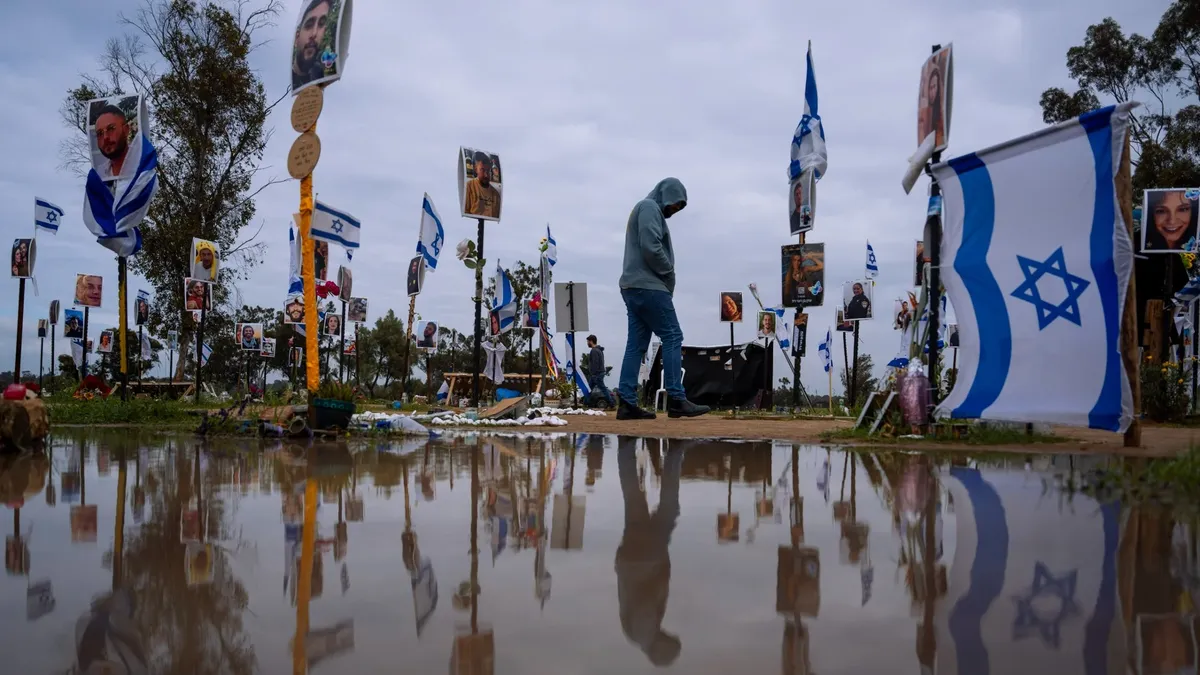
The site of the October 7 Hamas attack in Re'im. Photo: AP / TASS
18+. THIS MATERIAL (INFORMATION) WAS PRODUCED, DISTRIBUTED AND (OR) SENT BY FOREIGN AGENT VICTOR SEMYONOVICH VAKHSTAIN OR CONCERNES THE ACTIVITIES OF FOREIGN AGENT VIKTOR SEMYONOVICH VAKHSTAIN
On October 7, 2023, Hamas terrorists attacked the Nova music festival in southern Israel. It is impossible to count the number of victims of that day; there are thousands of people. Because in addition to those who died in the massacre, hijacked and killed hostages, and executed military personnel, witnesses to this nightmare, rescuers, doctors, and family members also passed away. The affected area, with new stages of traumatization, expanded like a virus, capturing new territories and absorbing people. A year has passed and there are many events, statements, deaths on both sides, actions and silence. How does Israel live now?
How do pain and horror translate into political decisions? Irina Vorobyova talked about all this with sociologist Viktor Vakhshtain.
— We are recording this interview right before October 7th. A year has passed since the events that shocked the whole world, it seems to me. And now I want to talk about this year. But before asking questions about Israeli society, I would like to understand what kind of Israeli society it is. Stable, solidary, monolithic, consists of two parts, three or more. What major contradictions exist within Israeli society? How can you describe it?
- Let's start traditionally - with clarification of concepts. Society is not a collection of individuals living in a certain territory. (This aggregate is called a “population” and is studied by demographers.) Society is a system of social connections between people. If these ties are strong, trusting, based on identity, solidarity and mutual assistance, we talk about “families”, “clans”, “tribes” or “communities”. If these ties are weak, formal, based on contractual relations, political coercion and minimal mutual recognition, we are talking about other aggregates - “corporations”, “classes”, “regions”, “nation states” or “global empires”.
Israel is an example of a nation state. Such social aggregates gather around the idea of a civil nation: there are many internally united communities that differ in language, religion, daily practices, country of birth and length of residence, and there is something that connects all these groups with each other, forces them to somehow agree, find common denominators. Sociologist Benedict Anderson called nations “imagined communities” - it is impossible to imagine such an aggregate as a real monolith, so that “there are even tears in the eyes in common.”
The unity of a nation is an imagined unity. Only in rare moments does it cease to be a metaphor.
The founding fathers of the state, however, believed that someday such internal heterogeneity would disappear. A new historical community will emerge - the Israeli people. This illusion was called the “melting pot” thanks to the play of the English playwright Israel Zangwill, who was first an ardent Zionist, then an equally ardent anti-Zionist, but actually used the image of the “melting pot” in relation to the United States. In his play, a Russian revolutionary, the daughter of a tsarist officer who was behind the Kishinev pogrom, falls in love in New York with a Jewish musician who lost his family in this pogrom and fled to the States. When they discover which of them belongs to which “tribe,” everything begins to crumble, but then, as usual, love wins, they decide to leave the dark Russian past in the name of a common American future.
In Israel this idea failed. Its constituent communities have not melted into anything. No homogeneous mass emerged. On the contrary, heterogeneity has increased over the years. President Reuven Rivlin acknowledged this in his speech with the characteristic title “The Four Tribes of Israel” in 2015 - it is pointless to invent a mixer that would mix all the social ingredients into a homogeneous mass; we need to build bridges and strengthen ties between communities. Heterogeneity and diversity are “not a bug, but a feature.” You shouldn't make a vinaigrette out of Greek salad.
— If we are not talking about homogeneity, but rather about communities, then what is the attitude towards strangers? Who are they if so many different people came and in general so many different things?
— Georg Simmel, one of the founders of sociology, has this formula: a stranger is one who came yesterday to stay tomorrow. This formula still bears the imprint of the 19th century—thinking in terms of stable and relatively homogeneous social unities. Here there is a small town or a large village, where everyone knows everyone, and there is an incomprehensible character who came here for some reason, and then moved his family. But urbanization begins, people move to big cities. Now they have to become spontaneous ethnographers, every day encountering other forms of life, looking for new mechanisms of coexistence. So the outsider turns from a marginal character into a central figure in twentieth-century sociology.
This situation, characteristic of New York or Chicago at the beginning of the twentieth century, has not disappeared in Israel. Each subsequent wave of repatriation brings something with it, somehow transforms, breaks into “tribes” and changes the system of relations between communities within the country.
There is an old satirical sketch by Arik Einstein and Uri Zohar, called “Aliyah”: people who fled their countries come ashore one by one - first from Russia, then from Poland, then from Yemen, then from Germany, then from Morocco, then from the Soviet Union (all, of course, are depicted very stereotypically), and each successive wave meets the previous one with a pronounced “hostility towards the alien.” Yemenites are too religious for Poles, Germans are too arrogant for Yemenites... This sketch is something of a cultural code. It never gets old and still brings laughter to Israelis of different generations.
If there were a monopoly of any one community on the right to separate “right citizens” from “wrong” ones, the situation would be different. Much more frightening. But in such a motley aggregate, such a monopoly is impossible. Each community regularly produces its own aliens: for secular ones these may be religious ones, for national-religious ones - ultra-religious ones, for Muslim Arabs - Christian Arabs, for Soviet repatriates of the 1970s - repatriates of the 1990s, for repatriates of the 90s - us .
How is it even possible in this situation to form a common identity, the formation of a “political body”? If Israel were an imperial state, one could play the card: “We are all from different tribes, but each of us is first of all a subject of the emperor, and only then a Hellenic or a Jew.” But Israel is not an imperial state. If Israel were an ideological ethno-nationalist project, as left-wing anti-Zionists are now trying to prove, they would have played the card of “ethnic unity and historical community of the Jewish people.” But this is generally nonsense. 21% of the population are Israeli Arabs (three Arab parties compete for their votes), and the Jewish majority fundamentally does not perceive itself as a “Jewish majority” because different communities within it use different criteria for defining Jewishness, with half generally rejecting ethnicity as a meaningful category. That is, this is not even Anderson’s “imagined community.” This is an incredible community.
As a result, a parliamentary republic - with all its pros and cons - became an organic political form for this Israeli-Greek salad. Because it is based on the idea of a contract. You will have to talk. You will have to make compromises. You will have to sacrifice the interests of your communities and take into account the interests of others, because otherwise the strangers will agree with even more strangers, and you will remain in the minority. The end result is a very fragile structure. One wrong step, one wrong decision - and the entire social aggregate is rapidly polarized.
This is what happened on the eve of October 7th. Because of the judicial reform project, people took to the streets. When I say “took to the streets,” you probably imagine Bolotnaya Square or Sakharov Avenue—a confrontation between citizens and authorities. But
Israeli protest is a protest of some communities against the actions of others. And when the intensity of passions reached its peak, October 7 happened.
— Do you remember yourself on October 7 last year?
- Yes, almost hourly. I woke up around 6 am to the sound of interceptor missiles exploding over the house. I waited for the siren and went down to the bomb shelter. This is already an automated action - in 2021, “Islamic Jihad”* fired at us from Gaza several times a day, and the skill was formed quickly. At the same time, by the way, we cleared the bomb shelter. Before that, everyone used it as a storage room. In general, I decided that another routine shelling had begun, waited until the alarm went off, called a taxi and went to see a colleague with whom I had an appointment that day near Jerusalem. The driver, an Israeli Arab, said that we would take a detour; it was unsafe to drive along the main highway. A vain precaution. The roads were empty, like in the film "The Langoliers".
The entire trip the taxi driver kept repeating: “What scum! What creatures! To be honest, I didn’t even bother to clarify who exactly. You never know. I received an explanation later from Mohammed, my neighbor in the house and bomb shelter. Palestinians call Israeli Arabs "mashtap", an acronym for "meshatef peula". Collaborative. Collaborator. And while I was riding in a taxi, the Israeli Arab Muslim Aouad Daraouche, just a couple of hundred kilometers to the south, was pulling Israeli children out from under the bullets until he was killed by Hamas.
People who talk about Israeli and Palestinian Arabs as a single “oppressed people” do not have a clear understanding of the situation in the country. Since October 7, hatred of Hamas in Israel's Arab community is stronger than ever before.
When I arrived, the first videos had already begun to appear in telegram channels. But it was difficult to understand the scale of what happened. Chaos. Screams. People are running. Shots. Later it turned out that a considerable part of those who posted these videos died within an hour.
A religious woman approached me on the street. He says: “You are secular, you can use the phone, what’s going on?” And this is not just Saturday morning, this is a big religious holiday. All observant Jews are in synagogues and are prohibited from using devices. I showed her the news so that there would be no doubt - the ban on using technology is lifted in an emergency. “You’re not from here,” she says. - This is my house. If so, we are waiting for you. We have access to the roof, a supply of food and three rifles. Just for such a case."
— But this episode with the woman who called, if anything, as I understand it, this is really such a very common story for Israel, it didn’t start on October 7th.
— It depends on what exactly is considered an ordinary story. Let's say, rocket attacks on densely populated cities are a common story. Terrorist attacks and, as a consequence, a large number of small arms among citizens are also a common story. Yesterday, just three stops from my house, two terrorists shot eight people at point-blank range. They would have killed much more, but the young man in shorts and flip-flops who went out to buy bread took a pistol with him.
Offering help to a stranger is an even more common story. It doesn't even require an emergency.
But the genocidal attack - and October 7 is not a terrorist attack, it is precisely a genocidal attack in accordance with international law - is no longer an ordinary story. Israelis are used to terrorist attacks, but are unaccustomed to full-scale pogroms. Since about the 30s of the last century. Mass murders and rapes, children burned in their homes in the arms of their parents, heads cut off with a hoe that came to hand. (Because, following the well-trained and armed militants of the Islamic Resistance Movement, less trained and less well-armed youth escaped through a hole in the fence into the operational space.) Hostages captured and taken captive. And all this was carefully documented and filmed by the killers themselves.
What happened the next day is also no ordinary story.
By the morning of October 8, the country had changed beyond recognition. I just said that Israel is an “unimaginable community” and that its unity only in rare moments ceases to be a metaphor. This was such a rare moment. The state failed the crash test, the communities did.
Weak ties instantly became strong. People who were vaguely familiar with each other called each other and organized deliveries to recruiting stations - food, linen, cigarettes. Complete strangers met on social networks in order to establish systematic transportation of volunteers and donors. The kilometer-long queues to donate blood for victims could only be compared with the queues of volunteers at recruiting stations.
On the 8th, without waiting for permission from the army command, a volunteer search and rescue group of new repatriates who had experience working “in the field”, gained at the Faculty of Biology of Moscow State University, went to the site of the Nova festival to look for survivors and wounded. Mostly remains were found.
A young mother-lieutenant was called up to the border with Lebanon (Hezbollah almost immediately began shelling the north of the country in support of Hamas), her husband volunteered for Gaza. She left the infant with her grandfather, expressing milk for several days. A neighbor wrote about this on Facebook**, and an hour later all nursing mothers within a radius of fifty kilometers were already on regular duty - everyone knew what time she needed to arrive and at what address.
Sometimes it got to the point of funny. In December, a female observer on the northern border tweeted: “We have everything, thank you. The only thing missing for the New Year is a bowl of Olivier.” Fifteen minutes later, the most expensive Russian restaurant in Tel Aviv has already announced that the chefs are working overtime today. Half an hour later, managers, IT specialists, doctors and professors - everyone who read this message - wrote back that they would stop by after work and deliver the salad to the bases on the way home.
The news headlines looked surreal at times:
“The crime boss handed over three hundred Kevlar body armor to the army.
“Since the police forces are busy searching for the remaining infiltrators and preventing new attacks, we will ensure order on the streets,” he said.”
Crime has actually dropped dramatically.
In a word, while all government structures were deeply knocked out, in a matter of hours the web of social connections between people was compacted to the state of ship ropes, and total social mobilization took place.
There is a video that well describes the situation of those days. The sergeant arranges a roll call of reservists:
- Religious obscurantists!
- Here!
- Leftist traitors!
- Here!
- Far-right fascists!
- On the spot!
After which they all load into one bus and go to the base.
- But then all this began to disappear? What has it changed to?
— Such spontaneous outbursts of solidarity, the transition of social ties to a different state of aggregation in classical sociology were called pathetically — “the birth of a community of fate.” Essentially, a collective response to an existential challenge. Unity is achieved not through lengthy negotiations and agreements, not through symbols and utopian images, not through narratives about the historical past... But through the actions of people here and now. But in the social world, everything has an expiration date. The community of fate becomes a community of trauma.
The first traumatization - from what happened - is followed by a second one. The girl who was on duty at the call center on the hotline that day. She received several hundred calls - screams, shots, children crying. She couldn't help. And psychologists could not help her. Six months ago she committed suicide.
The phrase I've heard constantly this whole year is: "I still have the screaming in my ears." I heard from a variety of people. From a Knesset member who speaks every day with the families of the kidnapped and murdered. From a volunteer identifying burned bodies. From a friend who came to visit a relative when two people rang her doorbell - an officer and a doctor.
And the second trauma is followed by a third. When we are faced with the reaction of the progressive world community. For example, yesterday’s terrorist attack that I mentioned - two people shot unarmed people on a tram and at a bus stop. A mother with a nine-month-old child in her arms died, covering him with herself. Today, a group of Columbia University students has already made an official statement. It turns out that this was a “significant act of resistance” and “a courageous act, a reminder that the struggle is not limited to Gaza and Lebanon” but continues “in the heart of settler colonial territory.”
Some of my friends, who kept proud opposition silence in Russia, having moved to the United States, resolutely joined (safe for them) to fight Zionist aggression and settlement colonialism. They, it seems, sincerely do not understand why their yesterday's colleagues, who chose Israel as a place of residence, perceive them now as Ukrainians-Russian Z-patriots.
- The fact that the world did not remain in the position of the first days and did not take the side of Israel to the end, also had to create the feeling that the enemies are enemies around?
- Not really. Apparently, it is necessary to once again look a little into the social theory in order to clarify the difference between the “enemy” and his “voluntary ally”.
Imagine three floors.
The first floor is the battlefield. Not metaphorical, informational or facebook. And quite real. With the fall of missiles near your house, cement dust in the air, night sirens, dead friends and acquaintances. There may be several front lines in the physical space. But in the space of existential confrontation, it is one - the distinction between “friend” and “enemy”. The enemy does not have to be morally vicious, aesthetically ugly, or to embody absolute evil. It is enough that his goal is to kill you. He is precisely the enemy (hostis), not the warning (inimicus). The warfare is the one who hates you, the enemy is the one who attacks you.
However, no one canceled freedom. The fact that you are geographically next to the front line does not mean that you must put yourself in the space of existential confrontation. You can leave, condemn the war or your former friends. You can go to the "internal emigration", locked in your apartment. (In repressive regimes, this, however, is complicated by the fact that the front line sometimes passes through the apartment - searches, arrests and raids also did not cancel.) But if you still made a choice in favor of the “first floor”, you are responsible For the consequences. At the same time
You remember that on the opposite side there are people who made a choice. Those who did not do it cannot be considered enemies. They are not of their own free will and are hostages, not combatants.
The battlefield has two reasons: risk and complicity. Risk is a danger taken into account. Danger is an objective probabilistic characteristic. A brick may fall on you, a fragment of a crossbreaker rocket or a piece of the wall of your own house. You can shoot you from around the corner by a teenager who imagines himself a partisan. You can arrest you at six in the morning FSB. And if, knowing all this, you remain in the dangerous zone, taking responsibility for the likely consequences of your own actions, the danger becomes a risk.
Complicity should be understood literally. In both senses of this insidious word. To say “I am here”, taking a position in the space of war means becoming simultaneously a target, a volunteer and an accomplice.
The second floor is built on the battlefield - the information space. There is also its own front line. True, much more blurry and mobile. There are no halftones on the battlefield. On the second floor, in the information space, they are. Here you can take a more restrained or more radical position. To say “not everything is so unambiguous”, or “I condemn Hamas and Ishal,” or “agree, there is much in common between the gas sector and the Warsaw ghetto”, as is customary for Russian -speaking left.
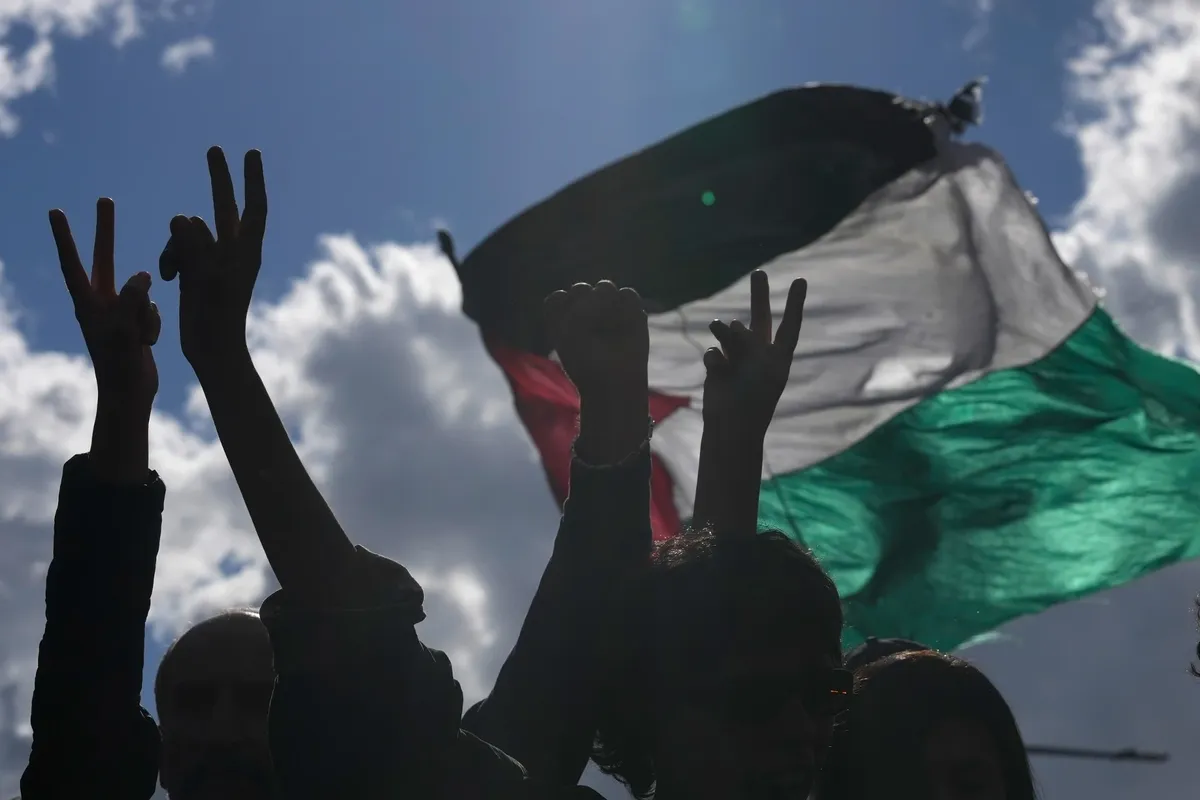
In short, in the war of opinions and narratives you are much freer in choosing a position. Although here you have to answer the question "Where are you?" For example: “I am in a campus of a good American university with a glass of champagne in my hand and a Palestinian flag on the lapel of a jacket I express solidarity to my students, expressing solidarity with the oppressed gase of the people.” That for a resident of the first floor, located on one of the sides of the non -metaphorical barricades, it will sound like "I am a Prokhamas creature that rejoices at the murder of your children."
On the ground floor there are very few signs, symbols and other semiotics. The distance between the designated and the meaning here is negligible: 30 seconds of the fly for Ashkelon, one and a half minutes for Tel Aviv, 14 minutes for a ballistic missile from Iran. But on the second floor - where the struggle goes for “public opinion” - narratives and images can fly along the most unexpected trajectories.
Rising from the first floor to the second (that is, having worked out a volunteer shift and opening social networks), a participant in the existential confrontation should also answer the question “Where are you?” And to honestly admit to himself that he is no longer there - under shelling, but here - in the comments.
It is not possible to switch far. In any case, for me, for sure.
Sometimes the second floor really fails and becomes part of the first. Any exchange of views has a chance to develop into war if its intensity reaches a certain threshold. But no matter how polarized the information space and no matter how radical the statements become, these statements themselves are not yet action. Until there is a risk. When they begin to plant for posts for five years, when the Prozraeil demonstrates dies from the blow of the Ostalestinsky - welcome to war.
That's just over these two layers there is another third. Professional.
Metosition requires the ethical autonomy of the profession. Research, journalistic, medical ... You can’t just jump and soar over the conflict. Taking a “neutral position” between the two camps on the second floor, you still remain on the second floor. To rise to the third - it should at least be rebuilt. I will gladly discuss the problem of collective responsibility and individual guilt with the Palestinian philosopher. The issue of the reliability of statistical data is with the Iranian sociologist. The topic of legal qualification "Genocide" - with the Prokhamas lawyer. If the interlocutor is in the position of a philosopher, sociologist and lawyer, and not a fighter of the second floor.
The idea of the autonomy of the profession was well illustrated by one Israeli doctor. In an interview, he described a terrible situation: the wounded terrorists, who made a massacre on October 7, were placed in the same hospitals where they tried to return their victims to the life of their victims. Literally in neighboring departments. (Because in Israel there is no system of prison medicine - hospitals common to everyone.) And he very much asked to take them from there, because the relatives of the victims periodically strove to arrange the impromptu courts of Lynch over the “surviving nonhumans”. Yes, and the doctors themselves, some of whom lost in that massacre of loved ones, were subjected to too much test.
- You are an anesthetist! - the host decided to ask. - There is no temptation to turn the valve when you operate the terrorist?
- I?! - the interlocutor flashes, instantly moving from the second floor to the third. - I'm a doctor. I gave an oath of Hippocrates ...
- In Russia, we spend quite a few words and emotions on discussing among ourselves and listening to different political forces that are expressed on the topic of Ukraine, and some of them for the immediate ceasefire. So, the other part says: in no case. And not a single way out of all this one is visible ... I do not want to call it the situation ... of all this disaster, which was not so arranged, but at least was close to saying: “O'Kay, yes, this is more or less less or less norm. Is there any consensus, some kind of way out of all this? This is where to go, in the end, to say: "Is it over?"
- Alas. The rhetoric of detached and refined pacifism is not a “way out of all this”. This is just a bet in the war of narratives. This bet is called "imitation of metaposition." Because you only pretend that you rise to the third floor, but in fact you take a “neutral position” in the second. You climb onto a stool, rising above the warring sides, and say: “I don’t care who is right and who is to blame. Just stop it immediately. ” But if you don’t care who is right and who is to blame, you, in fact, say: “I don’t care who the rapist is and who is the victim of the rape.” Becoming the same voluntary ally of the rapist.