
Translated material
"Changes are inevitable"
Novye Europe publishes a letter written by Boris Kagarlitsky in the colony. The sociologist discusses the war, political changes in Europe and the crisis of the left
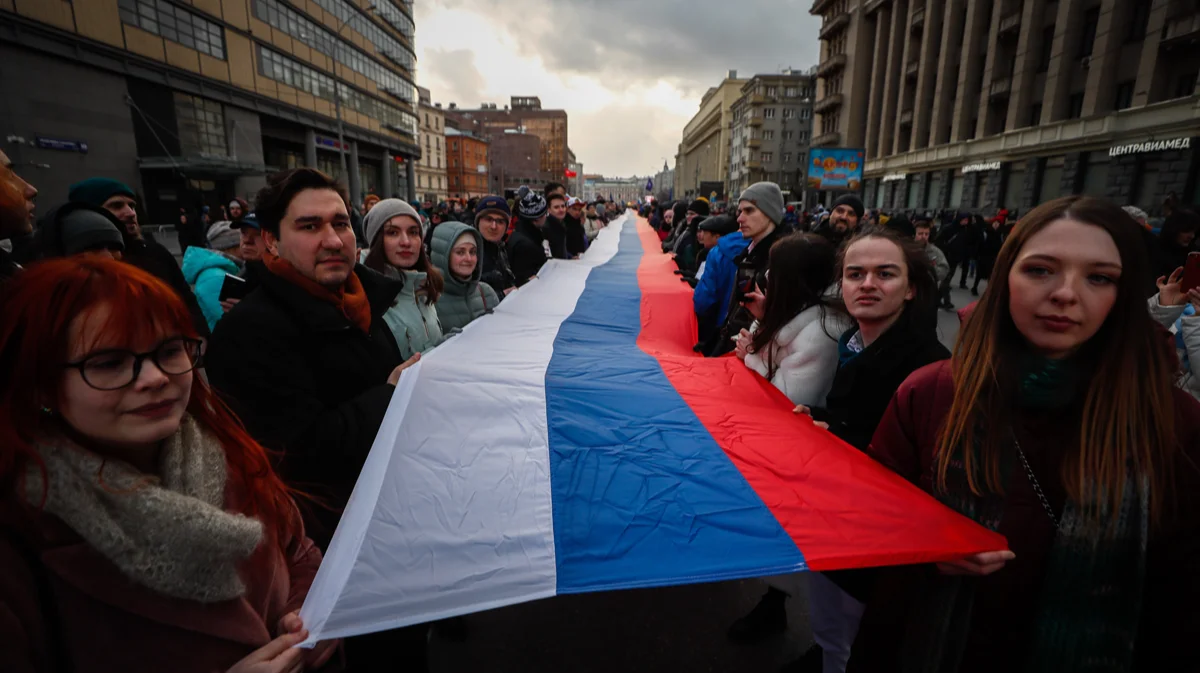
Participants in memory of Boris Nemtsov, dedicated to the fifth anniversary of his murder, Moscow, February 29, 2020. Photo: Yuri Kochetkov / EPA-EFE
On October 8, activists who seek the liberation of Boris Kagarlitsky hold an international conference of his name. Intellectuals and scientists from around the world will perform lectures: the philosophy professor Nancy Fraser from New York, professor at the Department of Sociology of Johannesburg University Patrick Bond, Grigory Yudin from Princeton University and many others. The conference organizers handed over to the Novaya Gazeta Europe a letter from Kagarlitsky, in which he talks about the global crisis of our time, ongoing wars, economics and the collapse of the usual world order in Western Europe, where the ultra -right are gaining more and more popularity. We publish this letter completely.
“Let's talk about current events,” writes Kagarlitsky, “it seems to me that, despite all the differences, the processes taking place in Russia and Israel are similar. We know that the current government needs a war that lasts as long as possible, since this is a condition for the political survival of the current government. A threat of political persecution hangs over Prime Minister Netanyahu. The end of the war will be both the end of the current ruling coalition, and, by and large, the beginning of serious political changes, which the current government cannot allow. As a result, it is easier to start a new war - now in Lebanon - how to finish the old one. Conservative policy has turned into a policy of war. In Russia, the situation is largely similar. Paradoxically, it does not matter how the military operations end. Circumstances in three years developed so that any completion of the so -called. The beginning of large -scale political changes in our state means. By the way, I suspect that this applies to Ukraine. One way or another, but the conservative faction in the leadership of the country now has only one goal: to maintain the current state of affairs as long as possible. And we can say that the only meaning to the continuation of the special operation is no longer in victory over Ukraine, but in the endlessly duty (preferably for several decades) continuation of the special operation. At the beginning of the military crisis, the Prochrevsky political scientists said that Russia needed ten years (which is identical with a decade of stability, which Stolypin dreamed of).
The trouble is that this does not happen. And it will not. Nowadays, even endless reproduction of the same situation actually changes the situation, creating new problems. Publishing polls show that moods are changing: people are tired. However, the power itself is much more tired and the economy is “tired”. You can “hold on” in such positions for a long time, but you cannot develop. There is no prospect, even for the elite. Therefore, in the structures of power, the “party of the world” is inevitably formed.
The paradox is that the conditional “party of war” cannot leave everything as it is. She needs to gain momentum in order to maintain control of the process at every round of confrontation. Look at the budget of Russia. If we assume that this is the budget of the state that wages a full -scale war, then the budget is very moderate. But if this is the budget of the state where peace and prosperity reign, and only somewhere on the western outskirts it is necessary to carry out a special operation, then the budget is catastrophic. For such a budget, on the one hand, it is necessary to carry out general mobilization, on the other hand, the budget is too “peaceful”. In other words, supporting the status quo, the system accumulates contradictions, risking them to get confused.
The fact that the conditional “party of the world” will ultimately be forced to triumph and take control of the situation, I have no doubt. The only question is how much time for this will be needed, how many people will die and suffer on both sides before they begin to take a strongly peaceful solution. But the main thing is not this, but the fact that a peaceful decision inevitably implies radical political changes that will come not after it, but with it. The current configuration of power will not leave other possibilities.
Of course, the liberal public, the “reasonable bureaucracy” and most of the society are in solid in the desire to return the good old days, when there was neither Covid, no special operation, nor war in Israel, in the gas sector and Livan. Return us 2019! Alas, at the obviousness of such a consensus, this cannot be done. Neither in Russia, nor in Ukraine, nor in Israel, nor in Western Europe, nor in the USA. All political and even social configurations have changed. In addition, the global economy is in the same dead end as politics. The neoliberal project has exhausted itself back in the 2008-2010s. However, part of the Western elites since the mid-2010s. In fact, he does the same as now at the military-political level in Israel and in Russia: they try to save and reproduce a system that no longer works at all costs. Such efforts are treated with each turn of the process more and more, require more and more resources, and again, unresolved problems and contradictions accumulate.
The successes of the extreme right in Europe and America, by the way, are explained by the same: these are forces advocating the preservation of the system from anti -systemic ideological positions. In a sense, this is the last political resource of conservatism, but the resource is extremely dangerous to use. So, changes are inevitable. We can make mistakes in the timing and pace, but our main trouble is not in this, but in the fact that over the years of expectation we lose the ability and habit of action. Time is now favorable for the left, but do the left needs of time meet the left needs? And will it happen that at the very moment when we are opened with wide opportunities, we will be confused and helpless?
In the history of Russia, it has repeatedly happened so that freedom fell into society unexpectedly, as a natural disaster. Naturally what I have above belongs not only to the left: we are so used to being helpless victims or embittered critics that any other role can be inorganic and incomprehensible.
We'll have to retrain. And the first step is now to end the culture of pessimism that has triumphed for many years among people who considered themselves carriers of advanced democratic values (both in the left and in the liberal sense). Pessimism and fatalistic humility are incompatible with responsibility. With the willingness to be not only spectators, but also participants, creators of social processes. But here it remains only to quote Hamlet: “Readiness is all” ”
In February 2024, the Court of Appeal of the Moscow Region tightened the punishment of Boris Kagarlitsky, previously guilty of “justification of terrorism” (Article 205.2 of the Criminal Code of the Russian Federation). The sociologist received five years of a penal colony, and is still in conclusion, despite the efforts of his supporters and a solid age: Kagarlitsky celebrated his 66th birthday in prison.