
Translated material
Ogazpromisli
Why “national treasure” became the most unprofitable company in Russia - says oil and gas analyst Mikhail Krutikhin*
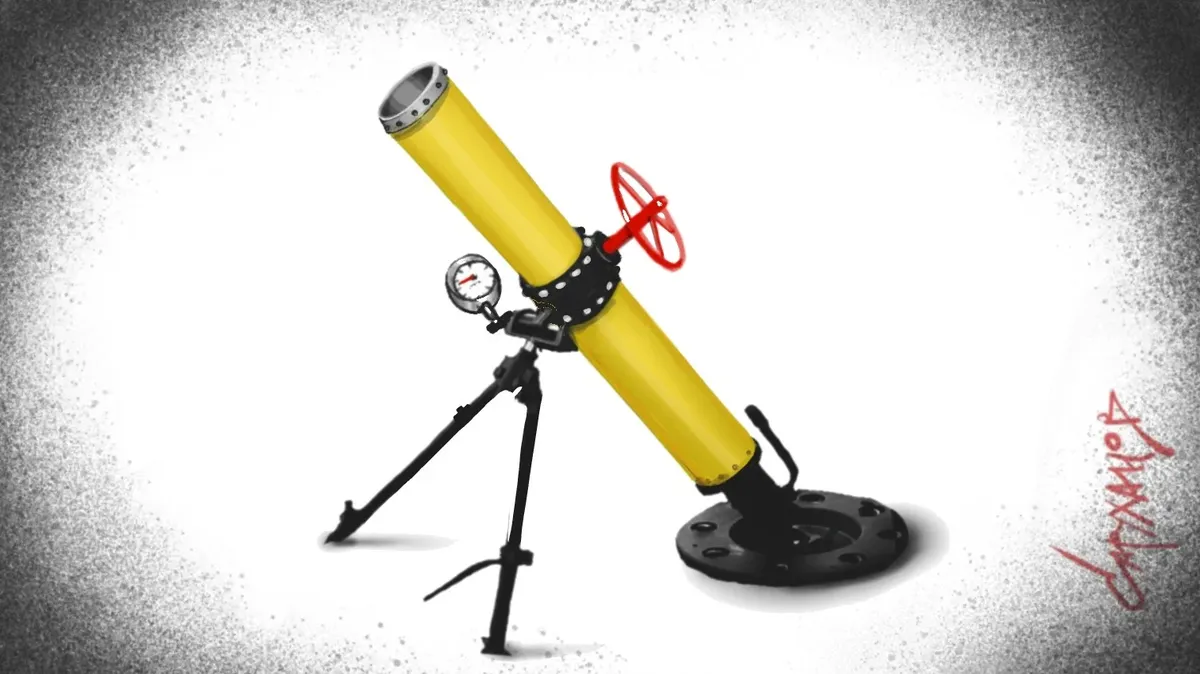
Illustration: Petr Sarukhanov / Novaya Gazeta
18+. THIS MATERIAL (INFORMATION) IS PRODUCED, DISTRIBUTED AND (OR) SENT BY FOREIGN AGENTS KRUTIKHIN MIKHAIL IVANOVICH AND BORUKHOVICH (TUMAKOVA) IRINA GRIGORIEVNA OR CONCERNES THE ACTIVITIES OF FOREIGN AGENTS KRUTIKHIN MIKH AILA IVANOVICH AND BORUKHOVICH (TUMAKOVA) IRINA GRIGORIEVNA.
The top ten most unprofitable companies in the country at the end of 2023, according to Forbes , were headed by Gazprom. In 2022, the “national treasure” was still making a profit - 1.3 trillion rubles, then something completely incomprehensible happened, and at the end of 2023 its net loss amounted to 583.1 billion rubles. True, analysts continue, in the financial statements for the first half of 2024, everything is fine again: net profit - 1.1 trillion. What is happening with Gazprom and how it will live in the future, says oil and gas analyst Mikhail Krutikhin*.
— Where did such a loss come from for Gazprom - more than half a trillion rubles? In general, the holding’s business is profitable; Gazprom should survive at the expense of Gazprom Neft. Why such losses?
— PJSC Gazprom is truly a group of companies under one umbrella. The gas company sought and, if I’m not mistaken, achieved that the general financial statements were taken into account, so that when analyzing profits it would not be visible that Gazprom was losing on gas production and sales. Everything is quite good with oil. There are other divisions that are not part of Gazprom Neft; they produce not only gas, but also oil and condensate, and they are also doing well in terms of oil.
All the main losses are due to the fact that Gazprom left Europe - its main market. I have seen materials in which, in my opinion, not very competent authors talk about how European companies, after the start of Russia’s [special operation] in Ukraine, began to refuse Russian gas. This is nonsense, it is not true, because Gazprom left on its own for political reasons, that is, on orders from the Kremlin.
— And this began, as far as I remember, back in the spring of 2021.
— This began in April 2021, when the decision was made to stop pumping gas into underground storage facilities owned by Gazprom in Germany, Austria, and other countries. This already began to cause panic in Europe, where no one refused Russian gas themselves.
There were no international embargoes, no boycott, everyone simply bought Russian gas until Gazprom received the order to “freeze Europe.”
Russian leaders spoke openly about this from high stands: now we will freeze them, they will capitulate. First, at Nord Stream it turned out that some Siemens turbine was allegedly out of order, then explosions occurred for an unknown reason.
- Well, the probable reason is known, it seems to me. Didn't the German police call her?
— Investigators in Denmark and Sweden came to the conclusion that this was a major operation that only the state could have done. And they didn’t find anyone specific who would be responsible for this. And the fact that someone descended to a depth of almost 80 meters with 400 kilograms of explosives...
- No, wait. The German prosecutor's office has issued an arrest warrant for a Ukrainian diver suspected of blowing up the Nord Stream pipeline.
“This is one of the theories; these conclusions do not seem convincing to me, and no one has yet been found guilty.
- Where does such a loss come from - more than half a billion rubles? When trade with Europe was still in full swing, it was known that about 20% of the produced gas was exported, the rest was sold on the domestic market. The domestic market hasn't gone away, has it?
— Indeed, Gazprom supplied more gas to the domestic market than for export. The whole question is what prices are on the domestic market. In fact, there is no market; prices on it are regulated by the state. Now tariffs are being increased for ordinary consumers who have gas in their kitchens, for industrial consumers, and for power plants. But the bulk of the gas is sold within the country at a low price, at which Gazprom is not very profitable to trade, so it covered losses from the domestic market through exports; cheap Russian gas was sold to Europe at a high price.
Now there is almost no source left to compensate for internal losses. And Gazprom has new projects in its investment program that need to be further financed. Moreover, funding is needed immediately. They learned to look at least ten years into the future and realized that they would not be able to fulfill contracts with the Chinese if they did not urgently save the Power of Siberia.
— The first “Power of Siberia”? What's wrong with her?
— These are not only my conclusions, other analysts wrote about this very convincingly, with documents in hand. The two fields, Kovykta and Chayanda, which feed the Power of Siberia, will not be able to produce as much gas as contracted for 30 years. In a few years, problems will begin there, which means gas must be supplied from somewhere else. The hope was for “Power of Siberia - 2”: if they connect it, gas from Yamal will also go to China, helping to fulfill contracts. But the Chinese did not meet Putin halfway and said that they did not need another gas pipeline.
This means that Gazprom needs to get gas from somewhere for the Power of Siberia. And he went back to the plan he had before. I have these documents. In addition to the two fields that I mentioned, fields in Yakutia should be connected.
These deposits need to be developed. According to the plan, they were supposed to connect in 2027 and beyond. In addition, Gazprom needs to save the project of the Far Eastern contract with the Chinese for the supply of 10 billion cubic meters per year, that is, to get this gas from somewhere. To this end, they have already begun to build a gas pipeline that will connect with the Sakhalin-Khabarovsk-Vladivostok line. That's why
Gazprom cannot sit still; it is forced to invest money in large projects because it has signed contracts for which it does not have gas.
— Gazprom has always had many “non-core assets”. What can they give up, what expenses are they willing to cut?
- Yes, here are examples: Gazprom built its “corn” in St. Petersburg on Okhta, it boasted of recreation centers for big bosses, and announced a competition there for the supply of a solarium for horses. He has an outrageously bloated staff, and highly paid ones; about half a million people work there. And what are the salaries of the bosses? Have you seen what they are?
- I'm afraid to imagine.
— These are absolutely unjustified administrative costs. In addition, Gazprom must also pay a “[special operation] tax.” Last year he was forced to pay almost one and a half trillion. First, as a one-time increase in the mineral extraction tax. Then they began to introduce such increases to him every month. Now there are fluctuations: introduce - do not introduce, cancel - do not cancel. In general, Gazprom also has such an expense item. In administrative expenses I also include what is conditionally included under the heading “kickbacks”, as I will call it. They have a lot of unproductive articles.
At one time, analyst Mikhail Korchemkin calculated several Gazprom projects and showed that laying a kilometer of gas pipelines costs on average three times more than similar projects in any other country in the world. That is, there are inflated estimates for everything possible, unnecessary gas pipelines and other unnecessary objects are presented as necessary.

— When losses were discovered, did they begin to cut back on any of these projects?
- I don’t know what’s happening now. But Gazprom had amazing expenses that could not have happened. Here's another example for you. They have an old, Soviet-era system for supplying gas from the Yamalo-Nenets Autonomous Okrug, where the main center of gas production in Russia is located, to the western borders and further to consumers in Europe.
The power of this system is twice as much as Europe needed before [the special operation]. They could connect the large Bovanenkovskoye field to this network in Yamburg, that is, lay a pipe about 300 kilometers and connect it to the old, fully operational gas pipeline network. But they decided instead to build a new gas transport corridor - a very complex one, eight lines. I have a document signed by Miller and the governor of the Yamalo-Nenets Autonomous Okrug, it is dated January 2008, it contains a chapter with financial calculations. This document says: just the construction of a gas transport corridor 2,200 kilometers long from the Bovanenkovskoye field to Torzhok costs 92 billion dollars. And they built it, although it was not needed at all. But those who built the gas pipeline with such inflated estimates profited very well from it.
- It’s already been built, that is, it can’t be shortened. What can Gazprom give up to reduce losses? Do they have anything left that can be cut?
— For example, they started a big project in Ust-Luga. It was planned to supply so-called wet gas through one or two lines from this gas transport corridor. This is a gas that contains different components: ethane, propane, butane, and so on. In Ust-Luga they wanted to build a gas chemical plant to produce various products from this gas. Plus - to build a gas liquefaction plant there with a capacity of 13 million tons per year and from there supply liquefied gas throughout the world. An absolutely unknown company was chosen as a partner. And with this company, Gazprom decided to build its own grandiose enterprise, which, in principle, no one really needed.
— What is bad about such an enterprise, why is it not needed?
— Firstly, supplying this “liquid gas” over long distances is very dangerous; there are known cases of terrible accidents. Secondly, it is not possible to supply liquefied natural gas in large volumes from the Baltic Sea. This is a shallow sea, Ust-Luga is a very shallow port, where the fairway is covered with sand; a normal gas carrier will not fit there. This means that you need to build a bunch of small ships and use them to transport gas outside the Baltic through the Danish straits, somewhere to reload it onto large ships. This is not a commercial project at all; it immediately looks very, very unprofitable. But the money went to him. Everything stopped only when it became clear that Gazprom did not have the technology for this, and because of the sanctions, no one would provide these technologies.
— They are stopping this forcedly, it turns out, and not to save money?
- Not out of savings. Now they are shouting that soon, literally just about, they will begin gas production at the Yuzhno-Kirinskoye field near Sakhalin. How will they start if, willy-nilly, they require underwater production complexes, which Gazprom also does not have? All these technologies can only be provided by companies associated with the United States, but due to sanctions they refuse. What does Gazprom do then? Well, I would stop and wait until [the special operation] is over and the sanctions are lifted. But no. They are throwing huge forces there to continue drilling wells. They drill a well from a floating platform without reaching the gas layer. Then they stop it all, bottle it up and move on. A lot of money is being invested.
- Why?
- This is a state-owned company. She does not work for the final result, but uses the money while it is there, uses the allocated funds.
- But I’m asking about something else. Now, it would seem, there are no allocated funds, but there are huge losses...
- You still need to spend money. Everything continues.
— They don’t save?
“Perhaps they started saving somewhere.” But there is still money, no one has cut such expenses when something can still be cut on a grandiose project.
— In a normal situation, such things should lead to bankruptcy of the company. But it is clear that Gazprom will not be allowed to go bankrupt. What could all this lead to?
— Gazprom is still making some borrowings on the domestic market, it has such an opportunity. Secondly, he is counting on receiving some money from the National Welfare Fund; it is unknown how long this fund will last. But while there is a flow of state money, the state company actually receives it. It turns out that this is not a commercial company: when it is unprofitable, money goes to it, money goes to it - it needs to be mastered. Therefore, Gazprom is, on the one hand, a completely cultural company; it employs half a million people and supplies Russia and some foreign consumers with gas. And there is another “Gazprom” - a tool for cutting money. This is also a very important function.
— Which function is more important to its functionaries?
“I don’t even know which is more important.” But Gazprom had a third function: it was a political instrument. By manipulating prices and volumes of supplies to Europe, he created a “camp of allies” of Russia there. Why is there such a powerful pro-Russian lobby in Hungary, Austria, and Slovakia now? Because we supply gas there. We cannot, they say there, go against Putin, because he gives us gas. This is an instrument of political blackmail and pressure.
- But this has also become less relevant? If Ukraine does not extend the gas transit agreement after December 31, will Russia lose these “allies” too?
— Nothing is clear with Ukraine yet. There are different opinions on this matter in Kyiv. But Gazprom has indeed lost this function to a large extent.
The Europeans realized that they were being “frozen” and decided to resist. It cost them dearly, but they created a system of uninterrupted gas supply; now they simply don’t need Gazprom.

Except for a few countries that did nothing to join this system. These are Austria, Hungary and Serbia, which is not part of the EU.
— And Slovakia too?
— In Slovakia the situation is easier. And Austria, if it thinks about it, can receive gas from several sources at once; after all, a more or less unified gas supply system for Europe has been formed; gas can be bought from traders in the center of Europe through existing hubs without relying on Gazprom.
— In any case, Gazprom’s political function is greatly reduced. Given the losses he incurs, does he still have the role of a “national treasure”?
- He never was. Gazprom would be much more efficient if there were a separate gas pipeline company that managed the country's unified gas supply system. It would be a natural monopolist, although in many countries “non-monopolies” work just fine. Well, let there be a monopolist. Like Transneft, which operates efficiently, pumps oil and petroleum products through pipes throughout the country. Gazprom could have the same system.
— Only gas transportation?
- Certainly. A gas transportation company spun off from Gazprom could play the same role. But gas production enterprises could exist as separate companies, work on a territorial basis, say, and we could see which of them is more efficient, they could compete with each other. And there would be separate sales companies that would buy gas and sell it further, as is done in many countries. In Europe, for example, in Germany, any household has the opportunity to enter into a contract with the supplier whose prices are more attractive. This would create a normal gas market.
- Yes, but the function that you defined with the word “rollback” would disappear.
- This would not have happened. But there would be competition, just like in a normal market.
- Disgrace.
- Of course, it’s a disgrace, because greedy comrades would lose the opportunity to receive additional income.
- Well, now - losses, the most unprofitable company in the country. Will this force Gazprom to undertake some reforms, even if not as radical as you propose?
- No. The last attempt at reform was made in 2012. Then they proposed to do it approximately according to the same scheme as I described. But they came to Putin from the Ministry of Finance and Gazprom. Gazprom members announced: we have a responsibility to supply the country with gas, and if reform suddenly begins, we do not rule out interruptions and social tension. And the Ministry of Finance added: with any reform of this scale, taxes will be reduced for some time. And Putin rejected all proposals for reform.
— Will the liberalization of gas prices within the country save Gazprom if we are talking about a strong rise in prices?
— I think this will save not Gazprom, but part of the Russian budget. What does Putin need now? Money to continue [the special operation]. This part of the money will still be taken away from Gazprom. They’ll leave some to feed the bosses, and then get out as best you can.
— So, raising gas prices for the population will also be necessary not to save the “national treasure”, but for the existing policy?
- Certainly. The priority is filling the budget.