
Translated material
Decommissioned-2
“Foreign agent” writers: reasoning about why they were included in the list and what went wrong
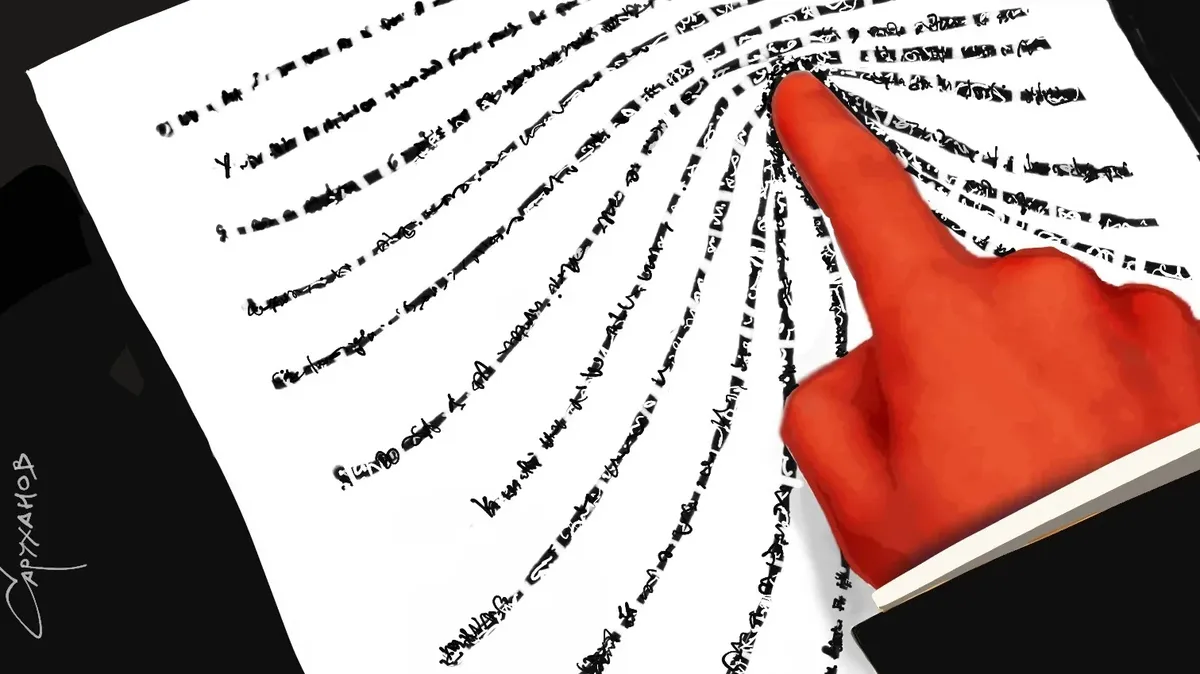
Petr Sarukhanov / Novaya Gazeta
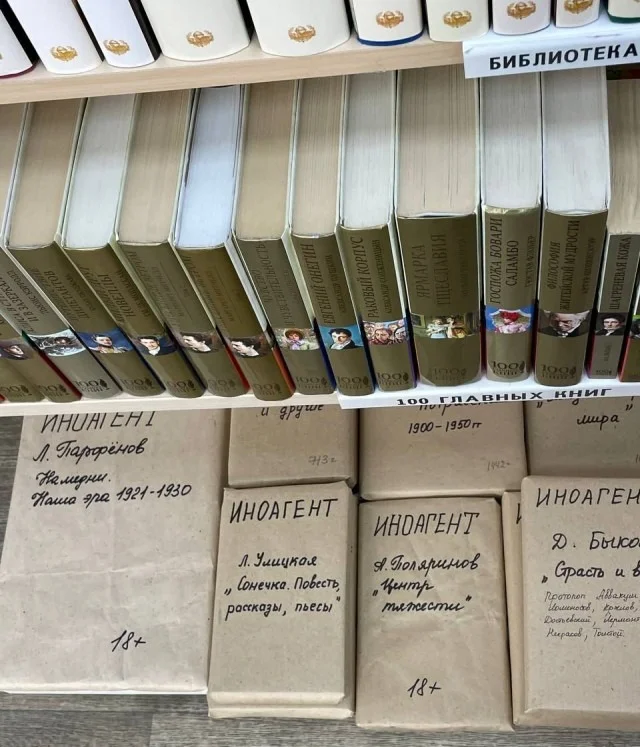
Today, the register of foreign agents already includes more than 40 names of writers, poets, publicists and generally authors who have published at least several of their own books, plus one founder of an independent publishing house. It seems that not a single truly major Russian author, who would be known both here and abroad, and whose books would be kept in all libraries of the country, has remained unwritten off. By the way, this total census made librarians think about many things: in the article “New adventures of Erast Fandorin in library collections: the practice of libraries working with works of foreign agents” (“University Book”, authors - Petrusenko and Eidemiller), RNL employees continue to complain that no one I still haven’t given a clear order whether to issue “harmful” books to readers or not. As we remember, the bill on clearing libraries of “foreign agency” literature had already begun to be adopted in the summer, but since then it has remained stuck at the first reading stage - apparently due to insoluble legal contradictions, of which there are too many in its text.
But now we are not talking about libraries yearning for commands. The massiveness of the census of the literary population and the significance of the names on the list are an occasion to think about what the status of a “foreign agent” writer has become for us in general and how attitudes towards it have changed over the past three years.
What did you want to do
In the novel by Dmitry Bykov* “Written Off,” the plot is built around the fact that random people are included in some incomprehensible lists, but they do not know why, for what purpose and according to what criteria. They don’t even know what will happen to them for this: they will be shot or rewarded. The register of “foreign agents” - along with the principles by which it is formed - is something very similar to the continuation of this novel, such as “Decommissioned-2”.
The status of a “foreign agent” is now commonly compared with the Soviet stigma of “enemy of the people” (or, as an option, “traitor to the motherland”), which was applied as casually and groundlessly as it now happens with “foreign agency.” Previously, the basis - at least formally - for inclusion in this register was “financing from abroad”, and the amount of this financing did not matter; you could get 200 rubles. Now the criteria for recognition as an “enemy” are completely blurred: the list can include not only someone who has not received any money from abroad, but also someone who—like the writer Alexander Genis*, for example—does not have Russian citizenship at all.
Commenting on his new status, Genis recalled that his grandfather was once recognized as an “enemy of the people” with the wording “an agent of foreign imperialism.” Find, so to speak, ten differences.
But still, there is one significant difference between today’s “foreign agents” and the then “traitors to the motherland”: the stigma of the enemy then, during the years of revolution and great terror, was synonymous with arrest and execution. Now only a few “foreign agent” writers—such as Boris Akunin* and Mikhail Zygar*—are in the enchantingly absurd status of being arrested in absentia. That is, labeling has now changed its purpose: the point of being recognized as a “foreign agent” is not to actually endanger people’s lives, but to classify them.
Categorization (unification, division into classes, ranks, types) is convenient because it gives those who divide a sense of order: here, they say, we have all the moves written down, all the masks have been torn off, we have this enemy in this cell, and that one in that cell , we manage everything, we can do everything, there is complete order in the country. On the other hand, labeling is also convenient for them because a person with such a label - and even more so a person of such a subtle mental organization as writers and poets - can feel like a leper: he is not guilty of anything, but his name is tarnished.
It is impossible to prove the absence of guilt, because it is not clear what the accusation is based on, it is useless to challenge the status in court, but while remaining in Russia, you constantly have to report to the “top” in your own activities - and it is impossible to pay with a bank card even with a taxi driver, because suddenly he after that they will be convicted of helping a “foreign agent.” And if the author did not stay in the country, then the psychological effect of being included in the register can still be quite convincing: the “foreign agent” writer, as it were, speaks not on his own behalf, but on behalf of some Western customer, “works off a grant”, belongs to to the mysterious “foreign agent” order - that is, in other words, those entering the register are trying to dissolve the personality of a particular author as much as possible in some abstract group of “enemies”. For writers whose view of the world is by definition individualistic (this is a requirement of the profession), such rowing with one brush can feel painful.
But first of all, of course, the lists are clearly formed not for those who compile them, and not for the “decommissioned” themselves, but for the readers.
All kinds of registries - not only “foreign agency”, but also “extremist”, for example - look like another attempt by the state to decide everything for the “people”, to build a clear coordinate system: this is bad, this is good, there are enemies there, there are “Friends”, that’s it simple, but thinking is harmful.
In her recent article on neo-feudalism, Novaya columnist Elena Panfilova described how the system of interaction between the Russian government and the “people” is now being built: how a clear class vertical is being built, how methods of transition from one social caste to another are being blocked, like the state, crawling into school curricula (and in literature too), forms a new serfdom. So, the formation of a caste of “foreign agents” is, in my opinion, a direct continuation of this neo-feudal policy: on the one hand, society begins to clearly divide into “us” and “strangers”, into “bad” and “good”, and on the other hand, the degree of “ the “badness” and “goodness” of the authors becomes predetermined, their presence in cultural life is limited in all ways, and as a result the reader, especially those who do not understand politics, finds themselves locked in the cultural space that the state has fenced off for them.
What did you do
But all of the above are possible goals of “list” politics (at least that’s how I imagine them). The effects of this policy are, to put it mildly, slightly different from what those who implement it would clearly like to achieve. Probably, many have encountered how on Fridays Facebook** begins to fill with joyful comments congratulating new “foreign agents” on being awarded an honorary title, and words about the fact that finally all the decent people are assembled. This is an effect that the Ministry of Justice could hardly have planned: Friday lists of “foreign agents” have long been perceived as premium, and “foreign agency” itself has become something like the title of Honored Artist (higher only is the popular one, that is, “extremist and terrorist”). Moreover, these quite clear analogies appeared three years ago - even then, complaints were heard in the writing community like: “Why was he recognized, but not me? Am I writing that badly?
Over the course of three years, this attitude towards “foreign agency” as a title has been preserved, although it has faded greatly - the list has expanded too much. Now you see a different reaction much more often: “X foreign agent? How is it not? Still?!" The sincere surprise of some authors, publishers, publicists: “for some reason they still haven’t recognized me” - has in itself become the norm, and has shown that the classification of writers according to the principle of “friend or foe” is also already perceived as normal, but falling out of this classification, on the contrary, is considered a deviation.
All this now resembles not the branding of “enemies of the people”, but the division into proletarian and non-proletarian writers in the 20s of the twentieth century. Both then and now, the struggle between class aliens and class close ones unfolded on the pages of books and periodicals - and just as then, now interest in literature is more acute than ever, because books and the media have become a battlefield. The biggest difference between the twenties of a hundred years ago and today is only one thing: then the Civil War moved from life to the pages of literature, and now, apparently, it begins with the printed word.
AUTHORS - “Foreign agents” (AS OF OCTOBER 11, 2024)
Alexandra Arkhipova - from May 27, 2023Arkady Babchenko - from April 7, 2023
Ilya Barabanov - from April 12, 2024
Natalya Baranova - from May 6, 2022
Dmitry Bykov - from July 29, 2022
Victor Vakhshtain - from April 22, 2022
Mikhail Weller - since April 5, 2024
Boris Vishnevsky - from May 29, 2024
Alexander Genis - from September 27, 2024
Linor Goralik - from August 18, 2023
Dmitry Glukhovsky - from October 7, 2022
Boris Grebenshchikov - from June 30, 2023
Sergey Gulyaev - from September 27, 2024
Ekaterina Dudko (pseudonym - Katerina Silvanova ) - since February 3, 2023
Mikhail Zygar - from October 21, 2022
Boris Kagarlitsky - from May 6, 2022
Anastasia Kazantseva (pseudonym - Asya Kazantseva ) - since April 12, 2024
Vladimir Kara-Murza - from April 22, 2022
Oleg Kashin - from June 3, 2022
Andrey Kolesnikov - from December 23, 2022
Yulia Latynina - from September 9, 2022
Andrey Makarevich - from November 25, 2022
Alexander Minkin - since January 12, 2024
Rostislav Murzagulov - from December 9, 2022
Anna Narinskaya - from February 16, 2024
Alexander Nevzorov - from April 22, 2022
Sergey Parkhomenko - from April 22, 2022
Vladimir Pastukhov - from May 5, 2023
Evgeniy Ponasenkov - from April 1, 2022
Elena Prokasheva (pseudonym - Elena Malisova ) - since February 3, 2023
Oleg Radzinsky - from September 1, 2023
Alexander Rodnyansky - from October 21, 2022
Maria Sabunaeva - from April 15, 2022
Alexey Semenov - from April 15, 2022
Daria Serenko - from January 27, 2023
Tatyana Sotnikova (pseudonym - Anna Berseneva ) - since August 18, 2023
Lyudmila Ulitskaya - from March 1, 2024
Andrey Filimonov - since April 8, 2022
Ivan Filippov - from April 12, 2024
Grigory Chkhartashvili - (pseudonym - Boris Akunin ) - since January 13, 2024
Viktor Shenderovich - from December 30, 2021
Ekaterina Shulman - from April 15, 2022
Tamara Eidelman - from September 9, 2022
Alexander Etkind - from September 27, 2024
- founder of Freedom Letters Georgy Urushadze - since September 27, 2024.
There are very few people left who are not “foreign agents” who are read. And those who are “ours”, few people know them, unless they write about getting caught.