
Translated material
"Fireworks in the Swamp"
The hidden norm of Russian galleries: about two St. Petersburg exhibitions
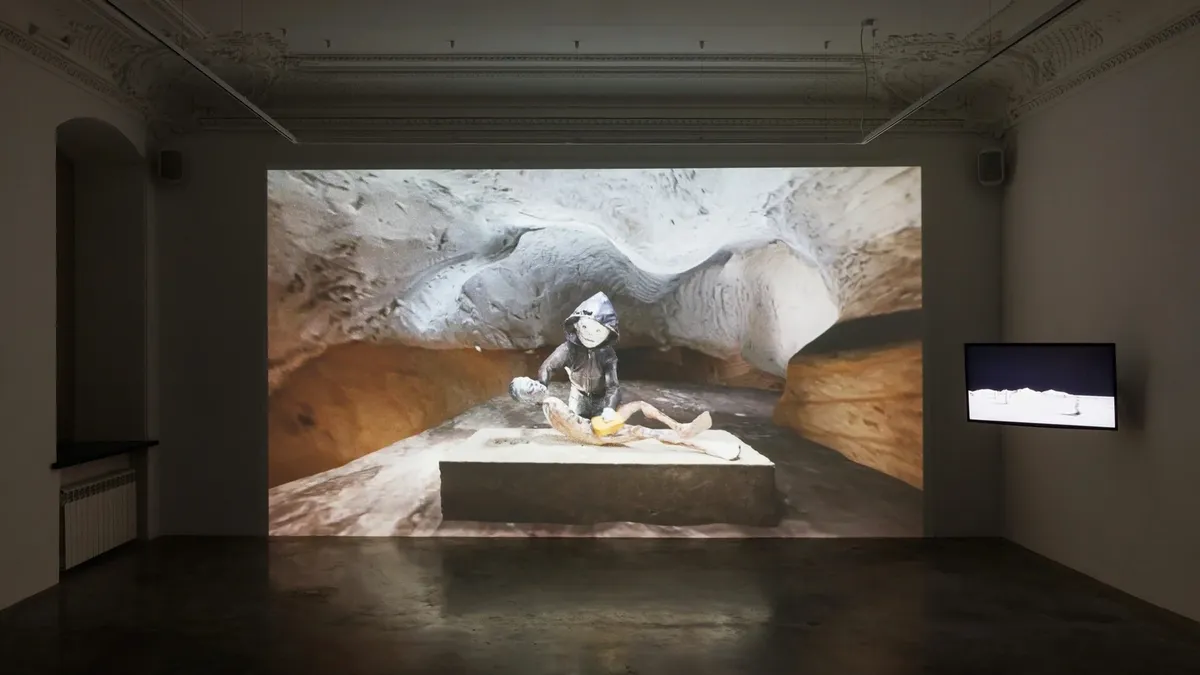
Photo: Ivan Sorokin / mythgallery.art
Two St. Petersburg galleries of contemporary art - MYTH and Third Place - are hosting the exhibitions "Hidden" and "Norma". Both of them are trying to comprehend and express our “today” - and both very clearly reflect how the Russian sovrisk is trying to work with this “today”.
There is an established expression in English - hidden gem. It can be translated into Russian as “hidden treasure”, something hidden or simply unnoticeable, but of great value. Gem is a precious stone, and it seems to me that it is precisely this multifaceted crystal that makes sense to talk about in the context of the exhibition “Hidden”, currently taking place in the St. Petersburg gallery “Third Place”.
The exhibition was distributed throughout the halls of the ancient mansion, and each of the 12 works took its place in it. The installations are completely self-sufficient - a virtual partition has formed around them, separating one work from another. Here, for example, is a series by Vladimir Potapov, who addressed the events of 50 years ago - the so-called Bulldozer Exhibition: the scandalous incident that occurred on September 15, 1974 will forever remain in history as a turning point in the development of unofficial art in the USSR. Potapov raises the question of the modern position of painting in artistic culture and expresses it through special work with a layer of paint.
His artistic technique is an old method of secret writing: images are applied to paper with milk or lemon juice, which appears if the sheet on which such a code is applied is held over a fire for some time.
The result is several graphic compositions of an ocher hue, exactly repeating photographs taken 50 years ago in which bulldozers disperse exhibitions of unofficial artists.
In other words, fire, a destructive force that destroys everything in its path, becomes an artistic means, a technique of Potapov’s author’s technique - just like the actions of the Soviet authorities, which suppressed and destroyed the artistic heritage of nonconformists. At the same time, it was precisely these actions that gave this movement the road to great life, provoking a sensation in the world media and serving as the starting point for organizing the largest legal exhibitions of unofficial art. In fact, it was thanks to this unplanned “promotion” that invisible underground practitioners came to light and many artists gained international fame.
Looking at the white sheets that Vladimir Potapov alternates with “developed” graphics, I want to talk about the new relevance of the underground, about the practices of mimicry and forced silence, about secret attempts at a real dialogue with the viewer, which some artists are trying to conduct today. In general, the current trend towards retrospectiveness, set by museums and large galleries, found its expression at the exhibition - only this expression, unlike similar cases in large government institutions, turned out to be critical: just look at the value of a drawn hundred-ruble bill, in the center of which there is an excavator grinning with a bucket. The banknote seems contemporary, just like the events of 50 years ago.
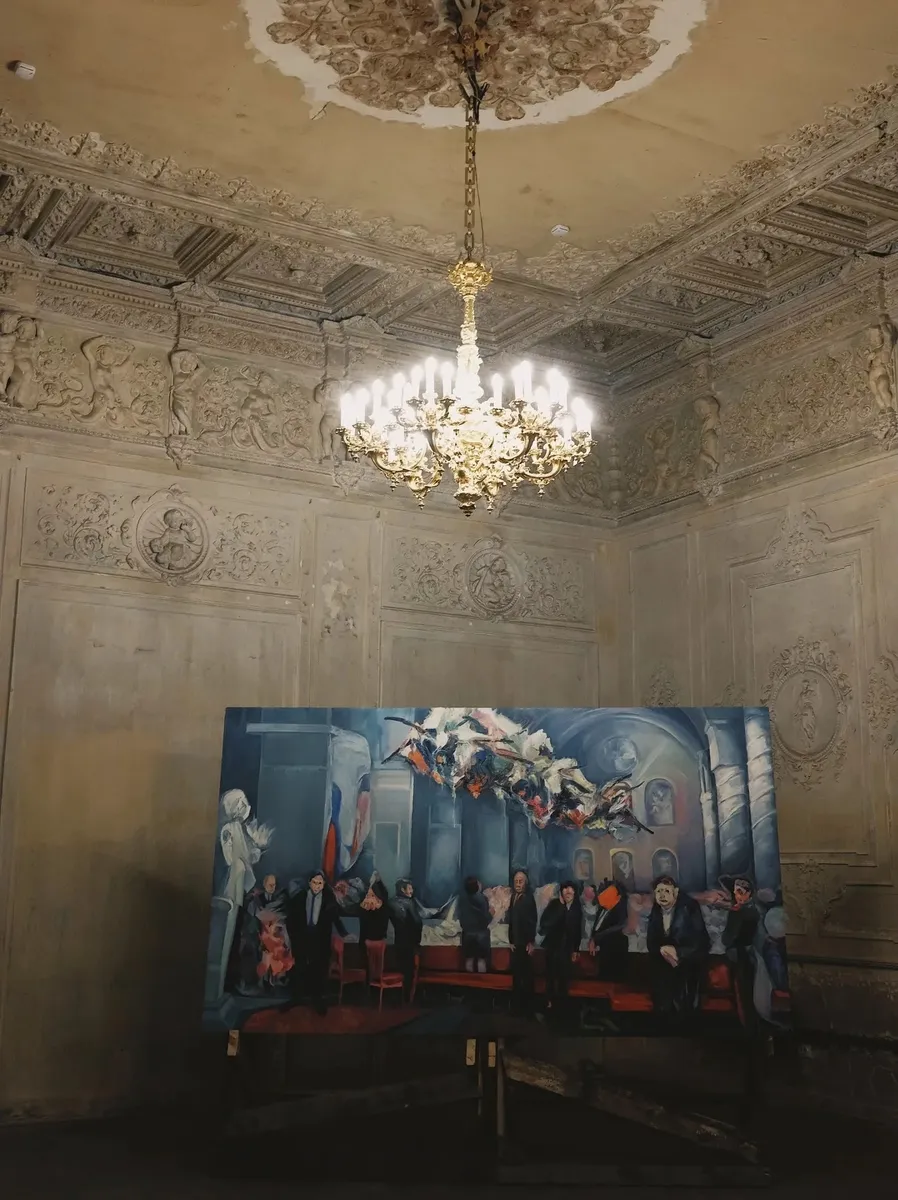
Mika Plutitskaya’s painting “A Toast to the Great Russian People”, presented in the large ballroom, fits into the same trend. The huge canvas in scope is reminiscent of socialist realism paintings - and this, of course, is no coincidence: the artist actualizes the Soviet myth and its embodiment in socialist realism in her work. The composition is a large hall in which a ceremonial meeting of the highest officials of power is taking place, one of whom, apparently, is making a toast. The work is based on the painting of the same name by artist Mikhail Khmelko from 1947 - a ceremonial portrait depicting the leadership of the USSR during a banquet in the St. George's Hall of the Kremlin at the end of May 1945. Stalin in the picture makes the very speech that was subsequently published in edited form in Soviet newspapers (Stalin’s words about the mistakes of the beginning of the war were removed from the text and emphasis was placed on the leading role of the Russian people).
The homage performed by Plutitskaya is ironic:
In contrast to Stalin’s carefully depicted dining companions, the characters in the painting from the exhibition in “The Third Place” become an intermediate link between historical figures and creatures from the paintings of Hieronymus Bosch.
Their features are blurry, their contours are not obvious, and there are practically no portrait similarities with real people, with the exception of the central figure who takes the place of Stalin and peers at the viewer. Nearby is a creature selflessly absorbing vodka straight from its throat. There is a feeling of an inappropriate feast during the plague, a booth, a Bakhtinian carnival - a reality reflected in a distorting mirror.
Plutitskaya’s huge canvas, for all its socialist realist scale, is only part of the composition, which also includes an installation by Andrei Kuzkin installed opposite. Kuzkin is known for his radical and at the same time formally restrained artistic gestures. The work is from the series “Everything is ahead” - 2011, when the artist, wanting to conduct a radical experiment, initiated a real rite of purification by walling up his clothes, all his previous works and his documents in large metal cubes. After 2022, black metal cubes with rusty streaks on the sides began to gather new associations around themselves. Referring to the victims of a special operation or to the abandoned material artifacts of pre-Relocant life, walled up in a world to which it is not possible to return, fragments of Kuzkin’s installation silently coexist with the huge canvas and catch the pensive or simply unfocused gaze of the official in the gray suit depicted in the center from Mika’s painting Plutitskaya.
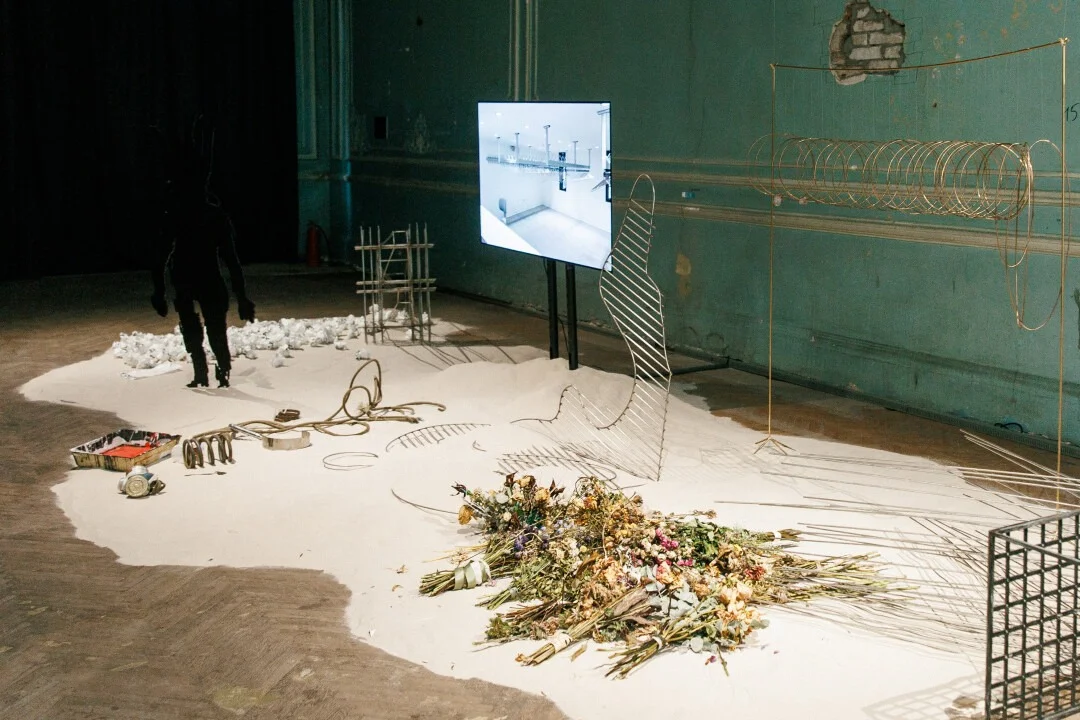
In the darkened area behind the ballroom are two small rooms separated by a black curtain. One of them presents the work of Ruslan Polanin “Ghosts of Emigration”. In the center of the room there is a plasma screen on which short videos recorded by the artist himself are broadcast. Judging by the format, the video was originally intended for Telegram: in a series of several circles, Polanin complains about the difficulties in adapting to life in new conditions, reflects on the importance of knowing the language of the country he came to, shares the consequences of a small flood that occurred in his apartment, — right under the ceiling, on the cornice, Ruslan saw portraits emerging from the water on the plaster, subtle sketches of someone’s faces. Later it becomes clear that these are the faces of emigrants from previous waves. Fitting into the long-standing tradition of exodus from the country becomes the core around which the author builds his reflection.
At the “Hidden” exhibition, the whistle of a steamship sounds - this sound becomes a symbol of the first waves of emigration, and the steamer - a symbol of an inexorable change of fate.
In the last room - the cinema hall - half of the space is occupied by a large screen on which a video shot by Sergei Prokofiev is broadcast. It's called "Fireworks in the Swamp." The viewer entering this room, as if having reached the last level of a long game, can sit in a chair and carefully peer into the swamps captured by the artist. At first it may seem that nothing is happening in the frame, but after a minute this illusion dissipates, and the quiet pool is illuminated by bright scarlet flashes of pyrotechnics. The silence of the swamp is broken by the deafening sounds of cannonade, and the twilight is replaced by a glow, which, after the end of the volleys, continues, fading, to hold the viewer’s attention.
At the “Hidden” exhibition, one of the announced works was never placed in the halls. The work of a team of famous Russian artists, the AES+F collective, could become the highlight of the program, but visitors to the project cannot see it yet. The first thing the administrators say at the entrance is that this is temporary. If this is true, then with the appearance of the work the exhibition will only benefit, but, as we know, there is nothing more eternal than temporary: after 2022, AES+F did not make a single exhibition in Russia and did not present itself on numerous prefabricated projects, so it its appearance on the exhibition poster was a surprise, but its absence looks like an expected pattern.
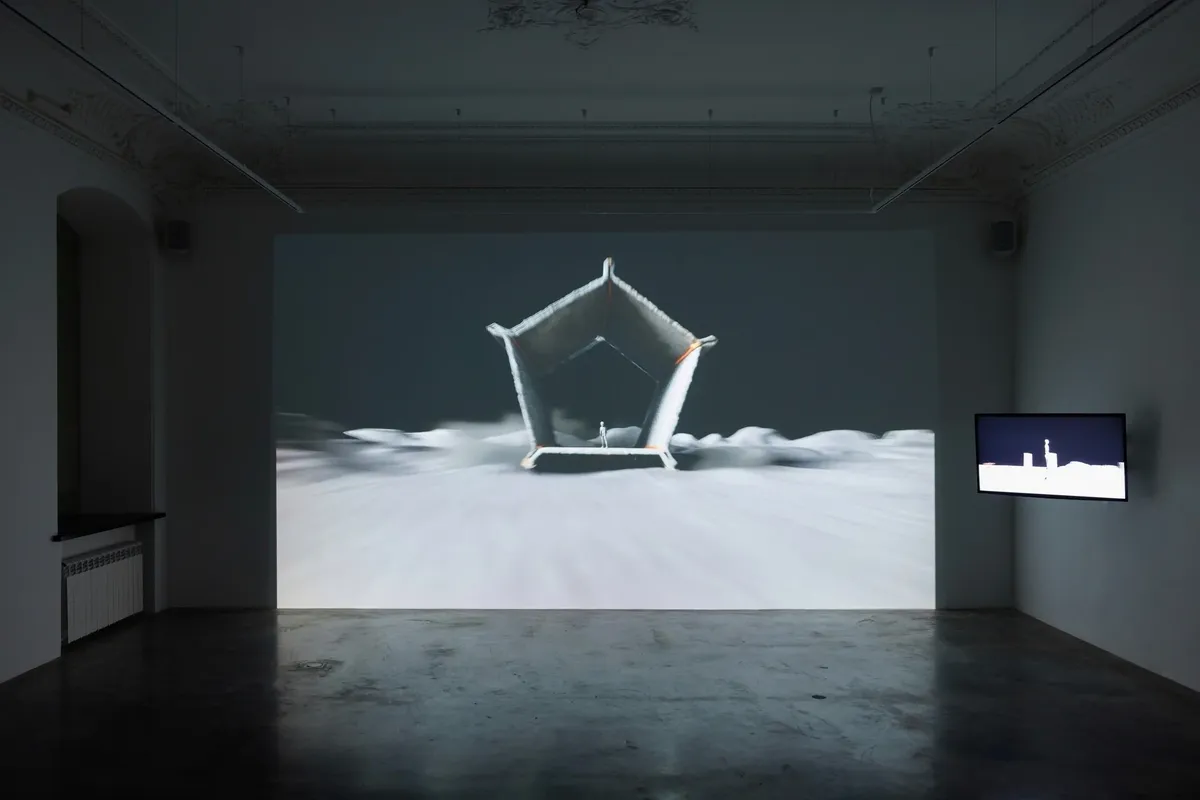
“Hidden” shows that the news background has become the norm for art. The new norm, of course, is not formed on its own, but is formed through the media and through the machine of repression, the work of which becomes our everyday life. Another exhibition of the same name in the MYTH gallery is dedicated to the topic of norms. Artist Nikita Seleznev, one of the residents of this gallery, left Russia in 2022, but the gallery owners still managed to put together the project and show new sculpture, graphics and video art.
This is not the first time Seleznev has addressed the topic of the Ukrainian conflict. For example, in one of his previous series he worked with the image of Christ, compassionate towards civilians, and within the framework of a new project he discusses how the concept of norm has changed in the everyday world. Catastrophic changes that seem to have happened spontaneously in modern society are the acceptance and inclusion in everyday life of constant searches at metro stations or military equipment on the streets of villages and cities.
The picture of the surrounding reality is very different from the state norm that is broadcast by the pro-government media, and the exhibition at MYTH shows the artist’s reaction to these contradictions.
Near one of the sculptures on the wall - a drawing on concrete framed by a metal rectangle, an image of a human face: eyes rolled back, mouth open - one recalls portraits of mental hospital patients, a series of which were created by the young Soviet artist Vladimir Yashke during his own imprisonment in such an institution. The centerpiece of the exhibition, a two-channel video, shows how this sculpture finds its place in a virtual post-apocalyptic landscape. The video demonstrates the world of Norma, which, according to the explanatory text for the exhibition, implies a lot: this is both a reference to Stephen King’s story “The Man Who Loved Flowers” (in this story, Norma is the name of the girl whom the maniac is looking for), and the first novel of the same name by the writer Vladimir Sorokin, where the absurdity of the concept of norm in late Soviet society was shown. This is also a reference to the opera by Vincenzo Bellini, where Norma was the name of a Druid priestess who was preparing an uprising against the Romans and secretly dreaming of peace.
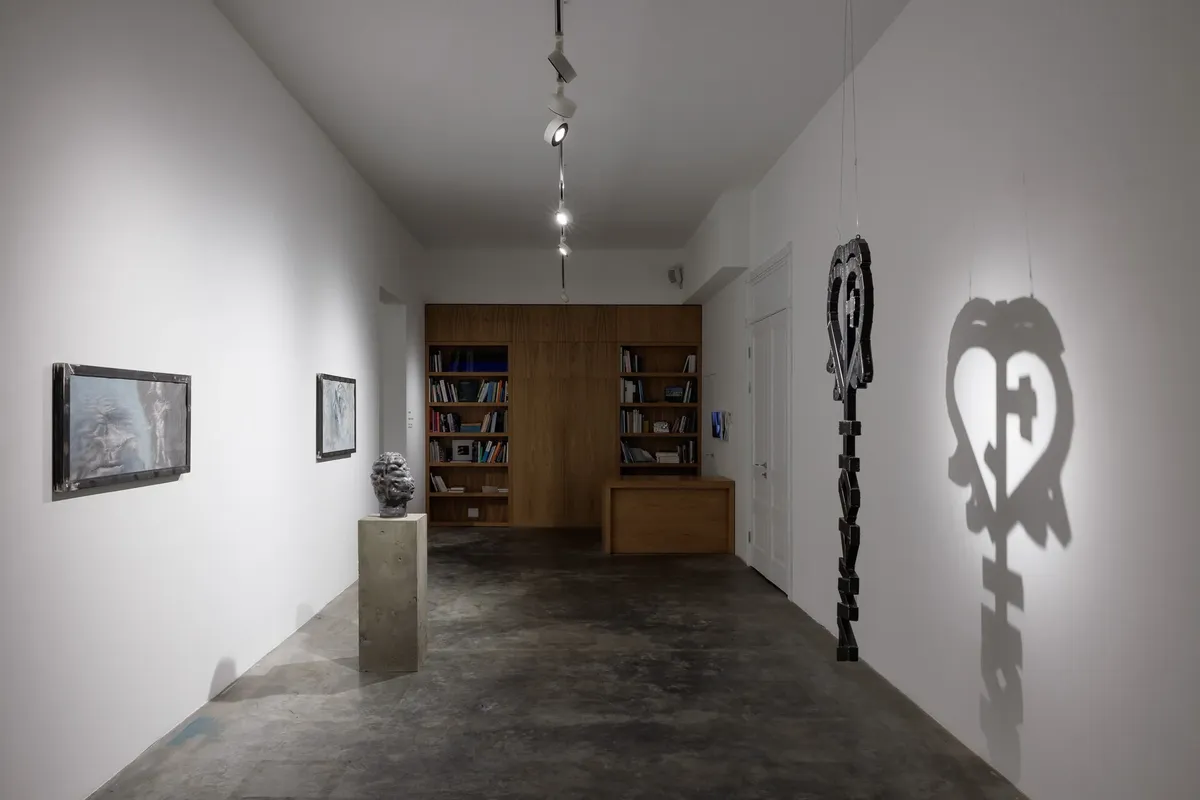
The world of Seleznev’s Norma is a bare gray earth, actually the lunar surface. The universe presented by Seleznev provokes reflection on the new rules of the game established in society. An artist who is able to look at the state of things “from a general perspective” shows the extreme absurdity of everyday life. This imposed absurdity, which has become the background of everyday routine, from the inside out is simply a destroyed world of hundreds of thousands of people, a world in which the generation to which the artist himself belongs spent decades building their lives.
In general, the new norm in today's Russian art, which both exhibitions demonstrate, looks simple: cultural life in galleries and exhibition halls continues to reproduce itself as if on an assembly line, almost without touching on issues of life and death, freedom and unfreedom, resistance and acceptance. Even the exhibition in the “Third Place” could not, and did not try to get rid of the fate of the background screensaver for the next Instagram photographs and mediations, the visitors of which (mostly first-year students) learn to reason without reasoning and express the main thing without saying a word about it directly . The explosions of fireworks in the swamp cause different reactions, sometimes acting for the viewer as another attraction like a roller coaster or a horror movie, after which you can leave the hall and have a cocktail at a nearby bar without really thinking about what you saw.
Yaroslav Manakhov