
Translated material
Lenin, Trump and the Garbage Man in the Theater of Violence
On October 18, the large-scale film festival “Message to Man” opens in St. Petersburg
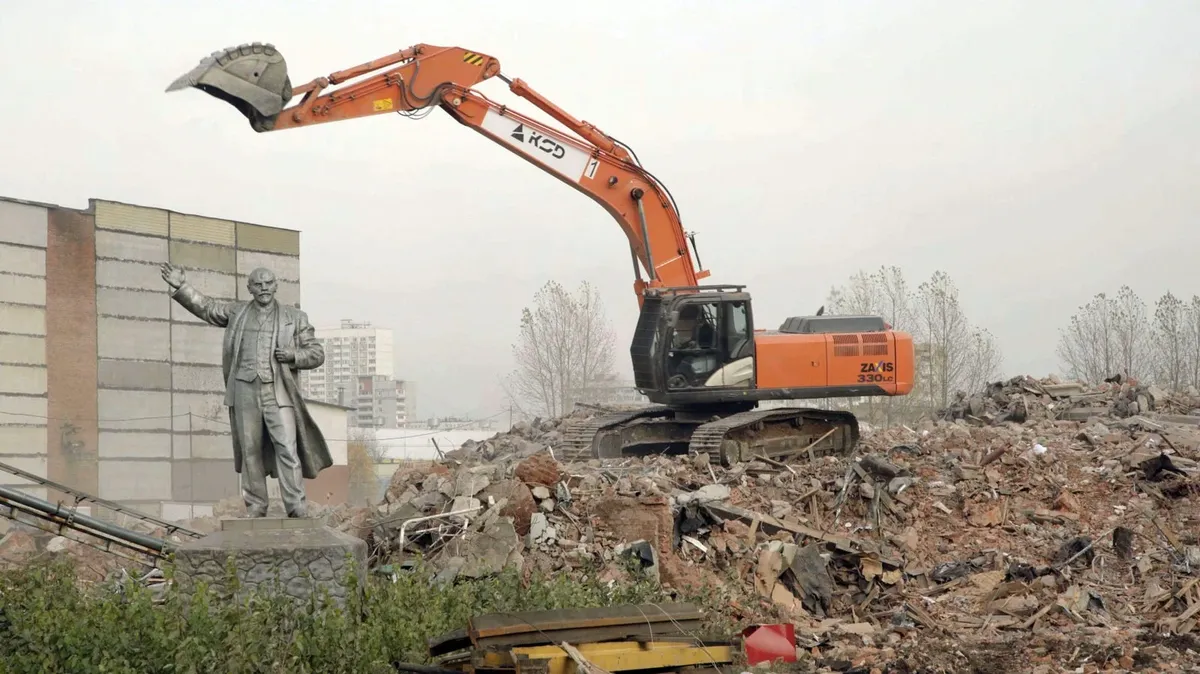
Still from the film “Forever Alive”
The screening will begin with the film “The Apprentice” about Donald Trump.
The scale of film screening at the 34th International Film Festival is amazing. In addition to the competitive sections: 13 special programs - a record number in the entire history of the festival, more than one and a half hundred films from all over the world. Screenings and meetings with authors - at the main film venues of the city from October 18 to 27. We talk about the most interesting films of the international competition program.
“Forever Alive” by Alexey Khanyutin
At first glance, it’s about monuments to Lenin. There were more than 25 thousand of them in the Soviet Union. An entire army of Ilyichs guarded and directed our loyalty to the “ideals of the party and government”
And so today.
A large area around the destroyed plant is being demolished: there will be a new microdistrict here. In the center of the devastation, as if after a bombing, is a monument to the leader: a message from Soviet times. The construction foreman doesn't know what to do with it. I already wrote upstairs. Who would you like to give it to? “Would you like to take it? — he asks the film crew, “otherwise it’s in the landfill.” He feels awkward, but what should he do?
...Excursion in Noginsk near Moscow to a white bust of the leader next to a shopping center with painfully familiar mantras: “Every feature of his appearance is precious for his contemporaries and descendants!” And in the background are the symphonic peals of the politically fundamental hit “Glory to the ages, Lenin!”
Already the decrepit sculptor and academician Anatoly Bichukov in his workshop, under the strict commands of his youthful wife (“Don’t nod, you have to answer!”) from the institute bench sculpted “Leninian,” as he says, “preserving the legacy.” All for the sake of art. He is asked to show the remaining sculptures of the leader, his wife orders: “Tolya, get up, walk carefully and show me, there behind Zhukov... in the corner under the stairs.”
...In the park area of the veterans' home, pensioners surrounded a monument dear to their hearts. They are told about a superstition: bring some candy, an egg, and your wish will come true.
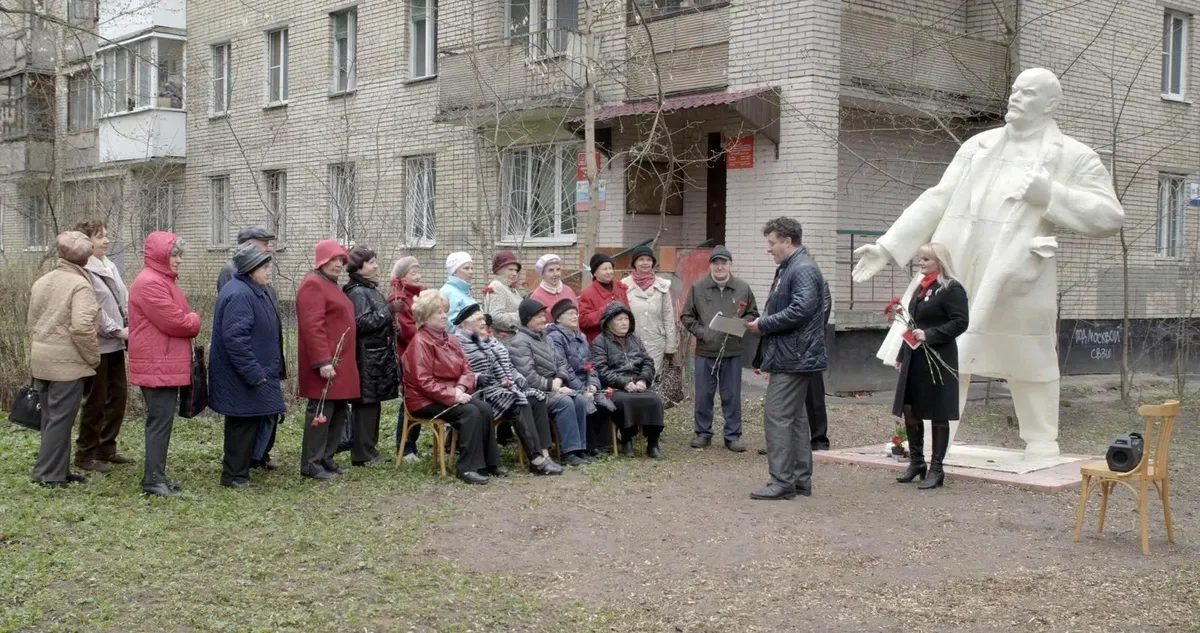
...Residents of the village do not allow the monument to Lenin to be demolished, “because there was a lot of good things under Soviet rule, under Stalin. Everything was worked out, everyone knew how to do it. Clearly."
...In front of the school building, the student has learned and with difficulty repeats the “main milestones” of the biography of Lenin’s grandfather.
...At the parade in Kurgan.
...Weddings at the monument. Flowers for Ilyich + photo - traditional ritual, Lenin as the imprisoned father.
...In Crimea, on the day of reunification with Russia, there was a rally at the monument: about the biological destruction of the Russian people: “we were days and hours ahead of the enemy.”
These monuments, in a sense, are both bonds, and a memorial to a disappearing and rekindled ideology, and an invisible gas that has eaten into the blood of generations. Eras change. But it is not treated.
"Scavenger" by Ahmad Bahrami
“The Scavenger” is a drama of amazing beauty and tragedy by Iranian director Ahmad Bahrami. Lifeless wasteland city. An elderly driver is pushing a cart with a dead dog.
As he slowly moves through the deserted clay village, we see the remnants of his former life. Stones protrude from houses that look like extensions of mountains. Next to the rainwater barrel is a broken-down sofa, the carcass of a car. He enters a room with boarded up windows: he collects things, boxes, picture frames, a desk with a lamp, books, musical instruments, unpretentious kitchen utensils, rags, someone’s lace underwear, broken mirrors, torn curtains. He even collects scarecrows from the road wearing hats and scarves. The camera films everything with Proustian thoroughness, catching the Garbage Man’s gaze—almost lifeless. The fire consumes the material evidence of vanished life - the image of today's doomed world.
The hero of the film is like Charon, and this journey through the dead city to the grave to the accompaniment of the howling wind is his river Styx.

Outstanding work by Ali Bagheriv as the Scavenger - you can’t take your eyes off his face and movements. This is magic, a special interaction with a monochrome environment. It seems that the Scavenger himself came out of the clay wall of the empty house. Long shots, black and white graphics. At least now any frame is on the wall.
This is the third installment of the Waste Trilogy, with each chapter focusing on an outcast fighting to end his suffering. The Wasteland ("Wasteland" - prize for the best film in the "Horizons" section). In the first film, one of the brick factory workers, faced with imminent unemployment, defends his rights. The second film (The Wastetown) is about the search for a woman released from prison (she was convicted of murdering her husband), her child, her struggle for custody (a prize for best director at the Dark Nights festival in Tallinn). All stories are internally connected. Tension is created through cyclical repetition, the quiet circling of the camera, the cumulative effect.
In Persian, the word "waste" means darkness.

“Theater of Violence” by Lukasz Konop and Emil Langball (Denmark-Germany)
An absolutely incredible story, familiar to us from the media. When brought closer to the author's gaze, it turns out to be even more incredible. As a boy, Dominic Ongwen was kidnapped by the Ugandan rebel group Lord's Resistance Army (LRA). They turned the child into a soldier, then into a commander, and so he became a war criminal. Years later, Ongwen is due to stand trial at the International Criminal Court.
“Kill them all: men and women, old, young and little children,” is the teaching of the LRA. The authors explore the history of how, in the 19th century, European nations divided ethnic groups without taking into account national characteristics, and over time mutual hostility arose.

Independence (since 1962) did not solve the problems of interethnic clashes, military coups, and struggles for power.
The army of the LRA rebel group has about two million fighters and a whole series of monstrous actions: from the kidnapping of 15 schoolgirls to an attack on Guatemalan UN peacekeepers.
Here is a mother talking at the international trial of Ongwen in The Hague about the genocide committed by LRA militants, how before her eyes they threw a child into the fire and burned houses.
As a child, Dominic Ongwen was an altar boy, an obedient, kind child. Neighbors from his village talk about this. They can't believe that sweet religious boy is the bloodiest rapist.
In the frame there is a boy against the backdrop of a giant field merging with the sky. He was kidnapped to become one of thousands of child murderers, rapists and cannibals. In the future, this is one of the most brutal war criminals of the 21st century.
Should he be tried for the brutal crimes he committed, or is he an unfortunate victim of circumstances, as the lawyers are trying to prove? Over several decades, the LRA killed more than 100,000 people and captured more than 60,000 children, many of whom became killing machines.
A social portrait of a society in which victims and criminals not only change places, but the environment itself provokes Kafkaesque transformations.
"Flatheads" by Jadon Martin
Flathead is the directorial debut of Australian cinematographer Jadon Martin.
Flathead is a fish that is used in local shops to make chips and delicacies. She is looked after before being sold by a young man, Andrew Wong, in the store of her late father, a Chinese immigrant. But Andrew is more concerned about his fitness and his bodybuilding training program.

His friend (wrinkled, age-spotted) Andrew Cass Cumerford returns to his abandoned childhood home. Apparently, he doesn’t have long to live: constant MRIs, he’s vomiting in the toilet. But no matter how much is left there, he lives to the fullest: he smokes constantly and drinks with pleasure. In conversations with friends, with a Christian preacher, with strangers, he is extremely sincere, talks about the sins of his youth, and does not justify his mistakes. And I’m almost sure: he won’t have enough time to fix them.
A report from the life of two men in Queensland, Texas, Australia. Behind the ordinariness of everyday life there is an air of poetry, philosophical reflections on the meaning of life, as if the authors dissolved the screen doors, letting us into the destinies of these people, this country.
Andrew reflects on his Buddhist faith and what the death of his father means to him as he devoted himself to his work. Cass sings a song of her own composition in the style of Bob Dylan. He meets with the agricultural workers of Queensland, on whose shoulders the region's economy still somehow rests, they are having fun... because they have less and less work.
The editing is like a slow dance, expressive portraits and a memorable shot: at night, old, ageless, Cass rides through the glowing city.
"On the contrary" Jonas Trueba
Anti-romantic comedy. Madrid. A fashionable married couple decided to divorce after 15 years of marriage. Director Ale (Itsaso Arana) and actor Alex (Vito Sanz) break up, although they look like an ideal couple and the relationship between them is excellent. Just a family crisis from which they come out in an original way. They throw a party to celebrate their amicable separation with the motto: “It is better to celebrate a separation than a union, because you never know how long a marriage will last.” A perfect marriage is possible, but what about a perfect divorce? And is it worth making a holiday out of divorce? Light airy style. An unobtrusive picture of history, irony, first of all, in relation to “romantic relationships”. There is a thin line between reality and cinema, especially since the heroes of the film are filmmakers. And at times it even seems like they’re not going to turn their divorce into a film?
Europa Cinemas Prize, Directors' Fortnight, Cannes.

MORE ABOUT CINEMA
Larisa Malyukova runs a telegram channel about cinema and more. Subscribe here .