
Translated material
Stress code
Why printed T-shirts are a much more serious challenge to dictatorship than it seems at first glance
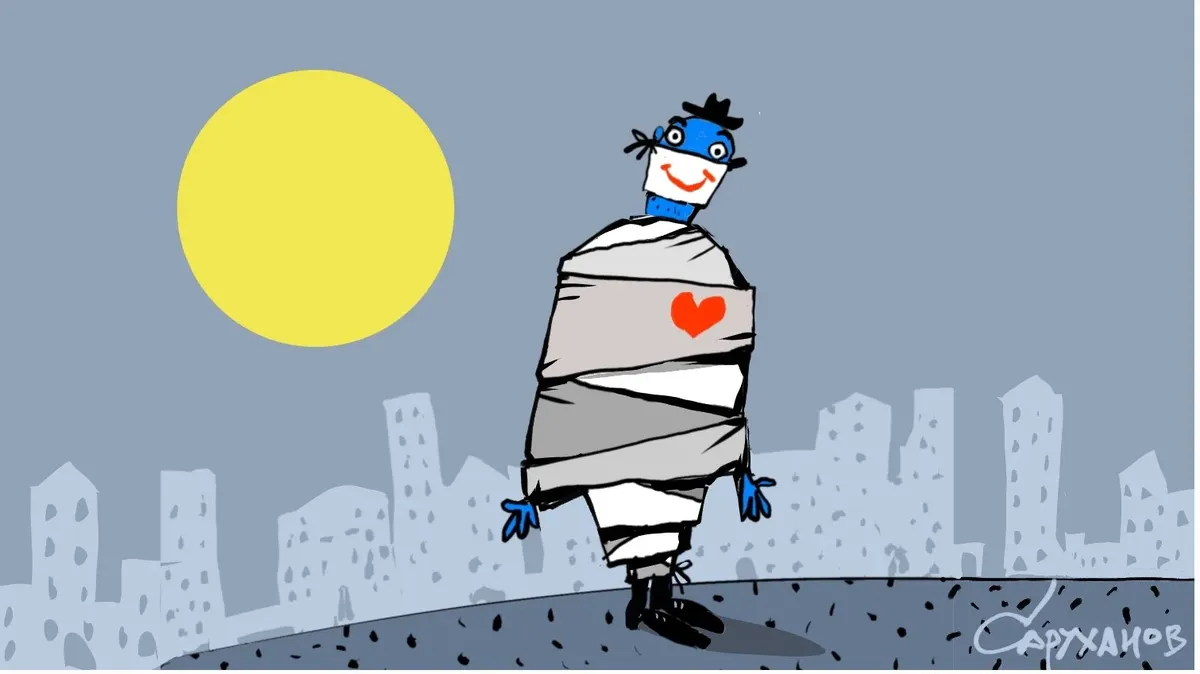
Drawing: Pyotr Sarukhanov / Novaya Gazeta
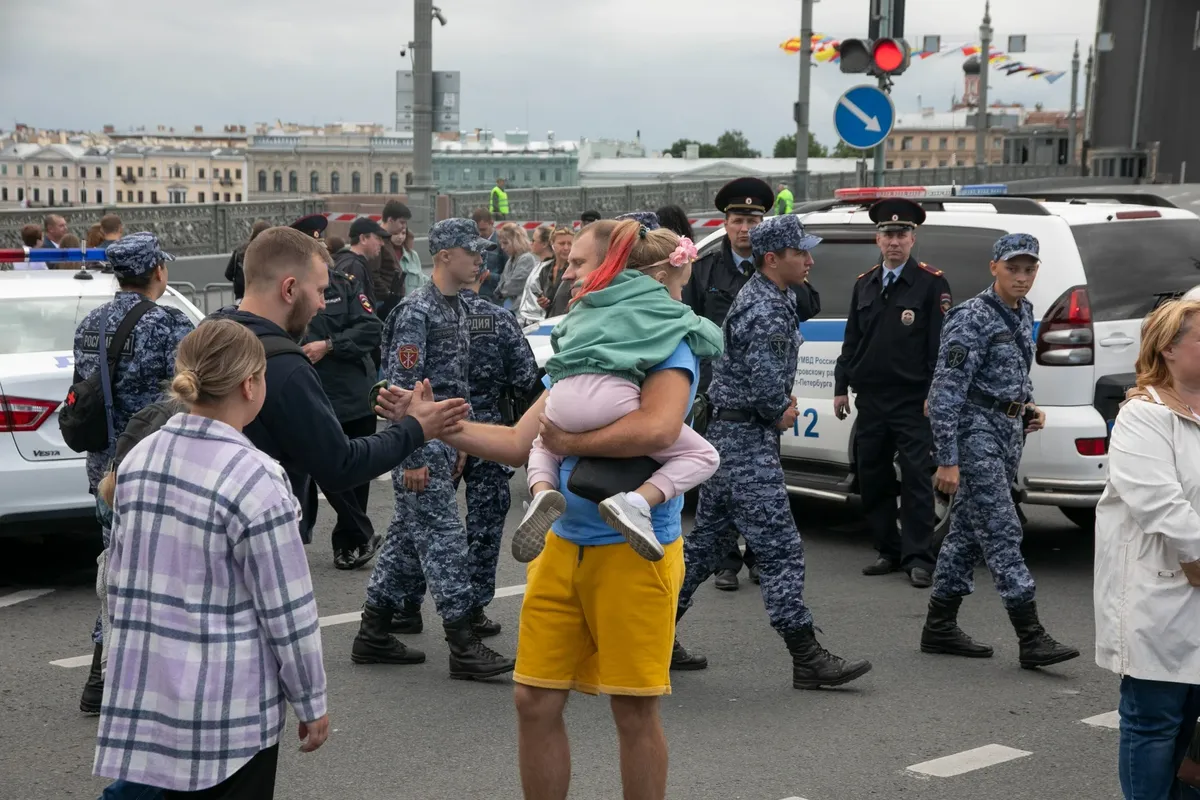
A colorful, but rarely taken seriously, manifestation of the widespread “tightening of the screws” in Russia after 2022 is the introduction of supervision over the appearance of citizens and tourists. You've definitely seen the news more than once about how the police imposed fines for T-shirts with Navalny's name, anti-Putin slogans, the Ukrainian flag, or even for yellow-blue hair. In the current realities, protest fashion is easily interpreted as “discrediting the army” or “uncoordinated public action” - with all the ensuing administrative or criminal consequences.
Which in 2024 began to extend even to extremely veiled protests. Last week in Mineralnye Vody, a man was put under arrest for five days for wearing a sweatshirt with the cover of the magazine “Ways of Creativity,” published in Kharkov during the times of the Ukrainian People’s Republic. In March, a Muscovite was detained at a polling station because of a T-shirt with the same print—after all, if you use your imagination, the “Path of Creativity” design turns into an opposition chant.
The sheer absurdity of such cases - and hundreds of others, when people were reported for yellow-and-blue sneakers, jackets, cakes and earrings (which Novaya Gazeta did a separate review of ) - makes one think that we are talking about local excesses and tyranny individual police officers. Even the State Duma calls this practice “complete nonsense and an abuse of law.” But the Kremlin obviously doesn’t think so.
Because in two and a half years, “complete nonsense” not only did not stop, but became systemic.
People are still regularly fined and arrested for the most harmless aesthetic contacts with the agenda, from “paths of creativity” to a blue and yellow forget-me-not on a backpack,
no one apologized for this and no one took the situation “under personal control.” “Detaining people for wearing clothes of certain colors that are not prohibited means turning society against government officials and only increasing the degree of tension,” says LDPR deputy Yaroslav Nilov. And he is completely wrong.
If you are an autocrat who wants to immerse society in the illusion of no alternative, strict discipline and social harmony, banning all kinds of sedition (and hints of it) in the appearance of your citizens is an excellent tool for achieving these goals. You can look at the problem from afar and find yourself, for example, in a prestigious private school like Eton College, where boys have been wearing collars and black tails for centuries. For what?
Private schools are polarized societies in miniature. In Western Europe, both the children of famous politicians and businessmen and low-income prodigies end up there, and there is no better way to emphasize their equality and prevent potential conflicts than through the same clothes, which also serve as a conductor of tradition, belonging to a social group (the one who wears otherwise, he is suspicious and most likely entered the campus illegally) and smoothing over political differences. Just in case someone decides to “rock the boat” and show up at Eton wearing a T-shirt with the IRA emblem, for example, as a joke.
Islamic culture is also largely based on the clothing requirements of Muslims. AND
When Islam mixes with politics, clothing turns from an instrument of religious discipline into an instrument of social surveillance.
Actually, the revolutionary situation in Iran in 2022 began precisely with the arrest for “inappropriate wearing of the hijab” and the mass refusal of Iranian women to comply with the dress code.
Here one can also recall Stalin’s attempts to introduce utopian ideology into Soviet ateliers, the red scarves of Chinese pioneers, or the “fashion police” of the DPRK, reprimanding Korean women for wearing heels and short skirts. “Fashion is the easiest and most visible way to indicate the wearer’s political views,” says Sook-Young Kim, a professor at the University of California, Santa Barbara.
Clothing and paraphernalia, as conductors of political meanings, turn cities into huge Hyde parks, filled with statements and slogans that do not require coordination with the authorities and verbalization in principle. In Russia, Boris Yeltsin understood this before anyone else, whose team, back in the late 1980s, picked up Yegor Ligachev’s phrase “Boris, you’re wrong,” “mirrored” it in “Egor, you’re wrong,” and made badges, sweaters and T-shirts with it (one of them can be seen on Tatyana Drubich in the film “Black Rose is the Emblem of Sadness, Red Rose is the Emblem of Love” 1989).
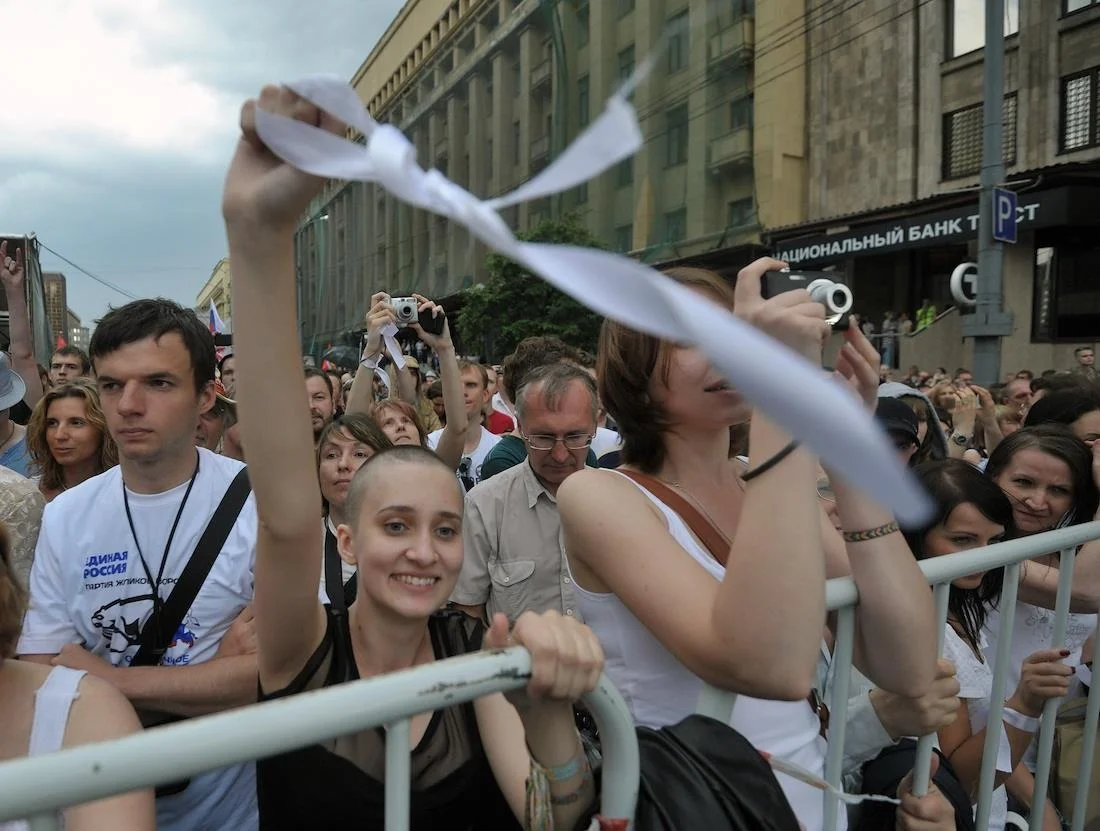
In the 2000s, Lonsdale Harrington jackets and Grinders ankle boots with white laces acquired a sad political connotation, which, following their British “colleagues,” became very fond of Russian NS skinheads as a dress code for “cleaning up Moscow” actions. And in the early 2010s, the opposition made its symbol a white ribbon, which was attached to clothing, accessories and cars and emphasized the commonality of opponents of “swindlers and thieves” - and became such a massive phenomenon that Putin had to compare opposition ribbons with condoms.
I agree with the philosopher Gilles Lipovetsky, who in The Empire of Fashion: Dressing Modern Democracy described fashion as the basis of modern liberal democracy - an element that ensures its characteristic individualization and diversification within and outside communities. According to Lipovetsky, fashion declared itself as an actor in political life in the Middle Ages, challenging its traditions and conventions, and in the 20th century it became synonymous with change and personal transformation.
“Political marketing corresponds to the attitude of democratic societies in the era of fashion consumption, reflecting the values inherent in their order, hedonism, leisure, play, individuality, psychologism, warmth, simplicity, humor, which drive and restructure political rhetoric,” and we saw this in 2016 year using the example of Donald Trump's iconic Make America Great Again baseball caps and in 2017 with the pink Pussyhat hats that his opponents knitted in response.
Political paraphernalia is a part of popular culture that tends to simplify and carnivalize politics, making it more understandable and accessible to the involvement of a wide audience (after all, this, again, is “the simplest and most visible way to indicate political views”). And fashion is capable of not only declaring its own narratives, but also sabotaging pro-government ones.
This was, for example, the goal of the Yekaterinburg jewelry company Avgvst jewelry, which in 2021 released a series of jewelry with the inscription “Foreign agent” in support of “Medusa” ( recognized as an undesirable organization ) and the Center for Assistance to Victims of Domestic Violence “Nasiliyu.net” ( recognized as a “foreign agent” ). “If there are as many items with this word as possible, then the negative context will probably decrease, and the “shameful” status will depreciate,” Avgvst explained the action.
In addition, such a targeting of protest fashion at a obviously “attractive” social group (in the case of Avgvst - young educated metropolitan residents) presented a condescending and ironic attitude towards the status of a “foreign agent” as normal in this advanced environment, by default contrasted with gerontocrats-isolationists, “ foreign agency" promoting. And there is simply no way to more clearly and unambiguously identify a cross-section of supporters of a certain agenda than to literally dress them in paraphernalia with its provisions and symbols - and then promote these visual images through the media or advertising as a branding identity.
The Kremlin is also well aware of this, and since 2000, when for the Putinophile youth movement “Walking Together” its ideologist Vasily Yakemenko ordered a huge batch of red T-shirts with a huge black print of Putin’s portrait and the inscription “All is well.” This is an obvious homage to the iconic T-shirt with Che Guevara, through which the authors of the idea not only sought to present the still young president as a leader of revolutionary proportions, but also to emphasize that he was supported by young people - photos from Red Square, filled with teenagers in these T-shirts, were then in all the media .
The Kremlin is well aware of all the other properties of political paraphernalia described above, and it would be strange if, with the colossal censorship of Russian pop culture, it bypassed such an important component as fashion.
Due to its unpredictability and uncontrollability (after all, getting into a wardrobe is much more difficult than getting into a TV or social network), attempts by the authorities to supervise appearance look especially clumsy. It sends signals to society about the need for a more restrained appearance in times of special operations, not through targeted bans, but through chaotic arrests and fines of ordinary passers-by on the streets.
And this unceremoniousness draws quite clear parallels with the “fashion police” of the DPRK or the behavior of the security forces of the Iranian ayatollahs. All these actors are united not only by fear of any form of dissent, but also by the desire to impose order and discipline on adults using the same means as children in closed private schools or military schools. And this says a lot about who the leaders of authoritarian regimes really take their citizens to be.