
Translated material
How to make money on other people's debts. Three companies that can win on the growth of private lending
This material (information) has been produced and widespread by a foreign agent The Bell or applies to the activities of a foreign agent The Bell. 18+
The largest players in the market of direct investment (Private Equity) plan to soon launch ETF, which will allow private investors to invest in the private lending market (Private Debt). It is expected that the influx of this capital can become a new growth driver for the industry, which previously relied only on institutional investors. Anastasia Dolgova, an analyst with Bell. Investigations, has chosen three companies that can win on a private lending growth.
Why is the private lending market growing
Alternative assets now account for only 3% of all assets of individual investors, the value of which is estimated at $ 150 trillion. In the future, this share will exceed 10%, and the driver will be private lending for such growth, said Eric Mogelof, the head of Global Client Solutions in KKR, one of the largest management assets.
Private or direct lending has become one of the fastest growing segments of the entire global financial system over the past 15 years. We talked about what direct lending and other types of alternative assets here . Private lending has become noticeable during the global financial crisis, when the largest banks refused business lending. This brought to the market a new class of private creditors who helped to finance the business. First of all, we are talking about Apollo, KKR and BlackStone, which remain the largest companies in terms of assets under the control (AUM), which are invested in alternative assets.
The current increase in interest in private loan by borrowers is due to the fact that such loans can be adapted to specific needs, offering greater flexibility in conditions compared to traditional banking loans. Private debt is increasingly involved in financing projects: for example, partially with its help, the SOU-Fi Stadium in Los Angeles was built worth $ 5.5 billion.
On the part of investors, interest is due to high profitability (at the level of shares) with relatively low volatility compared to the risky loans market (Levered Loans) and “bonds, along). From 2020 to 2023, private lending provided an average of 10.4% of the annual profitability. The leading analytical company Preqin expects that in 2023–2029 the yield will be 12% per annum.
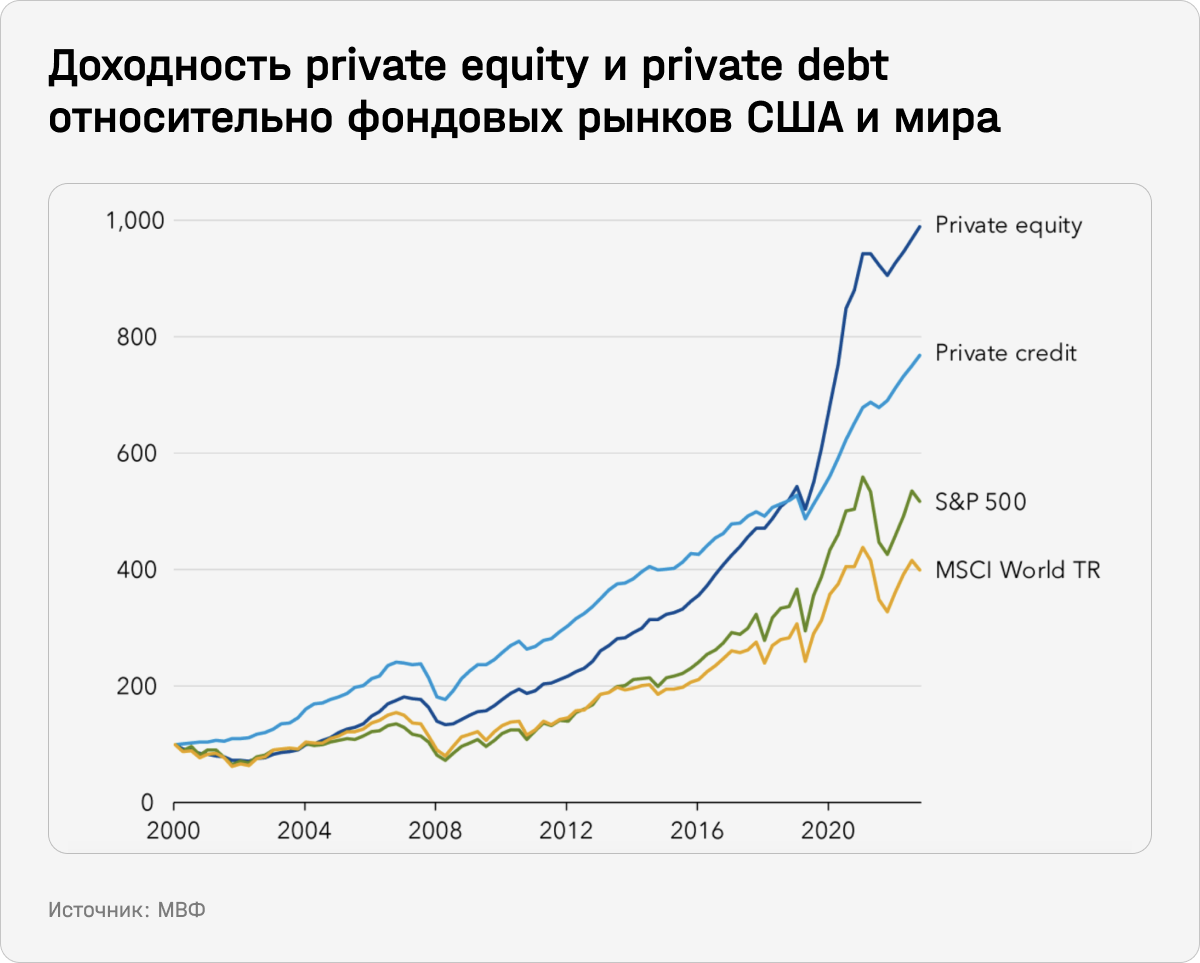
The number of investors represented by limited partnerships (LP) who want to increase investments in private lending is now almost 40%, have calculated Goldman Sachs analysts, and reduce or suspend - half as much. LP is a business form in which partners are liable only within their investments and have a limited impact on operating decisions, do not participate in management.
According to the results of 2023, the Private Debt market volume (that is, assets under management) reached $ 2 trillion around the world, which is about 10 times more than in 2009, the IMF reports . At the same time, McKinsey believes that now the targeted market (TAM) of private lending exceeds $ 34 trillion only in the United States and will continue to grow. “Banks provide less than 20% of all loans to enterprises,” said Mark Rowen, co -founder and CEO Apollo Global Management.
As the main reasons for the growth of the McKinsey market, it indicates the expansion of private lending to a wider range of assets, including, for example, aircraft purchasing, leasing of expensive equipment, etc. Also, the company believes that in the future we can expect a Private Debt customer profile from a resolved load with increased debt loading companies with an investment level rating and the need for financing large -scale infrastructure projects or, for example, large real estate objects. It is no coincidence that this year the largest transaction in the history of private debt, a transaction worth $ 7.5 billion. The Coreweave technological startup supported by NVIDIA received a loan for the deployment of the AI infrastructure from a group of creditors led by Blackstone and with the strategic participation of Magnetar and Coatue. Carlyle, CDPQ, Digitalbridge Credit, etc. also took part in financing.
Now the giants of Wall Street, including Apollo Global Management, BlackRock, Capital Group, KKR and State Street, arranged a real race to make non-accountable debts with liquid and affordable for a massive investor through ETF (we wrote briefly about it here ). Previously, this market was available only to institutional and super -rich investors, and the main demand was on institutional investors, mainly pension and insurance funds. The influx of funds of private investors can further increase the capital available to the manager.
Private investors who want to invest in private lending via ETF will need to take into account several specific risks. PE-funds with a bias in private lending (especially short-term) are concentrated in niches, where banks do not work or where they leave, which can be a signal of increased risks. And also supervision of such funds lower than those that are already available to private investors, and therefore, according to the IMF, requires “more close attention” of regulators due to risks for the financial system. Nevertheless, the IMF itself does not consider the situation dangerous, noting that the risks of instability are controlled, since the credit shoulder remains moderate, and the capital is frozen for the long -term period.
The President of the Federal Reserve Bank of Minneapolis, Neil Kashkari, believes that the growth of a private credit market may even lead to a decrease in systemic risk in the US financial system. This may be due to the fact that banks may encounter a sharp outflow of deposits (as it was in the case of the collapse of several regional banks in March 2023), while PE films attract capital for a long time.
We have already talked about some of the promising companies in this market here , here and here . It should be noted that the entire layer of PE-funds is traded on increased multipliers and they cannot be called unambiguously cheap now. For investors who are not ready to invest in private debt through funds, we have chosen three companies from which it occupies a significant share of business and which still look attractive.