
Translated material
Whether the American market is waiting for a lost decade
This material (information) has been produced and widespread by a foreign agent The Bell or applies to the activities of a foreign agent The Bell. 18+
The profitability of the American stock market in the next decade will barely exceed the inflation rate, follows from the Goldman Sachs analysts model. Its difference from others is that it is the only one takes into account the level of market concentration, which is now near maximums for 100 years. We tell you why investmentbank is so pessimistic about the US stock market and what other long -term forecasts for it are.
What's happened
This week, Goldman Sachs made a lot of noise , from which it follows that a decade of the rapid growth of the American stock market is hardly repeated. Bank analysts, headed by one of the most noticeable Wall Street strategists, David Kostin, calculated that in the next 10 years the average annual nominal yield of the S&P 500 in the base scenario will be only 3% per year, that is, taking into account inflation, only 1%. This can be one of the worst segments in the history of 10 years in terms of profitability.
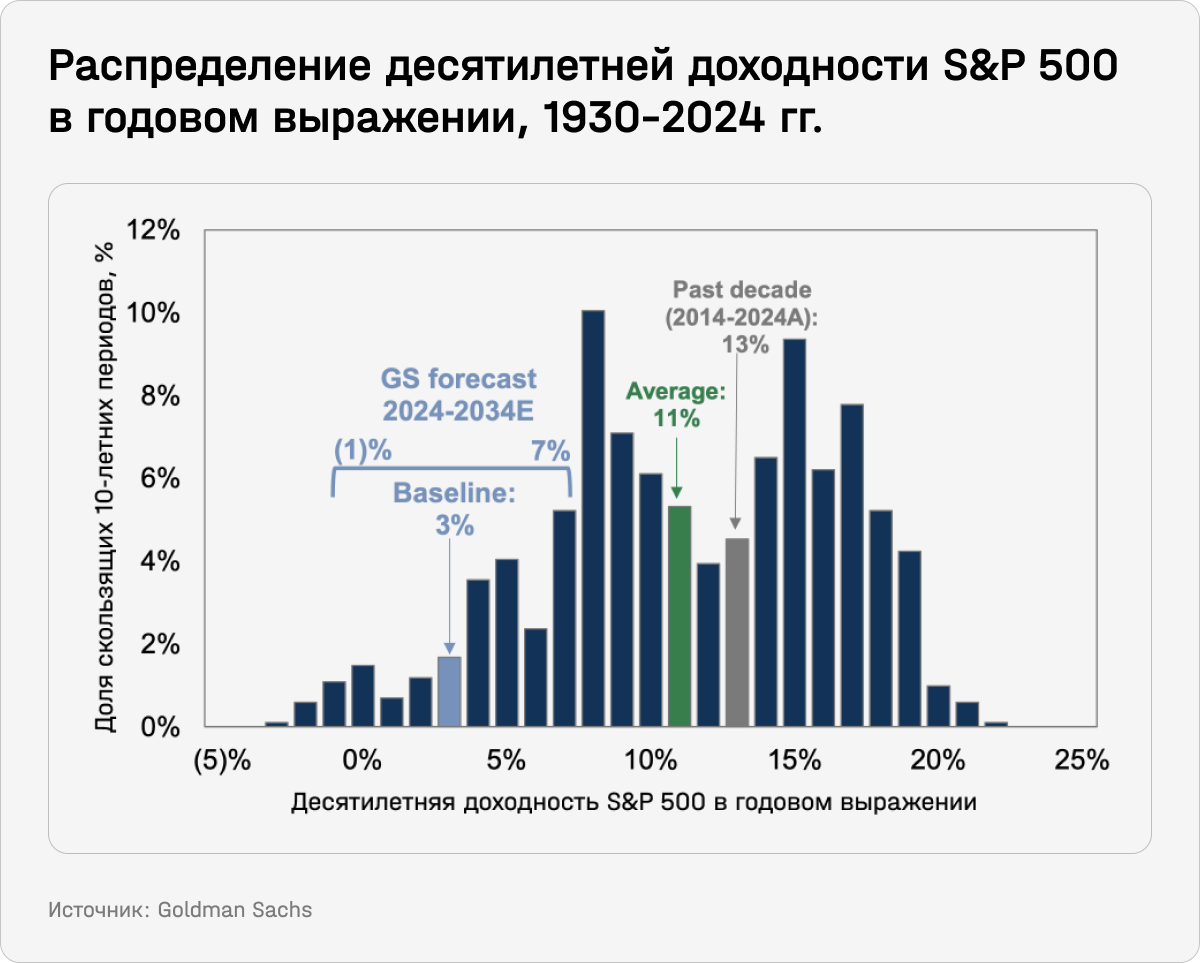
For comparison, over the past 10 years, the nominal indicator was 13%, and the long-term average (from 1957 to the end of 2023)-11%. At the same time, high profitability was accompanied by a relatively low volatility: as the AQR investment company showed , the Sharpe index (profitability taking into account volatility) in 10 years, which ended on July 1, 2023, amounted to 0.82. This is twice as much as the average of the middle of the 20th century.
Goldman Sachs strategists also believe that the likelihood that until 2034 the index will lag behind the treasury bonds is approximately 72%, and the likelihood that it will lag behind inflation is 33%. According to their forecast, the equalized S&P 500, that is, the one in which all companies receive the same weight, in the next 10 years will be ahead of the familiar index balanced in capitalization. In other words, the Bigtehs who pushed the indices up in the last couple of years will stop driving the market, and will lag behind the market. At the same time, Kostin more recently increased his forecast by 12 months in advance for S&P 500 from 6,000 to 6300 points, which is approximately 11% higher than current levels.