
Translated material
Political prisoner Polina Yevtushenko: “The punishment for an “incorrect” post is identical to the punishment for committing a serious crime”

Polina Yevtushenko faces 22.5 years in prison for her words. She is accused of 12 crimes under six articles of the Criminal Code, including “treason,” “promotion of terrorism,” and “fakes about the army.” The denunciation against her was written by the provocateur Nikolai Komarov - he ingratiated himself into Yevtushenko’s confidence, recorded all the conversations on a dictaphone and took the edited fragments of the recordings to the FSB. Polina Yevtushenko's mother and six-year-old daughter Alisa are waiting for her to be released.
Yevtushenko regularly writes complaints about violations of his rights, including demands to decriminalize articles that allow for decades of imprisonment for speech. We publish an excerpt from one of them.
I am a law-abiding citizen with an active position. I am the mother of a six-year-old girl, her father volunteered for the Northern Military District. I am being tried under terrorist-extremist articles for my words.
For words I face up to 22.5 years in prison! But I didn’t kill anyone, didn’t rob anyone, didn’t cause harm, and didn’t intend to do anything like that. In fact, I am being judged for my political position. I am not a criminal, not a criminal. I am a prisoner of the regime.
In violation of Art. 5 of the Federal Law “ On Operational Investigation ”, which states that an employee conducting operational-search activities is prohibited from inciting and encouraging (i.e. provoking) the commission of a crime, the witness-informer Komarov (presumably an employee of Center “E” in Samara) himself asked me about the organization recognized as terrorist in Russia and recorded it on a voice recorder. And then he took the edited recordings to the FSB and wrote a false denunciation against me. He accused me of answering his questions.
Because of conversations with Komarov, I am charged with two particularly serious articles of the Criminal Code of the Russian Federation - 275 (treason) and 205.1 (assistance in terrorist activities). Please note that these are particularly serious articles, under which I face up to 22.5 years in prison. 22.5 years for answering Komarov’s questions, for allegedly “creating a positive image” of a terrorist organization.
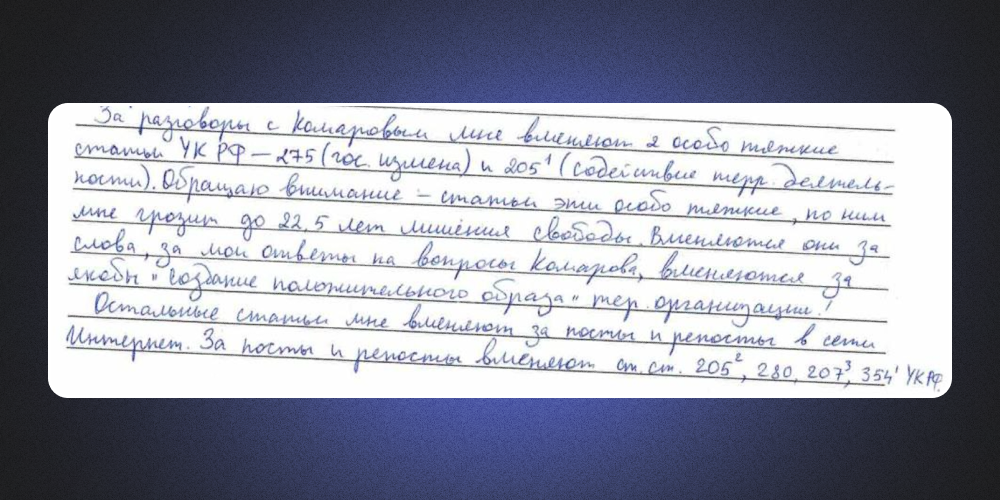
The remaining articles are charged to me for posts and reposts on the “Internet”: Art. 205.2 (public calls for terrorism), 280 (calls for extremism), 207.3 (fakes about the army), 354.1 (rehabilitation of Nazism on the Internet) of the Criminal Code of the Russian Federation. I could still understand fines for posts/reposts, but how in a country with such a wonderful Constitution, which gives us the right to think freely, freedom of speech, freedom to search and disseminate information, I can’t understand how a real sentence can be imposed for posts.
According to Part 2 of Art. 205.2 maximum term - seven years, according to Part 2 of Art. 207.3 - 10 years - and that’s just for posts on social networks. In my case, not even for my personal words - I did not comment on the post and did not express my personal opinion in the post. I am being persecuted for other people's words from a video that was not filmed by me. It’s not me who speaks in the video, but they accuse me, and I could be imprisoned for a very long time.
I consider it necessary to revise the sanctions in the articles of the Criminal Code of the Russian Federation, which imply criminal liability for an act that was committed without intent or negligence. Answering questions or expressing your opinion are actions in which there is no criminal intent. This should not be considered a crime, but in modern judicial practice, unfortunately, it is.
Article 6 of the Criminal Code of the Russian Federation establishes the need to serve the principle of justice when choosing punishment. Punishment must correspond to the nature and degree of social danger of the crime, the circumstances of its commission and the identity of the perpetrator. The principle of justice should be manifested in three aspects: when criminalizing socially dangerous actions, when determining sanctions for a crime, and when courts impose punishment. But at present the principle of justice is not fully implemented.
When criminalizing comments, posts, reposts and private conversations, it is necessary to proceed and take into account the likelihood of words materializing into specific illegal actions, to determine the real possibility of damage arising in connection with the spoken words or post/repost/comment, it is also necessary to take into account the audience reach, methods of involving the audience and the direct degree of participation of the person who has the carelessness to say a careless word or post/repost/comment.
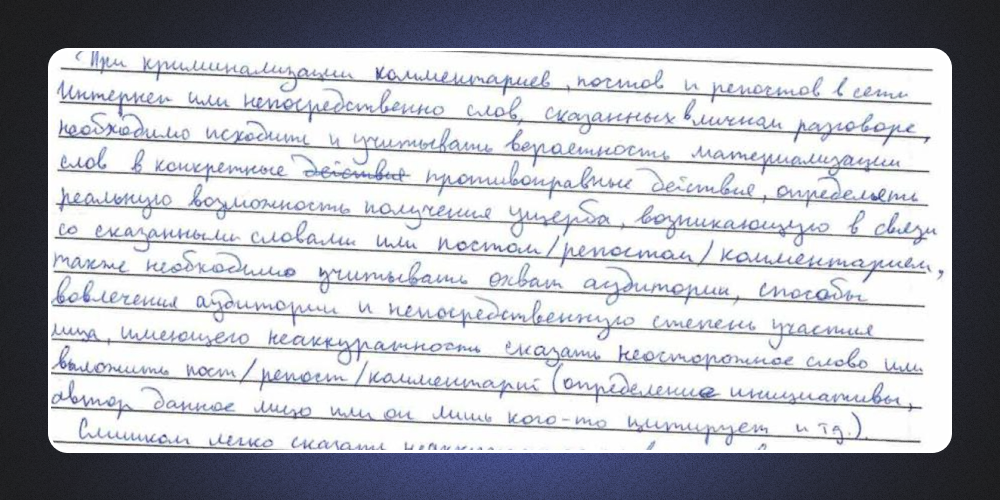
In addition, this practice opens up wide scope for falsification, fabrication, and forgery. A person can be provoked to make any statement, and then, with the help of interested linguists, it can be turned into a criminal offense.
Linguistic examinations in government agencies are carried out with the aim of reaching the necessary conclusions for the investigation. Examinations consist of 90% interpretation of special terminology and bibliography. The conclusions of such examinations sometimes contradict data from their own research part.
Intelligent, literate and law-abiding citizens who have an active civic position and want to improve life in the country began to be put in prison with the stigma of “terrorist” or “extremist”. Law enforcement agencies miss real terrorists (Crimean Bridge twice already, Crocus City Hall, arson on railways and cell phone towers, etc.), but they put them in prison for reposting or carelessly spoken words.
The Criminal Code of the Russian Federation establishes the following tasks: protecting the rights and freedoms of man and citizen, property, public order and public safety, the constitutional system of the Russian Federation from criminal attacks, ensuring peace and security of mankind, as well as preventing crimes. To accomplish these tasks, principles and norms of criminal law are established, defining acts that qualify as criminal. But there are flaws in the current legislation. Actions that do not violate all of the above in any way or are not capable of causing any harm to anyone are considered criminal offenses.
The attention and forces of law enforcement agencies (which, by the way, are already in short supply, because the staffing level of the Ministry of Internal Affairs, for example, is less than 50% even according to official data, but according to unofficial data, the situation is even more depressing) are scattered on the capture of people who made a post on the social network, and not on preventing terrorist attacks, murders, acts of fraud and other crimes that really encroach on the security of the individual, society, and the state.
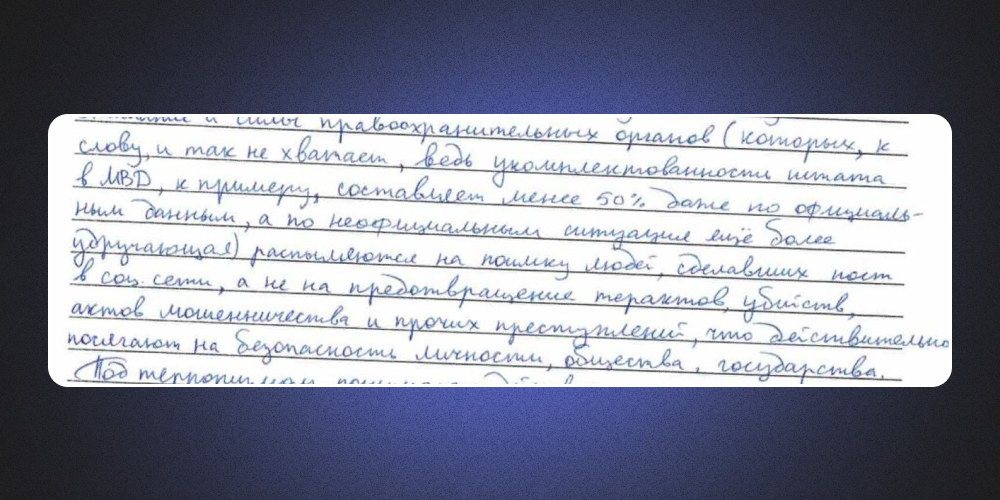
According to Art. 205.2 of the Criminal Code of the Russian Federation deprives of liberty even in cases where there was no justification for terrorism or its propaganda.
For words or a post you can receive the same sentence as under Part 1 of Art. 111 of the Criminal Code of the Russian Federation - up to eight years in prison. This article implies actual infliction of grievous bodily harm, while Part 2 of Art. 205.2 of the Criminal Code of the Russian Federation is only a normative article. It turns out that the punishment for an “incorrect” post is identical to the punishment for committing the most serious crime, encroaching on a person’s health, for a socially dangerous act.
The principle of justice in criminal law is aimed, first of all, at maximum individualization of punishment. It is unacceptable to equate fasting with causing grievous harm to health, but due to the similar timing, they are actually equalized in terms of the degree of public danger.
The term "act" is used to refer to criminal behavior. This formulation of the law is intended to emphasize that a crime is always the behavior, the activity of a specific person. The peculiarity of law is that it is neutral to the inner world of a person. Intentions and goals for the sake of which a person does not take action do not fall within the scope of criminal law regulation, since they do not create a public danger of causing harmful consequences. Thus, the threat of murder is punishable under Art. 119 of the Criminal Code of the Russian Federation when it is expressed in such words and actions that make the victim fear for his life and limit the freedom to choose behavior.
At the same time, simply expressing an intention to commit murder does not create a state of danger and therefore is not a crime. Then why does a post of “wrong nature” posted on a social network a priori fall into the category of socially dangerous and criminally punishable acts, and even with a sanction of imprisonment for up to 10 years? Why is a serious crime charged without taking into account and analyzing the real danger? Intentions alone, even if publicly expressed, do not in themselves create a public danger.
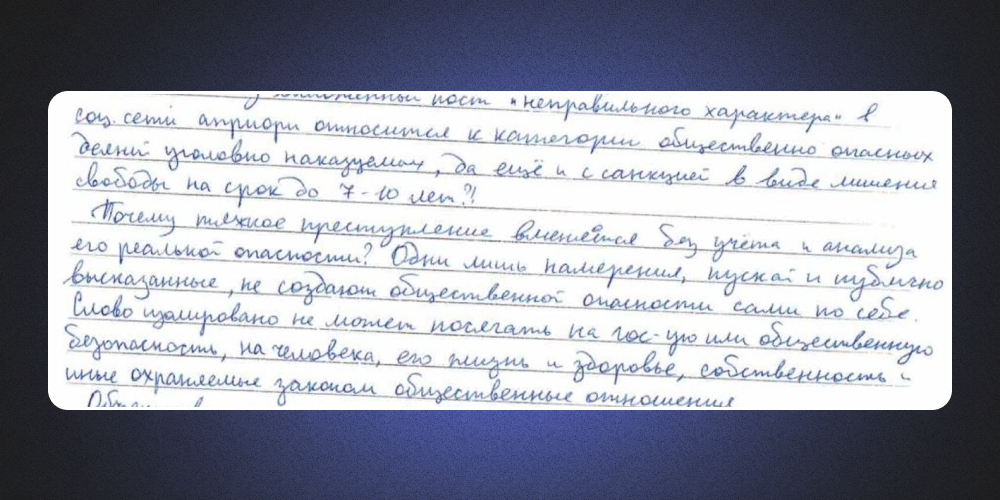
Objectively considering the disposition of Art. 205.2 and delving into its essence, we do not find in it any signs that characterize a socially dangerous act as a crime, namely the object, i.e. social relations protected by law that are encroached upon by a crime. Words without additional actions or certain markers indicating the real possibility of someone committing a crime under the influence of words from a specific post are not of interest from the point of view of criminal law.
I think that Art. 205.2, 207.3, 280, 280.4 need to be reviewed and amended. The crime committed for the first time during the year, provided for by the disposition of any of these articles, at a minimum must be taken outside the scope of criminal legislation into the category of administrative offenses. The current criminal legislation contradicts its principles of the Constitution of the Russian Federation.
Address for letters and postcards with words of support: 443047, Samara region, Samara, st. Utevskaya 18A, IK-15, PFRSI, Evtushenko Polina Sergeevna, born in 1998. (there is a service for sending letters online Zonatelecom ).