
Translated material
I taught first graders in a private school. War destroys even them
When Russia launched a full-scale invasion of Ukraine, Anna Zakharova was working as a teacher at an elite private school in the center of one of Russia's largest cities, teaching elementary school students about world mythology. Unlike regular public schools, there were no “Things to Talk” or lessons on patriotism, but gradually propaganda and war began to permeate the conversations and behavior of even the smallest and most privileged of Russians. At the request of Kholod, Zakharova tells how this happened and how she tried to fight it. The names of children mentioned in the text have been changed.
For a year and a half I watched how “we will bomb them” and “for ours” break through in conversations about Greek myths
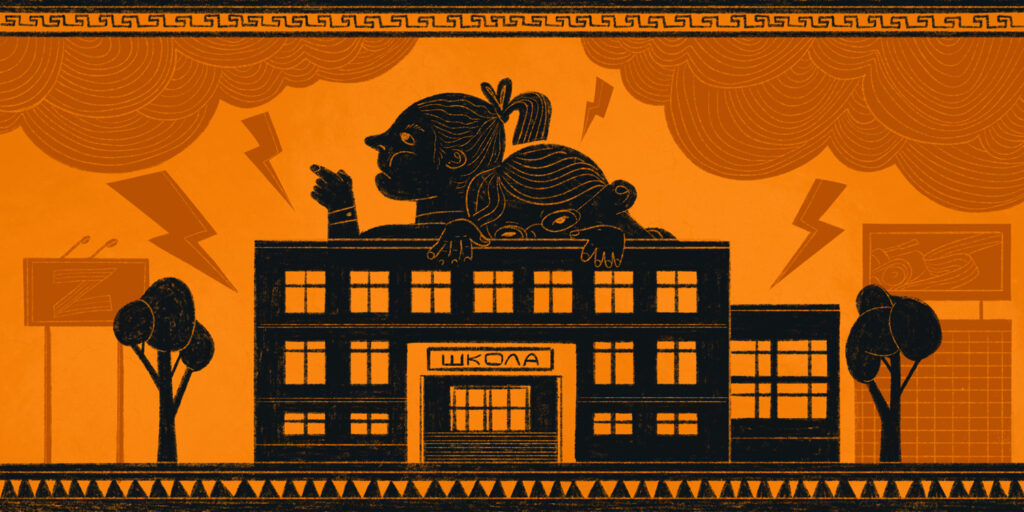
For the past three years I have worked as a teacher in a private elementary school that I would rather not name here. This is a small school in the city center, well organized and quite expensive. Children have every reason to love her. There are no “Conversations about Important Things” or other aggressively patriotic events at this school. This school is a separate closed world, a fortress into which the horrors of the outside world almost do not penetrate. Life there continues - if not quite as before, then at least well. They don’t talk to schoolchildren about the war, but they talk a lot about culture and art. There is even a separate subject dedicated to this: it is very conventionally called “mythology”. That's what I was leading.
- Anya, have you been to Egypt? Can't be! We've been twice!
- Book of Judges? Oh, my dad is a judge!
I didn’t have to be afraid for my students
Of course, we are afraid for teenagers. For anti-war teenagers, for LGBT teenagers, for those who cannot talk to their parents, for those who argue with classmates, for those who do not dare to argue with the teacher, for those who find themselves hostage to family and school. They have “Things to Talk”, murderers come to their classes, and their views and beliefs, barely beginning to form, are damaged, which we will all one day have to appreciate.
It seems that I didn’t have to be afraid for my students.
I met them between Covid and the war, and in the first six months of work it seemed to me: the worst thing that could happen to them was the school where they would end up in the fifth grade. There they will find themselves in a reality they are unaware of.
At the last lesson with my first fourth graders, at the end of May 2022, I talked about Prince Siddhartha. About how he grew up in a golden palace, surrounded by young and beautiful servants, how through a crack in the fence he first saw poverty, illness and death, about how, in the end, he became the first Buddha.
The real cause of the war The real picture of the war is available to everyone, but few are ready to face the facts. Not among them is anyone who started this war out of resentment Politics 4 minute read
The war was already underway. I knew that one of them would probably leave in the summer. I read them a story recorded by the Teacher for Russia project. There, the girl tells how after school she and her friend walk under the only lantern in the village.
“I’m telling you all this, only to you, because you are fourth graders, and you will now leave your golden palace, I mean, from school...
- We understand.
I don’t know if they understood, but they looked at me incredulously.
This is how the gods punish
These are my first first graders. Lena, Anton, Kolya, Seryozha and 10 more people. Mid-second quarter, three months before the start of the war.
Today we are talking about the children of the goddess Latona - Apollo and Artemis. The huntress Artemis is almost more popular among girls than the defender of cities, Athena; Apollo, with his eternal failures in love, does not inspire enthusiasm.
I've spent the last 10 minutes talking about Niobe and her children. There are fourteen of them, like my boys, seven boys and seven girls.
Queen Niobe refuses to make sacrifices to Latona. She, who gave birth to fourteen, does not want to bow down to the one who gave birth to two. The difference is that Latona gave birth to the gods, and the gods can take revenge for the insult done to their mother.
Silver-bowed Apollo kills the boys, one by one. Huntress Artemis - girls. The last, the youngest of them, hides in the folds of Niobe's tunic, but Artemis kills her too.
I live on 47 thousand rubles a month I save on everything, buy soy meat instead of regular meat and treat my teeth on credit Society 5 minute read
The children sit in a semicircle in front of me, their faces illuminated by the projector screen.
On the screen is a pale statue of Niobe covering her youngest daughter with her arms.
- Do you think Apollo and Artemis are right?
I ask each of them in turn, from left to right. If I were at least a year older than working at the same (or any other) school, I would not have decided on such an experiment.
- Yes, they are right.
- Why?
- Because they are gods.
- Well, they are right, because she herself is to blame.
- The gods punish this way.
- I don’t know, it seems to me that they are right, they are gods.
When I tell them, “You can disagree with the gods,” I mean, “You can disagree with me, with any other teacher, with any other god, or with anyone.”
He called me princess
I have one lesson a week - 40 minutes to discuss how Gilgamesh sought immortality or how Abraham almost sacrificed his son. Disappointingly little, to be honest. Of course, we are not talking about war.
I promise myself that if a child asks me, I will interrupt the lesson and answer. They don't ask. The oldest of them is 11, and I still think I don't have to worry about them.
At my subject group, instead of medieval legends, we discuss The Lord of the Rings. The club differs from regular lessons in the absence of a clear program and a small number of participants - only those who want to come. Fourth graders are reading Tolkien for the first time, I am rereading it. They often veer off into the Shire or Mordor from the intended themes (Tristan, Isolde, King Arthur), and I pick up the discussion with a sense of painful urgency, but I don't know if they feel the same.
Something changes in December 2023. Or rather, at that moment I notice that something is changing. At first it is just a sensation, similar to an unpleasant but very faint odor or a uniform, distant hum. I don't have enough attention to catch the details, but I hear - or imagine - disturbing jokes between the older ones, random, too adult phrases from the younger ones.
Help Kholod tell human stories
We put people at the center of our journalism and talk about people who face injustice, but do not lose spirit and continue to fight for their rights and freedoms. To continue covering people's stories, we need the support of readers - thanks to your donations, we continue to work, despite government pressure.
- Foreign card
- Map of the Russian Federation ↘︎
- Patreon ↘︎
- Translation
- Crypt
Monthly
One-time
5 €
- 10 €
- 20 €
30 €
5 €
- 10 €
- 20 €
- Other
- Bank of the Russian Federation
- Foreign bank
Card number:
5536 9138 6472 8742
Copied!
Recipient:
Taisiya Bekbulatova
Copied!
Recipient:
Projektas Šaltis
Copied!
Account number:
LT613500010016198323
Copied!
SWIFT BIC:
EVIULT2VXXX
Copied!
Bank:
Lietuvos Bankas (Bank of Lithuania)
Copied!
Comment - purpose of payment:
Parama įstatymų numatytais tikslais (be konkretaus tikslo)
Copied!
We ask you to provide a comment so that we can accurately determine the receipt of funds. The phrase is translated as follows: “Support for statutory purposes (without a specific purpose).”
Amount: €
Donate
By making a donation, you accept the privacy policy
The first time this happens is on Wednesday, during the last lesson.
There are still five minutes before the start, and while there is time, the boys build a castle out of pillows. We study in the playroom, there are pillows and ottomans everywhere. Seryozha, sitting in the center of the castle, declares: “I am a princess.”
Lesha laughs. Pavlik collects his pillows, says: “Lesha, you are a princess too,” and smiles.
Lesha jumps up. He rushes towards Pavlik and kicks him hard into the pile of pillows that Pavlik presses to his stomach. One pillow falls. I return Lesha to his pillows, to the now destroyed castle.
- Why did you do this?
- He called me princess.
“We do not respond to words with violence.” This is not a reason - I’m starting to guess what got him so hooked.
- So what? - this is Pavlik speaking. He doesn't look offended and clearly wants to sort things out.
- What if I called you a girl?
- The girl is more at school, the girl is less. And then, Anya sometimes says this,” he nods in my direction and draws an imaginary crown with his fingers, “imagine that I am the Pope.” And you are a peasant. For example. (I really often do this - when talking about some difficult situation, I appoint myself and the guys as its participants: it’s easier to figure it out.)
Strange flash. And really, why is it so scary to be a princess?
Over time, this incident becomes part of a chain of similar ones—unexpected aggressive reactions to randomly thrown phrases. I don’t know Lesha’s father, but I can imagine him explaining to his son how boys should look and behave, and I have nothing to oppose this imaginary person. I see Lesha once a week and only to tell him about King Arthur or the Crusades.
If anything happens, we'll bomb everyone
A couple of weeks later, the same boys settle down on the pillows again.
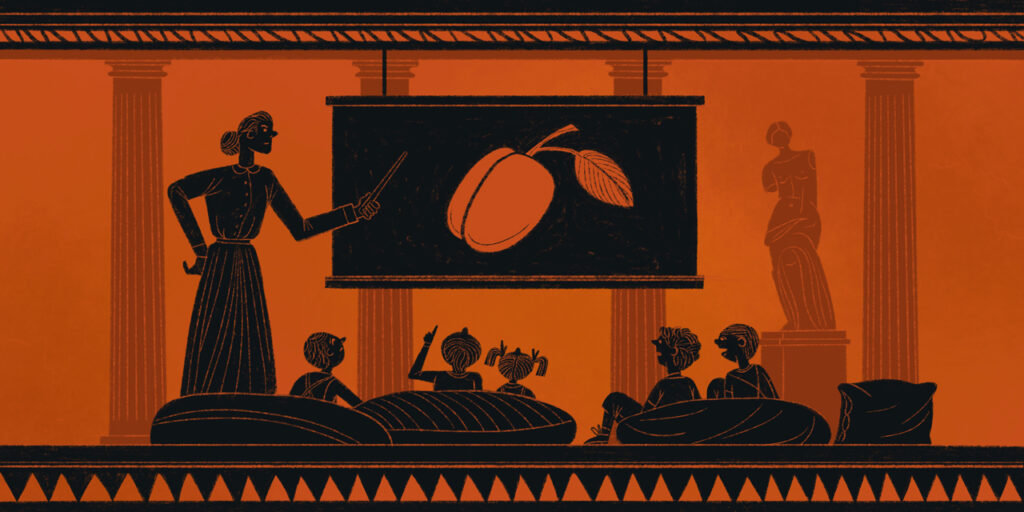
The first slide in the presentation is black, with one white sentence in the middle:
“The only benefit from them is that the apricot appeared on the table of Europeans.”
- Guys, what do you think we will talk about today?
— About the Egyptians? - suggests Pavlik.
Fourth grade first suggested "Arabs and Japanese," so I'm not too surprised.
“You don’t think that sounds a little misanthropic, do you?”
It worked with the previous group, but not now. They continue:
— Is this about some eastern people?
- Guys, please listen to what you are saying.
- About Jews?
- Okay, stop. Okay, if you don't understand what the problem is, let's try it this way: “The only good thing about the Russians is that...”
I don't have time to finish. Lesha jumps up, his face is red and angry:
- Yes we, yes we, yes we will bomb them all!
Several weeks will pass, and in such a situation Pavlik will shout: “Guys, we are Russian!” He, unlike Lesha, will have a lot of fun.
Where was Russia then?
With the fourth grade we are talking about the Hundred Years' War.
“And what, England wasn’t enough for this Edward?” — Dima nods towards the map. - It was already on all sides, look, the whole south of France is also England. So he's actually just greedy?
I smile and say:
- Looks like it. This happens sometimes. Imagine, he never found out how this war ended, and yet after it for another 30 years there was another, already internal, almost civil war.
Dima frowns and once again looks closely at the map:
—Where was Russia then?
I don't have time to answer. He continues:
“If only Russia had captured everyone then.” That would be cool!
And now I don’t know what to answer. Several guys from the class shout out: “For ours!” and “For Russia!”
Who won the Hundred Years' War?
— Who won the Hundred Years' War?
This time the lesson is for the second grade.
- England!
- France!
- France!
- Ukraine! - This is Kostya, he likes to shout something like that. I know that it’s not out of a desire to somehow interfere with me, he just wants to answer funnier. The reaction of one of my classmates is immediate:
- And there will be no such word - “Ukraine”!
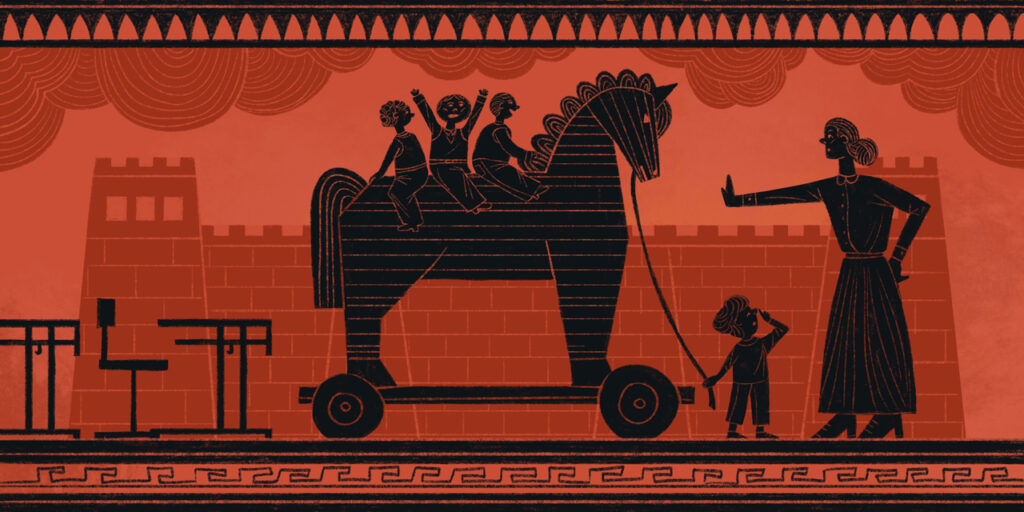
In a normal situation, the teacher should stop the lesson and talk to the children. Talk for a long time, not like me. I just said that in my lesson we will never talk about any country like that, that it is simply unacceptable. I think I was so scared that a second grader would say something like that that I couldn’t find better words. And therefore she very quickly returned everyone present to the 15th century, to England and France, to their kings.
This is not enough. We adults now communicate allegorically. We know how to ask a cautious question and correctly understand a cautious answer, mention something inadvertently, grin, say “goodbye,” recognize “ours” by facial expression. Children can't do that.
"Our"
In the first grade of this school, everyone goes through the myths and legends of Ancient Greece. We end with the Trojan War and the journey of Odysseus. Now Agamemnon insulted Achilles, now Achilles lost Patroclus, now the time has come for the battle between Achilles and Hector.
- But ours won? - asks Ksyusha.
- Which ones are ours?
- Greeks.
“Did I tell you how Agamemnon almost sacrificed his own daughter to go to this war?” And about how Odysseus threw his little son Hector from the walls of Troy?
I talk about Hector and his family, about King Priam. There is no Homeric text before my eyes, but I am trying to reproduce as closely as possible the scene when Priam begs Achilles for the body of his eldest son. But I want to say something else about something else. I realize that I am going beyond what should be said in a first grade lesson.
“They are people like us,” Tema suddenly says. “It’s not their fault that they’re in Troy.”
The subject is a quiet and closed child, I can’t be sure that he understands what he’s talking about. I have so often heard children bring terrible words from their parents from home, and so often I hoped that they themselves did not think so, did not understand what they were talking about. Now I really hope that Theme understands everything.
Kill the dragon Ildar Dadin was a symbol of peaceful protest - and died with a weapon in his hands. Here's his story Society 15 minute read
My first graders know who Aesop is, but that doesn't mean they speak his language. I no longer work at that school and cannot give advice on this matter even to myself, but still: I had to talk to them directly. We must speak to them directly.
Because war affects everyone. Even the smallest, protected, prosperous ones, even in a private school, in family education or in another country. If you have children, talk to them about this war. They already know it’s coming, they’re used to it—remind them that it doesn’t have to be that way.
One day - maybe not very soon - we will all have to return to normal, build a new one, remember what a world without war could be like. But those who went to first, second, and third grade this year will have nothing to remember. No matter how well our lives and the lives of our children are arranged, the war affects them too. The happiest child in the best of schools cannot fail to know that there is a war going on, but he may not understand that it should not be going on.
The author's opinion may not coincide with the opinion of the editors.
In order not to miss the main materials of “Cold”, subscribe to our social networks!


Kholod needs your help to continue working
We continue to work, resisting bans and repression, to preserve independent journalism for the Russia of the future. How do we do this? Thanks to the support of thousands of caring people.
What do we dream about?
About the simple and at the same time complex - the opportunity to work further. Life will change beyond recognition many times, but we, the editors of Kholod, want to stay close to you, our readers.
Support Kholod today so we can continue to do what we do best - be independent media. Thank you!
Author: Anna Zakharova Illustrations: Nastya Pokotinska