
Translated material
Whose flag?
History of the Russian tricolor from Peter I to the war in Ukraine

A swimmer with the Russian tricolor enters the water. Photo: Dmitry Tsyganov
Since the beginning of Russia's full-scale war against Ukraine, many Russians have been faced with the question of national symbols. Is it okay to use a flag when your country's army is using it in a war of aggression? Does it mean that the flag is disgraced forever if war crimes were committed under it? Why do we use the tricolor at all and what is the story behind it? Especially for Novaya Gazeta Europe, historian Alexey Uvarov looked into the issue.
The appearance of the tricolor: from the Netherlands to Arkhangelsk
The idea of the tricolor as a state symbol first arose in the Netherlands. Fighting for independence from Spanish rule at the end of the 16th century, they adopted a red, white and blue flag.
This flag symbolized freedom, the struggle for independence and national unity - ideas that are consonant with the future Russian tricolor.
Following the Netherlands, tricolors became popular in other European countries. The history of the Russian tricolor begins in pre-Petrine times. In the late 1660s, by decree of Tsar Alexei Mikhailovich, the first Russian warship, the Orel, was built in the village of Dedinovo near Moscow. During the construction and equipping of the ship, Captain Butler, invited from abroad to lead the project, mentioned in his documents the materials needed for naval banners and pennants. His descriptions include such elements as “a large banner at the stern,” “a narrow banner on the mast,” and “a banner in the fore tree.”
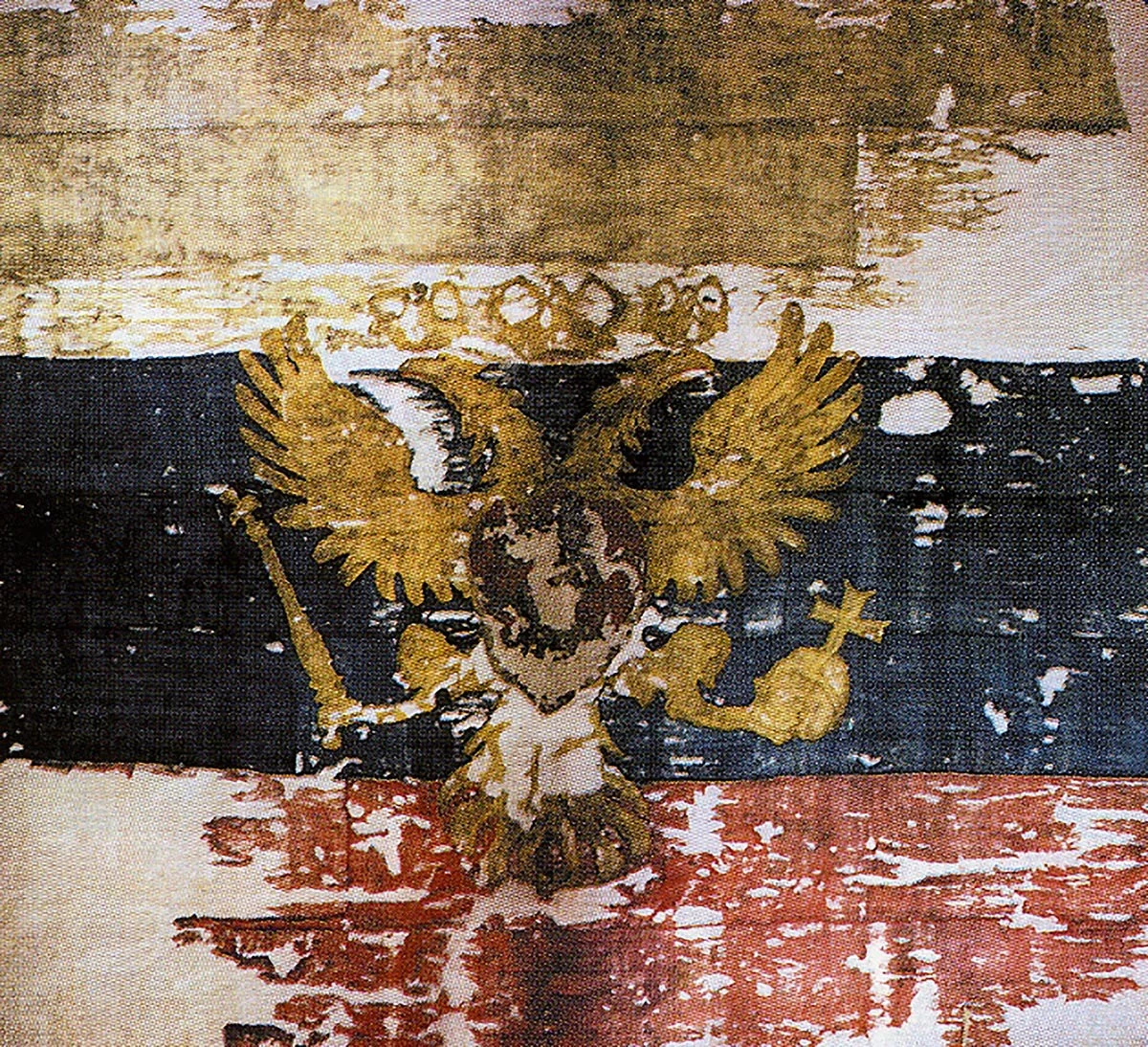
Referring to the colors of the flags, Captain Butler noted: “The flags are in colors as the Great Sovereign will indicate, but this happens, which state the ship is, which state the banner is.” This opinion, based on European practice, pointed out the need for a warship to reflect the colors of the power to which it belonged and which it defended. As a result, according to surviving documents, Alexei Mikhailovich ordered the provision of three colors of material for the banners of the ship “Eagle”: worm-like (red), white and azure (blue). This was the beginning of the colors of the Russian flag: red, white and blue, which later acquired the status of state ones.
In 1693, the young Tsar Peter I, inspired by sea travel and captivated by the idea of creating a strong fleet, went to Arkhangelsk, which was then the only seaport in Russia.
Having seen large bright flags on foreign ships, he got the idea to create a similar flag for Russian ships. In Arkhangelsk, flags were made for his ships, including a white, blue and red banner, later known as the “flag of the Tsar of Moscow.”
Then he first raised the white-blue-red flag on the yacht “St. Peter”, and from that moment the tricolor began its history in the Russian fleet.
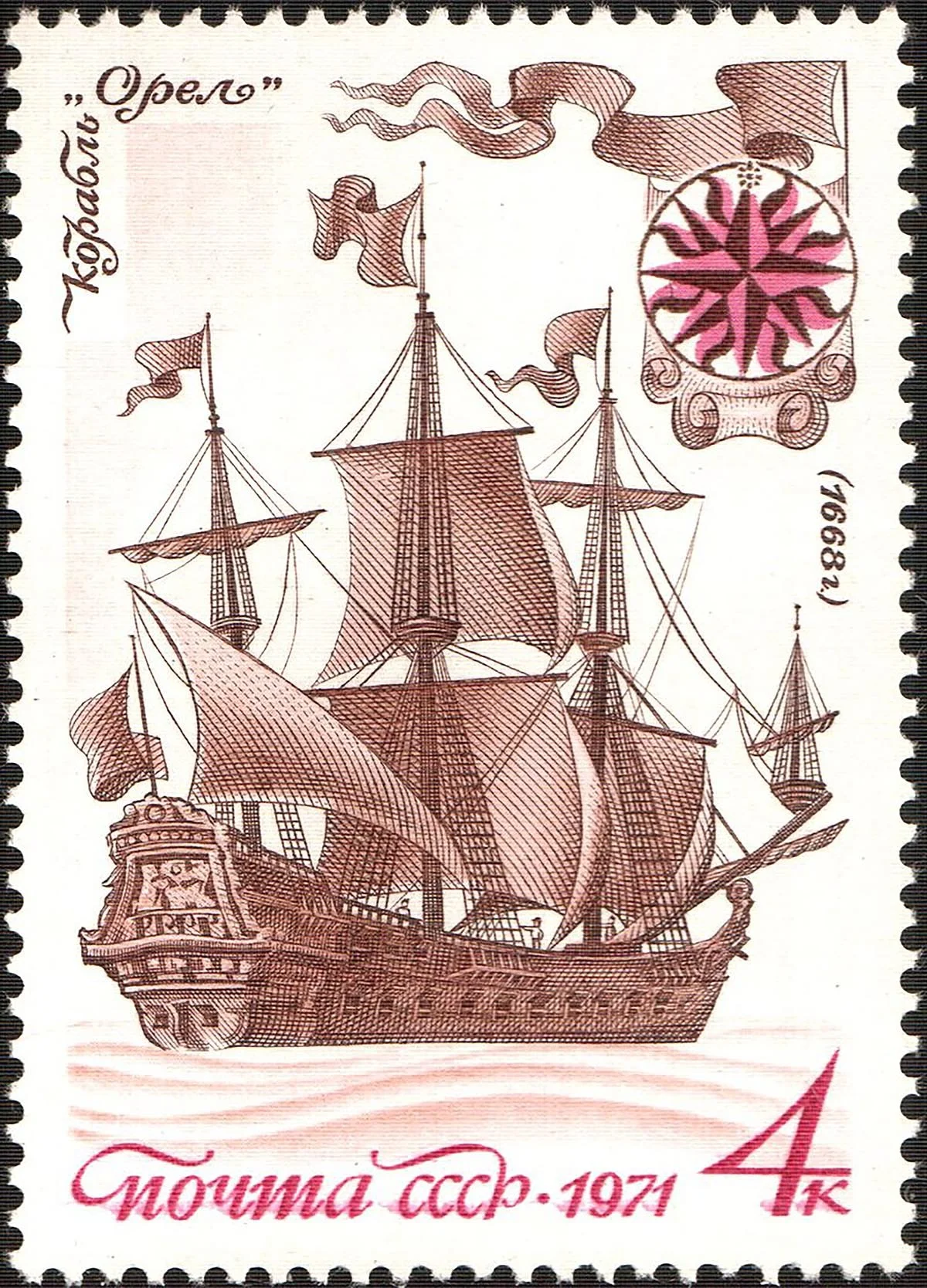
The origin of the colors of the Russian flag remained a matter of debate. Over time, several hypotheses have emerged to explain the choice of white, blue and red. One of the most popular versions is the Dutch hypothesis. It is believed that the Russian tricolor was influenced by the flag of Holland when Peter I, inspired by the advanced maritime work of that country, adopted the Dutch color scheme, changing only the order of the stripes, moving the red stripe down. Holland served as an example for Peter of an advanced maritime state, and the colors of the flag may have reflected this sympathy.
In Soviet times, flag expert Nikolai Semenovich proposed a different explanation for the color of the Russian flag, relying on the ancient heraldic symbols of Russia. In his opinion, the blue color may be a symbol of the mantle of St. George the Victorious on the Moscow coat of arms, and the white and red fields are probably associated with the white horse of St. George and the red background of the coat of arms. One way or another, the king’s choice settled on these flowers, and subsequently their use expanded.
In 1705, Peter issued a decree obliging all Russian merchant ships to fly this particular flag. This decree became the first official document approving the tricolor in Russia, and thereby marked the beginning of its more than three-century history as a state symbol.
Empire: from Peter I to Alexander II and the official consolidation of the flag
Between the reigns of Peter I and Elizabeth Petrovna, the white-blue-red flag in Russia was used primarily as the flag of the merchant fleet. The state symbol remained the coat of arms of the Russian Empire with a black double-headed eagle on a gold background. For the first time in 1742, in honor of the coronation of Elizabeth Petrovna, the State Flag of the Russian Empire was created: a yellow cloth with a black double-headed eagle and 31 territorial coats of arms. This flag was used at coronations, state ceremonies and the burial of monarchs.
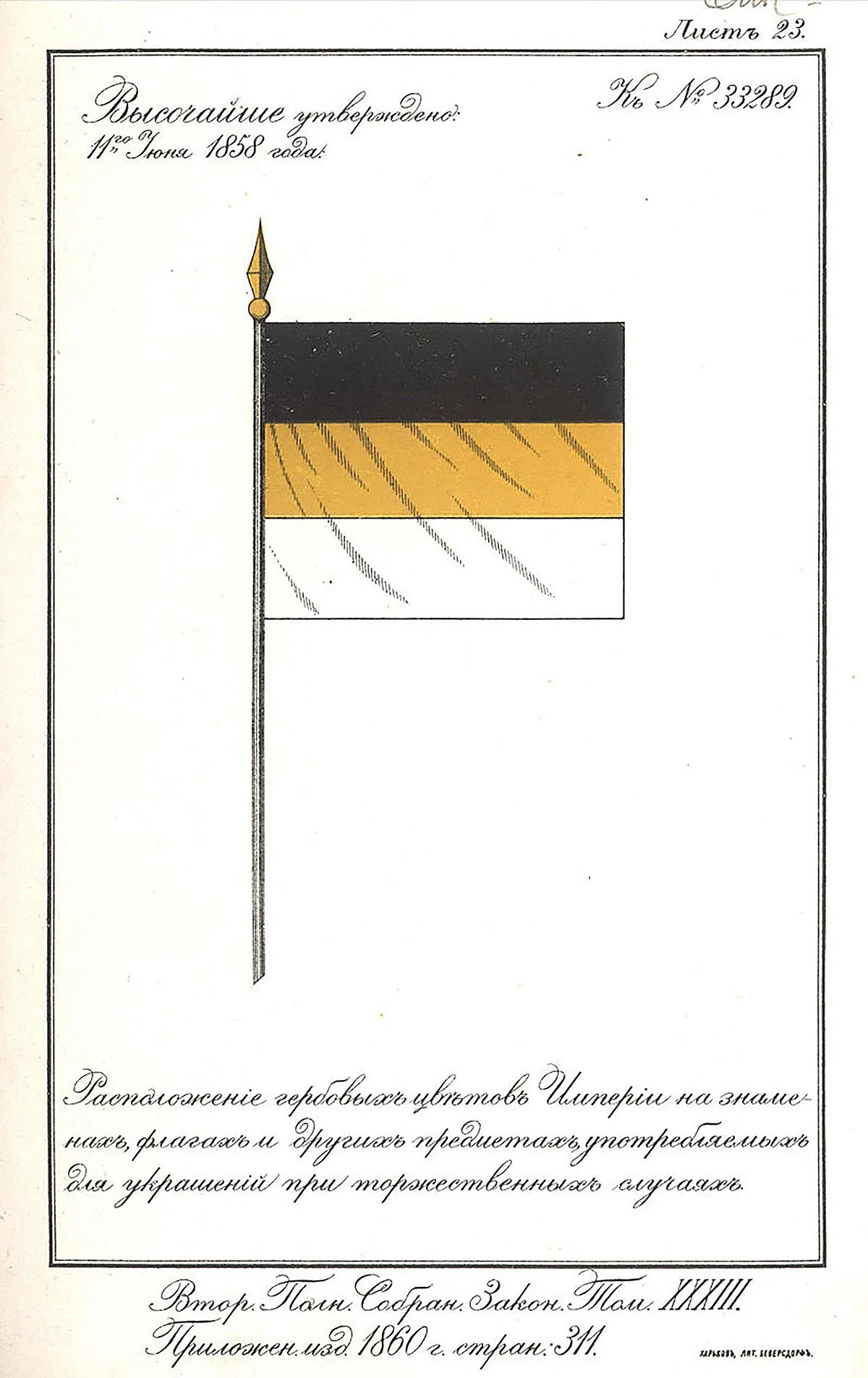
In 1856, for the coronation of Alexander II, armorial specialist B.V. Köhne proposed introducing the colors of the state coat of arms (black, gold and white) as the official colors of Russia, which were also used on banners, in uniforms and in the design of celebrations. Subsequently, the black-yellow-white flag, officially approved by Alexander II in 1858, began to be considered the “herald of the people’s flag,” or national.
At the same time, the white-blue-red flag, associated with the merchant fleet since the time of Peter I, remained widely popular. By the end of the 19th century, it began to be perceived as a symbol of civil society,
in contrast to the black-yellow-white, which was considered government. In 1883, Emperor Alexander III decreed that the white-blue-red flag be used to decorate buildings on special occasions, which strengthened its status as a national flag. In 1896, before the coronation of Nicholas II, a Special Meeting was convened, which recognized the white-blue-red flag as national and finally established it in this status. At the beginning of the 20th century, this flag was officially assigned to Russia as the state flag, despite attempts to return the black-yellow-white color.
20th century: tricolor and revolution
After the February Revolution of 1917, the white-blue-red flag was temporarily used by the Provisional Government as a symbol of the new republic. However, with the establishment of Soviet power in 1918, it was replaced by a red flag.
After the end of the Civil War, the white-blue-red tricolor became a symbol of Russian emigration and the White movement outside the USSR. Emigrant organizations, consisting of former members of the White Army, continued to use the tricolor, perceiving it as a symbol of pre-revolutionary Russia and a sign of resistance to Bolshevik power. This flag appeared at events of Russian emigrants and was used in their symbolism, strengthening the meaning of the tricolor as an opposition sign abroad.
During World War II, the white-blue-red flag was used to a limited extent by Russian military units that fought on the side of Germany. For example, the Russian Liberation Army (ROA), under the command of General Andrei Vlasov, used elements of national symbols. However, the tricolor itself was used only sporadically. Its use was often initiated by representatives of the Russian emigration, since the German command preferred the symbolism of the St. Andrew's Cross. The tricolor was associated with pre-revolutionary Russia and was not the main symbol of these formations.
After the war, the tricolor remained in the symbolism of the Russian emigration, in particular in Europe and America. It retained symbolic meaning for Russians living abroad and acted as a symbol of Russia before the revolution.
Rebirth: 1988–1993
With perestroika in the USSR, since 1987, the tricolor began to be used by national-patriotic and democratic organizations within the country. He appeared at rallies and demonstrations, signifying support for the ideas of reviving national traditions and democratic reforms.
In October 1988, the white-blue-red flag was raised for the first time at an official event in the USSR - a rally at the Lokomotiv stadium in Leningrad. This flag quickly became a symbol of democratic movements, and by the end of the 1980s it was already associated in the mass consciousness with a new, democratic Russia. In 1990, the white-blue-red tricolor attracted public attention when Garry Kasparov competed under this flag in the world chess championship match.
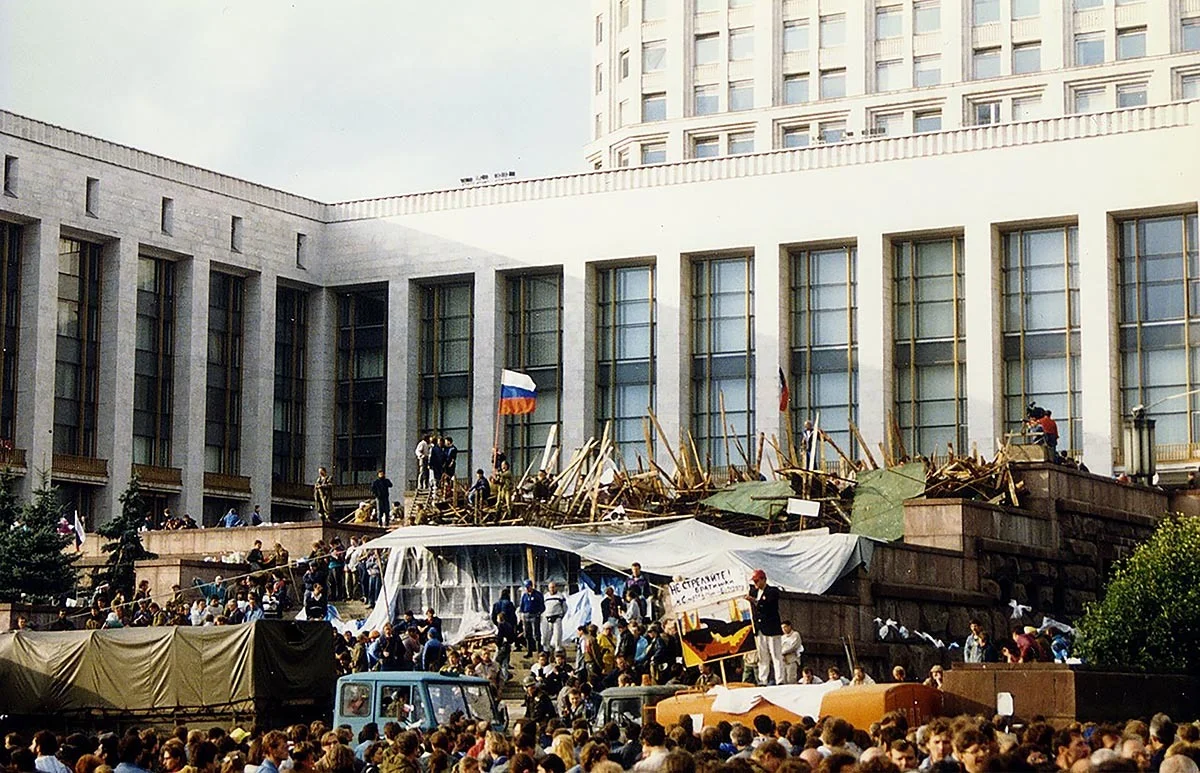
In August 1991, during the August putsch, the flag became a symbol of resistance to the putsch. On August 22, 1991, the Supreme Council of the RSFSR approved the tricolor as the official national flag of the Russian Federation. Soon after this, the tricolor was raised above the White House in Moscow as a symbol of victory over the putsch and the establishment of a new Russia. The initiator of raising the tricolor over the White House was a group of deputies, whose opinion was expressed by deputy Leonid Volkov, one of the developers of the Constitution. He later recalled :
“I felt how important it was to symbolically indicate the connection between the new constitution and the new state in general with continuity in relation to the Russian democratic revolution. The same one that happened in February 1917.”
The symbol of this continuity in August 1991 was the tricolor. In the autumn of the same year, the description of the flag was enshrined in Article 181 of the then Constitution, where it was described as “a rectangular panel with three equal horizontal stripes: white, azure and scarlet, with a width to length ratio of 1:2.”
The October events of 1993 led to a revision of the Constitution, which affected the status of the flag. The new Constitution, adopted in December 1993, established that the national flag must be approved by a special law. Before its adoption, the flag of Russia did not have an official status, and to correct this, in November - December 1993, the flag, coat of arms and anthem of Russia were approved by presidential decrees. The new decree described the flag as “a rectangular panel with three equal horizontal stripes: white, blue and red, with an aspect ratio of 2:3.”
National flag: how to live after crimes?
Sometimes, to symbolically move away from a past of violence, oppression or loss, a state changes its flag. The new flag serves as a sign of renewal and also helps to create a new identity that reflects hope for a brighter future and unity of the nation. This is what Germany did, for example, by abandoning the swastika in 1945 and returning to the symbols of the Weimar Republic. The adoption of the tricolor in 1991 after 70 years of communist dictatorship was the same “return to normal” for Russia.
At the same time, changing the flag in itself does not mean moving towards a democratic state. This is well illustrated by the example of Germany after the First World War. The German Empire experienced military defeat and the collapse of the monarchy. Instead, the German Republic appeared, better known as the Weimar Republic. And indeed, the new Germany also changed its flag. Instead of black, white and red, the German flag became what we know it now - black, red and yellow. At the same time, having changed the flag and abolished the monarchy, Germany did not hand over war criminals to the Entente and refused to take responsibility for unleashing an aggressive war. The change of symbols could not by itself lead Germany to a democratic path - this finally happened only after the defeat in World War II. But even then it took years to work through the past and accept responsibility for the crimes.
The connection between state symbols and crimes can be examined using the example of other countries. The Italian tricolor is well known, becoming a state symbol after the unification of the country in the 19th century. Already in the 20th century, Italy launched an aggressive war against Ethiopia. Then, in 1935–1936, horrendous war crimes were committed under the national Italian tricolor. Italy actively used chemical weapons - phosgene and mustard gas - against the Ethiopians, and bombed peaceful cities. After World War II, Italy changed from a monarchy to a republic and changed its coat of arms, but it still uses the tricolor to this day.
Another example: in 1940–1944, the collaborationist Vichy government operated in France. It used the same tricolor as the French government before it. Under this tricolor in Vichy, the deportations of Jews, the murder of partisans and the torture of members of the Resistance were carried out. But at the same time, the French, as part of the Allied forces, also fought under the French tricolor - but against the Germans and for the liberation of their country. After all, what is the tricolor for France? In many ways, this is the legacy and symbol of the Great French Revolution, the slogan “Liberty, equality, fraternity”, which formed the basis of modern French statehood. However, colonial conquests in Africa and Asia were carried out under the same flag. Does one cancel the other?
For the French and Italians, the answer is clear - no.
Does this mean that Italy and France, using the tricolor, automatically reproduce the practices of colonialism and aggressive war? No, that doesn't mean it. Both countries took responsibility for the crimes committed
and have invested a lot of effort into building peaceful and democratic states.
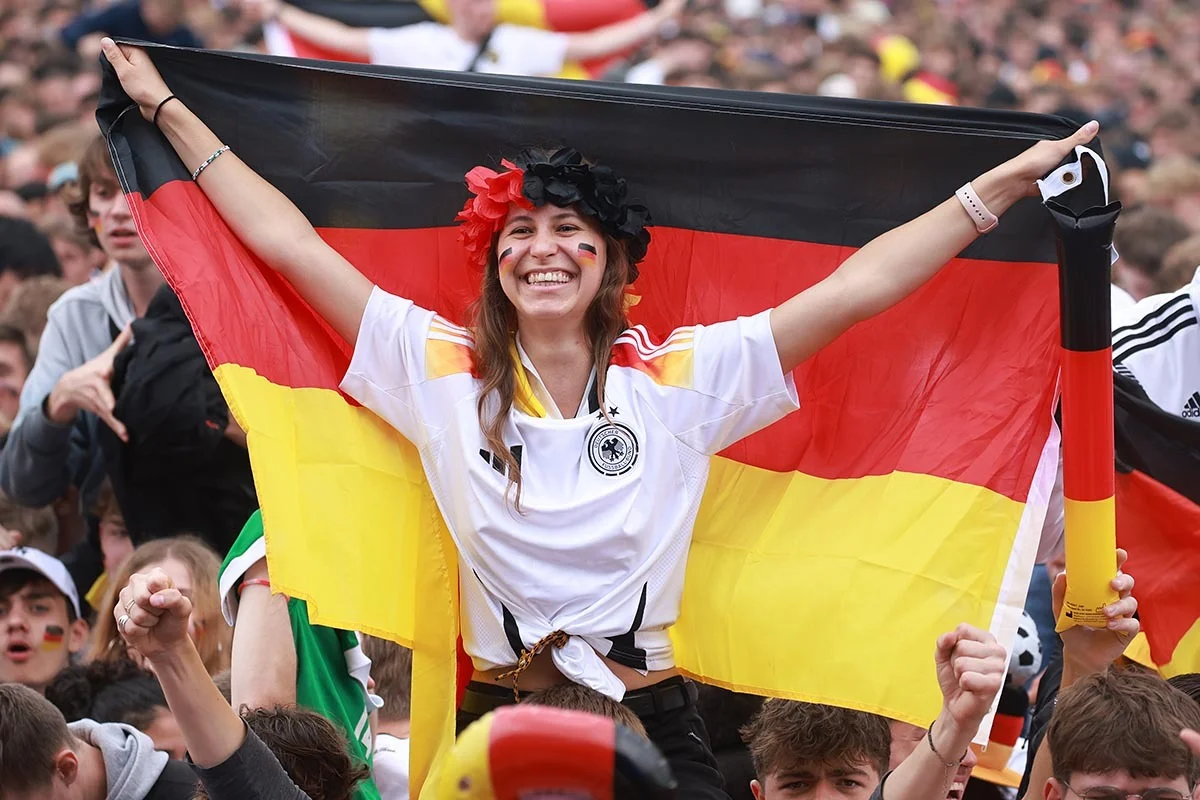
Let's return to the example of Germany in 1945. Would changing the flag have played a big role if it had not been followed by years of work to process the past and accept responsibility? Would it be easier for German Jews if they saw a new German flag, but an unchanged country?
It seems that the discussion about the flag does not rest on the combination of three colors that is applied to uniforms, the armor of tanks and the fuselage of military aircraft. These colors themselves are neutral and exist outside of human will, like other colors of the solar spectrum. You can take others instead of these colors, but the question is not in the colors themselves.
The question is whether a state that identifies itself with these colors can move from dictatorship to democracy. Will it be able in the future to accept responsibility for the destruction and death caused and will it be able to guarantee peaceful politics and security for its citizens and neighbors in the future. Changing colors is easy. Not to relieve oneself of the responsibility for building a different future is much more difficult. The good thing about the BSB flag is that it removes the entire trail of blood and violence that has been following Russia since 2022. For someone who does not want to have anything in common with Russia and thus protects himself from criticism, he has every reason. But he himself cannot give Russia anything good. Political changes, movement towards the future, not the past, and most importantly, acceptance of responsibility - these actions will speak much more eloquently than any colors.