
Translated material
Stop feeding the war
Expenditures of Russian regions on SVO in 2024 will exceed 800 billion rubles. In some regions this is a third of all expenses
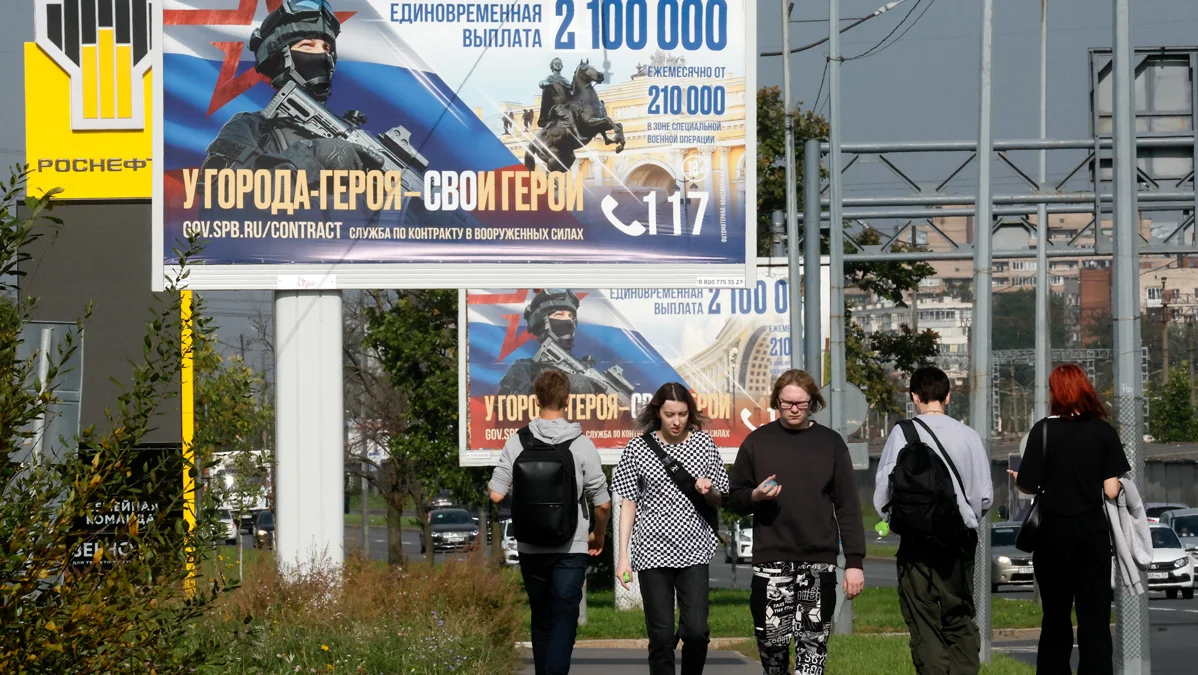
Billboard advertising contract military service in St. Petersburg, September 13, 2024. Photo: Anatoly Maltsev / EPA-EFE
By the end of 2024, Russian regions and occupied territories plan to allocate almost 1.5 times more funds for war-related expenses than last year - more than 800 billion rubles. And this is a minimum estimate, without taking into account Moscow and many hidden costs. In Adygea, Kurgan and Kursk regions, these will exceed spending on healthcare. “New Europe” tells how regions are paying for the war in Ukraine.
On October 24, the State Duma approved in the first reading the draft state budget for 2025 and the planning period 2026–2027. According to the project, national defense remains the largest expenditure item: it will account for almost a third (32%) of all federal spending next year (13.5 trillion rubles).
A significant part of the military burden fell on regional budgets. Not all regions have already adopted relevant laws for 2025. But for 2024, we counted 813.4 billion rubles allocated by the regions for war-related items: this is 3.6 times, or 588 billion rubles, more spending on the same items in 2021.
For comparison, regional spending on social payments for items not related to war has increased by only 1.16 times since 2021.
Such significant expenses were not initially planned. At the beginning of the year, regional budgets provided 445 billion rubles for these items, that is, war-related expenses should have decreased compared to 2023. However, by mid-October, the amount of planned spending almost doubled (by 83%). At the same time, the regional expenditures approved for 2024 generally increased during this period by 12%, and for health care and social payments for items not related to the war - by 14% and 8%, respectively.
Until 2022, the “military” expenses of the regions consisted mainly of costs for civil defense and protection from emergency situations, social security for veterans of the Great Patriotic War, Afghan and Chechen wars, and primary military registration. Our calculations also include some of the expenses not related to the war. For example, emergencies are not always caused by military operations. But it is impossible to separate these expenses from truly military ones, since funds for the construction of bomb shelters and for eliminating the consequences of fires and landslides often go through the same budget items.
However, while the war did not affect Russian territory, regional spending on civil defense and emergencies was relatively stable: about 130–140 billion rubles per year. In 2024, they grew to 225 billion rubles (of which 34 billion rubles were in the flood-affected Orenburg region, but even without taking this amount into account, the growth is obvious).
In addition, the regions are now responsible for payments for signing contracts with the Ministry of Defense, and various benefits for participants in the “special military operation” and their family members, and compensation for housing destroyed during Ukrainian attacks, and even the formation and arming of self-defense units in the front-line areas.
War-related expenses of the regions are not limited to the “national defense” section: its share is just insignificant and in the 2024 budgets it is only 4.4% of all. Most of the costs related to the war are distributed among “peaceful” sections: “social policy,” “housing and communal services,” “health care,” “education,” and “national issues.”
What we thought
In our calculations, we considered the following as war-related expenses:
everything provided for in the section “National Defense” (among them - mobilization preparation of the economy, primary military registration and others);
expenses for payments to mobilized and contract soldiers;
social payments, benefits and compensation to SVO participants, members of their families, refugees and residents of occupied territories, as well as residents of Russia who suffered from the actions of the Armed Forces of Ukraine;
spending on civil defense, emergencies and territorial self-defense;
spending on military-patriotic education and pre-conscription training.
The level of military spending varies greatly from region to region: while the occupied Lugansk and Donetsk “people’s republics” and the Kherson region account for a third on military items, Chechnya and Tatarstan spend about 0.5% of the total budget on war.
After the invasion of the Ukrainian Armed Forces in 2024, the Kursk region reached the levels of the occupied regions: 28.7% of the budget goes to war-related expenses. Now these expenses are 1.3 times higher than the region’s spending on education and almost 4 times higher than on healthcare. At the same time, non-military expenses have not increased since the beginning of 2024 (taking into account inflation, this actually means their reduction).
Regions whose military spending exceeds spending on healthcare also include the annexed Crimea, the Kurgan region and the Republic of Adygea. War-related expenses were almost equal to health care expenses in the Belgorod, Bryansk regions and Altai.
The regions cannot afford such an increase in military spending: according to the current plan, all 89 regions will end the year with a budget deficit. This deficit is covered mainly by federal money, and in 17 regions subsidies exceed their own income.
For example, in the Kursk region, instead of the planned 18.3 billion rubles of transfers, the current version of the budget has already included 45.6 billion rubles. Transfers from Moscow are almost equal to the Kursk region’s own income. At the end of 2024, they should amount to 50.9 billion rubles.
The above estimate can be considered minimal; a significant part of war-related expenses cannot be recognized in the budget and taken into account in calculations.
A number of payments and benefits for SVO participants and their families in regional budgets are made under general expense items. Thus, free legal and psychological assistance, meals for children in educational institutions, reimbursement of fees for a child attending kindergarten, subsidies for gasification of housing and other benefits from the regions are often provided for in articles “for certain categories of citizens.” Since the circle of “separate categories” may include not only SVO participants, but also large families, disabled people and other groups, it is impossible to accurately determine the share of expenses specifically for SVO participants in this case, and we did not take them into account as military expenses .
Although the regions are responsible for a significant portion of the costs of “restoring” the occupied territories, these costs go through intermediaries. As a rule, money is transferred from regional budgets to reserve funds, then to non-profit organizations, and only then reaches its destination. We wrote about this scheme in the material “ All of ours are assembled .” As a result, it is impossible to determine what amounts a particular region allocated for work in Mariupol or Donetsk based on official data. 82 regions are involved in the restoration of “new territories”, but in their budgets we did not find expenditure items directly related to this activity.
Part of the spending on “economic development” is in fact intended not for the civilian sector, but for the military-industrial complex (MIC). “Many regions provide various subsidies and subsidies to enterprises producing military products. Often this is not even an initiative of the regions themselves, but an order from above, from the center. But in reporting it is customary to use rather broad formulations: it is difficult, often impossible, to distinguish investments in the civilian economy from money for the military-industrial complex,” explains Tatyana Mikhailova, an economist at the University of Pennsylvania.
Although all regions have introduced one-time payments for concluding contracts with the Ministry of Defense, more than half of the regional budgets do not have a corresponding expense item: apparently, the money is “disguised” as other social spending.
Our calculations hardly take into account the richest Russian region—Moscow. According to the federal portal “Electronic Budget”, Moscow’s expenses in 2024 amounted to only 182.9 billion rubles - slightly more than in the Altai Territory. These data are obviously far from the truth. According to the portal “Open Budget of the City of Moscow”, the capital’s actual expenses this year have already exceeded 3 trillion rubles, and according to the forecast at the end of the year they will amount to 5.6 trillion rubles. However, the resource does not contain detailed data broken down by article.
“It is impossible to accurately estimate what part of Russian military spending is distributed among regional budgets,” says Tatyana Mikhailova. — A significant part of them cannot be recognized in budget reporting. These expenses do not, in fact, depend either on the desires of the regions or on their capabilities:
they are forced to carry out orders from Moscow, and the lack of money can be covered by transfers from the federal budget.
With the outbreak of a full-scale war, the federal budget also became deficit, and, according to the new budget law , will remain in deficit for at least the next three years.
With the participation of Ksenia Storozheva