
Translated material
Dictators and death. Long goodbye
The tyrant's physical body dies, but the symbolic body remains. To get rid of totalitarianism, one must also abandon its symbolic legacy
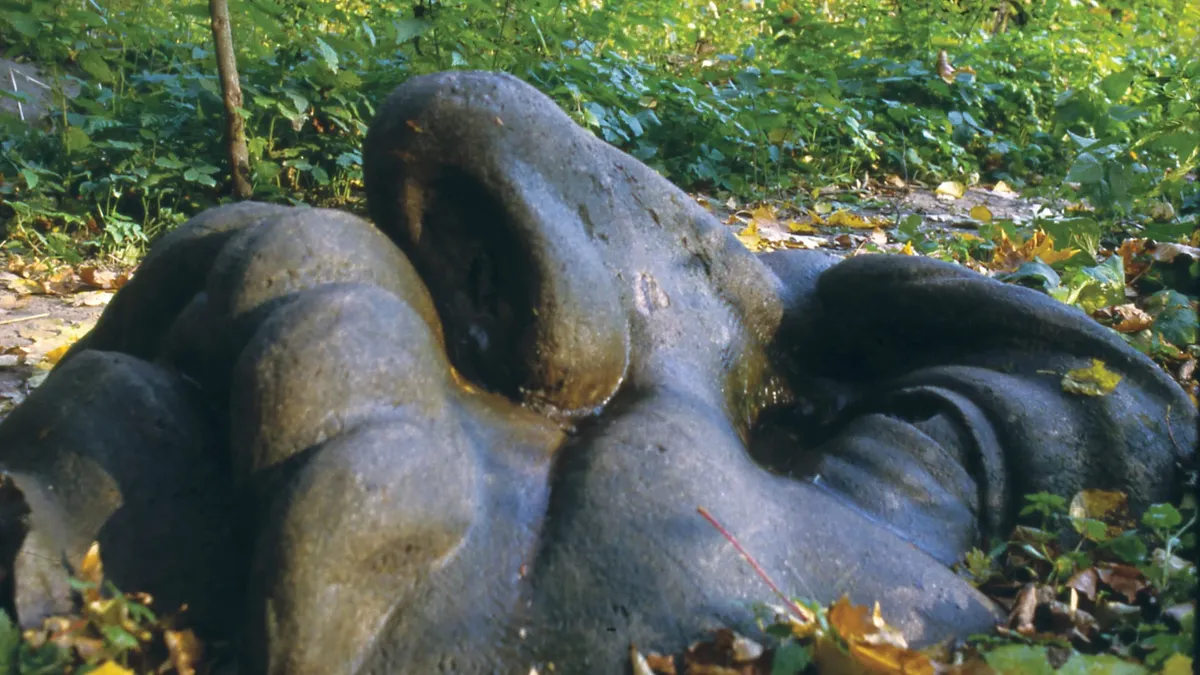
Photo: Tofik Shakhverdiev
(18+) THIS MATERIAL (INFORMATION) IS PRODUCED, DISTRIBUTED AND (OR) SENT BY FOREIGN AGENT ANDREY VLADIMIROVICH KOLESNIKOV OR CONCERNES THE ACTIVITIES OF FOREIGN AGENT ANDREY VLADIMIROVICH KOLESNIKOV.
“...here he suddenly raised his left hand (which was moving) and either pointed it somewhere upward or threatened us all. The gesture was incomprehensible, but threatening, and it is not known to whom or what it referred to..."
Svetlana Alliluyeva, “Twenty Letters to a Friend”, 1963
He says goodbye, but doesn't leave. The dictator rules for a very long time, and therefore his subjects have the feeling that their leader’s life is eternal. “And we have long forgotten that Stalin is a man,” wrote Ilya Ehrenburg, “he turned into an omnipotent and mysterious god. And so God died of a cerebral hemorrhage. It seemed incredible."
The dictator has ruled for so long that the masses wonder: if he leaves, will things get worse? A dictator, like a king, according to the research of medievalist Ernst Kantorovich, has two bodies - physical and symbolic. If the physical body dies, the symbolic remains. Hence the conclusion: “The king is dead, long live the king!” The dictator does not die, he just stops being around...
Without regaining consciousness
A smart dictator takes care of his successor in advance, because even his symbolic heredity can be interrupted if the mechanism of transfer of power is taken carelessly. There will be no two bodies, only one will remain - and that’s it. However, caudillo Franco did not help either. Although he did not hang upside down in a square in Milan, like Mussolini, his legacy was recognized as toxic, and his remains were reburied. In this sense, all dictators, with rare exceptions such as Stalin, who found a second, if not third, posthumous life, are equally unhappy. But Stalin was also taken out of the mausoleum. And Lenin, an exhibit of the panopticon, lies in his personal hell - in the sarcophagus.
Even their death is sometimes extended over time. Dictators care about prolonging their lives. After the war, Stalin spent more and more time at his southern dachas. In his old age, Franco preferred recreational fishing to everything else, except for watching Real Madrid matches. But it’s not just life until death that is extended in time, the process of dying itself is lengthened.
According to the memoirs of Nikita Khrushchev, Beria cursed and scolded Stalin when he showed no signs of life, but as soon as these signs returned, he immediately fell to his knees and began to swear allegiance. In the fantastic interpretation of Alexey German in the film “Khrustalev, car!” Beria is trying to revive the leader - with all the unappetizing details.
Antonio Salazar unsuccessfully plopped down on a canvas chaise longue, hit his head hard, was between life and death for months, and then lived in a parallel reality - the country was ruled by another person, Marcela Caetano, and the dictator was brought a special edition of his favorite newspaper, Diario de Noticias, made personally for him. . The production of this paper fragment of fictional reality was personally taken care of by the editor-in-chief Augusto de Castro. At some point, the dictator began to recover altogether, which somewhat puzzled - but only temporarily - the new top leadership of the country, which was later demolished by the “carnation revolution.”
Franco was not disconnected from the life support equipment for a long time. And he died painfully. And only at the request of his daughter, after several days, the tubes were finally disconnected from the device - and the caudillo died.
Should we not remember how the courtiers pretended that everything was fine with Konstantin Chernenko, he even voted for something at the Central Clinical Hospital, received a certificate of deputy of the Supreme Council of the RSFSR. Soviet joke: the general secretary began to perform his duties without regaining consciousness. This is also about Brezhnev - he was on psychotropic pills, which were supplied to him by the deputy chairman of the KGB, Semyon Tsvigun.
Anecdotes did not spare a succession of Soviet gerontocrats: why did Brezhnev, with his physical weakness, go on visits abroad, and Andropov sits in Moscow? Because Brezhnev worked on batteries, and this one was powered only. No matter how much the leaders hid the true state of affairs, rumors that Andropov’s kidneys had failed and he was forced to regularly “renew his blood” circulated throughout Moscow. The Secretary General depended on being connected to an artificial kidney, and even during his lifetime, Chernenko’s successor could not work without artificial lung inhalation.
Symbolic scene: Konstantin Ustinovich’s last visit to Yuri Vladimirovich in the hospital, Andropov lies unconscious, Chernenko is breathing heavily in the room where he himself will die in a year. An equally symbolic picture: members of the Politburo carry the coffin of their General Secretary and seem to be descending one after another into the underworld behind this coffin - this is Pieter Bruegel the Elder, “The Blind Leading the Blind”!
The equipment supported the existence of the leaders; they did not intend to leave during their lifetime, and the entire elite intensely monitored the progress of the “severe and prolonged illness,” thinking about how power would be divided postmortem.
“In a dictatorship, the fixation on the ruler’s body is stronger and more direct, because the dictator’s power is directly linked to his body,” wrote the German political scientist Philip Manow in In the Shadow of Kings. “The rites of passage that we are familiar with from the funeral ceremony of the king are carried out today using strategies aimed at artificially prolonging the life of the dictator. This is being done to ease the crisis surrounding his death and facilitate the transfer of power.” In the mature Soviet Union, the procedure was worked out to the point of automaticity: whoever headed the funeral commission for the Secretary General would be the next first person - the symbolic body of the king did not die. And so on until the end of the personnel bench, until the final of the “carriage race”.
Suitors of Death
The motive of heroic death is extremely important for a dictator. He himself is equated with the Motherland; in totalitarian regimes one must die for the Motherland, not live. A totalitarian regime is one big Valley of the fallen: some build it under the supervision of guards, others lie in it. You always need to be prepared for death. One consolation is that later they will say that she was heroic. “For the Motherland, for Stalin!” - symptomatic formula. And religion will always promise reward in the next world. Again, it is no coincidence that during the Great Patriotic War, Marxism-Leninism, if it did not give way to Stalinized Russian patriotism, which also appealed to Orthodoxy, then stood on par with it as a motivator of the warring people.
Historian Antony Beevor, author of a seminal work on the Spanish Civil War, wrote about the willingness of the Carlist "requetes", representatives of a radical nationalist Catholic group, to dissolve personality and individual responsibility in a common cause. They were told that “every Red killed would shorten the killer’s stay in purgatory by a year... It was this dehumanization that made the war so terrible.”
Pathetic hymns and marches of totalitarian movements invariably included a motif of pathetic heroism, and death always loomed behind the heroes.
“And as one we will die in the fight for this” is a well-known song of the Red Army, but it also existed in the “White Guard” version: “We will boldly go into battle / For Holy Rus' / And, as one, we will shed / Young blood!”
The blood, of course, must be young, it is the youth that must support the leader and lay down their heads for him. That’s why the Italian fascist anthem was called “Youth” - Giovinezza. In this series are the German “Song of Horst Wessel-Lied”, the Spanish Legion march “The Bridegroom of Death” (El Novio de la Muerte), and the songs of other skinned Aryan-looking young people with stage names. In this logic, one can become a hero only by shedding blood for the leader and in spite of the whole world.
“Viva la muerte!”, or the incident in Salamanca
On October 12, 1936, the University of Salamanca celebrated the 444th anniversary of the discovery of America by Christopher Columbus. Such achievements are declared by totalitarian regimes to be almost the personal achievements of the leader, as if it was he who sent Columbus in search of India. Moreover, it was a “celebration of the Spanish race” (which did not really correspond to the ethnic origin of Cristoforo Colombo). The “special path” of the corresponding nation and its messianic role are also an integral feature of all such regimes. Germanic Deutschtum is adjacent to Italianità, and Hispanidad is adjacent to the “lusotropicalism” of old man Salazar. The “Russian World” does not lag behind, because, according to the poem by F.I. Tyutchev “Russian Geography”, borders: “From the Nile to the Neva, from the Elbe to China, / From the Volga along the Euphrates, from the Ganges to the Danube... / This is the Russian kingdom...”
So, let's return to the assembly hall of the University of Salamanca, the center of Castile and Leon, where a tribune was erected for the guests of honor. Caudillo was presented personally by his wife Dona Carmen, and the highest generals were also present. One after another followed speeches about restoring the “spirit of a united, great, imperial Spain.”
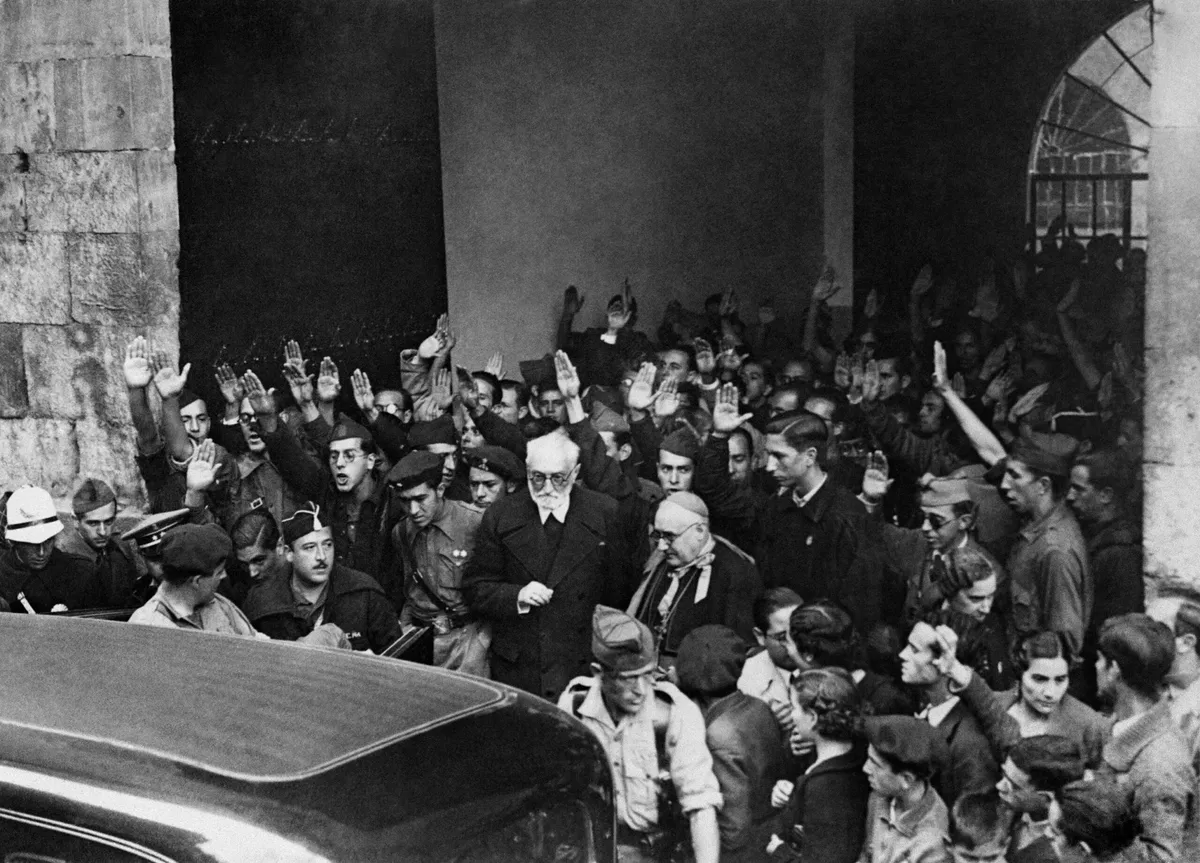
The rector of the University of Salamanca, the world-famous philosopher Miguel de Unamuno, presided (or was forced to preside). He generally supported Franco because he believed that Spain needed to be saved from Bolshevism. However, his mood was affected by the recent murders and arrests of colleagues and friends, including the death two months before these Francoist celebrations of Federico García Lorca. The 72-year-old classic tried unsuccessfully to intercede for those arrested and doomed before the inexorable Franco.
Professor of Spanish literature Francisco Maldonado de Guevara gave a passionate speech in which he assessed the Civil War as a battle for Spanish “traditional values” and against the “anti-Spain” Reds, as well as Basque and Catalan nationalists. The “cancer of the nation,” Basque and Catalan nationalism, he argued, had to be removed with the scalpel of fascism.
Someone from the audience, overexcited by the professor's eloquence, shouted the slogan of the Spanish Legion: Viva la muerte! - “Long live death!” Following this, General José Millán Astray, a personal friend of Franco and a classic “old soldier” who had lost an eye and an arm during the war in Morocco, shouted three times: “Spain!” The answer to him was the cries of the Falangists, throwing out their hands towards the portrait of the caudillo and Doña Carmen in a fascist salute: “United! Great! Free!”
Unamuno took the floor. He said that a civil war is an uncivilized war. He also said that he had received a personal insult - he is a Basque by nationality, a native of Bilbao, and the bishop present at the ceremony is a Catalan from Barcelona. He taught Spanish all his life, and the fighters against “anti-Spain” present here don’t really know him. The most important thing: the slogan “Long live death! - necrophiliac, and it sounds like “Let life die!”
Unamuno did not stop there and continued his thoughts against death in front of a hostile audience. Records of his indictment vary—newspapers published all of his speeches except the rector’s. But in general they come down to the following: “Long live death!” - an absurd paradox, and it disgusts me. General Miljan Astray is a cripple. He himself is a symbol of death, being a war invalid like Cervantes. Alas, there are many cripples in Spain now. There will soon be even more of them, unless God helps us. It pains me to think that mass psychology is defined by General Miljan Astray. The cripple, deprived of the greatness of Cervantes, will seek sinister consolation by sowing mutilation around himself. Miljan Astray wants to create a new Spain in his own image. That’s why he wants to see Spain crippled, as he himself made clear.”
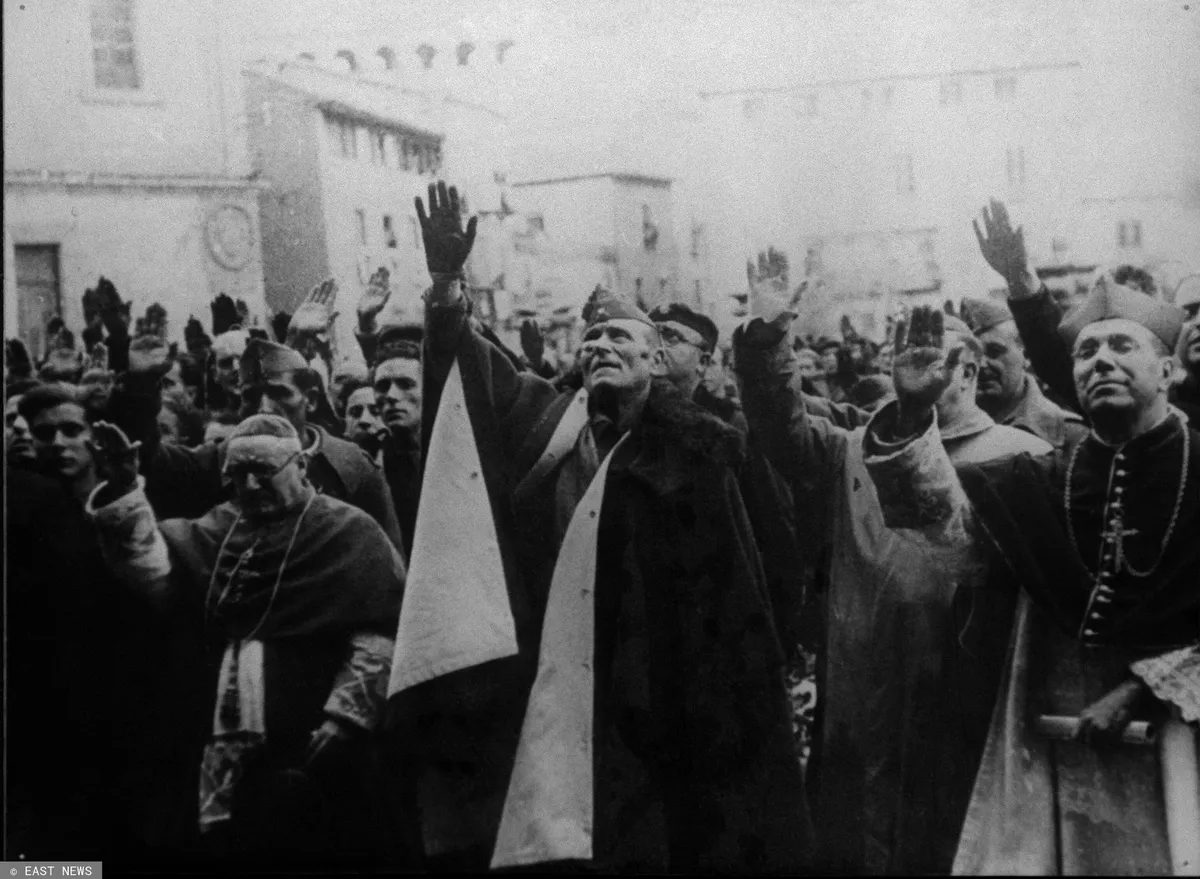
In response to these words of the sage, the enraged general shouted: Muera la inteligencia! - “Death of the intelligentsia!” (or "intellectuals" or "intellect"). The Phalangists echoed, drew their pistols, their weapons pointed at Unamuno. Nevertheless, the university rector continued: “This is the temple of the intellect, and I am its high priest. You are profaning its sacred precincts. No matter what the proverb says, I have always been a prophet in my country. Winning does not mean convincing. You will win because you have more than enough brute force, but you will not convince, because to convince is to convince. And to convince, you need what you lack in this struggle - reason and rightness. It seems to me that it is useless to urge you to think about Spain.”
The words addressed to the muzzles of the Phalangists' weapons became famous: Venceréis, pero no convenceréis - “To win does not mean to convince.” They could be addressed to all dictators of all times and peoples who flirt with death and win through brute force.
Only the presence of Dona Carmen, although she was a rather empty lady, behaved with dignity in this situation, saved the sage from reprisal - in any case, they left the assembly hall immediately after his speech together. Amid whistles and hooting, Carmen Polo de Franco escorted Miguel de Unamuno to her “official” car and took the philosopher to his house on Calle de Bordadores.
Almost immediately, by order of the caudillo, Unamuno was removed from his post as rector of the university. As is expected in such regimes, his friends and colleagues who had not yet been killed by the regime turned their backs on him. He died on December 31, 1936, two and a half months after the incident at the university.
Repentance and dedraconization
During World War II, movements with approximately the same ideology dominated for some time in different countries: the Arrow Cross in Hungary, the Ustasha in Croatia, the National Legionary State in Romania. “The Legion of the Archangel Michael” is a typical example of a totalitarian movement in which the idea of death and sacrifice becomes the supporting structure of the entire ideology. “We believe in the redemptive power of our graves”; "Legionary nationalism supports and extols the ideas of will, power and territorial expansion, encourages military discipline, glorifies asceticism and death for the common good." “The legionnaire loves death, because his blood nourishes the tree of the future legionary Romania.” It is no coincidence that Romanian legionnaires participated in the Spanish Civil War on the side of Franco.
Dying on the battlefield for a leader is an extremely important task. But it is even more important to destroy the enemy. The fight against enemies - external and internal - is one of the purposes of a dictator: he brings death to his enemies. Well, for example, as in the Unamuno case - to all sorts of intellectuals.
Martin Heidegger, like Unamuno, was also rector for some time. And he also justified the regime, but as a result did not go into confrontation with it. On the contrary, he laid his philosophical foundations along with other Nazi philosophers and lawyers, whose leader was Carl Schmitt. In a course of lectures in 1933–1934, Heidegger called for exposing the enemy, who cannot always be seen at first glance. If the enemy is invisible, he needs to be “created” so that weapons and vigilance are not dulled. It is necessary to identify the enemy, “to force him to shed his disguise.” One must be prepared to attack “with the ultimate goal of total destruction.”
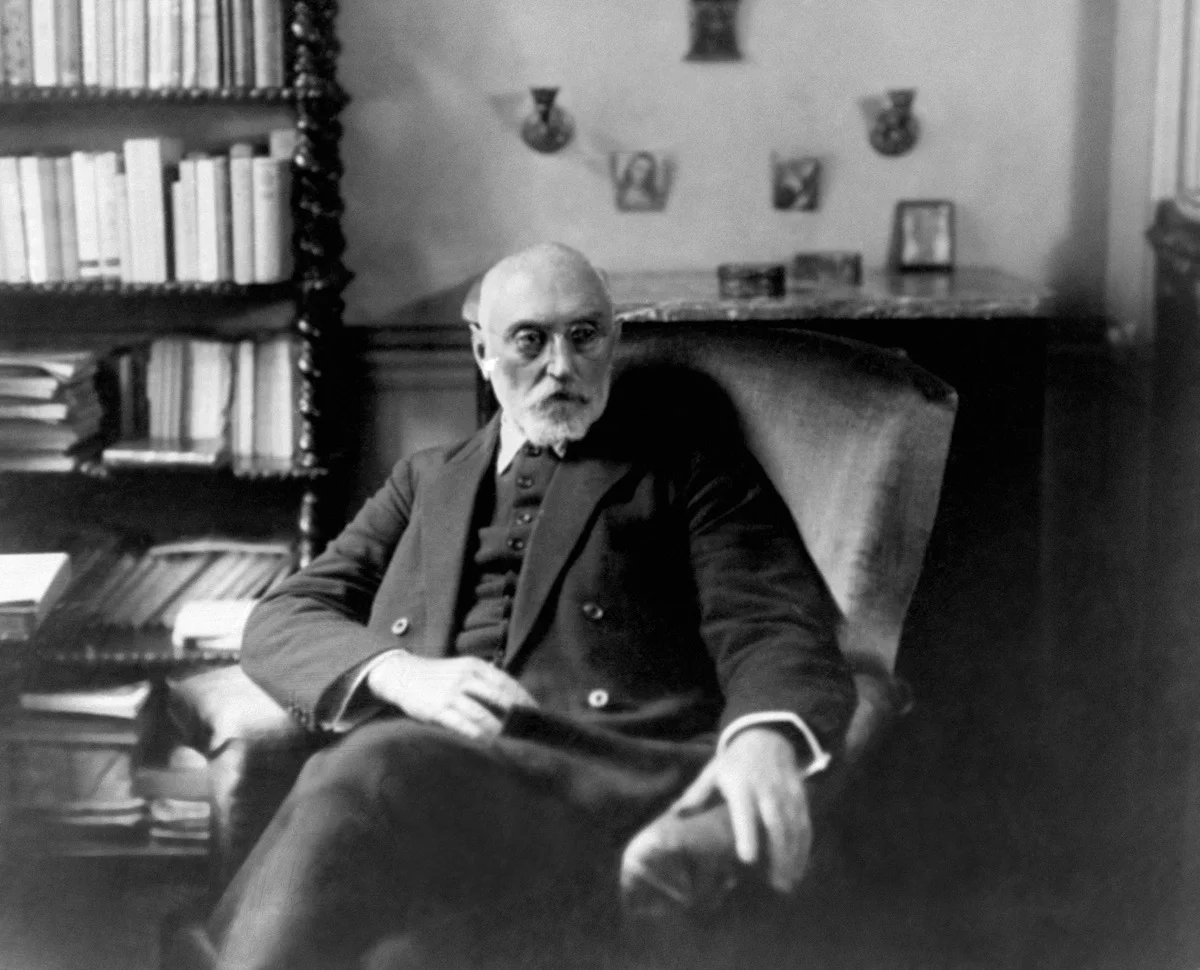
Political criminals, wrote Nazi lawyer Eric Wolf, must be treated much more harshly than ordinary criminals. Resistance to the total state must be criminalized - “the crime in the form of disobedience and rebellion comes to the fore, the enemy of the state is persecuted in the criminal.”
However, in a total leadership state, the key role is played by the national spirit and the people themselves, who communicate with the leader directly without intermediaries. And then the leader is the embodiment of the people. According to Ernst Kantorovich, medieval political theology was the same: the king is the body of the people, the subjects make up the body of the king. The homeland, patria, is the king, it is useful to die for the king, virtue requires giving birth to children for the patria. You must love the sovereign more than your father.
After all, as Merab Mamardashvili noted, “the regime is totalitarian through the people.” Without subjects, there is no king; without those willing to die for the sake of an autocrat, there is no dictator. But the same crowd sometimes welcomes the execution of the natural body of the king in order to prolong the life of the symbolic political body. Only the king's name will be different.
From Schwartz's fairy tale we know that killing the Dragon is not enough. It regenerates like a lizard's tail. What is necessary, as Natalya Gromova puts it , is the dedraconization of the state itself and social relations.
Some states succeeded in this dedraconization. After death games ended for dictators in a variety of ways. Someone was lying in a puddle of his own urine, great, terrible and pathetic. After several operations and the phrase “How painful it is to die,” someone was disconnected from life-sustaining equipment. There was also a character whose corpse was hung upside down along with his mistress in the square in front of the central station.
“The 14 corpses were hanged by their feet from an iron fence in front of a gas station,” his biographer Jasper Ridley describes Mussolini’s end, “and a huge crowd that had gathered in the square attacked them, hurling insults and kicking them.”
Dictators have a poor relationship with death. Entering into an alliance with her, marrying their subjects with her, they still become enemies with her and invariably suffer defeat. As a rule, in the most humiliating way. Even if physical death is followed by a lavish state funeral. Ungrateful generations then carry the dictator out of the mausoleum and lay him in a hole, covering him with concrete slabs (and he still emits relict radiation). Or the remains are taken out for reburial from the chapel in the Valley of the Fallen near Madrid, a terrifying memorial that was built by 20 thousand prisoners. Even if a similar procedure has to be done several times, as in the now forgotten film “Repentance” by Tengiz Abuladze.
* Included by the Russian authorities in the register of “foreign agents”.
This material was published in the first issue of Novaya Gazeta. Magazine". You can buy it in the online store of our partners .