
Translated material
“When problems arise on the horizon, wise people prepare for them.”
Even liberal-minded residents of the United States are beginning to buy weapons and prepare for civil war. They blame their fear on the rise of political violence and don't listen to experts
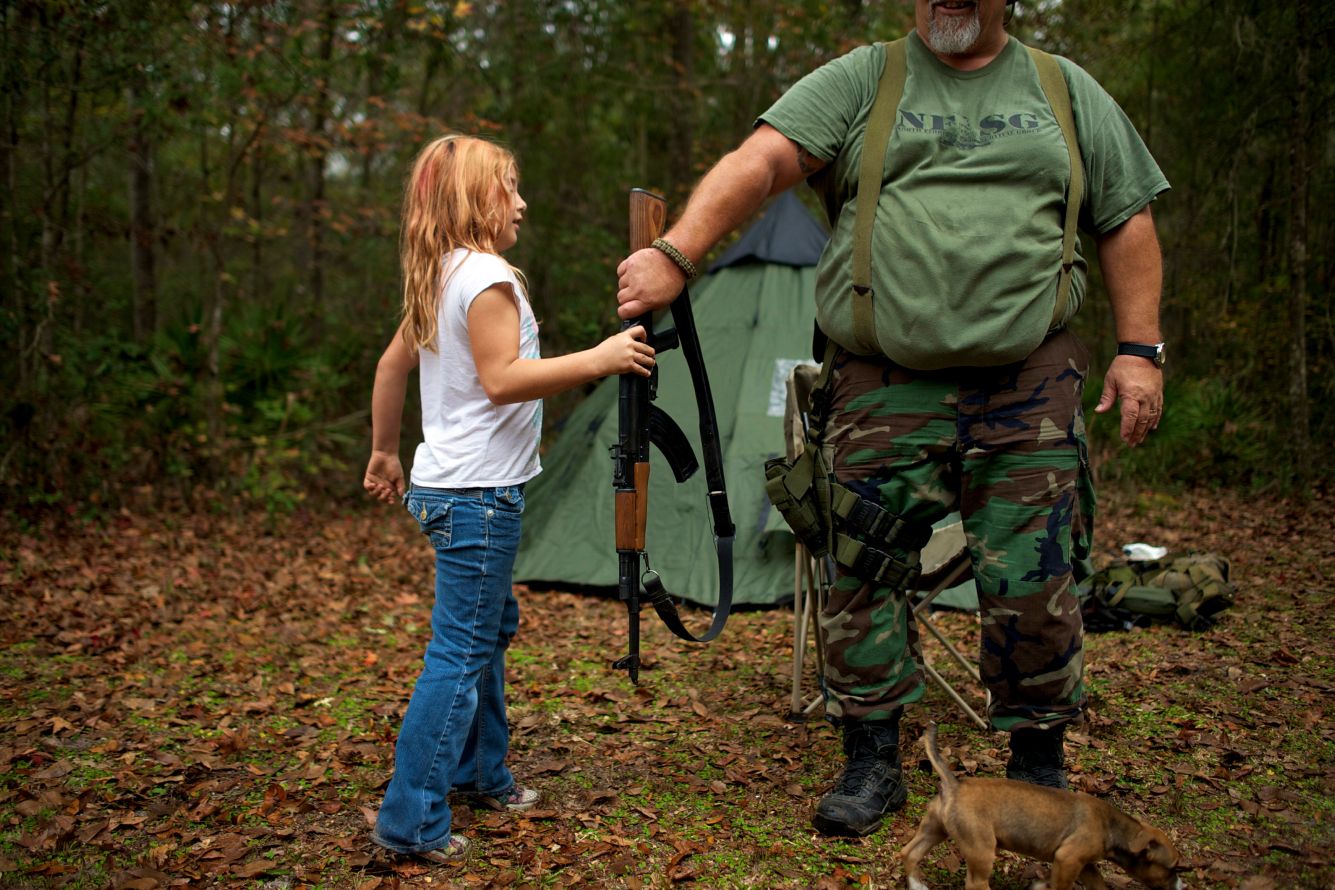
Many people in the United States fear that due to the escalation of disagreements between people of conservative and liberal views, a second civil war could begin in the country. To prepare for such developments, they began to form prepper communities. "Medusa" retells The New Yorker's story about what preppers are doing and what their fear of escalating political violence is based on.
US residents are enrolling in survival schools en masse. These are not only gun lovers and conspiracy theorists, but also peaceful liberals
There are more gun owners among liberal Americans, The Wall Street Journal reported in September 2024. At the same time, a study by University of Chicago researchers, cited by The New Yorker author Charles Bethea, showed that, on average, three out of 10 liberal Americans own firearms in the country. And scientists from Johns Hopkins University found that more than half of Democratic Party supporters who registered pistols or shotguns over the past four years had never purchased a gun before in their lives, Bethea writes.
The same trend is noted by the organizers of survival courses in extreme conditions. According to Shane Hobel, director of Mountain Scout School in East Fishkill, N.Y., in recent years liberal-minded men and women, who might previously have scoffed at the idea of such classes, have increasingly signed up for his seminars.
Some course participants come with children. The founder of one of these schools, Alex Bryant, said that at first his courses were mainly attended by eccentric enthusiasts and lovers of “playing war games.” However, after the 2020 elections, more of them appeared who “never hunted, fished or made a fire.” According to Bryant, this happened because "people are seeing signs of troubled times."
A Reuters study published in August 2023 revealed a sharp increase in political violence in the United States: between January 2021 and the time of publication of the material alone, journalists identified more than 200 crimes related to ideological differences.
Nothing like this has been seen since the 1970s - but then political violence was mainly directed at property, while now people are more often attacked. Another recent study , conducted by researchers at the University of California, Davis, found that one in three American adults (including as many as half of Republican Party supporters) believe that violence is “usually or always justified” as a means of achieving political goals.
In survival schools, where Americans attend because they are concerned about a possible surge in violence, they are taught how to use weapons and tools, build shelters from scrap materials, use camouflage, navigate the terrain using compasses and maps, and provide first aid. Some courses tell you how to remain “invisible” - that is, hide from possible pursuers. The authors of some courses release applications that you can use to study from home. One such app, Collapse Survivor, simulates different situations that could lead to further escalation of political violence, and the user answers questions about what they would do in extreme circumstances. At the end of the test, the application, based on the answers, determines the person's chances of survival.
Many survivalists prepare “alarm suitcases” in advance, a set of basic things that can be useful in extreme conditions. Last year, Open AI CEO Sam Altman said he keeps weapons, gold bars, potassium iodide , antibiotics, batteries, water supplies and gas masks on hand. And writer Walter Kirn admitted that he keeps an “emergency library of world literature” in his car in case he has to “restore civilization.” His set includes The Arabian Nights, Moby Dick, the stories of Sherlock Holmes and other classics.
Another interlocutor, Charles Bethea, a former investor in Silicon Valley and innovation adviser in the Barack Obama administration, John Ramey, had in his alarming suitcase a portable solar panel for charging gadgets, duct tape, a radio, a flash drive with documents, food that does not cause thirst and does not require cooking, a water filter, a sleeping bag, a set of clothes, cash, a pistol and - “for psychological health” - a deck of cards. Raimi himself now works as a “disaster consultant” and helps his clients equip shelters. Not only conservative lovers of conspiracy theories, but also devoted supporters of the Democratic Party turn to his services.
Mark Burton, who runs a company that offers armor installation to Utah car owners, has also noted growing concerns about political violence. According to him, the demand for equipping cars with protection from firearms has jumped almost sevenfold over the past four years, despite the high cost of such services (up to 40 thousand dollars). According to Burton, his company is now selling out absolutely everything it manages to produce.
Many Americans fear political provocations and escalating violence between the election and Trump's inauguration
According to the US Federal Emergency Management Agency, cited by the author of The New Yorker, about 20 million Americans are actively preparing for a “cataclysm” - about twice as many as in 2017 (the US population is more than 335 million people). Perhaps most of all, US residents are worried about the possibility of civil war. In May 2024, billionaire financier Ray Dalio, in an interview with the Financial Times, estimated the likelihood of internal conflict in the United States at 35%, and in June said that it was already more than 50%. According to Dalio, a civil war, if it does happen, will be “an existential battle of the far right versus the far left, in which everyone will have to either choose a side and fight, or hide, or flee the country.”
“Human history confirms that any institutions and rules sooner or later reach their limits,” said “disaster consultant” John Raimi about a possible civil war. — At some stage it is no longer possible to fix anything. Our society puts great effort into creating systems for redress, such as the justice system. But when they fail, as they do now, we return to the only remedy left: violence.”
Such reasoning is largely based on the rhetoric of American politicians. For example, in July 2024, Republican Senator from Ohio George Lang, speaking at a rally in support of Donald Trump, said : “If we lose this election, I’m afraid the only thing that will save the country is a civil war.” Although Lang later apologized, such rhetoric from the conservative right is hardly fringe. Heritage Foundation President Kevin Roberts recently warned that a “second revolution” is about to begin. Political commentator and Trump supporter Tim Poole has repeatedly talked about a "civil war" on his X (formerly Twitter) account, where he has more than two million followers. And Trump himself increasingly talks about certain “enemies from within.”
Fears of a conflict between right and left gained momentum after the assassination attempt on the Republican leader. Then some Trump associates blamed their opponents for the incident. Since then, many Americans, regardless of political preference, have come to believe that the country is on the brink of political disaster.
One of the survivalists who agreed to talk to The New Yorker author before the election suggested that if Trump loses, Texas could declare secession from the United States, and if the Republican wins, Oregon and Colorado could split from within. “Perhaps someone will shoot Greg Abbott ,” suggested Bethea’s interlocutor. — Some crazy people might open fire in Fort Cavazos . The media will distort the situation. Militias will form and begin to fight among themselves. It will be an irrational conflict, but irrational wars are common.”
Before the election, most of these predictions were based on the likely discontent of the MAGA movement if Trump lost. This will definitely not happen, since the Republican won. However, according to preppers, the tense period could last at least until the inauguration , while the new political order is not yet fully formed.
One of the most popular ways to prepare for the American Civil War is to buy a place on a protected ranch.
Not all survivalists limit themselves to completing courses, preparing “alarm suitcases” and downloading the appropriate applications. Many of them immediately invest in shelter in case political violence in the United States leads to extremes.
The New Yorker author visited one of these shelters, a ranch specially equipped in case of disaster under the leadership of former air intelligence officer Drew Miller. The journalist compared the structure, located on a site in Colorado far from roads and populated areas, to a “hurriedly built hostel.” Inside, he saw sleeping quarters, game consoles, supplies of rice, canned food, coffee, instant food and toilet paper, and a lot of weapons: shotguns, pistols, rifles, a supply of ammunition and a crossbow (shooting classes are regularly held at the ranch). According to Miller, all this could be useful in protecting against “marauders,” as Bethea’s interlocutor called those who, in his opinion, would participate in unrest and skirmishes over resources in the event of a civil war. Another survivalist assured the journalist that if necessary, they could defend the ranch for at least a month.
In addition to the site in Colorado, Miller owns six more ranches in different states. The total number of participants in his program is more than a thousand people. Among them are adherents of different political views and representatives of different professions: doctors, engineers, restaurant employees, pilots and entrepreneurs.
The cost of one place on the ranch is from four to 60 thousand dollars, depending on the amenities and the time during which the prepper can take refuge there if necessary (from five to 50 years). Annual fees for maintaining conditions and replenishing supplies reach up to 1.5 thousand dollars.
Most experts The New Yorker spoke with suggested that, even with unprecedented levels of political violence and sharp divisions between Democrats and Republicans, a full-scale civil war is unlikely to break out in the United States in the coming years. According to US Department of Defense official, political scientist and participant in military operations in Iraq, Afghanistan and Kosovo Chris Ellis, neither the protests of the Black Lives Matter movement, nor the seizure of the Capitol, nor the assassination attempt on Trump seem to be events that could completely split the nation, as happened in 1860 -X.
However, survivalists who pay large sums of money for the opportunity to hide from fanatics, marauders and government troops prefer to play it safe. One of these people, a programmer from Colorado, admitted in a conversation with a journalist that the very thought of the rise of political violence frightens him, and the place on the ranch gives at least some sense of security. “I’m not what you’d call a professional survivalist,” says one client at Drew Miller’s Colorado ranch, a former CIA operative named George. “I don’t want to run through the forest or live without running water.” But when problems arise on the horizon, wise people prepare for them. And civil war is very real.”
"Jellyfish"