
Translated material
“We help those coming to Russia adapt and comply with the laws”
Botirjon Shermuhammad was born and raised in Uzbekistan. He studied to become a lawyer in Tashkent, and then decided to continue his studies at MGIMO. However, after moving to Russia, his life changed dramatically: Botirzhon had to work at a construction site and live in a barracks for 10–15 people. He faced bureaucracy, xenophobia and violation of his rights. Then Botirjon began counseling other migrants who were experiencing similar difficulties. He got a job as a lawyer at the non-profit organization “Tong Jahoni”, launched a YouTube channel and media about the problems of Uzbeks in Russia. “Such things” and T—J asked Botirzhon to tell how he helped migrants defend their rights and why he left jurisprudence for media management.
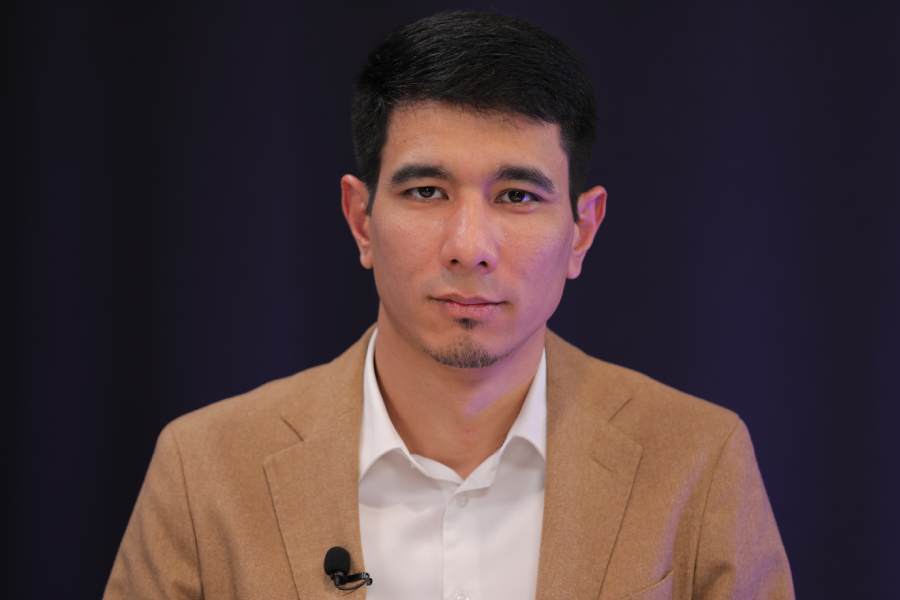 Botirjon Shermuhammad Photo: personal archive of Botirjon
“I missed half of my classes because I went to the Olympics”
I was born in 1985 in the village of Urta-Shakhrikhan, Uzbek SSR. His father, a lawyer by training, worked as a prosecutor. Mom was a botany teacher at a school for the deaf for some time, and then quit and devoted herself to raising children. I was the middle of three brothers.
Soon after my birth, my father was transferred to work in another area, and we moved. I had good relationships with my family and an active childhood: like all children, I loved to walk and play with the kids in the yard, and also practiced karate and football. But I always devoted most of my time to studying: from the age of seven I went to an English tutor and studied a lot on my own. I studied mostly with straight A's.
When I was 12 years old, we returned to our home area. My brothers and I had to move to new schools. I studied better than anyone - apparently, that’s why dad decided to realize his unfulfilled dream through me. He said that I needed to become a scientist and suggested that I enter a lyceum with in-depth study of physics and mathematics.
I didn’t yet know what I wanted to do, so I didn’t object to my father. Even when it turned out that it was too early for me to go to this lyceum: I only moved to the seventh grade, and they took me there from the eighth. The director, an acquaintance of my father, decided to give me a chance. I was enrolled in the lyceum on the condition that at the end of the first quarter I would pass the exams along with my classmates.
In the end, I managed, but I had to study a lot with tutors to catch up with the other guys. It was hard. And most importantly, I quickly realized that I was not a techie, but a humanist: what I liked most was history and law. My father also noticed this and, without even asking, transferred me to another school a year later. From the ninth grade I began to study at a lyceum with in-depth study of law. Then I realized for sure that this was mine.
I studied well, constantly went to Olympiads and law competitions. Sometimes I missed half of my classes because I was traveling all over the country. I still have a lot of certificates for participating in competitions, several times I even won prizes.
Due to missing the seventh grade, I graduated from school at 15 years old. I remember that I didn’t even have a passport to apply to the university, and instead they gave me a special certificate. There were no doubts about my future profession. I was so interested in law that I decided, like my father, to become a lawyer. I chose one of the most prestigious universities in Uzbekistan - Tashkent State Law Institute (TSLU).
Unfortunately, I didn’t get in that year: I was only five points short. I think the high competition and the fact that I was younger than others played a role - I still needed time to prepare. My parents helped: they rented an apartment for me in Tashkent and hired tutors who prepared me for admission to TSLU. As a result, I succeeded the second time and became a student in 2001.
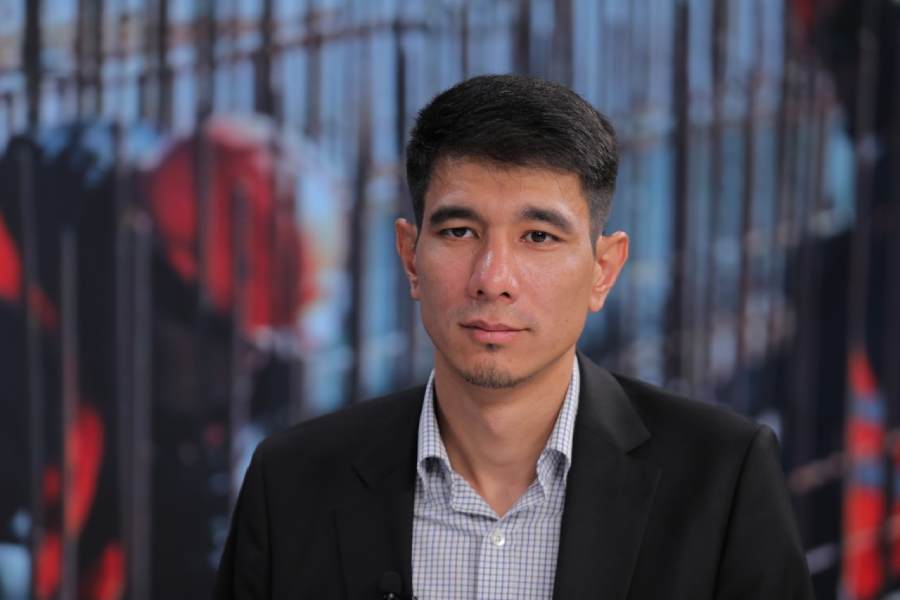 Botirjon Shermuhammad Photo: personal archive of Botirjon
“I realized that I would definitely not be either a prosecutor or a judge”
I liked my student years: my brother and I lived in the apartment of a family friend , walked around Tashkent, we had many friends. From my second year I began working as a tutor, preparing schoolchildren to enter my university. I received good money, but it was still not enough to provide for myself, so my parents helped me. Studying at the university made me happy. We had good teachers and interesting subjects, for example international law, in which I took second place at the Olympiad.
But in general, I studied imperfectly: I was often late, I went only to those classes that I considered useful for myself. I didn’t count on getting a diploma with honors - I understood that they wouldn’t let me get it anyway, because I was constantly quarreling with the dean’s office. I didn't like the omnipresent controls, like the dress code: we were forced to wear a suit and tie every day. If someone came in different clothes, they had to write an explanatory note, and for frequent violations they could be expelled. At school we also wore a uniform, but everything was not so strict, so I was not indignant. But at the university I became a rebel.
During my student years, I began to get involved in the Russian press. I always thought that smart people read newspapers, and I wanted to live up to that image. But during the time of Karimov, there was strict censorship in Uzbekistan: it was impossible for us to read anything about politics and economics. So I subscribed to Russian publications - “Arguments and Facts”, “Trud”.
In 2003, for the first time, I received the magazines “Kommersant Power” and “Kommersant Money” from Moscow. It was space: so many interesting things, deep analytics, beautiful bright photographsThen I became disillusioned with working in government agencies. In the third and fourth years we had practice in the courts and prosecutor's office, and I saw that a lot of things were done there not according to the law. For example, the verdict was passed in advance - by the time the hearing began, we already knew how it would end. What the lawyers and the prosecutor said did not matter. The court allegedly retired for a meeting, but this was a profanation: they did not decide anything, but simply drank tea. I realized that I would definitely not be a prosecutor or a judge.
In 2005, I graduated from university and thought about what to do next. As a result, I decided to change my specialty and enroll in a master’s program at the Faculty of International Relations. Since I was interested in Russian politics and the press, I chose MGIMO. I had to study in Russian, but I didn’t see this as a problem: I went to a Russian kindergarten, studied the language at school and university, and tried to read and write a lot in it.
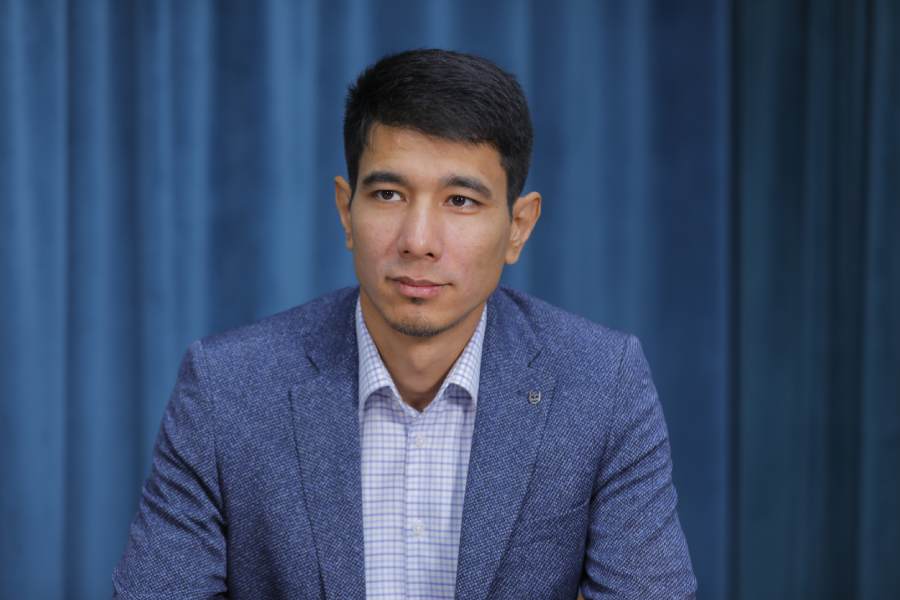 Botirjon Shermuhammad Photo: personal archive of Botirjon
“Working as a courier was psychologically difficult”
However, I made the decision to enter MGIMO too late. When I arrived in Moscow in October, the acceptance of documents to universities had already ended. I had to wait until next year. I decided to stay in Moscow, work and save up money for my studies: as a foreigner, I could not count on a budget-funded place at a Russian university.
At first, I stayed with friends who were renting a room in Odintsovo. I registered at my place of residence - this was required for work.
Without a residence permit, I could only get a job as a courier in the online store “Butylka.ru”. Psychologically, of course, it was difficult for me to do this with a higher education. But I worked there for only 15 days: one of my relatives called me and said that he knew the director of a construction company in Moscow who could hire me.
I still remember how I went through the interview.
The director immediately decided to test my Russian. He asked: “How do you spell “milk”?” I said: "With an 'o'." He replied: “Well, it’s not that bad!”I was hired: together with other workers, I laid roofing on Plyushchikha Street. This work, of course, was far from my specialty, but I was officially registered - thanks to this I received permission to work in Russia for a year.
Two months later, an acquaintance from the online store where I initially worked called me to the Ermakov and Partners company and said that they were looking for a legal assistant. Naturally, I accepted the offer: I was glad that I could finally do something in my field. But the salary was small, only ten thousand rubles. I had to look for a part-time job, and I started helping other Uzbeks.
They contacted me through friends. I prepared and restored their documents, helped with the purchase of air tickets, made money transfers to their relatives: not everyone knew Russian well and could get from the construction site to the bank or ticket office. As a result, after a few months I was fired from the company - I was too busy with my part-time job and was often late for the office. Then I completely devoted myself to helping other migrants.
I earned some money, but it was not enough to rent an apartment or room in Moscow. So I lived in a barracks for 10–15 people along with construction workers from our area. It happened that I stayed in cabins at construction sites and in the basements of residential buildings along with the janitors.
Sometimes I had to deal with xenophobia. Then, in the 2000s, skinheads had not yet died out; sometimes they even killed migrants. Once at the Leningradsky station I met such people: they looked at me aggressively and even took a few steps in my direction. For a long time I did not dare to go out into the street, I stayed at the station, where the police and other people were, and waited for the skinheads to leave.
Things also happened to ordinary townspeople. A classic situation: you’re standing in line at the supermarket, someone glares at you with displeasure and grumbles: “Here we go.” One woman at the migration service, hearing that I spoke Russian, said: “Wow, it turns out there are literate Uzbeks!”
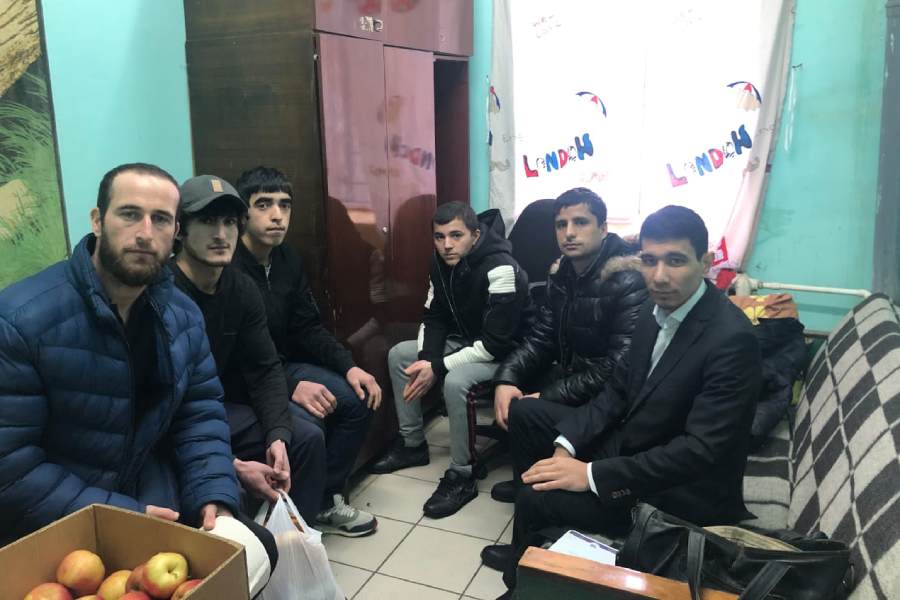 Botirzhon in a special detention center for migrants, 2020 Photo: Botirzhon’s personal archive
The police, fortunately, were rarely interested in me, but there were unpleasant situations with them too. Once I was stopped to check my documents at the Leningradsky station and asked where I was going. I replied that I was going to St. Petersburg, to visit my relatives. “Have you already managed to get relatives here?” - the policeman said mockingly. At the same time, he did not return my migration card, he crushed it and almost tore it.
Another time, the police even started showing me some white powder in a bag. They threatened that they would throw it at me if I didn’t give them 500 rubles. At that time it was a decent amount. I had to agree to their terms.
“I told landlords that I was from Uzbekistan, and they immediately refused me”
By the summer, I changed my mind about going to university: for a foreigner, studying at MGIMO cost six thousand euros a year, but I couldn’t save that kind of money. In addition, I realized that working was more interesting for me than studying.
At the beginning of 2007, the lawyer who fired me from Ermakov and Partners suddenly contacted me and offered to open a company together. He planned to engage, among other things, in helping migrants and hoped to receive clients through me.
This is how I became the co-founder and CEO of the NIKA consulting group. There were no problems with documents: anyone could register a legal entity in Russia. I also coped with the work. I quickly delved into the peculiarities of Russian legislation - it is practically no different from Uzbek legislation. We helped migrants with applying for work, registering companies, obtaining patents and other issues.
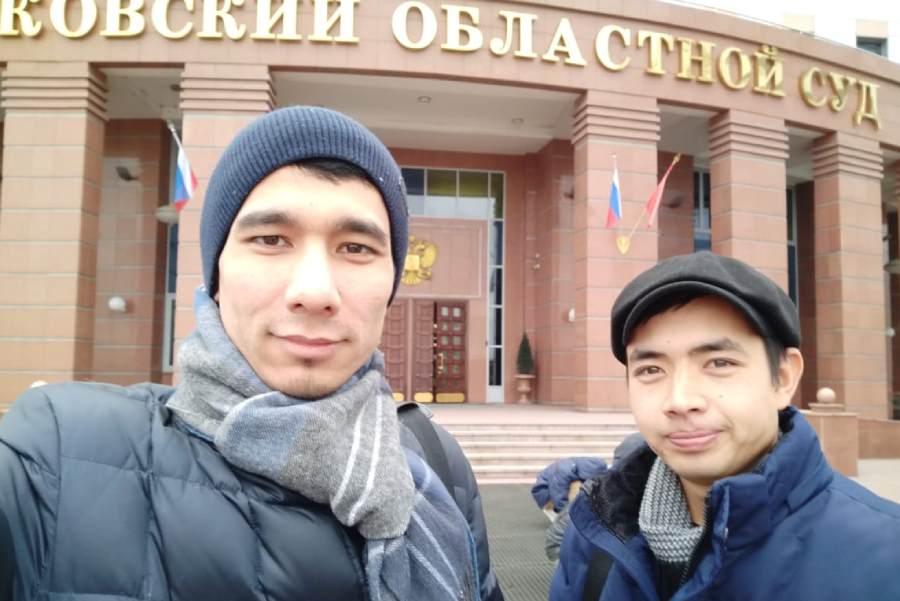 Botirzhon after a hearing in the Moscow Regional Court, 2019 Photo: Botirzhon’s personal archive
I started having more money (I used to earn two or three thousand dollars a month), and I started renting a house. First, I moved in with friends from Uzbekistan - the four of us lived in a two-room apartment. Then I tried to find separate housing for myself, but it turned out to be difficult. As soon as I said that I was from Uzbekistan, they immediately refused me. I had to ask a Russian friend to arrange a viewing and go to it with me - we lied that we would live together. Only after that the apartment was rented to me.
In 2008, through my parents, I met my future wife. She had never been to Russia, but despite this, she easily agreed to move in with me. We got married and began to live together in that same apartment.
In order for me to have the right to be in Russia, I needed registration. But the owner of that apartment did not want to register me - this is a very common problem among migrants. Like many others, I had to buy registration in a place where I did not live - it cost about three thousand rubles for three months . It was also dangerous because the address could be checked at any moment. If it turned out that I didn’t live there, I would have been deported. But I was lucky: my registration was never checked - I think because I spoke Russian well, looked presentable and did not arouse suspicion.
Every year I had to re-issue a work permit to confirm that I had a reason to be on Russian territory. It took a long time to collect the necessary documents, and then stand in a huge line at the migration service. Sometimes it took all day.
Only in 2010 was I able to obtain a temporary residence permit (TRP) for three years. It requires grounds - I had my own company and paid taxes in Russia. Although by that time I had been running a business for several years, it was not possible to get a permit before: every year a limited number of quotas were allocated to the region. After another two years, I managed to obtain a residence permit for five years, then I extended it several times.
“It was an incredible feeling - we were really helping people”
While working at NIKA, I often advised migrants for free, but it was still a commercial story. I changed the direction of my activities in 2013, when I met Valentina Valentinovna Chupik, the head of the international organization “Tong Jahoni”.
The organization conducted trainings for migrants, and I joined one of the classes. We were taught how to look for work and housing, how to interact with the police. We played out different situations, it was useful and interesting. That was the first time I learned that there are people who provide legal assistance to migrants completely free of charge.
Valentina Valentinovna and I began to communicate a lot.
She influenced me greatly: I was amazed by how eagerly she helped others, despite the fact that she did not profit from itIn 2015, I also decided to start protecting the rights of migrants. I started with the Migrant mobile application. Many Uzbek citizens complained to me that they do not know where to look to see if they have a ban on entry into Russia. I contacted programmers I knew and ordered them to develop an application that would help me log into the Ministry of Internal Affairs website and check my status. It cost me $1,500.
We made and launched Migrant in three months, and the application immediately became popular. Then it had more than 170 thousand downloads and many positive reviews. I have been thanked personally many times. Migrant was my first social project, not a business one - I didn’t earn anything from it.
In 2016, I came to Uzbekistan and asked one of the large local publications, Kun.uz , to interview me. In this hour-long conversation, I talked about the problems of migrants in Russia and my application. Then other Uzbek and Russian journalists began to contact me, for example, employees of Dozhd and the BBC Russian Service. I did a few more interviews.
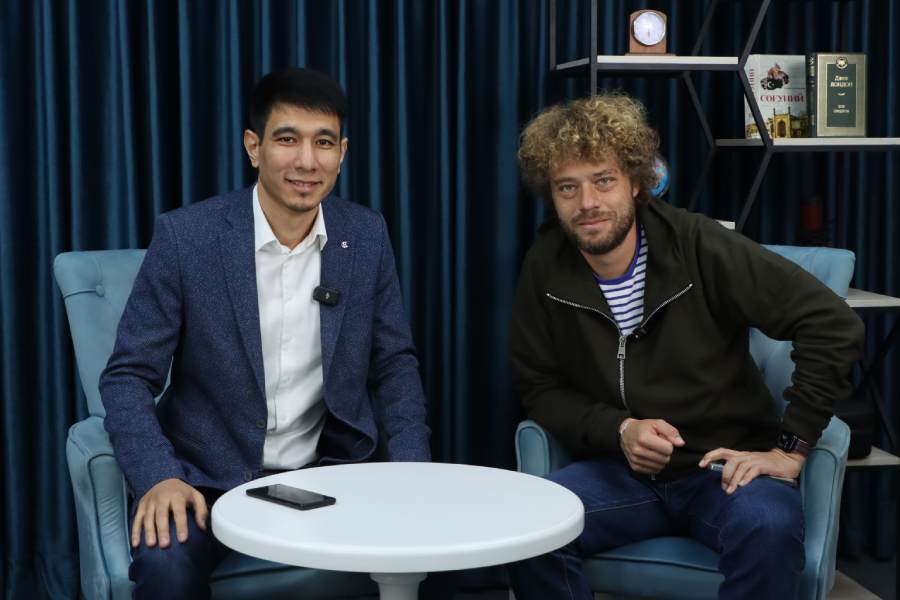 Ilya Varlamov interviews Botirzhon, 2023 Photo: Botirzhon’s personal archive
Soon I myself began to write for the Uzbegim newspaper published in Moscow. In his materials, he covered various legal issues: he told how to get a work permit, what is needed to obtain a temporary residence permit, why you can get an entry ban and how to remove it.
In 2017, Valentina Chupik invited me to join her team as an Uzbek-speaking lawyer. I still had my own business, but I agreed and worked at Tong Jahoni for the next three years.
All the assistance our organization provided was free, and we, the employees, received salaries from grants. There wasn’t too much money: at first my salary was about 450 euros, the next year - about 1000 . But everything was compensated by an incredible feeling: we really helped people. I realized that I liked this much more than working in commerce. He was no longer very active in business, and then he completely closed his company.
Tong Jahoni had four lawyers on its staff. We helped about 25 thousand migrants a year. During the pandemic, we received calls from people who were unable to call an ambulance. The operators refused them - they said: “You are not citizens of the Russian Federation, you do not have health insurance .” Then the head of the External Labor Migration Agency of Uzbekistan approached us and offered to organize a call center to help migrants call an ambulance.
We gathered journalists who write about migration, lawyers, activists, volunteers and quickly created a single issue. People called it, and operators answered them in four languages: Uzbek, Kyrgyz, Tajik, Russian. They found out what the person’s problem was, helped them call the ambulance and get it to come. Thanks to our call center, more than 700 people were able to receive medical assistance.
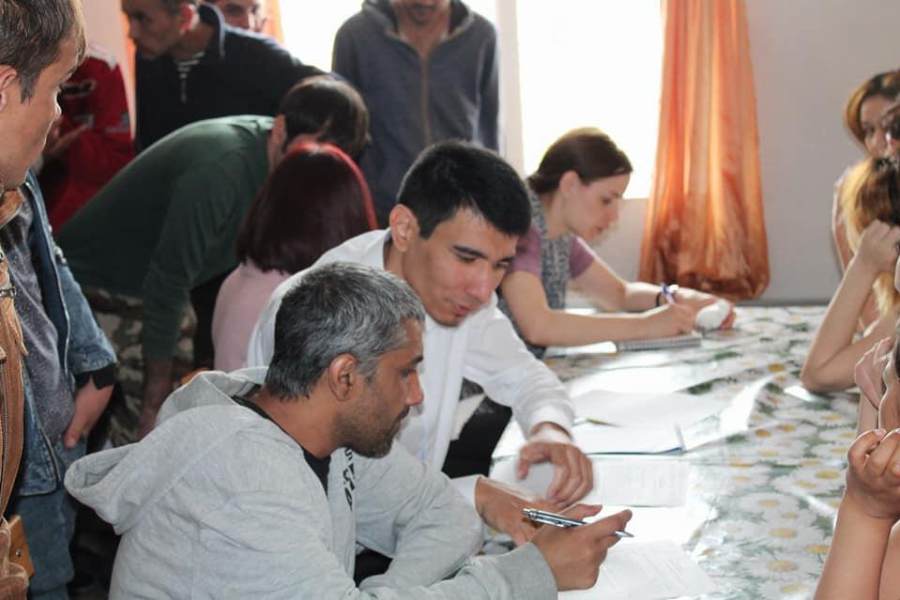 Botirzhon helps migrants fill out documents, 2019 Photo: Botirzhon’s personal archive
We also received many complaints about the police: usually migrants were stopped on the subway or taken from their apartments for “document checks.” According to the law, three hours after the arrest, the police had to either bring charges or release the person, but it happened that people were kept much longer without any reason. In such cases, we called the police department and asked to explain the reason for the detention. Usually after that people were released. If not, we shared information in our group and asked volunteers to call the department too. Mass calls, as a rule, were triggered.
Once every three months we went to the Sakharovo special receiver in Moscow - those who were expelled from the country through the court waited for deportation there. As a rule, they are there a half to two months until the decision enters into force. The special receiver finances the state, but sometimes the money ends, and the supply problems begin.
We drove clothes, medicines, food and water to migrants. In addition to Sakharov, specialists attended in the Moscow and Tver regions - usually the conditions are even worse there, because there is not enough funding.
"Millions - only the media can cover everyone"
Soon I realized that I want not only to advise individuals, but also to convey information to a wide audience. In 2017, I began to produce the free newspaper Migrant in Russian and Uzbek. It contained articles with useful information for migrants: various tips, instructions, analysis of laws.
I myself wrote the materials and my acquaintances from Tashkent. I also hired a designer and a layout, found a printing house where we printed a circulation of five thousand copies. It was possible to find a newspaper in the Migration Center Sakharovo, in the office of my company and the cafes popular among migrants (for example, in the teahouse "Anor").
However, we managed to release only four migrant numbers. The release of the newspaper cost about 80 thousand rubles, I invested my personal funds in the project, and with advertising I managed to recapture only 20% of expenses. There was simply no financial opportunity to continue. But even in four months we had regular readers - those who wrote to me with gratitude said that they were waiting for a new issue.
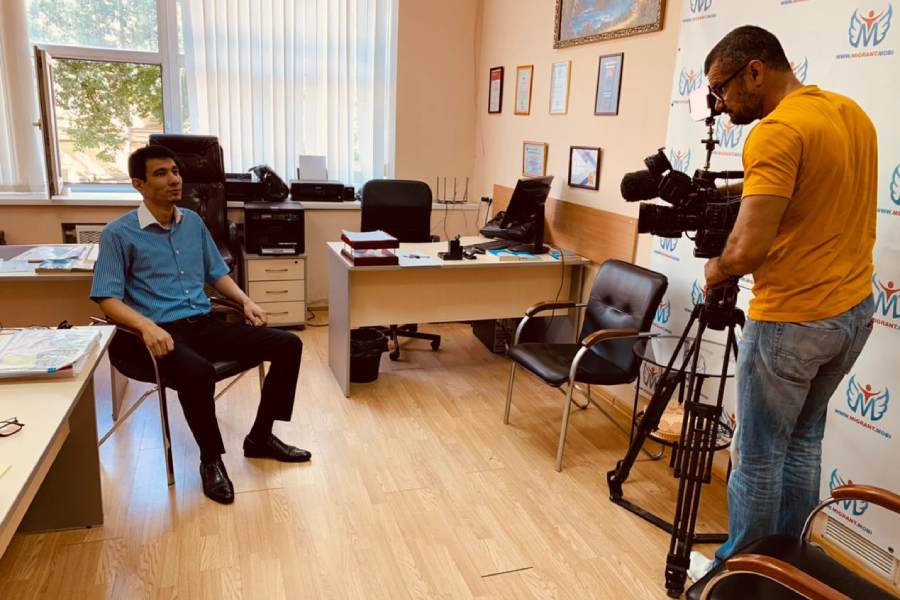 Botirzhon gives an interview for Russian television, 2021 Photo: Personal Archive of Botirzhon
Instead of the newspaper, I decided to launch the Migrant Uz Utuub channel . They often called me with the same questions, and I thought that it was convenient to collect answers to them in one place. In 2017, my assistant and I posted the first video shot on the phone. Then they prepared a whole series of rollers and began to regularly conduct broadcasts, where I answered the questions of the audience.
Media projects gave me the feeling that I was doing something useful. The only problem was that I did not earn on them. Everything changed in 2018, when I scored 10 thousand subscribers: the channel began to bring a small income, I was able to hire an installer operator. Now my channel has already 900 thousand subscribers.
I realized that I had reached a new level: four lawyers from NGOs could help tens of thousands, but in fact there are millions of migrants. It is the media that makes it possible to cover everyone and convey important information to everyone.
In 2021, I realized that the channel was not enough: I led him alone in his free time from work and, of course, did not have time to do much. Then I decided to launch a full -fledged media - the Migrant.uz portal . He hired professional journalists and editors who began to write news and articles.
In our media, we raise migrant problems and attract the attention of the authorities to them. Often, the state is inactive until the media endure the situation in the public field. Only after that does the order come to figure it out.
We have already helped many. For example, a six -year -old daughter was selected in the wedge from the Uzbek. The woman gave birth to at home, and the child did not have a birth certificate. On the street they were noticed by social workers and, when the mother was unable to present the documents of the girl, they decided to pick her up. We wrote about this, and then I, as a lawyer and translator, helped a woman. As a result, the Embassy of Uzbekistan intervened, and two months later we were able to return the child to the parent. The girl was drawn up, they were sent to Uzbekistan together with her mother.
"The state should not see enemies in human rights defenders"
In the summer of 2021, my family and my wife and three children decided to move to Tashkent. I had no plans to stay in Russia forever, although I stayed there for 16 years. I was tired of living away from home and relatives. In addition, the children grew up, and I did not want them to study in Russian schools. I saw that the teenagers are swearing, smoking, drinking, kissing - all this contradicts our national traditions.
In Tashkent, I continue to develop migrant.uz . Now there are ten people in our team, we are registered as the media, we work more systemically and professionally. I myself am no longer writing materials, just lead the air on YouTube. I am also engaged in organizational activities, I solve financial issues - in general, I work as a media manager. In addition, as a migration specialist, I often act on different sites: I give an interview and put forward my proposals to solve problems.
Our lawyer working in Moscow helps us not to fall out of the Russian agenda. She selects and writes news for our portal, and also advises migrants. Once a year I go on business to different regions of Russia and find out what is happening there. In addition, readers share their problems with us.
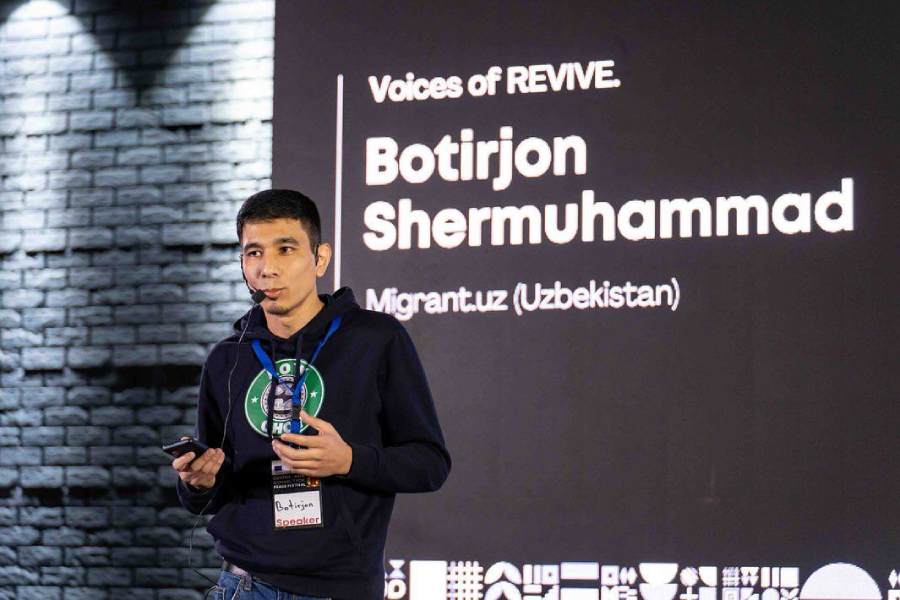 Botirzhon at media conference in Almaty, 2024 photo: Personal archive of a bootirzhon
I now see the main problem in the field of assistance to migrants in the fact that many activists and human rights activists in Russia are put in prison or deported. For example, Zhurabek Amonov . I heard that the FSB has a black list in which I am either: the state does not need people from it, they supposedly interfere with him, pumping migrant rights.
This attitude prevents human rights organizations, journalists and bloggers - it turns out that Russia sees enemies in us. But we are not enemies: we explain to migrants the laws of the Russian Federation and the rules of life in the country, we help them adapt. However, we are the only ones who do it. There is no systemic work with migrants from the state: no programs to study history, laws, language, culture.
Nobody helps migrants - this is bad for both of them and localI want to change this situation. I expect that in the future we will release materials for Uzbek migrants around the world: in the USA, the European Union, Turkey, South Korea. I am going to create a whole media holding, including launching the TV channel - not only about migration, but also about life in Uzbekistan.