
Translated material
Why has oil become more expensive just now and what will happen to other goods? Analysis of "Traits"
Analysis of "Traits"
Briefly
Oil prices have risen in Russia. And this has become one of the main topics of recent weeks. " Devil " studied everything that was said and written on this subject, and came to the conclusion: the rise in oil prices is a model story for the economy of a country that has been waging a full-scale war for three years and is under sanctions. And the main question that it’s time to ask is not “ why has the price of oil gone up?” " , and " why has it risen in price only now? " and " Why are we talking only about oil now? »Oil prices have risen in Russia. And this has become one of the main topics of recent weeks. " Devil " studied everything that was said and written on this subject, and came to the conclusion: the rise in oil prices is a model story for the economy of a country that has been waging a full-scale war for three years and is under sanctions. And the main question that it’s time to ask is not “ why has the price of oil gone up?” " , and " why has it risen in price only now? " and " Why are we talking only about oil now? »
According to Rosstat, since the beginning of autumn, retail prices for butter have risen rapidly. In September they grew by 5.1%, and since the beginning of October the increase has been more than 1.5% per week. As a result, in 2024 the price of oil has already increased by 25.7%.
In real money, the statistics look like this: average retail prices in January 2024 were 876 rubles per kilogram, now they are about 1,100 rubles.
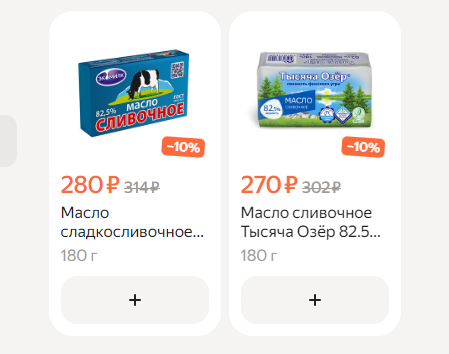
However, even these dramatic figures do not reflect reality. In the most widespread and popular chains - Pyaterochka and Magnit - the cheapest oil, even with discounts, now costs more than 1,200 rubles per kilogram (220 rubles for a 180 gram pack ) . We are talking about 85.5% oil - “ Peasant ” oil (name according to GOST), since a product with a lower percentage of fat content, at best, simply has less oil, but most likely, all kinds of additives. And about more or less reliable brands that comply with GOST and do not add trans fats to the oil.
Why has the price of oil gone up?
In mid-October they tried to blame retail chains as the culprit for the rapid rise in prices. Deputy Chairman of the Board of the Rusprodsoyuz Association Dmitry Leonov said that the markup on butter is more than 70%, and the difference between the purchase price of a product and its cost in the store is one of the reasons for the rise in price of butter.
However, it quickly became clear that this was not at all the case. The head of the Association of Retail Trade Companies (AKORT), Igor Karavaev , said that the markup on socially significant categories of “first price” butter is in the range of 10-12%, and on average the markup on the product is 22%. Given the Central Bank's key rate of 21%, such a markup is literally unprofitable. It barely covers the cost of money, not to mention trading costs and other expenses.
According to retailers, retail purchase prices for butter have increased several times, by a total of more than 31%. And this is data only for the beginning of October, after which they grew by at least another 9%.
That is, the reason is not the greed of retailers, but the rising cost of producing the oil itself. Manufacturers have been talking about this since August . But why has production become more expensive?
An increase in employee salaries by 24% and this is only from January to August 2024. Not everyone talks about this, but the reason for the shortage of workers and the need to raise wages in order to attract employees to production is clear - war. Military contracts and well-paid jobs in the military-industrial complex attract employees from other industries. This means that in order for all other manufacturers not to even compete with the defense industry, but simply to somehow stay afloat, it is necessary to increase wages.
Logistics costs increased by 30-35%. And here too there is a completely understandable reason. The Russian army spends 10 thousand shells every day , and all these shells end up at the front not through mysterious portals, but along the same logistics routes that are used in the economy. And you also need to transport people, transport them food, uniforms, medicines, and so on. The full-scale war, which has been going on for almost three years, is putting enormous strain on the logistics system, increasing time and costs for manufacturers. To this we must also add the rise in price of gasoline and fuel.
Increase in credit load . The key rate since the beginning of the war has increased from 6.5% per annum to 21%. This means that if enterprises need to refinance, now the cost of the loan will be 14.5% more expensive. The cost of any investment in expansion or replacement of equipment has also increased.
Problems with servicing imported equipment . The sanctions did not directly affect oil production. The raw materials are mostly domestic, and 25% of imports from the total volume of oil consumed are covered by 90% supplies from Belarus. However, almost all production uses imported equipment from “ unfriendly ” countries, which requires repair and maintenance. And in the last three years, this process has become much more expensive due to the fall of the ruble and difficulties in supply, precisely because of sanctions. And the longer the confrontation with the West lasts, the more acute the problem. And replacing equipment means new expenses and investments. That is, an even greater increase in production costs, especially given the depreciation of the ruble and the high key rate.
Among the reasons for the rise in oil prices is the increase in prices for raw materials - by more than 20% in 2024. However, the rise in prices for milk and cream is due to the same factors: rising wages, logistics costs, difficulties with repairing imported equipment and expensive loans.
Model crisis
Based on all of the above, there is nothing specific about the rise in oil prices. There was no death of cows - the increase in prices for raw materials for butter (+20%) was due to the same reasons mentioned above. There is no retailer conspiracy or butter-eating bug. The situation with oil looks like a model and objective. All manufacturers and industries have the same problems.
So instead of the question “ Why has the price of oil gone up?” “ It’s worth asking the questions : “ Why are we talking only about oil? " and " Why has it risen in price so much now? "
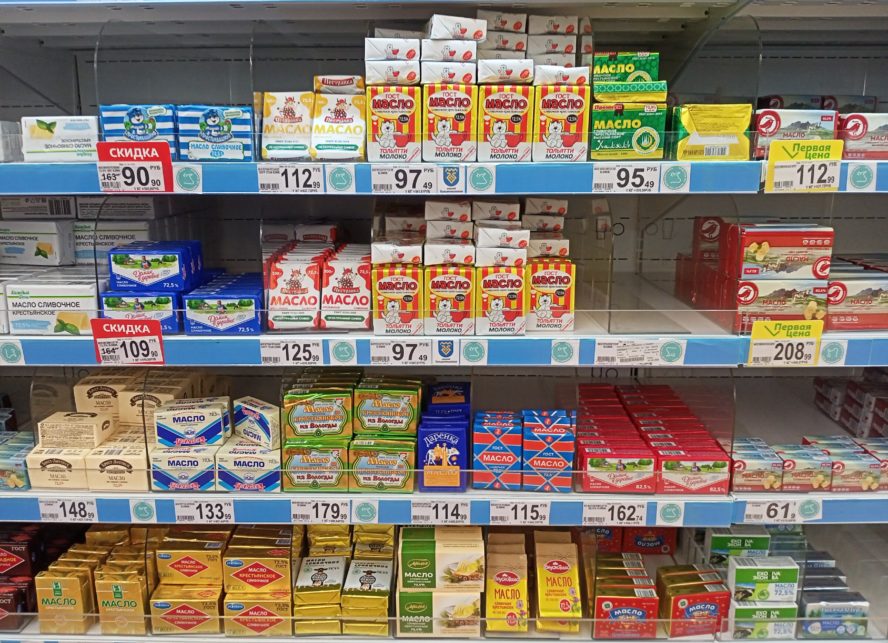
To answer the last question, let's go back to accusing retailers of charging 70%. Large retail chains are one of the important tools with which the state controls prices for socially important products. In stable years, their monopoly position allows them to increase almost any markup. And in times of crisis, they can compensate for price increases precisely by reducing markups, so as not to create a shock effect among buyers. Large producers work in much the same way: not wanting to expose themselves to sanctions from the authorities, they restrain prices as much as possible during crises and then win back due to the privileges of scale.
This is how it has worked so far. Despite the objective processes in the economy, the increase in butter prices in 2023 was noticeably lower than inflation: only 3.5%.
However, this system of containment was not designed for long-term crises, and by the end of the third year of the war, the effect of containing price increases led to a critical distortion in the market. And there was a breakthrough.
One of the triggers for discussing the rise in oil prices was a statement by Health & Nutrition (a former Russian subsidiary of Danone). They suspended supplies of butter under the Prostokvashino brand, citing a 30% increase in the price of raw materials. The company did not produce the oil; it bought it ready-made in blocks and repackaged it under its own brand. They decided against it because the price for blocks of butter in the market had risen so much that it was higher than the packaged product.
Artificial containment of retail prices has led to the fact that the price in the B2B segment - the sale of oil to confectionery or bakery production - turned out to be higher than in the retail market. “There is now an extremely unusual situation there: prices for the block product turned out to be higher than for the packaged product,” Forbes quotes Alexey Gruzdev, CEO of STREDA consulting.
And if we take the situation with oil as a model, then similar breakthroughs should be expected in 2025 in many markets.
What's next?
Objective military pressure on the market will not go away and the problems will only intensify. This means that sellers and manufacturers will look for a way to maintain the appearance of price stability. But they no longer had the resources accumulated during the “ fat years ” . Even the possibility of reducing packaging has almost been exhausted - almost all manufacturers have long switched from 200 gram packages to 180 gram packages. And now they have begun to use packs of 160 grams .
And judging by what is happening in the market now, a solution will be sought in reducing the cost of production and selling low-quality oil - with the addition of or simply based on trans fats with flavoring additives.
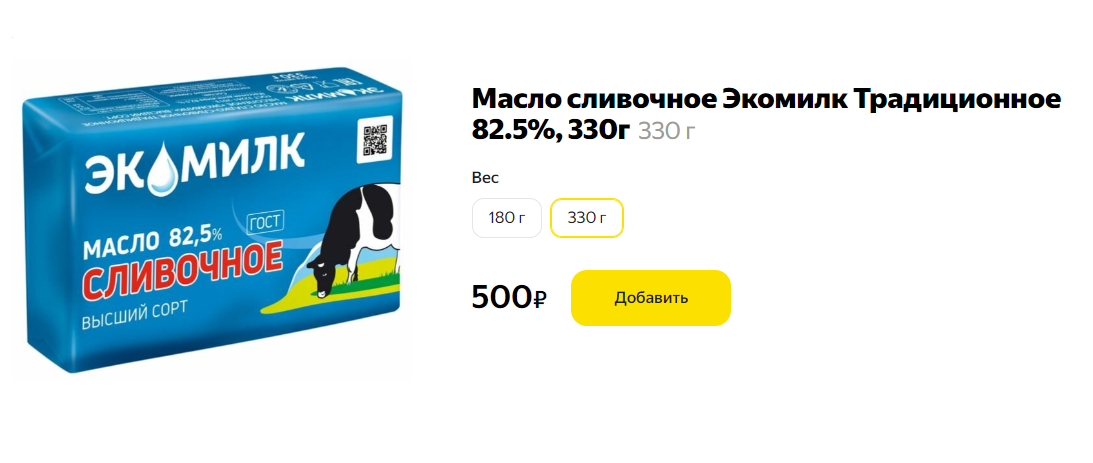
The same “ Pyaterochka ” also has a cheap type of oil with 85.5% fat content. “ Syrovarov Butter ” and “ Maslov Traditional ” , 180 rubles per 180 grams. However, if you read reviews of this oil , then the desire to buy it disappears completely. The main idea of users, if expressed more or less restrainedly, would be this: “ The price is like butter. The taste is like margarine . " And the overall rating on the Otzovik website is 2.2. It’s the same story with the low-price flagship of “ Magnit ” - “ Butter Maslodel ” , 180 g for 160 rubles at a discount. The user rating here is slightly higher - 3.1, but the main idea of the users is the same: “ Bald-faced lies about the fat content and composition of the product, the corresponding aroma and taste of margarine in butter . ”
This solution to the problem would not be the worst if it were not for the huge difference in the impact of healthy animal oil and extremely harmful trans fats on our body.
Let us repeat our conclusions.
There are no industry specifics in the rise in oil prices. The key influence on this crisis was exerted by those processes in the economy that equally affect all other sectors and production.
The pressure of war and sanctions on the economy only increases due to the cumulative effect and creates difficulties that objectively lead to a critical increase in costs and, as a consequence, higher prices.
Under government pressure, retailers and manufacturers managed to contain price increases for almost three years using internal resources. But these resources are practically exhausted. Moreover, artificial price suppression ultimately creates distortions in the market that will lead to crises and sharp rises in prices.
The sharp rise in oil prices is not an anomaly, but a model history that should be repeated in 2025 with other products and consumer goods.