
Translated material
Syroezhkin and NeuroDugin
What will the Kremlin’s attempts to create “sovereign artificial intelligence” lead to in an isolated country?
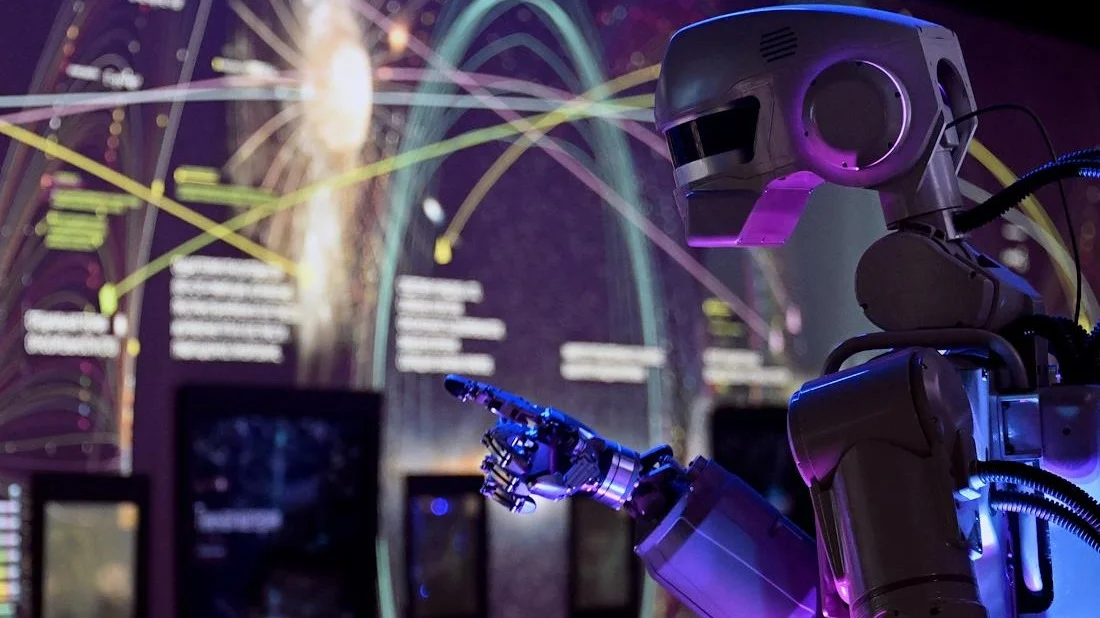
Photo: Anatoly Zhdanov / Kommersant
Technological development in Russia in the current circumstances belongs to the realm of science fiction. But this myth from the distant past is still being replicated by high-ranking state officials, whose expertise is expressed in “two buttons to look.” The result corresponds to the scale of the personalities: we are told silly fairy tales that have no relation to reality.
First, it’s worth agreeing on terms. What are we building: real or formal? The latter, as practice shows, is possible even under conditions of sanctions and isolation. A supercomputer has already been built. True, few people have seen it; it is assembled from cheap Chinese components, but it most likely turns on, can calculate some data and exactly corresponds to the estimate of the endless costs of unknown funds.
Or some, excuse me, Rutube. Thousands of servers, millions of videos, if you go in and click, everything plays and there is sound. Expensive advertising campaign. And no problems with copyrights. This is where you can watch online for free and without SMS. Formally, it’s a YouTube killer, but in practice, it’s a very expensive and of little use thing that hasn’t gained popularity even with a slow competitor.
What about State Services? What about the tax office? What about the national Fast Payment System? Aren't these great achievements for local sovereignty? And that’s true, but there are nuances.
All this serves state interests and lives in a vacuum of limitless budgets. The modest appearance and functionality of similar services in other countries shows the disadvantages of democracy.
When there is strict public control, including over money, it is unrealistic to build an expensive IT service: private companies are needed, and private companies need profit.
And this is only about serving state interests. There is no example in modern history when an initiative from above would lead to the creation of at least some successful mass service.
And how many there were! Messengers, social networks, search engines, encyclopedias... Any online trend does not go unnoticed by officials who have long been detached from life. Any technological innovation must have a local sovereign analogue that corresponds to spiritual and moral values. The idea of sovereign artificial intelligence, which the president spoke about, only confirmed this rule.
It all started with sorting out the relationship with the access interface to the hardware machine. Some encountered Alice, others encountered the command line. The very fact of such a collision could be worth a separate discussion: when an official starts talking to the TV, questions begin to arise about his (the official’s) mental state. But in our special world, everything went differently.
Having discovered that an abstract neural network answered controversial questions outside of the canon, people whose computer experience was limited to two buttons immediately rushed to attack soulless machines.
Moreover, both for existing ones (a conversation with the virtual assistant Alice is a rather pointless task: the iron lady is censored right down to the microcircuits), and for future ones. “We need our own, Russian artificial intelligence!” What he does is not important, but his position on major issues must be consistent with current policies. Let us leave behind the scenes the fact that they want to deprive an already not very smart system of the remnants of its brains at takeoff.
Can the state build its own artificial intelligence, whatever that means? The answer was given long ago by our Chinese colleagues.
At the time ChatGPT took off, Chinese universities were conducting government-ordered market research to try to figure out the reasons for its success. And the answer, despite the multi-page results, is very simple: freedom.
OpenAI and similar companies are vacuuming up the market for industry geniuses, motivating them not so much with money as with great tasks and opportunities for self-realization. It is impossible to sell patriotism and state needs to such a candidate.
At the same time, the Chinese private sector plays quite successfully in this clearing, apparently observing certain Chinese rules, trying not to interfere too much with politics. Another question is that China is always a bad example. This is a separate civilization that has no analogues in any respect.
In general, building something reminiscent of popular analogues is not so difficult today. In addition to OpenAI, there are hundreds of companies in this market, and there are already open algorithms and language models that can be used right now. Taking advantage of other people's achievements and your data is a common thing. There are even examples of successful implementation. With all the traditions. This is the Zhirinovsky neural network. An array of data from an odious politician who passed into another world was digitized and fed to a computer. The result is that it works. The fact that not the most educated party workers coped with this only confirms the thesis of the availability of technology.
But these are jokes. And sovereign artificial intelligence already exists. These are GigaChat and Kandinsky from Sber. The first, as the name suggests, is responsible for the text, the second for the pictures. Considering that this is a state bank, it would be hard to blame soulless machines for something bad. However, even if he turns around, nothing will happen: virtual bonds will not allow him to do anything indecent. It doesn't matter what's under the hood. How much intellectual work, in addition to name, belongs to local programmers? After all, the Lada is assembled from Chinese components, so don’t find fault.
The only thing worth considering is that Sber operates outside the market and has an unlimited amount of funds.
Comical dialogues with a piece of hardware and the generation of funny pictures are the top of the iceberg, below the water are dreams of how artificial intelligence will solve the problems of the consequences of the demographic crisis and shortages in the labor market.
It will replace the population that has dropped out of the workforce for various reasons. The idea “robots work hard, not people” arose in Syroezhkin’s head immediately after meeting Elektronik.
But this is where difficulties arise. Neural networks really do an excellent job with simple tasks like text or image processing. And those who mastered these tools could easily advance their careers by delegating a wide range of monotonous activities to a smart machine. Another question is that those who succeed at least speak English and have access to American and European infrastructure. Sovereign services were not noticed in this. Those. with all the possibilities of artificial intelligence (let’s say, appearing out of thin air), you still need an operator with a human brain, preferably a developed one, to train the AI and give it a task at least a little more difficult than processing Zhirinovsky’s speeches.
Creating large models, and even more so new algorithms, is an order of magnitude more difficult. If you do it without regard to what is foreign, then developing solutions comparable to world analogues requires a similar amount of brains. And not just sufficiently developed ones, like with a basic knowledge of English, but outright talent. Which there are none. And the “remnants of luxury” work under duress and have limited freedom, which also does not contribute to productivity.
As a result, we have mutually exclusive and conflicting tasks that even a supercomputer cannot solve.
The emphasis on “spiritual and moral values” and the crippled education system lead to an obvious devaluation of human capital. A submissive idiot and a talented mathematician rolled into one is a rare phenomenon on which sovereignty cannot be built. And if we take into account demographics (Russia is aging), the volume of this capital is modest. Rare exceptions, even at the stage of their training, are taken away by large companies like Sber.
And this is official policy. Raising a humble and stupid person who does not ask questions is declared from the stands.
Innovation requires an open world and one's own openness to this world. This is not only banal access to what is now blocked, it is travel, it is foreign languages, friends from different countries, the exchange of knowledge and experience. This is freedom and security. In general, everything that in one way or another contradicts current policy.
Some die, others leave, those who remain become dumb and begin to believe in the magic of technology: artificial intelligence will come to us and save everyone.
But no, it won’t save you.
Talk about development is fantasy. Real developments require personnel, environment and money. The latter, economists say, are now in short supply in Russia, and for the existing wealth there are many contenders from different industries, far from the most high-tech.
Dreams that a computer will solve the personnel shortage are, to put it mildly, naive. Recent market research shows, for example, a shortage of engineers. Replacing them with pieces of iron is unrealistic. And to make it realistic, other engineers are needed at this stage. But they are no longer there - the first vicious circle.
It’s easy to take open models and make a demo version from available material and sticks for display at a pretentious exhibition. It will be tight, it will be consistent with values, but it will be absolutely meaningless.
Demonstrating the capabilities of language models and graphical algorithms is easy. The soulless machine withstood Zhirinovsky, and will also withstand Dugin. It’s not difficult to make a neural network broadcast Eurasian values, house-building and bast shoes like shoes.
But victories of artificial intelligence in various industries are possible only in cases where there is real intelligence behind it. But its presence today is punishable.
The second vicious circle.