
Translated material
Russian field of daffodils
Where and how do prohibitions come from and why are they becoming more and more numerous? Anthropologist Roman Shamolin - about two types of culture
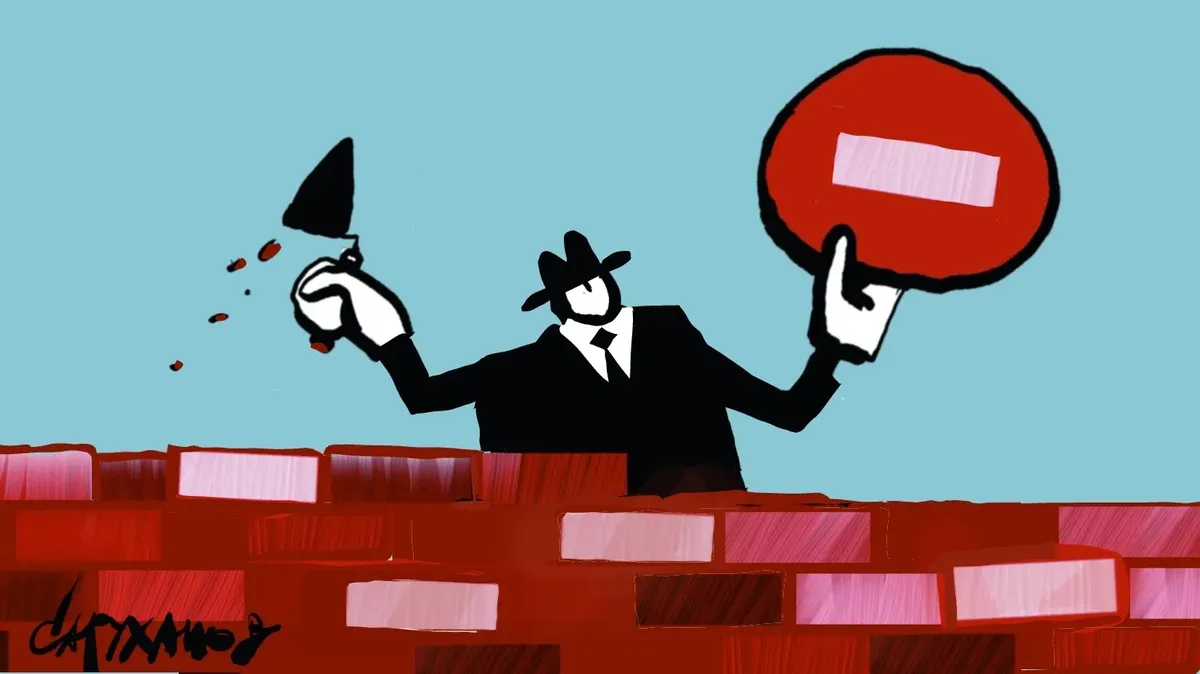
Illustration: Petr Sarukhanov / Novaya Gazeta
When state power prescribes something to its people and the people do not tell this power to go to hell, but somehow fulfill what is prescribed, this means that this power corresponds to the picture of the world in which the people exist. At least this is true for the picture of the world shared by that part of the people who do not tell this government to go to hell.
And when we talk about the picture of the world, we, of course, talk about culture. For culture is what creates from the fragmentary elements of the world its relatively holistic image, its picture. And it keeps this picture from falling apart.
Power, the state is one of the elements of culture. Oswald Spengler was right when he said that
the form of government is as natural a part of the “cultural soul” as a folk song or an ornament on a window shutter.
Power and the state are included in culture; they are part of it. Moreover, most often within a culture they are a dynamic, determining element. Whatever incredible and crazy things come from power, they, in fact, come not just from a group of deviant rulers who have climbed to the top of the food chain - they come from culture. To the extent that this culture accepts such power within itself.
If the government tirelessly produces prohibitions and taboos, if it expels from its territory everything that it does not like in any way, then this is a question not only directly to the power itself, but also a question to the culture on the basis of which such power has grown.
What is there in culture that loves prohibition? What kind of picture of the world is this, which is based on the expulsion of everything dubious?
***
Prohibition in a culture is the suppression of freedom of expression of certain thoughts and desires, accompanied by punishment. The phenomenon is universal and originally characteristic of the human race.
While suppressing freedom, the ban is nevertheless tied to the very principle of freedom. Free to coerce and dominate. At will. Dominance of the strong over the weak. The strong do not explain to the weak why something is prohibited. At least that's where it starts. According to a well-known sacred legend, human history begins with an inexplicable prohibition, its violation and punishment for violation.

But even though the ban is based on arbitrariness, as social ties are formalized and strengthened, it acquires some logic. Since archaic times, the tribe and clan have restrained the spontaneous, free, irrational principle in the individual, setting up against it a set of prohibitive customs and laws, a set of taboos.
Along with the formation of social organisms, prohibitions acquire ideological, ethical justification and mass character. But at first all this is not universal logic and ethics, but purely tribal, local: what is prohibited on “one’s own” territory and with “one’s own” is quite acceptable in relation to “strangers”, i.e. in relation to the rest of humanity. In connection with such an emphasis on “one’s own” and contempt for “their”, this type of community and culture can be called narcissistic.
The human world is divided into thousands of separate communities, each with its own totems and taboos, and anyone who honors other totems or breaks taboos can be punished. Punishment may fall on an entire neighboring tribe living according to different customs. Any violence against such a tribe is permitted. These are the times of tribalism, when an individual was sacrificed without hesitation to the power of the clan and tribe. A strictly defined sacred identity, for which the surrounding world acts as a source of hostility, fear and rage. The tribe is alienated from the world and sets up a thick curtain around itself, and prohibitions and punishments are an effective way to keep this curtain up.
***
Despite the strictly strict and rather even cruel nature of tribal prohibitions, their origin is irrational and spontaneous. On the one hand, behind them is the fear of the big world outside and the incomprehensible, dark world inside a person. And the desire to protect yourself from the unpleasant influences of these worlds. But not only that. For
fear, as a rule, constrains and does not promote imagination, and the forbidden practice is very inventive and is accompanied by truly creative scope.
It is likely that many prohibitive ideas are born out of what can be called offensive narcissistic self-affirmation, due to the active narcissism of the group and its leaders. The ban is intended to emphasize the special, autonomous and “God-chosen” path. Because everything that comes from outside or does not follow the mainstream is perceived not as a reason for an upgrade, for evolution, but as a reason for weakness and self-betrayal. Narcissism basically does not understand or accept evolution. Closed to himself, he crosses out everything else. Moreover, with a certain passion, he searches around him for more and more new objects or ideas to cross them out, to ban them. Thus he is confirmed.
The phenomenon of closed consciousness arises when concentrated attention on “one’s own” existence alienates and devalues the existence of the surrounding, external world. If “one’s own land” and “one’s own blood” are exclusively sacred, then the rest of the world, all other lands and tribes, is a zone of profane and, in general, inanimate existence. The significance of such a world is small, as is the interest in it.
***
Some prohibit for self-affirmation, while others agree with the prohibitions out of anxiety and fear. An ordinary person of the tribe, adapted and loyal, perceives the prohibitions that isolate him from the world as something unconditionally positive, as a kind of guarantee that he and his clan will not dissolve, will not disappear into the endless. Perhaps this is how people imitate that natural species isolation that, by default, is characteristic of all animal beings as their genetic skill. After all, people themselves do not have species-defining skills, but if you believe humanists and philosophers, they are a priori universal beings and free in self-determination.
But it is freedom that creates painful uncertainty. The dangers of external existence, together with the anxieties and fears of internal, mental existence, give rise to a completely oppressive atmosphere. And most individuals face a tough question: how to find ground under their feet?

The answer to this question is a ban. By following the prohibition code, individuals have a good chance of protecting themselves from many risks. And also from one’s own unpredictable nature, from fears and from those abysses for which the imagination of anyone who is not burdened by developed reflection is so rich. In general, it sounds something like this: if we do not erase the external world from contacts and impose strict taboos on the internal world, we will not survive. No unnecessary searches or questions: one land, one people, one god, one leader. What isolates us makes us stronger.
***
Narcissism, which tends to prohibit or repress from the limits of consciousness everything except oneself, is expressed in a certain type of culture. Such a culture, as a rule, has pronounced collectivist, corporate features, features of a sect or a network marketing company. For narcissistic consciousness is absolutely not self-sufficient, it needs constant confirmation and recognition, and this is ensured in conditions where certain things and ideas are guaranteed to be recognized and approved around. To identify with these ideas and no longer know the need is the path of narcissism.
Therefore, it is quite possible to talk about a narcissistic type of culture, where the same thing is always reproduced, the same meaning in familiar forms, and everything that does not correspond to it is rejected. The criterion of this meaning is not derived from some abstract, abstract and universal positions accessible to the reflective mind. No, it is simply derived from the need of not very enlightened people to obtain an understandable and stable identity - such that their natural narcissistic instinct is satisfied. When people of such a culture say how proud they are of their nation, homeland, history, literature, religion, this means precisely that their narcissism is satisfied and they no longer know the anxieties that freedom of knowledge brings with it.
***
Typically, a narcissistic culture is content to exist within its own boundaries and is not overly interested in anything external. Everything that is revered within it as high and correct values should not be placed next to values of “foreign” origin. Comparison, of course, is acceptable, but only to once again emphasize the unequivocal superiority of one’s own picture of the world. The narcissistic mind is convinced that to acknowledge or even respect alternative or so-called universal ideas is tantamount to depriving oneself of solid and proven ground under one's feet. This is tantamount to your own loss of rights. Therefore, in relation to the “foreign”, skepticism is always ready: “Can anything good come from Nazareth?” (John 1:46).
As a result, even when the “foreign” is not directly prohibited, an internal ban is established in the mind not only on its recognition, but also on the very interest in it.
A phenomenon arises that can be called willful ignorance. It provides perhaps the highest guarantee that no new ideas will penetrate the cultural field and disturb the peace of its inhabitants.
***
It was mentioned above that prohibitions can arise not only from “protective” motives, but also from “offensive” ones. Narcissistic consciousness, as is commonly believed by psychologists, does not have internal content. It's empty from the inside. At least, everything that relates to the meaningful, intrasemantic aspect of the human “I” is not developed in it and does not have a significant influence. And probably, in order not to remain in the horror of complete objectlessness, such consciousness must constantly fill itself with objects. Moreover, objects that will confirm the narcissistic identity. Give satisfaction. In fact, it is only in this way - by attaching objects - that satisfaction occurs here.
The object can be anything: life and death, people and relationships between them, feelings and beliefs. Narcissism acts in such a way that every individual encountered falls into the status of its subject, working for its identity. This happens both on a personal level and on a collective level. At the level of narcissistic culture.
In a culture that prescribes narcissistic objectivity, individuals must hide, repress, or even completely destroy their own identity, their subjectivity, and replace it with an identity issued by a narcissistic manager, which is either directly the authorities, or popular public opinion with its own the attitude that hosts discussions is “this is how we do it” or “everyone here does it.” In fact, this is the most radical prohibition of all possible - a ban on subjectivity, in the place of which “correct” narcissistic objectivity is established. Cultural patriotism. Speaking in the language of popular modern concepts,
In a narcissistic culture, individuality is subject to absolute abuse.

Probably the main goal that the stewards of culture want to achieve is the complete loyalty of the individual to everything that is done or proclaimed in the culture. Internal self-prohibition of disloyalty. And one can only be amazed at how easily an individual gives consent to all this. Without thought or regret, he becomes a narcissistic object, ready to fulfill the prescribed demands. Like the character in Franz Kafka’s story “Metamorphosis,” Gregor, who, one morning, discovering himself transformed into a large insect (a beetle), is not particularly shocked or even surprised by this. Yes, narcissism wants agreement from its objects, not surprise. Narcissism does not need a surprised object.
***
This state of affairs and the subordinate, “abusive” role of the individual are so obvious and everyday at all times (both ancient and current) that the idea of their inevitability and even naturalness arises. But is a different, non-narcissistic structure of the cultural field and a different, non-objective position of the individual in it possible in principle? Yes, they are possible.
Changes begin with the emergence of ancient global civilizations. Or, as the philosopher-anthropologist Karl Jaspers called this era, since the “Axial Time.” The Greeks and Romans of those times for the first time had ideas about universal, ecumenical ideas: goodness, beauty, virtue. These ideas relate to absolutely any individual and are no longer measured by tribal territory or blood tradition. The difference between one’s own and foreign gods does not give rise to enmity, but to research intrigue. The centuries-old discourse of tribalism is exposed to irony for the first time:
If horses and bulls could create, then they would create gods according to their own kind, writes the Greek Xenophanes of Colophon.
The narcissistic nature of people, of course, does not disappear anywhere, but the ideological foundations are removed from under it. Dissent is recognized by ancient civilization and is actively supported. Throughout the vast territory of the Roman Empire, no people or tribe were prevented from seeing the world in their own way. And believe in your own way. Moreover, the Romans gladly adopted the most strange, exotic ideas from the population of their subject lands. And the triumphant historical march of Christianity, if we look at it as a cultural phenomenon, and not as a metaphysical revelation, was made possible thanks to ancient universality. “There is neither Jew nor Greek” - of course, this is a Hellenic, ecumenical thought.
***
Actually, the entire subsequent history of mankind is an interweaving and antagonism of these two defining cultural positions - narcissistic and ecumenical. They can coexist in the space of one time, country and language, but at the same time they do not mix, do not become one. What was revealed by the philosophical cosmogony of Giordano Bruno or the art improvisations of Caravaggio is not the same as what the decrees of the Holy Inquisition or the sermons of Savonarola represented in the same place and at the same time. What Chaadaev and Pushkin thought and wrote is not one with the military parades of Nicholas I or the theory of “official nationality” of Count Uvarov.
Coexisting and contradicting each other, these two cultures give history mobility. The narcissistic principle asserts itself in prohibitions and, as a rule, dominates. Ecumenical - overcomes prohibitions in various creative ways, but most often occupies an outsider, or even marginal position. Nevertheless, if society develops, if morals and ideas evolve, these are always the fruits of the influence of ecumenists. At some point, their exits from forbidden zones can no longer be ignored, and a qualitative leap occurs in the history of social existence.
However, it is also possible that the narcissistic side decides to completely destroy its opponents. In this case, the prohibitions become absolute and power resources are actively used, which are fully possessed by the main narcissistic subject of any social existence - power. Coexistence becomes impossible, and the ecumenical side is forced to either leave the common territory, or go into a mode of minimal manifestation, or, by posing an open challenge, receive the full measure of repression. The only changes that are on the horizon in this case are those associated with an even greater, absolute strengthening of the main narcissistic subject. And accordingly, with the absolute transformation of all actors in this process into objects. At least until the main narcissistic subject also suffers an absolute catastrophe.
***
It seems that the evolutionary advantages of the ecumenical variant are obvious. But that's not true. A huge number of people even now perceive freedom as nothing other than the freedom of its “dark” sides. And knowing yourself is like a waste of time, which is so necessary for survival and arrangement in the world of material things and relationships. These people look expectantly towards those who promise them, instead of freedom, understandable, distinct and anxiety-relieving meanings. Who promises to give truly correct, “their” gods.
And it is not a fact that people are generally inclined to recognize themselves as a universal and complex organism - humanity. Even in the future. But it is precisely such hopeless prospects that the thought of philosophers and humanists lives on.