Date
Author
Женя Снежкина, Диана Петриашвили
Source

Preserved copy
Translated material
What is happening in Abkhazia?
The opposition refuses to leave the seized parliament and demands the resignation of officials. We answer the main questions about the protests
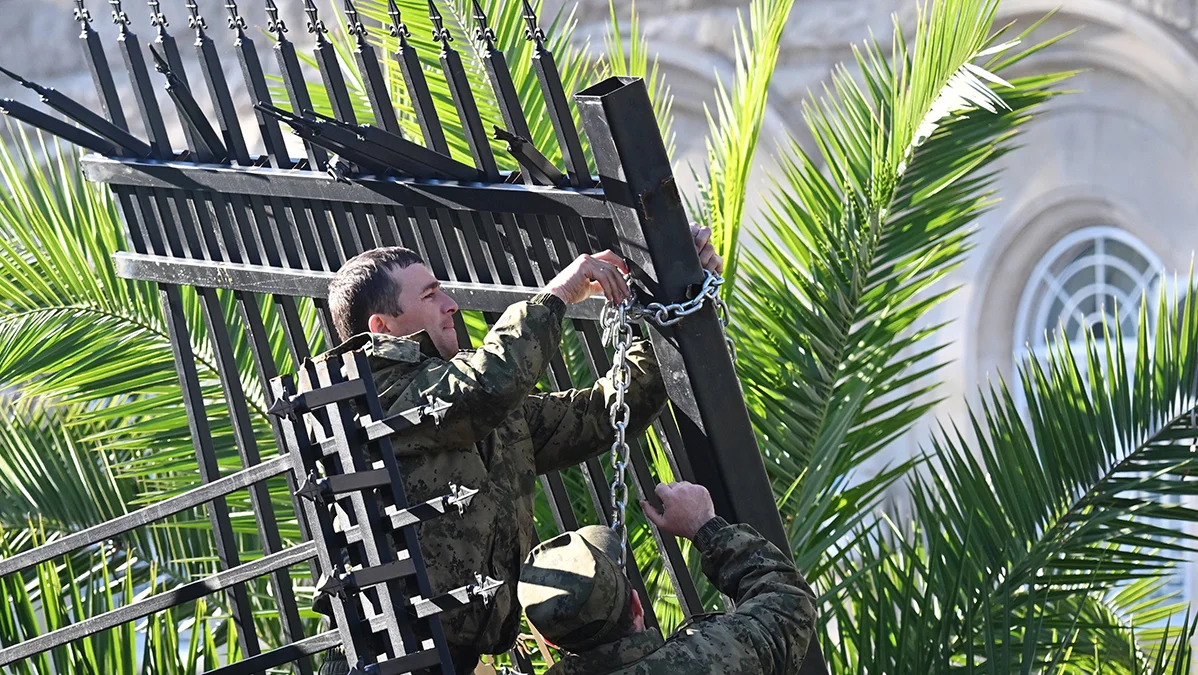
Abkhaz Defense Ministry officials remove a chain from a broken fence and tow military equipment away from the parliament building in Sukhum, Abkhazia. Photo: Ilya Pitalev / IMAGO / Scanpix / LETA
Mass protests against the agreement on Russian investment continue in Abkhazia. Oppositionists stormed the parliament in the unrecognized republic, have held it for the fourth day and are demanding the resignation of the president. He agreed to leave and call early elections, but only after government buildings were vacated. We briefly tell you what is happening in Abkhazia and what protests could mean.
What you need to know about Abkhazia?
Abkhazia is a breakaway republic from Georgia that is recognized by only five countries out of 193 UN member states - Russia, Nicaragua, Venezuela, Nauru and Syria. The rest of the international community still considers it part of Georgia. And Georgia considers Abkhazia its territory, which was occupied by Russia.
Abkhazia declared itself an independent state from Georgia in September 1993. This happened after the bloody Georgian-Abkhaz war, which she would not have been able to win without Russian military assistance. The Russian Federation does not recognize its participation in the war and calls itself a neutral peacemaker.
On the one hand, Abkhazia cannot conduct full-fledged foreign economic activity and is doomed to remain a satellite of Russia, and on the other hand, it insists on its own sovereignty and does not allow Russia to completely subjugate it. The Kremlin’s attempts to push through certain bills, for example, on LGBT people or foreign agents, failed . In addition, in the history of Abkhazia there have been cases when voters defeated the Kremlin’s presidential candidates.
The citizens of Abkhazia are most concerned about the claims of foreigners to land and infrastructure; the country’s legislation still prohibits the sale of land to foreigners
and limits the presence of foreign businesses. Russian authorities and business, on the contrary, claim to own and manage the attractive resources of Abkhazia, especially the Black Sea resorts.
Since 2020, Russia has been carrying out targeted work to “harmonize the legislation” of the Russian Federation and Abkhazia. As part of this process, Russia proposed signing an agreement “On the recognition and enforcement of judicial and arbitral decisions in economic matters,” which, in general, meant that Abkhazia would accept the decisions of Russian courts as its own. The draft agreement caused resistance in the Abkhaz political environment, and in response, on September 1, 2024, Russia suspended payments to Abkhaz public sector employees and also began selling electricity at a commercial price. On September 25, 2024, the Parliament of Abkhazia ratified an agreement with Russia on the courts.
“The Agreement between the Government of the Russian Federation and the Government of the Republic of Abkhazia on the implementation by Russian legal entities of investment projects on the territory of the Republic of Abkhazia” was the next step.
What's wrong with this agreement?
The agreement provides for Russian investments with a minimum funding of two billion rubles in almost all areas of the economy of Abkhazia, which the agreement calls “strategic areas of the economy.” Investments can be made in agriculture, the heat and power complex, roads, ports and railway infrastructure, electric power, as well as everything related to tourism. According to the agreement, the Abkhaz side undertakes to provide land plots for the implementation of these projects, and ownership of the land can be transferred to the owners of investment objects. Moreover, to implement this kind of projects, branches of Russian banks can be opened on the territory of Abkhazia, and investors will be exempt from paying customs duties on construction materials, property and profit taxes for up to eight years. Investors will also be able to bring foreign workers to the territory of Abkhazia.
The agreement, of course, could not help but alarm the Abkhazians, because in fact with this document Russia declared a claim to the transfer of almost all the property of the unrecognized republic to Russian enterprises, as well as obvious discrimination against Abkhaz entrepreneurs.
How did events develop?
On the evening of November 15, protesters managed to disrupt a parliamentary meeting at which the ratification of an investment agreement with Russia was to be considered - the crowd tore down the fence and broke into the parliament territory. The authorities soon announced their readiness to revoke the agreement, but the protesters said that they would not leave parliament until the president of the self-proclaimed republic, Aslan Bzhania, resigned. He was given an hour and a half to make a decision and was threatened: if the demand was not met, the protesters would seize the building of the state security service, where Bzhania was located at that time (it should be noted here that the presidential administration by this time was also already controlled by the protesters).
When the ultimatum expired, the presidential press service stated that Bzhania “went to his native village of Tamysh.” The opposition believed that the president had in fact relocated to the territory of a Russian military base, and then the press service distributed video footage from which it followed that the president, apparently, was indeed in this village. The next morning, the press service sent out a new video from the village of Tamysh. In these frames there was a statement from Bzhania: “They say that I left Abkhazia, but here I am, I am in Abkhazia. We gathered not in order to preserve my power, but in order to preserve the statehood of Abkhazia. Those who are now in the presidential administration must leave there. After which I will announce new elections and resign.” But the opposition refused to satisfy this demand and continues to insist on its own.
Are the security forces on the side of the protesters?
On the night of November 15, local media reported that immediately after Bzhaniya’s departure, almost all security forces left the territory of the state security service and the Ministry of Internal Affairs. Some took it as a sign of solidarity with the protesters. It was reported that some law enforcement officers had gone over to the side of the opposition the day before, during the confrontation near parliament - in fact, if they had not gone over, the activists most likely would not have been able to demolish the fence and break through to the parliament building.
Several independent media in Abkhazia, citing a senior Defense Ministry official, reported on November 16 that the day before, Bzhaniya demanded the army vacate government buildings, but was refused. Acting Defense Minister Beslan Tsvizhba (the minister on vacation) said that he would not violate the law, which prohibits the use of military equipment to suppress protests.
What happened next?
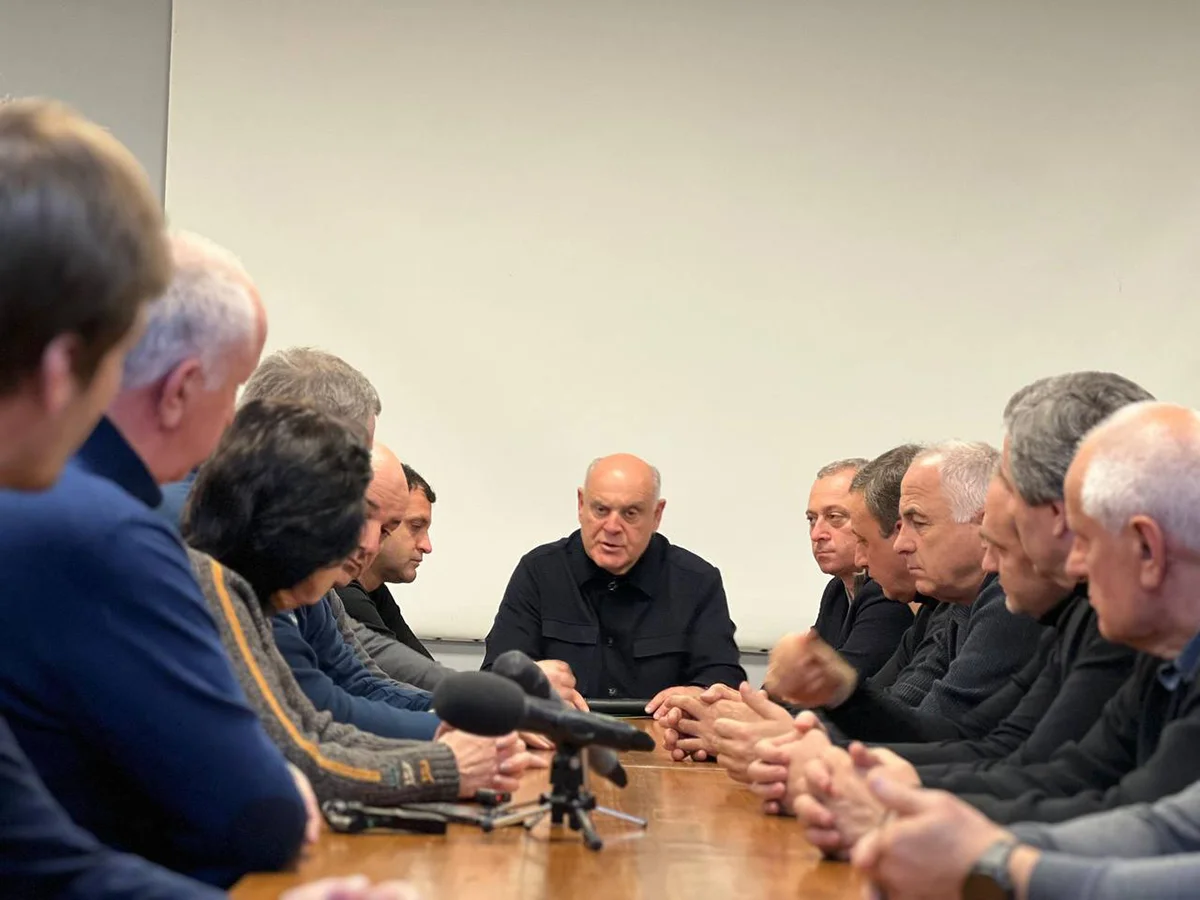
On November 16, the Coordination Council of the Abkhaz Opposition called on citizens to come to parliament at 2:00 pm and continue to demand the resignation of the president. Local residents came to the rally, and members of the Council of Elders spoke to them. The meeting passed without incident.
The next day, acting Defense Minister Beslan Tsvizhba met with opposition forces at the Presidential Administration. After this, the Respublika telegram channel reported that the protesters, on their own, put the military equipment standing near the building in order and handed it over to employees of the Ministry of Defense. On November 17, another gathering of protesters took place .
During the action, the opposition demolished the fence around the complex of government buildings and called on the deputies of the People's Assembly to “get together and begin active work to overcome the political crisis.”
“Bzhania says that after his departure he wants to do... O. President Badru Gunba. In this case, we propose, as a compromise, to dissolve the Cabinet of Ministers and install our person as prime minister.
So that if a member of Bzhania’s team is nominated for elections, administrative resources will not be used,” said Adgur Ardzinba.
Also at night, the press service of the President of Abkhazia reported an attempt to seize the Abkhaz television studio. The statement said that 15 people opened fire in the air while employees were in the building, “creating a tense situation.”
“A group of people allegedly representing opposition forces approached the territory of the TV channel in order to establish control over the broadcasting. To prevent entry into the protected area, security personnel were forced to fire warning shots. These actions made it possible to stabilize the situation and prevent the development of the conflict,” the information center later noted .
The Respublika telegram channel wrote that “those protecting the Abkhaz TV from the attack quarreled among themselves and even shot a little.”
Can the speeches be considered anti-Russian?
The protesters emphasize that they are not against Russia, but their main goal is to protect the national interests and natural resources of Abkhazia. It seems that this is the main dilemma of Abkhaz society - how to protect its interests and not quarrel with Russia?
The editor of the independent South Caucasian publication JAMnews in Abkhazia, Inal Khashig, is convinced that this dilemma will be inherited by the next president after Aslan Bzhania resigns: “Finding a new algorithm for relations with Moscow will be one of the top priorities of the next government. Its formula is extremely simple: maintain friendship with Russia without infringing on your sovereignty. However, as long as your country’s budget is half subsidized by Moscow, it will be extremely difficult to achieve the desired balance.”
How do people in Tbilisi feel about what is happening?
In Tbilisi, the resistance of the breakaway Abkhazia is viewed without much optimism, believing that the agreement will be ratified in any case, which, in turn, will be a step towards further annexation of Abkhazia by Russia.
“Russia is preparing for Abkhazia to become part of it, and Georgia to be in its sphere of influence. This is what Russia wants to get as a result of political trade with the Trump administration, says Georgian expert Nodar Kharshiladze, founder of the Center for Strategic Analysis. “Abkhazia, of course, will not be the main or even tenth on the list of topics important for Russia. But Moscow wants to prepare with a clear “offer” for trade with Trump, to have its own “offer” for the territories it wants to keep under its control.”
The famous Georgian Conflictologist Paata Zakareishvili called the silence of the Georgian government, which deliberately does not notice the actual annexation of Abkhazia by Russia, an alarming sign: “I am sure that the Georgian Dream will not react in any way to the events taking place in Abkhazia,” Zakareishvili said, recalling how the authorities Georgia ignored the visit of the President of Belarus to this self-proclaimed republic two years ago. “When Lukashenko arrived there, and [Georgian Prime Minister] Irakli Kobakhidze made the shameful comment: “So what, he was just traveling along the Black Sea coast.” This silence [from the authorities] is alarming, because Georgia is clearly ceding Abkhazia to Russia. This is probably the price that Georgian Dream must pay to maintain power with Russian support,” Zakareishvili said.
The material was prepared by the authors of MediaNet.