
Translated material
Domestic Violence Calendar
Every day, Russian courts hear cases of domestic violence.

“Verstka” examined how, during the Year of the Family in Russia and annexed Crimea, they punish partner domestic violence. We analyzed thousands of judicial acts and found that every weekday Russian judges consider cases of violence against women. The most common punishment for beating remains a fine of 5 thousand rubles. In murder cases, judges can reduce a man's sentence if the woman he killed swore or drank alcohol. Children are a guaranteed mitigating circumstance, even if they saw their father kill their mother.
In order not to miss new texts from “Layout”, subscribe to our telegram channel
Russia’s main achievements are the institution of family and traditional values, said President Vladimir Putin in January 2024, when he launched the Year of the Family during a ceremony at VDNKh. The government has allocated half a billion rubles for PR of “traditional values” in 2024. Deputies, senators, public figures and the president are especially vocal this year about supporting the family.
In several regions, private clinics refused to perform abortions , State Duma deputies passed a law prohibiting the “propaganda” of childlessness and a law that would not allow citizens of countries where transgender transition is allowed to adopt Russian children.
According to officials, deputies and representatives of the clergy, all these measures have one goal - to increase the birth rate and protect Russian women and children from destructive “Western values.”
The Year of the Family is coming to an end, but during this time not a single law has been adopted in Russia that would help protect women and children from violence within the family. Thousands of Russian women who decide to start a romantic relationship or start a family are subject to violence from their partners. Young children become unwitting witnesses and victims of violence. “Verstka” found out how law enforcement agencies and courts responded to this in 2024.
CONTENT:
How we collected domestic violence cases
What “reasons” become triggers for murders?
Judges choose punishment below average
Anything can be a mitigating circumstance
Women who end relationships are still at risk
Judges dismiss the case if the aggressor and the victim make peace
A fine of 5 thousand is the most common punishment for domestic violence.
Violence often occurs in front of children
The presence of children is often taken into account as a mitigating circumstance
Are there prospects that the situation with domestic violence will change?
The main thing we learned
- Every day, Russian courts hear cases of domestic violence. During the first half of 2024, there was not a single weekday when judges did not rule on a domestic violence case.
- 84% of men were drunk when they killed or beat their partners to death.
- Every third murder was committed out of jealousy.
- In 73% of cases, men received a sentence of less than 10 years in prison, that is, below the average provided for in Part 1 of Article 105 of the Criminal Code (“Murder”).
- In 70% of murder cases, cooperation with the investigation was counted as a mitigating circumstance.
- In 30% of murders, the presence of children was a mitigating circumstance. Even if the children witnessed the crime.
- In 17% of cases, judges called the women's behavior before the murder "immoral" and "unlawful." Even if they were just swearing during an argument.
- In 13% of murder cases, mitigating circumstances included references from employers, neighbors and relatives. Even just “satisfactory” and “mediocre”.
- In 3% of murder cases, judges took into account the man’s participation in a “special military operation” as a mitigating circumstance.
- Every second criminal case for causing minor harm to health and every eighth criminal case for battery were dismissed in court.
- 66% of non-criminal cases of domestic violence resulted in a fine of 5 thousand rubles.
How we collected domestic violence cases
In order to collect cases of domestic violence, “Vorstka” used its own developments, as well as the i forensic parser from the independent project “To Be Precise.” With the help of our colleagues’ parser, we downloaded criminal cases under violent articles of the Criminal Code from district courts of all regions of Russia and annexed Crimea.

Only a fraction of domestic violence cases are heard in district courts. A large number of them end up before magistrates. In order to download cases from the websites of justices of the peace, the data department of “Vestka” developed 10 i scrapers from scratch.
We downloaded decisions made by courts from January 1 to June 30, 2024. We chose this period because we consider it important to show the latest current data on the situation with punishment for domestic violence.
All acts and metadata were collected into a single database. It contained about 30 thousand acts. In fact, in the first half of 2024, Russian courts considered many more cases, but they publish their decisions gradually, and some judicial acts are not made public at all.
We analyzed 30 thousand judicial acts using a language model based on artificial intelligence - GPT-4o-2024 - 08-06. We worked on the system industrial product for a long time, tested it and carefully checked the results. As a result, our model made it possible to identify cases in which there are signs of domestic violence. In addition, in each judicial act, the model additionally identified such features as alcohol intoxication, mitigating circumstances, bodily injuries that the woman received, and others.
As a result of the analysis, we received about 5 thousand court decisions in cases of partner domestic violence.
Among these cases, 245 convictions were made against men who killed their girlfriends and wives. Of course, there are many more cases of women killed as a result of domestic violence. For the first half of 2024, only a portion of the sentences have been published, and “Verstka” admits that not all cases were included in our selection.
However, the available murder verdicts, as well as 3 thousand administrative decisions on battery and over 1.5 thousand criminal verdicts on domestic violence, allow us to estimate how Russian judges punish men for murder and beating their partners in 2024.
Based on the collected data, we also made an interactive calendar . Each calendar page is a mini-story from a domestic violence case heard in court that day.
What “reasons” become triggers for murders?
During interrogation, investigators and judges usually ask men what preceded the crime. Most say they just got angry and couldn’t control themselves. But some clarify the details of the conflict.
For example, a resident of Volgograd killed the girl he lived with after she said that she did not want to have children yet, and a resident of Ufa beat his wife to death because she did not want to let him go to war with Ukraine. A resident of Moscow, in front of his teenage daughter, killed his wife because she had been in the store for too long, and a resident of the Penza region stabbed his wife in the artery in her leg after he learned that there would be khinkali for dinner and not fried potatoes. A resident of the Khabarovsk Territory burned his wife alive after she did not kiss him when they met, and a resident of St. Petersburg killed and threw his ex-wife from the balcony because she left him and met someone else.

In every third case (in 83 cases out of 245), the reason for the murder was jealousy, “Verstka” found out.
In Perm, on March 19, 2024, local resident Sergei Patrakov, who killed his girlfriend with a knife, was sentenced to 9 years and 8 months in prison. The young people were chatting and drinking beer in their apartment. Suddenly Patrakov remembered that three days ago the girl received a call from an unknown man. He asked her who it was, and, as Sergei later claimed during interrogation, the girl told him that an acquaintance called. She once kissed and danced with him, and now he invited her to go to the club together again.
At that moment, as Patrakov told investigators, the girl allegedly admitted to cheating on him and “he had a sudden nervous breakdown, he could not control himself.” He got angry and punched the girl in the face several times. Then he grabbed a kitchen knife that was lying on the table near the TV and “automatically” stabbed the girl in the chest several times. When the “state of shock” ended and he began to come to his senses, Patrakov decided to commit suicide. He stabbed himself in the stomach four times, and then dialed the ambulance number on the phone and asked the doctors to come. He explained to investigators that he wanted to “leave” with the girl, and called an ambulance so that their bodies could be found.

A resident of the small town of Kondrovo, Kaluga region, Sergei Eremin was also jealous of his girlfriend and killed her during a quarrel. Eremin met a girl on social networks. They were both divorced and raising children. According to Eremin, he fell in love with a girl and wanted to start a family with her. A few months after they met, he proposed to her, but the girl said that she was not yet ready to accept him.
On the day the murder occurred, according to Eremin, they were supposed to go to the forest to pick berries, but they had a fight. During an argument, Eremin hit the woman forcefully in the neck with his fist. The impact broke the bones of the woman's larynx and skull, and she died. Frightened, Eremin decided to hide the body. He took the corpse to the forest, doused it with gasoline, set it on fire, buried the remains and disguised the place with dry branches. Over the next few days, he lied to the relatives of the murdered girl and claimed that he did not know where she had gone. Only when relatives filed a report about the girl’s disappearance with the police and Eremin was summoned for questioning did he confess. Investigators interrogated the friends and relatives of the murdered girl and learned that Eremin was constantly jealous of the girl and was convinced that she was cheating on him. He saw the reason that “their couple was jinxed.” To remove the damage, he took the girl to pray in Orthodox churches and showed her to witches and clairvoyants. Shortly before the murder, he found a ritual that helps drive out demons from women that provoke the emancipation of “base desires.” He took a photo of this handwritten text and saved it in his phone gallery.
When investigators asked him to explain his interest in such rituals, Eremin stated that he was not involved in occult practices and considered himself an Orthodox person. According to him, he did not want to kill the girl and accidentally injured her during self-defense. During the investigation, it also turned out that while Eremin suspected his girlfriend of cheating, he himself was conducting romantic correspondence with other girls on a dating app.
The Dzerzhinsky District Court of the Kaluga Region sentenced him to 9 years in a maximum security colony and ordered him to pay the relatives of the murdered woman 4 million rubles as compensation for moral damage.
Judges choose below-average punishments
The Russian Criminal Code does not have a separate article for the murder of a woman as a result of domestic violence. If she was subjected to systematic violence and was in a vulnerable position, this will not be an aggravating circumstance. Moreover, the murder of a stranger out of hooliganism or hate is considered a more serious crime than the murder of a loved one. Almost all criminal cases involving the murders of women by their partners are initiated under Part 1 of Article 105 of the Criminal Code (“Murder”) or Part 4 of Article 111 of the Criminal Code (“Infliction of grievous bodily harm resulting in death”).
Article 111 of the Criminal Code is less serious than 105 of the Criminal Code. She is charged if the investigation has no reason to believe that the man wanted to kill the woman. Under Article 111 there is no lower threshold for punishment, and the upper limit is 15 years in prison. Under Part 1 of Article 105, the lower threshold is 6 years, and the upper limit is 15 years. If the murder was committed with particular cruelty or in a generally dangerous manner, for example, through an explosion or arson, the court may impose a sentence of up to life imprisonment.
However, judges rarely impose long sentences. In the first half of 2024, in 73% of cases under the article of murder (Part 1 of Article 105 of the Criminal Code), men were sentenced to terms of more than 6 but less than 10 years. Those who became involved in the case of grievous bodily harm resulting in death (Part 4 of Article 111 of the Criminal Code) received sentences of less than 10 years in 93% of cases.
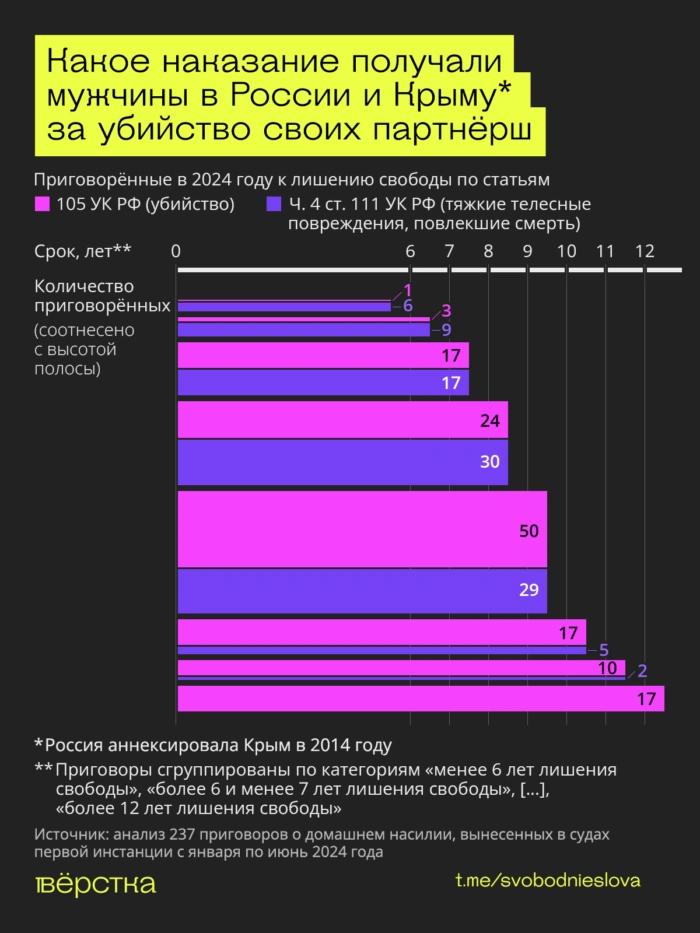
Sometimes men manage to avoid real punishment altogether. For example, if the case is initiated under the article on causing death by negligence (Article 109 of the Criminal Code).
This happened in the Tambov region, where local resident Vitaly Lukyanenko killed his wife and hid her corpse.
The couple lived in the village, raised two children and often quarreled. During another quarrel, Lukyanenko hit his wife in the head with his fist at least once. The woman fell, hit her head on the corner of a wooden table covered with an oilcloth tablecloth, and remained lying on the carpet. Lukyanenko looked at his wife’s motionless body and went to work on the farm. A few hours later, when he returned home, the woman was lying in the same position and dead.
Fearing that he would be sent to prison for the murder of his wife, Lukyanenko took a baby stroller from the yard, in which he usually carried firewood, put the body in it and drove it to the field in the dark. There he buried his wife, returned home and told the children that their mother had “gone somewhere.” A few days later, when neighbors and fellow villagers began to ask him where his wife had disappeared, he wrote a statement to the police about her disappearance. The police organized a search, which involved village residents. They searched the area but were unable to find the woman. During the first interrogation by the police, Lukyanenko denied that he killed his wife and said that he did not know where she had gone. When he was sent to a temporary detention center for disobeying the police, he confessed to the murder and showed where he buried the body.
Numerous witnesses - the head of the village council and friends of the family - told investigators that the man systematically beat his wife. They often saw bruises and abrasions on her face. However, investigators decided that the death was due to “careless criminal acts.” Lukyanenko was sentenced to restriction of freedom. For 14 months, he cannot go to cafes and bars or change his place of residence without the knowledge of the inspectorate.
Anything can be a mitigating circumstance
According to Russian laws, a number of circumstances can mitigate the guilt of a man who killed his partner. For example, admission of guilt, cooperation with the investigation, the presence of children, the health status of the defendant and his relatives, characteristics, awards and social activities.
In 70% of cases, as Vestka calculated, the judges considered “contributing to the investigation and solving of the crime” as a mitigating circumstance: the man showed how he killed the woman and explained what he did after the murder. In 67%, the mitigating circumstance was repentance, in 30% - the presence of minor children, in 20% - an apology to the relatives of the deceased, in 17% - the “immoral” and “illegal” behavior of the woman, in 13% - characteristics, in 3% - participation in a “special military operation” .
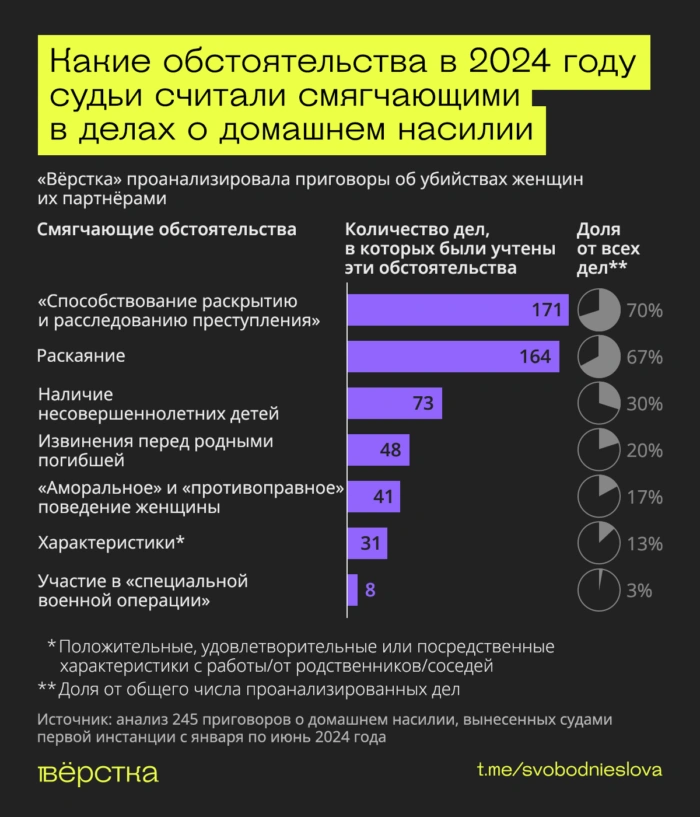
Judges choose mitigating circumstances, guided by the laws, but at their own discretion. For some, it is enough that a man has satisfactory or mediocre characteristics. In the Republic of Tuva, local resident Omak Mongush killed his common-law wife at a shepherd’s camp and hid her body. A neighbor saw the murder. Mongush threatened that if she told about what happened, he would kill her and her son. As a mitigating circumstance, the Tes-Khemsky District Court on June 6, 2024 accepted a “mediocre characterization at the place of residence.” For murder and threat to kill, he was sentenced to 11 years in prison and 1.5 years of restricted freedom. The court considered a repeat crime to be an aggravating circumstance - the man had already been convicted of murder.
Judges can consider almost anything to be “immoral” behavior of a woman. For example, if a woman insulted people close to a man, swore during a quarrel, or drank.
In the Irkutsk region, local resident Viktor Saluev killed his wife, angry at her for drinking too much alcohol during a summer picnic on the shore of a reservoir. The Padunsky District Court , which considered the case, called the behavior of a woman who drank in the presence of children immoral. At the same time, the court did not find anything reprehensible in the fact that the children’s father also drank alcohol. Under the article on causing grievous bodily harm resulting in death, Saluev was sentenced to 5 years in prison.
The Pavlo-Posad City Court of the Moscow Region called the actions of a girl who dated a married man and told his wife about their affair immoral. The girl was a citizen of Uzbekistan and met Nurali Zhoraev, also a citizen of this country, in a dormitory at the plant. They started dating and were together for about two years. Zhoraev’s official wife and children lived in Uzbekistan at that time.
According to the friends of the murdered woman and the commandant of the hostel, the girl prepared Zhoraev’s food and helped him with housework. She told her friends that Nurik had promised her: he would take her as his second wife, they would buy a garden and build a house. But this did not happen. At some point, the girl could not stand it and decided to tell Zhoraev’s wife about their relationship. Having learned about this, Nurali got angry, grabbed a knife and attacked the girl. The girl ran around the hostel, tried to hide and find protection, but Zhoraev killed her.
In court, he denied his guilt and claimed that he had sex with the murdered girl only once. According to him, the girl herself ran after him, “didn’t give him peace” and “blackmailed” him that she would send his wife photos of them together, which she took secretly.
In July 2023, the Pavlovo-Posad City Court sentenced Zhoraev to 9 years in prison. The prosecutor's office did not agree with the verdict and filed an appeal. The state prosecution asked to take into account that the reason for the murder was the “immoral behavior” of the deceased woman, “expressed in actions aimed at systematically discrediting Zhoraev’s personality.” The Moscow Regional Court agreed with the prosecutor's office, overturned the verdict and returned the case to another judge. During the retrial of the case, the Pavlovo Posad Court reduced the sentence by 1 year. Zhoraev was sentenced to 8 years in prison. The court recognized the girl’s “immoral” behavior as a mitigating circumstance. “Immoral,” according to the court, was that the girl behaved “immorally”: she created scandals, insulted him in the presence of colleagues, entered his dorm room without permission and told Zhoraev’s wife about their affair, which is why the wife left the family for a while.
In order not to miss new texts from “Layout”, subscribe to our telegram channel
Women who end relationships are still at risk
Some women were no longer in a relationship with the killers or were going through a divorce at the time of the murder, but still suffered from intrusive attention. In Russia there are no penalties for stalking, so if a man spies on his ex-wife or girlfriend, comes to her home or work without warning, and persistently seeks a conversation, he is not breaking the law. This leaves women in a helpless situation: they are afraid, but cannot contact the police.

In Bashkortostan, on March 21, 2024, the Supreme Court of the Republic sentenced to 20 years in a maximum security colony a young man who killed his underage girlfriend, her new boyfriend and hit a random driver.
A resident of the village of Kirgiz-Miyaki did not accept the fact that his girlfriend left him. He began to follow her and one evening he saw her with someone else. They sat in the car and kissed. At this moment, Subkhankulov, as he later told investigators, experienced “jealousy, anger and resentment.” He went home, took a knife, came back and killed them both. Then he bought vodka, drank it, got behind the wheel again and drove to Ufa.
By this time, the police had already learned about the crime and began chasing the suspect. Trying to escape pursuit, Subkhankulov drove into the oncoming lane and collided with a Lada Granta car. The driver of the Granta died, but Subkhankulov survived.
Investigators questioned the friends of the deceased girl. They said that the relationship between the deceased and Subkhankulov was difficult. The girl left him because, during another attack of jealousy, he beat her. After breaking up, the girl told her friends that Subkhankulov tried to commit suicide, but survived and began to pursue her. Forensic psychiatrists diagnosed him with an emotionally unstable personality disorder - it manifests itself in excessive impulsiveness, instability and reduced self-control.
In the Krasnodar Territory, on March 29, 2024, the Novopokrovsky District Court sentenced local resident Vasily Kubinets, who killed and set fire to his ex-girlfriend because she did not want to continue the relationship, to 11 years and 4 months in prison. After another conversation in a bar, during which the girl said that they had broken up completely, the man followed her, broke into her home and beat her. While the girl was still alive, he set fire to the apartment and ran away. In court, he argued that he “loved this woman very much” and wanted a future together with her, but “did not calculate the strength of his blows.”
Judges dismiss the case if the aggressor and the victim make peace
Many of the dead women, whose murder sentences were studied by VERSTKA, suffered from systematic violence. Some of them reported to the police, others admitted to their loved ones that they felt sorry for the men and therefore did not contact law enforcement agencies.
Relatives of a resident of the Khabarovsk Territory killed by her husband in February 2024 told in court that the woman was afraid of her husband, especially during periods of his drinking bouts. But she asked not to interfere in family affairs and did not report the beatings to the police, because she believed that the man would take the path of reform. In the summer of 2023, her husband burned her alive after she did not kiss him when he came home.

Some of those women who nevertheless decided to write a statement to the police withdraw it or ask the court to discontinue the proceedings. In such cases, the court almost always agrees.
13% of cases under Article 116.1 of the Criminal Code (“Battery by a person punished for beating or having a criminal record for a crime with violence”), which were found by Vestka, were terminated after reconciliation of the parties. Under Article 115 of the Criminal Code (“Intentional infliction of minor harm to health”), 44% of cases were dismissed in court.
In the Kurgan region, on March 13, 2024, the magistrate of precinct No. 22 dismissed the criminal case against local resident Salavat Biktashev, who beat his wife and abused her.
Biktashev broke his wife’s nose, forced her to take off her clothes and socks, and locked her naked in the cellar for the night. The next morning, he pulled her out of the cellar and began to persuade her not to report him to the police. To prevent the woman from documenting her injuries, he chained her to the floor with a bicycle chain and ordered her to sit “until the bruises go away.” The woman spent at least a day in chains.
She was released only because a court summons was brought to her house. The woman was summoned in a case regarding the restoration of her parental rights. Her husband let her go to the hearing and when the judge asked where the bruises on her face came from, she lied that she had been in an accident. A little later, when the woman won the trial and communicated with employees of the commission for minors, she admitted that her husband beat her, kept her in the cellar and in chains.
Two criminal cases were opened against Biktashev - for causing minor harm to health and unlawful imprisonment. While the investigation was ongoing, he was at large, and two months after contacting the police, the woman returned to the man. She became pregnant and at the court hearing said that she had forgiven her husband. The magistrate dismissed the case for reconciliation of the parties and released the man from criminal liability.
Women withdraw applications or ask the court to dismiss the case due to the fact that they are in a vulnerable psychological state and depend, including financially, on the aggressor, explains an anonymous lawyer from the women’s assistance center “Violence. No".
“There are cases when victims are simply afraid for their lives, because even the fact of a criminal case or a criminal record does not stop the aggressor from violence,” says the lawyer. “It happens that a woman reconciles because she wants to save the family, including so that the father communicates with the children and raises them, hopes for his correction and does not want criminal liability for him.”
Such reconciliation may have negative consequences, the expert notes: “If the aggressor has avoided responsibility, he can continue the violence, which can affect not only the woman, but also the children. The worst thing is that the power of physical violence can grow exponentially - and it can lead to real murder.”
In order to prevent this from happening, according to the lawyer, the state must provide the woman with free psychological and legal support, give her protection and shelter. In this case, the woman will understand the consequences of her actions and her decision will be conscious, and not made under pressure and fear. The aggressors themselves, according to the Nasiliyu.net lawyer, need to be registered and sent to special psychological courses.
A fine of 5 thousand is the most common punishment for domestic violence.
Only some cases of domestic violence become grounds for criminal prosecution. Most situations fall under the category of administrative offenses. This is due to the fact that in 2017 domestic violence was decriminalized in Russia. Beatings that did not lead to long-term health problems began to be classified as administrative offenses - under Article 6.1.1 of the Code of Administrative Offences. The maximum punishment under this article is compulsory work for up to 120 hours. But Russian courts resort to it extremely rarely.
“Verstka” analyzed decisions on 3 thousand cases under Article 6.1.1, which were considered by magistrates and judges of district courts in Russia and annexed Crimea in January-June 2024.
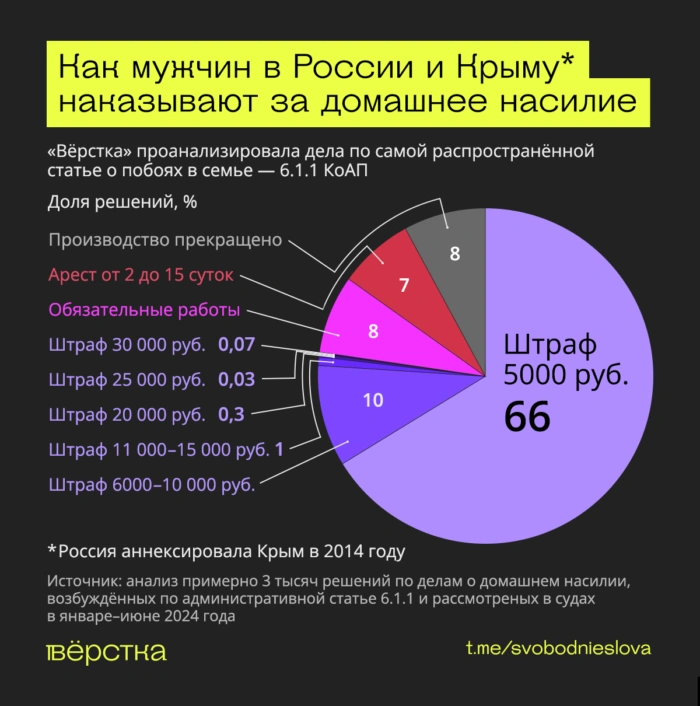
In 66% of cases, judges imposed the minimum punishment provided for in the sanction of the article - a fine of 5 thousand rubles . In 10% of cases, judges chose amounts from 6 to 10 thousand rubles. Men pay all fines imposed under this article not in favor of the beaten women, but in the state budget. The affected women do not receive any money.
Punishment in the form of administrative arrest, as “Verstka” calculated, was imposed only in 7% of cases. Mandatory work - 8%.
8% of cases ended with the men receiving no punishment. The cases were dismissed, the judges limited themselves to oral comments.
On January 29, a magistrate in Mari El issued an oral reprimand to a local resident who pulled his wife by the hair, grabbed her by the neck and punched her in the face at least 10 times. A neighbor called the police after hearing screams. She told police that she knocked on her neighbors door and saw a man. Behind him stood a crying woman with a small child in her arms. The case was considered on the same day. The woman and the man who beat her were brought to court, and the woman said that she had forgiven her husband. The judge of Magistrate Precinct No. 23, reviewing the police report, decided that the case was insignificant. She freed the man from punishment in the courtroom.
However, even if a woman wants to bring a man to administrative responsibility, she does not always succeed. In June 2024, the testimony of a teenage boy was read out in the Sovetsky District Court of Voronezh. His father killed his mother. The teenager told investigators that his father constantly beat his mother and she contacted the police. After that, he said, the police came, “talked with the father about the inadmissibility of such behavior, and then left.” In November 2023, after another call from the woman to the police, the police took the man to the police station, talked to him and released him. Returning home, the man killed his wife.
In many cases under Article 6.1.1 of the Administrative Code, it would be reasonable to place the aggressor under administrative arrest for up to 15 days, says lawyer, head of the Center for the Protection of Victims of Domestic Violence, Mari Davtyan. “This can be a vital time for a woman to calmly prepare to leave the shared home, to gather herself, to take a break from control and violence,” she explains.
Judges choose a minimum fine instead of an arrest for various reasons, notes Davtyan: “They don’t want to hit the whole family with a ruble, because the fine is paid from the general budget, the judge sees that they have common children, property, someone does not consider this offense as a whole dangerous enough to impose a serious fine.”
In general, courts consider cases where the victim is a person to be much less socially dangerous than cases where the state is on the other side. “Therefore, the fine for illegal parking may be higher than for beatings, not to mention fines for rallies or violation of the rules of business of a foreign agent,” explains the lawyer.
In addition, as Davtyan notes, judges live in the same society and see that state policy is aimed at protecting “traditional values.”
Violence often occurs in front of children
It's not just women who suffer from domestic violence. Children often become unwitting witnesses to beatings and murders. Often they are the ones who run to neighbors for help or call the police. Their testimony is taken into account by the court as evidence of guilt. In court decisions from 2024, we found many accounts from children about the violence they saw.

On June 17, in the working-class village of Zalari, Irkutsk region, a magistrate fined a local resident 5 thousand rubles for beating his common-law wife. The couple was spending time in their private home, and the woman decided to bite her husband's ear as a joke. He didn't like it. He got angry and hit her in the face twice. When the woman began to cry and went out into the yard, he followed her, pushed her, and when she fell, he kicked her three times in the side.
The woman's little son returned from a walk and saw his stepfather beating his wife. The boy's mother was lying on the ground, screaming and asking to call the police. He found her phone and called. In the case file, the police describe the call as follows: “The duty station received a telephone message that the stepfather was beating, kicking, and killing my mother. My son called, he was very scared and crying.” The boy told the police who came to the call that his mother was crying because she was in pain, and he was scared at that moment.
The judge who heard the case found no reason to order arrest or mandatory labor. She came to the conclusion that the resident of the Irkutsk region should be fined “within the sanction of the article in the minimum amount.”
The presence of children is often taken into account as a mitigating circumstance
When a man who beat or killed a woman ends up in a courtroom, he is asked about the details of his life. The judge also checks whether the man has children and how old they are. If the children are under eighteen, this may be a mitigating circumstance. According to the logic of the judges, a man must provide for children and spend time with them. Therefore, his punishment may be reduced.
Children became a mitigating circumstance in 23% of cases of domestic violence under Article 6.1.1 in 2024, Vorstka calculated.
The statistics for femicide cases for the first half of 2024 are even higher. In 30% of sentences, children are listed as mitigating circumstances.
The judges do not find out whether the man participates in raising children and how much he spends on them. If he is divorced and does not live with or even see the children, the children will still be a mitigating factor. This also works in situations where children saw their father beat or kill their mother.
On January 23, a local resident was sentenced in Surgut for trying to kill his ex-wife and beating his little daughter when she called for help.
The girl's testimony, which she gave to investigators, was read out in court. She said that her parents divorced 3 years ago. Sometimes dad takes her younger sister to visit, but she refuses to go to him because “he might beat her.”
That day, her father brought her younger sister home. He “smelled unpleasantly of alcohol,” he entered the hall and began shouting at his wife, grabbing her by the hair and hitting her with his fists. The girl saw her mother run out of the room and ran to the kitchen, but her father caught up with her, threw her to the floor and began to choke her. Both sisters were crying at that moment. At one point, the father ordered them to bring a knife so “he could stab her [the mother].” It was the most terrible moment, the girl recalled. Then it seemed to him and his sister that dad would kill mom.
The girl decided to try to call for help. She ran to the front door, ran out of the apartment and started knocking on the neighbors, but they didn’t open for her. She felt someone grab her by the collar of her T-shirt; her father ran after her into the corridor and forcibly dragged her back. In the apartment, he grabbed her by the hair and punched her several times in the head and body. The beating was stopped by the mother, who ran up and grabbed her daughter. Then, as the girl said, “the police arrived, and dad didn’t touch anyone anymore.”
A criminal case was opened against the man on two counts of threats to kill and two counts of beatings (Articles 116.1 and 119 of the Criminal Code of the Russian Federation). The Surgut City Court sentenced him to 2 years of suspended imprisonment. The fact that the man has daughters was considered by the court to be a mitigating circumstance.

In the Perm Territory, on May 20, 2024, a father with many children was sentenced to 9 years in a maximum security colony for killing his wife for several hours in front of his small children.
The man told investigators that he came home drunk at night and went with his wife to wash in the bathhouse. There the couple quarreled. The man accused his wife of cheating, but the woman denied everything. Angry with her, he began to beat her, and then, as he claimed during interrogation, they had sex by mutual consent.
During “consensual sexual intercourse,” the man again decided that his wife was cheating on him and began beating and torturing her. He broke her jaw, beat her with his feet, hands and a log all over her body, and poured boiling water on her naked face and body. The woman was diagnosed with numerous injuries, fractures, burns, ruptures of the labia and internal organs.
Little children entered the dressing room and saw their father pouring boiling water over their dying mother. During the interrogation, they said that they asked their father to stop the bullying, but he ordered them to “go into the house and not come again.” According to the children, before the murder they often heard their parents swearing and saw bruises on their mother’s arms and legs.
A criminal case was initiated under the article on grievous bodily harm resulting in death through negligence (part 4 of article 111 of the Criminal Code). The Kudymkar City Court of the Perm Territory, which considered the case, recognized that the man caused special suffering not only to his wife, but also to his children, who were eyewitnesses and tried to protect their mother. This did not prevent the court from recognizing the fact of having children as a mitigating circumstance for the man.
Are there prospects that the situation with domestic violence will change?
According to lawyers, domestic violence in Russia will decrease only as a result of fundamental changes.
“There is not enough police work on domestic violence cases. A whole system of organizations must be organized that interact with each other and provide assistance to the victim. — объясняет анонимная юристка центра „Насилию. нет“. — Данная система подробно описана в проекте закона о профилактике семейно-бытового насилия, который до сих пор не принят».
Несколько лет назад закон о профилактике домашнего насилия разрабатывался группой правозащитников при активной поддержке спикера Совета Федерации Валентины Матвиенко. В 2019 году он забуксовал. По словам источников «Вёрстки», законопроект заблокировала Русская православная церковь . По мнению РПЦ, законодательные меры по борьбе с домашним насилием не совместимы с «традиционными семейными и духовно-нравственными ценностями». Как утверждают источники «Вёрстки», с просьбой не принимать закон к Владимиру Путину обратился лично патриарх Кирилл.
В 2024 году в России на уровне государственных институтов снова заговорили о профилактике домашнего насилия. Уполномоченная по правам человека Татьяна Москалькова в июне 2024 года, выступая с докладом в Совфеде, заявила, что государство должно вернуться к обсуждению закона об ответственности за насилие в семье. По словам Москальковой , в 2024 году она получила «несколько больше» обращений о домашнем насилии, чем обычно.
За ужесточение наказания также высказались представители парламентских фракций «Новые люди», ЛДПР и «Справедливая Россия». Но источники «Вёрстки» во фракциях «Единая Россия», ЛДПР и «Новые люди» рассказали, что в настоящее время работа над законопроектами о профилактике домашнего насилия не ведётся и их разработка заморожена на неопределённый срок.
Адвокат, руководительница Центра защиты пострадавших от домашнего насилия Мари Давтян согласна, что в ближайшие годы не стоит ждать принятия закона о профилактике домашнего насилия.
«Перспектив нет. Мы прошли ту историческую точку, когда это было максимально возможно, — говорит Мари Давтян. — Многие женщины- экспертки, феминистки, правозащитницы с начала 90‑х проделали огромную работу, чтобы сделать проблему гендерного насилия общей повесткой. Общественное восприятие проблемы менялось в лучшую сторону, что, пусть и очень медленно, но подводило власть к логическому решению принимать специальные меры защиты. Через два года пройдут очередные выборы в Госдуму и нет никаких оснований полагать, что там окажутся политики, готовые добиться принятия рабочего закона о домашнем насилии. Сложно вообще сейчас что-то прогнозировать на долгий период вперёд, но вероятнее всего огромную работу по аргументации, что в России юридических мер для защиты женщин недостаточно, придётся начинать не то чтобы с нуля, но заново».
По словам Мари Давтян, для того, чтобы решить проблему домашнего насилия в России, нужен комплексный подход, учитывающий специфику разных регионов. Но если государство предпримет хотя бы одну меру — организует специальные курсы для полицейских по правильной работе со случаями домашнего насилия — это может снизить количество случаев убийств женщин.
Infographic: El
Illustrations: Lyalya Bulanova
Цель нашего спецпроекта «Календарь домашнего насилия» — сделать видимой проблему насилия в семьях. Мы проанализировали тысячи судебных решений и придумали, как визуализировать данные, чтобы привлечь внимание к ситуации с домашним насилием.
Эта работа стала возможной благодаря пожертвованиям наших читателей и подписчиков. Спасибо каждой и каждому за этот вклад.
Если вы хотите поддержать нашу команду, оформите регулярную подписку на любую сумму. Она позволит «Вёрстке» не только продолжать работу над спецпроектами, но и рассказывать о самом важном, что происходит в России.