
Translated material
Timur and his team from the FSB
The court found that provocateurs associated with the Russian special services acted under the guise of “Ukrainians” in the case of cooperation with foreigners.
18+. THIS MATERIAL (INFORMATION) IS PRODUCED, DISTRIBUTED AND (OR) SENT BY A FOREIGN AGENT OF THE “FIRST DEPARTMENT” PROJECT OR CONCERNES THE ACTIVITIES OF A FOREIGN AGENT OF THE “FIRST DEPARTMENT” PROJECT.
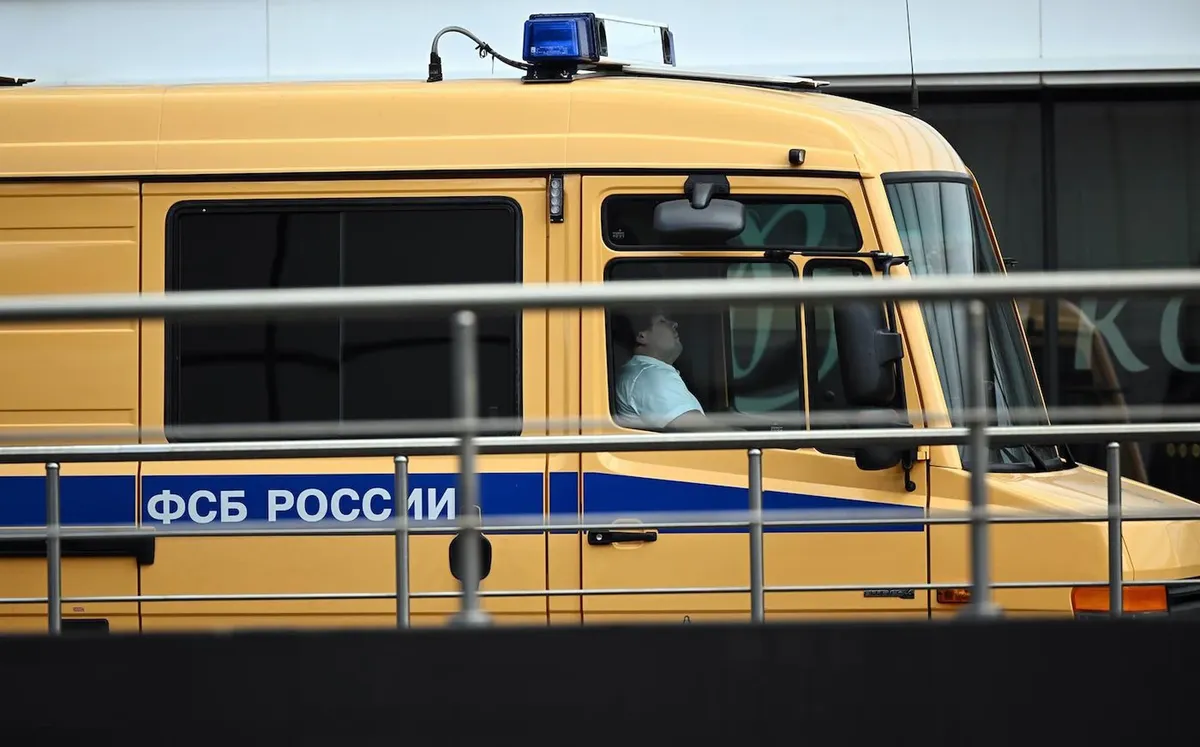
FSB officers pretend to be Ukrainians on the Internet in order to provoke anti-war Russians to commit crimes against state security. Evidence of this was discovered on the eve of the past year by the “First Department”* project (its lawyers and advocates specialize in defending citizens in cases of “high treason”). The evidence was the verdict of a provincial court against a Russian accused of “confidential cooperation” with Ukraine.” It turned out that he confidentially “collaborated” not with a Ukrainian, but with an FSB operative. There was not even a crime in the case. We tell you what was revealed in court.
The fact that security forces are actively provoking Russians for the sake of “solving crimes” is not particularly news: however, previously they usually used scams for drug addicts.
A new flurry of such pseudo-disclosure, as you might guess, began after February 2022 - citizens who opposed military operations began to fall for the bait of the special services.
The security forces, however, have never admitted that they are taking on the role of outright provocateurs. But now there is an official document - a whole court decision in which this role is confirmed by the judge.
In July 2024, the Oryol Regional Court sentenced local resident Ivan Tolpygin under Art. 275.1 of the Criminal Code - for “confidential cooperation with a representative of a foreign state.” Tolpygin received his four years in a general regime colony and a fine of 500 thousand rubles specifically for the fact that, as follows from the verdict, he “established and maintained relations” with an unnamed “representative of Ukraine” in the Telegram messenger.
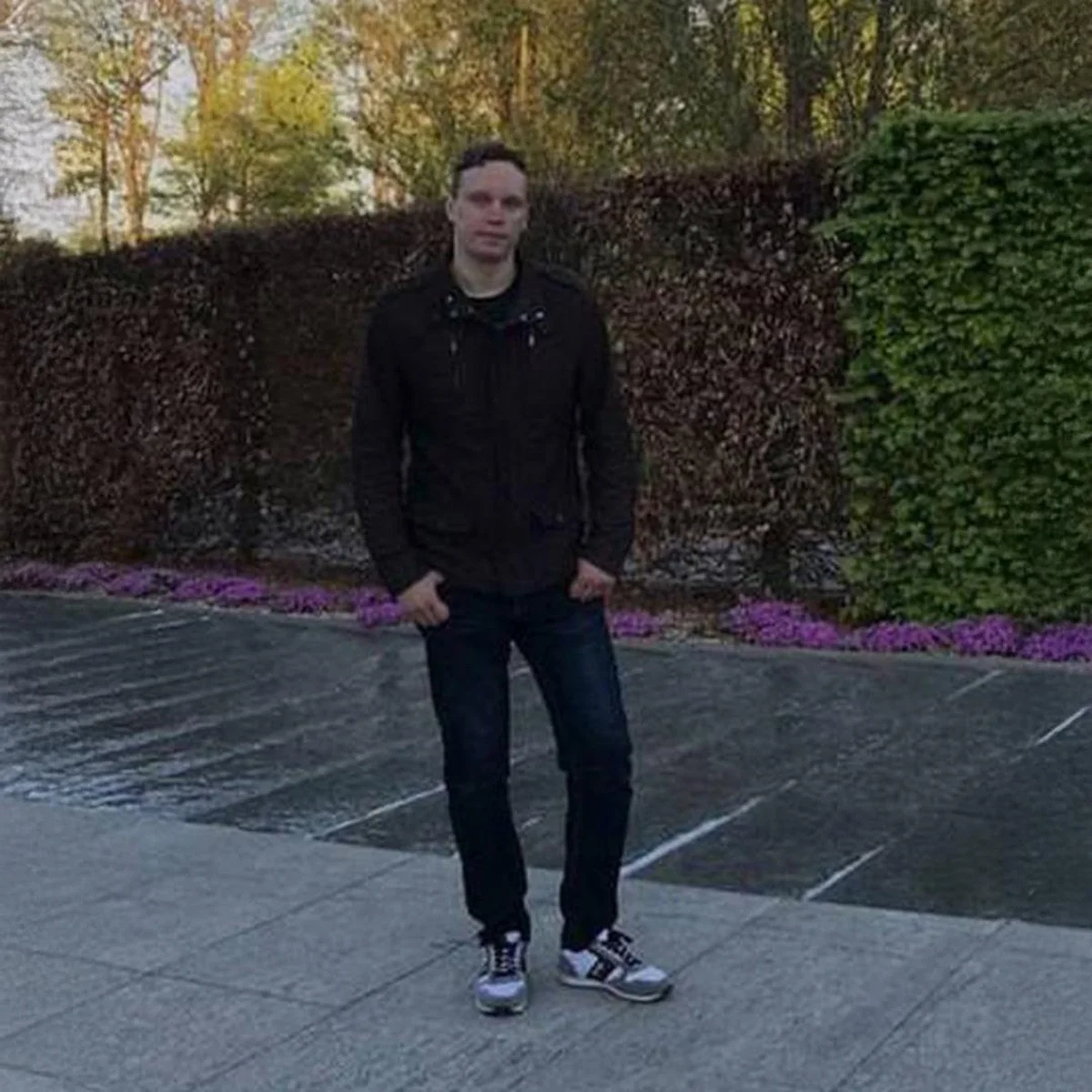
Paradoxically, the court itself, represented by presiding judge Valeriy Markov, wrote in black and white in the final decision that no “representative of Ukraine” actually existed. An active FSB officer posed as a “Ukrainian.”
QUOTE FROM THE VERDICT
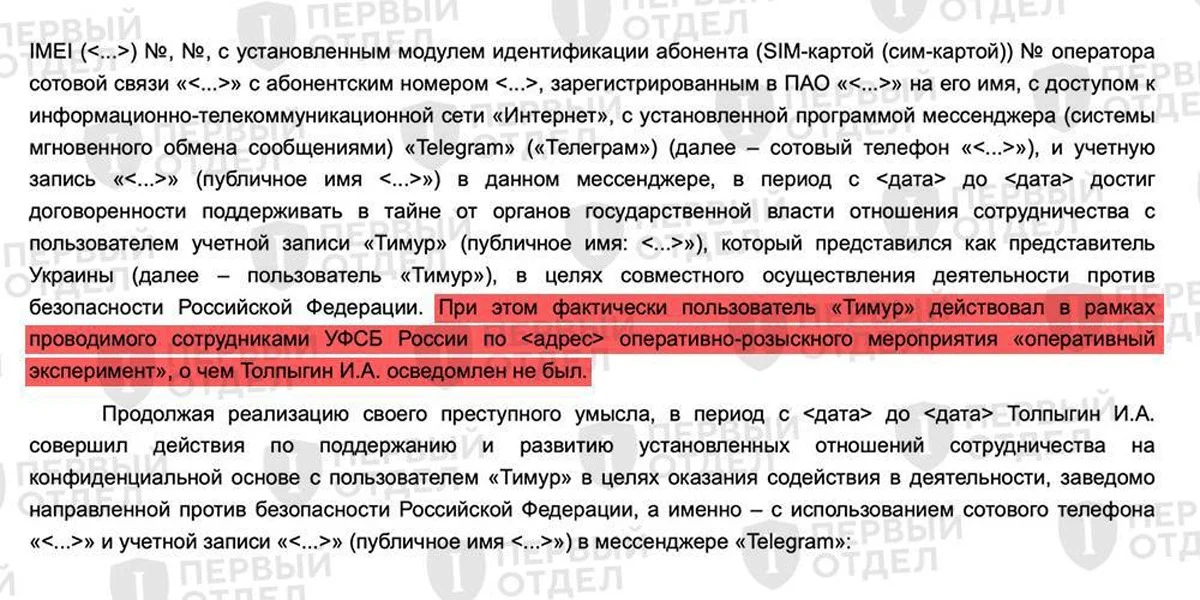
“In this messenger, in the period from <date> to <date> [Tolpygin I.A.] reached an agreement to maintain a secret relationship from government authorities with the user of the account “Timur” <...>, who introduced himself as a representative of Ukraine ( hereinafter referred to as “Timur” user) for the purpose of jointly carrying out activities against the security of the Russian Federation.”
When reading the verdict, you really experience a feeling of cognitive dissonance. In the decision signed by Judge Markov, a red thread runs through the phrase that in fact the user “Timur” acted within the framework of an operational-search activity “operational experiment” carried out by employees of the Federal Security Service of Russia, about which Tolpygin I.A. - the judge emphasized - “I was not aware.”
At the same time, the wording from the indictment was later transferred into the verdict using obviously traditional copy-paste:
QUOTE FROM THE VERDICT
“Continuing to implement his criminal intent, in the period from <date> to <date> Tolpygin I.A. took actions to maintain and develop established cooperative relationships on a confidential basis with the user “Timur” in order to provide assistance in activities known to be directed against the security of the Russian Federation.”
“Timur,” on instructions from the FSB, provoked Tolpygin to send coordinates of military facilities and information that contained “information creating conditions for causing damage to the security of the Russian Federation.”
Lawyers and jurists of the First Department note that the actions of the FSB in this case were not operational investigative measures. This is nothing more than inducement to crime. While the Federal Law “On Operational-Investigative Activities” prohibits law enforcement officers from inciting, inducing, inducing, directly or indirectly, to commit illegal actions. “The verdict against Ivan Tolpygin describes a classic example of provocation to commit a crime against state security,” said First Department lawyer Evgeny Smirnov.
What is known about the convicted person himself? The verdict notes that after the start of mobilization, Tolpygin began to look for ways to “surrender to representatives of Ukraine” and “turned to Ukrainian resources, including “I Want to Live . ”
According to the First Department, Russian security forces monitor and keep track of who reads Ukrainian public pages and websites on Russian territory. This is how they tracked down Ivan Tolpygin, after which “the user “Timur” contacted him, introducing himself as a representative of Ukraine.”
In a word, be vigilant. Victims of provocations include users on VKontakte and Telegram who are members of pacifist and opposition groups. The scenario, warns the First Department, is always like this:
“Provocateurs from the FSB are added as friends or forced to communicate. As a rule, at first they conduct a conversation on an abstract topic, but then they begin to ask questions about ***, pretending to hold similar views, and provoke more and more radical responses and illegal actions.”
Well, the law, as always, will not work. In the specific case of a resident of Orel, the following conflict occurred with this very right: it was the messages of “Timur,” acting on instructions from the FSB, that, in the understanding of the investigator and then the court, became the beginning of the implementation of the objective side of the crime - that is, “the establishment of a relationship of cooperation on a confidential basis with a representative foreign state."
After all, Tolpygin, having believed “Timur,” agreed to “carry out the tasks received,” “pre-informing the interlocutor about all his actions, thanks to which the FSB officers knew where he himself could be filmed.”
And they filmed it.
However, according to Evgeny Smirnov, the court made a mistake in qualifying Tolpygin’s act. If the man had all the incriminated communications with an FSB officer (and the verdict does not say otherwise), it means that he did not establish “confidential contact” with the representative of Ukraine and did not transmit any information to them. A resident of Orel passed on the information to an FSB officer. This means that he can only be charged with attempted crime, and not the completed offense.
But the court imputed exactly the completed composition. Ivan Tolpygin will go to prison for 4 years.
And this, of course, is not the first time.
According to the calculations of the lawyers of the First Department, hundreds of criminal cases related to “treason” and “confidential cooperation” are initiated precisely after such provocations by FSB employees or people associated with the special services.
By the way, Ivan Tolpygin’s cellmate in the pre-trial detention center, as it turned out, became a victim of the same employee under the nickname “Timur”. Ivan Gavrilenko, a 39-year-old resident of Orel and a native of Ukraine, was sentenced in September 2024 to 17 years in prison for setting fire to a relay cabinet. The mechanism of provocation was the same as in the Tolpygin case. Moreover, it was on Tolpygin’s letterhead that Gavrilenko responded to one of the letters from outside.
This is how human rights activists learned that an intelligence officer under the nickname “Timur” not only offered Gavrilenko money for arson—$1,000—but also made threats. “In June 23, a certain “Timur” contacted me, who, at first for money, but after my refusal, resorted to threats, provoked me to commit illegal actions, which I committed out of my stupidity, frivolity, fear and because the painful state of his psyche,” the man wrote.
The convict also reported that after his arrest, employees of the Orel FSB allegedly used torture and torment against him, despite the fact that he immediately reported his illnesses and his intention to fully cooperate with the investigation in solving the crime and searching for the provocateur who forced him to commit the arson closet
But the special services do not need provocateurs. After all, they themselves are the provocateurs, as the Oryol Regional Court officially confirmed for the first time.