Translated material
Victory was not delivered
In the second round of elections in Moldova, the candidate from the pro-Russian party could gain 12 thousand votes, New Europe calculated. But this was not enough to change the result
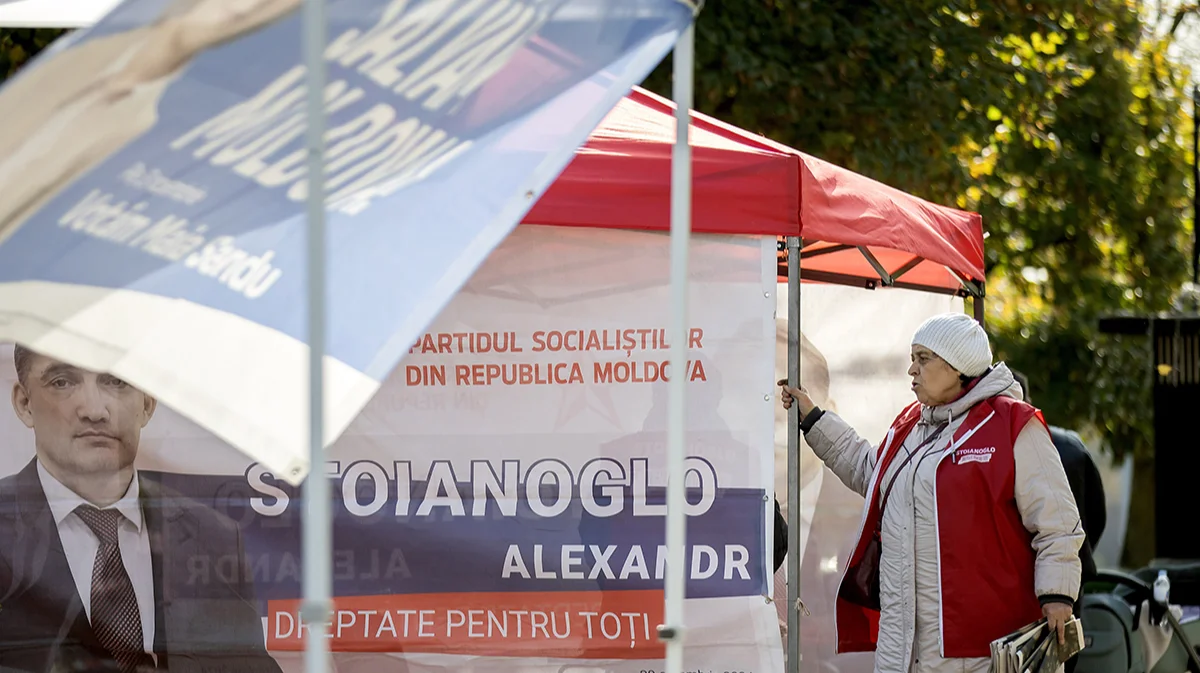
Photo: Dumitru Doru / EPA-EFE
The second round of elections in Moldova took place on November 3. They were won by the pro-European candidate Maia Sandu. Observers and Sandu herself reported Russia’s attempts to influence the results: by bribing voters in the first round, and by transporting the electorate to the polling stations in the second. New Europe studied the elections in Moldova from a statistical point of view and found that there was interference in favor of the candidate nominated by the pro-Russian party, but its scope was limited.
Electoral tourism
Moldovan police reported the transportation of voters voting for Sandu's competitor Alexandre Stoianoglo at polling stations in Azerbaijan (Baku), Turkey (Istanbul) and Belarus (Minsk), and only in the second round. This nature of the alleged electoral violations makes their statistical verification convenient: in the polling stations where the supply was noticed, in the second round the turnout and the number of votes against Sandu simultaneously increased, and by approximately the same amount.
In all other areas such an anomaly is not observed. This is clearly visible on the graphs if each point represents a polling station.
The only exception is polling stations in Moscow, but in this case there is less reason to talk about organizing transportation: among voters in Moscow, the result of Sandu’s opponents was high in the first round. It is logical that in the second round the majority of new voters also voted against Sandu (which does not exclude violations, but it is more difficult to prove).
At the same time, in Baku and Minsk, Sandu’s result in the first round was not very different from other foreign sections, which suggests that in the second round it increased precisely as a result of artificial intervention. In Istanbul, Sandu's initial result was higher than at most foreign sites, but lower than in Moscow. In such a situation, the transportation of voters is more difficult to prove, but given that both media reports and our analysis indicate it, we can assume that it did take place.
There are also polling stations in France, where in the second round Sandu, on the contrary, received noticeably more support than in the first. However, the nature of the distribution of points on the graph is less similar to coordinated activity: the outlier areas are located more chaotically on the graph. Political scientist Galia Ibragimova, who lives in Moldova, noted in a commentary to New Europe that a significant part of the Moldovan diaspora lives in France, and Emmanuel Macron is very popular in Moldova. Both of these factors, together with Sandu’s team’s continued reliance on diaspora votes in the second round of elections, likely played a role in the high turnout of voters abroad and votes cast for the current pro-European president.
Our analysis shows that at polling stations in Baku, Istanbul and Minsk, with the help of transporting voters, about 3,150 votes could be gained in favor of Alexander Stoianoglo.
This is exactly the “surplus” of voters who voted against Sandu in the second round compared to the first. This is only 0.1% of the foreign votes for Stoianoglo, which probably did not affect the election results. At the same time, according to Moldovan laws, organized transportation of voters on any scale is considered a crime.
Stoianoglo himself questioned the accusations of such methods of electoral violations, explaining that Moldovans could come, for example, to Istanbul just “for the weekend.”
Delivery to Transnistria
There is a region in Moldova where pro-Russian views and the Kremlin’s influence traditionally remain high . This is Transnistria. Despite this, Evgeniy Ceban, a correspondent for the independent Moldovan publication NewsMaker, in a conversation with New Europe, claims that there was no evidence of mass transportation of voters to polling stations in this region. Ibragimova notes that accusations of organizing the transportation of voters to Transnistria were made both by the authorities and by the opposition.
Our analysis indicates that Stoianoglo supporters probably did transport voters to polling stations in Transnistria.
For this region, as for the rest of Moldova, you can apply the same method for identifying the transportation of voters as for foreign polling stations: compare the increase in votes against Sandu with the increase in turnout in the second round. And this method shows a very clear anomaly: many new voters came to the 24 polling stations for residents of Transnistria in the second round, almost all of them voted for Stoianoglo. At the same time, the initial result of Sandu in these areas was not seriously significantly lower than in other parts of Moldova (we determined the anomaly of the areas, among other things, by this criterion).
There is no unanimous pro-Russian sentiment in Transnistria, Ibragimova confirms: “In 2020, a significant number of Transnistrian residents voted for Maia Sandu, although this region is traditionally considered pro-Russian. In these elections, Sandu’s opponents also had fears that Transnistrian voters would support her.”
This means that the number of new supporters of Stoianoglo in the second round is difficult to explain by anything other than electoral manipulation.
“Clean” elections?
To assess the integrity of elections, analysts often construct graphs in coordinates where the horizontal axis is turnout and the vertical axis is the result of the candidate of interest. In the graph below you can notice unusual patterns in certain groups of areas, which may indicate falsification. But they can also be explained by differences in the electoral behavior of residents of different regions (therefore, in this text we do not use the Shpilkin method - it does not work well in conditions of strong heterogeneity).
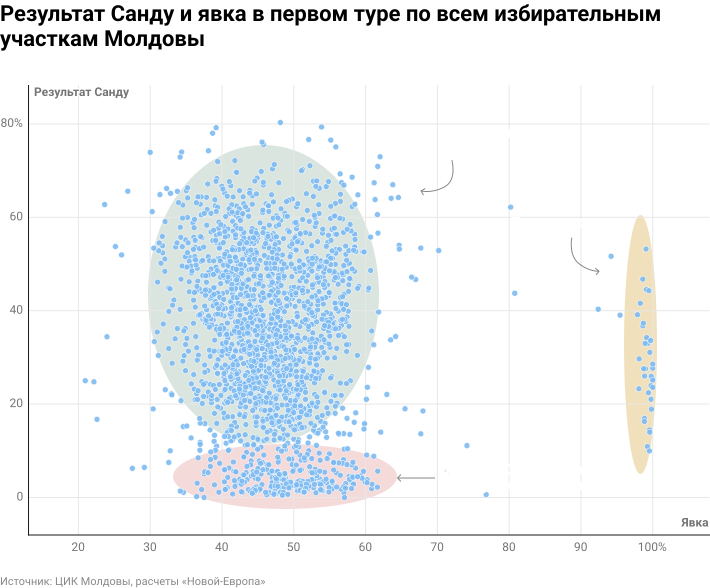
The cloud containing the votes of the majority of the country's population is highlighted in green. The shape of this distribution suggests some regional differences rather than serious falsification.
Particularly noticeable are the polling stations where residents of Transnistria voted (highlighted in yellow). These polling stations show a high turnout, but Sandu’s result in them differs little from the national average. There is no anomaly in this: citizens with registration in Transnistria are not tied to polling stations, so the concept of turnout in this case actually makes no sense.
Red cloud - areas where Sandu's result is much lower than the national average. Most of the points in this cloud are located in the regions of Taraclia and Gagauzia. However, in the case of Moldova, this indicates regional differences rather than falsification.
Evgeniy Cheban, in a conversation with Novaya-Europa, noted that about 80% of ethnic Gagauzes live in Gagauzia, who are traditionally pro-Russian. Taraclia is inhabited mainly by ethnic Bulgarians, who can also be considered supporters of Moscow.
Galia Ibragimova notes that Sandu’s poor results in these regions are also a consequence of her policies: “The south of Moldova is one of the poorest regions of the country,” says the political scientist. “In addition to low incomes, residents face a lack of basic infrastructure such as running water and sewerage. Maia Sandu tried to resolve these issues during her presidency, but significant progress was not achieved because the problems of the region were ignored for years by the previous authorities.” Evgeniy Ceban agrees that Maia Sandu and her Action and Solidarity party, like other pro-European parties, do not pay much attention to Gagauz autonomy.
Another reason is that Sandu Stoianoglo’s competitor comes from Gagauzia, so he enjoys more support there. In addition, in the southern regions, the influence of the country’s main pro-Russian politician, Ilan Shor, is strong—it was his structures that were accused of bribing voters in the first round of elections. Experts note that in Gagauzia and Taraclia, bribery was one of the mechanisms for mobilizing the pro-Russian electorate, but they do not call this the main reason for Sandu’s loss in these regions.
Evgeniy Cheban also notes that in regions where voters vote unanimously, in theory it is easier to organize falsifications: all commission employees and observers may turn out to be supporters of the same political forces. “But even if this happened, these are individual cases, and not systematic work on falsification,” he claims.
According to him, despite the poverty of the population and vulnerability to external interference, elections in Moldova remain competitive. Although the country has problems with political corruption, opaque party funding and varying levels of access to the media, the election process is organized in such a way that it is extremely difficult to falsify the results. Each PEC and observers include representatives of all opposition parties represented in parliament. In almost all polling stations, competing parties organize parallel vote counting. External and internal monitoring missions are also present everywhere.
Our analysis confirms these findings. Massive fraud is usually indicated by correlation of turnout with the result and integer anomalies , but in the case of Moldova we observe neither one nor the other. As was the case a few weeks earlier in Georgia , Moldovan political forces are having to resort to more complex methods of electoral fraud, such as bribery and voter transportation. For example, Maia Sandu claimed that “a criminal group intended to buy 300 thousand votes.” But such manipulations are much more difficult to detect statistically.
By transporting voters to the polling stations, Pridnestrovians Stoianoglo could gain almost 9 thousand votes. In total, about 12 thousand votes were obtained using this method in foreign and domestic polling stations. This is less than one percent of all votes for Stoyanoglo, and therefore did not affect the final result of the second round. But given that the gap between the candidates was small, with a slightly different distribution, these increases could lead to the defeat of the pro-European forces in Moldova.