
Translated material
I'm being forced to sign a contract with the Ministry of Defense
How to avoid being sent to the front, what rights do you need to know and what to do if you don’t want to fight in Ukraine?
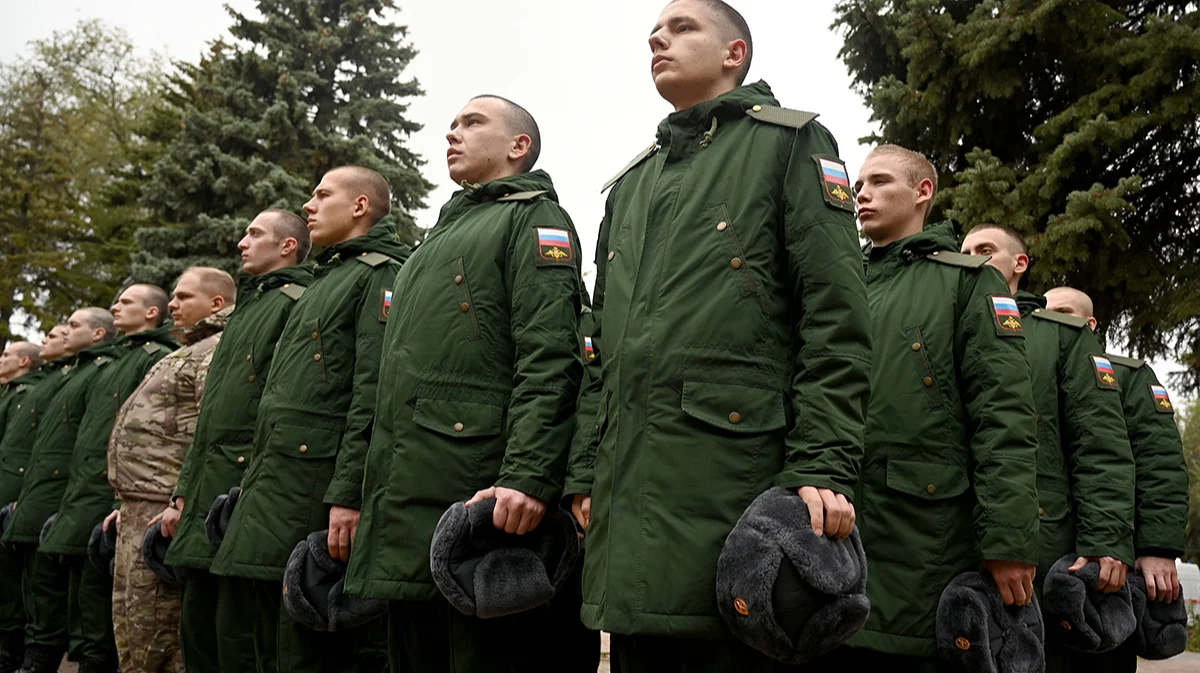
Russian conscripts called up for military service during the ceremonial departure to the garrisons at the assembly point of the local recruiting station in Rostov-on-Don, Russia, October 20, 2024. Photo: Sergey Pivovarov / IMAGO / SNA / Scanpix / LETA
Since the beginning of the war in Ukraine, pressure on conscripts has increased: they are forced in various ways to sign a contract with the Ministry of Defense. And this year this trend continues unabated. Thus, parents of conscripts from Chuvashia stated that their sons were persuaded to sign contracts under psychological pressure already on the first day of service. They scare young people in other ways: the day before in Moscow, security forces staged a raid on conscripts in the dormitory of the Tchaikovsky Conservatory. Three students were detained in their rooms and taken under escort to the police, where they were given summonses to the military registration and enlistment office and their passports were taken away.
People are forced to agree to contract service not only by force or deception, but also by money: Vladimir Putin has already signed a law according to which overdue loans of up to 10 million rubles will be written off for participants in the war in Ukraine. How to protect yourself under pressure from the Ministry of Defense, in what ways does the military department scare and deceive military personnel, and are there any loopholes in the law with which you can avoid being sent to the front after signing a contract? “New-Europe” is sorting it out together with experts.
1. Conscripts complain that they are forced to sign a contract with the Ministry of Defense. How to protect yourself to prevent this from happening? What is the main rule?
The only way to protect yourself 100% is to not have any contacts with structures that can somehow cooperate with the Ministry of Defense, Ivan Chuvilyaev, a representative of the “Walk through the Forest” movement, emphasizes in a conversation with New Europe:
“Hybrid mobilization has been going on for two years now; it is a very tricky phenomenon that easily mutates and adapts to any changes.”
Signing a contract is “slamming a mousetrap,” the director of the human rights group “Citizen. Army. Right” Sergei Krivenko: “Before that you are a citizen with rights and you can somehow resist, after that it’s either war or prison. But, of course, you can and should resist even in a mousetrap.”
Interlocutors of “New Europe” advise avoiding any service: not only under contract, but also urgent. After all, this is where it is easiest to put pressure on a person. “New Europe”, on the eve of the autumn conscription, told what legal ways there are not to join the army.
2. In what ways does the Ministry of Defense force you to sign a contract (or something similar to it)?
The first way is to sign a contract under the guise of an employment contract . According to Ivan Chuvilyaev, structures associated with the Ministry of Defense can post such dangerous vacancies even on popular job search sites: “They write there: we need an engineer, a cook, a courier - anyone. A man is going for an interview and is surprised to discover that his route goes straight to a military unit. And there he can be offered any job - a PR specialist, a copywriter, a cook, but these will all be contracts with the Ministry of Defense. Ultimately, he will not be in the kitchen, not in the office, not in the warehouse, but on the front line. Because there is only one contract,” says the interlocutor of “New-Europe”. Therefore, when responding to any vacancy, you need to look carefully and double-check several times what kind of organization is offering it, notes Chuvilyaev.
The second method that the Ministry of Defense resorts to is putting pressure on conscripts : that is why the main advice is to avoid military service by hook or by crook. In addition, you can also die on it, the expert continues: “Starting from August 2024, a counter-terrorism operation regime was introduced in the Bryansk, Belgorod and Kursk regions, and the Ministry of Defense is actively sending conscripts there. There are fighting going on there,” notes Chuvilyaev. Also, according to him, the military department has the right to send conscripts to Crimea and Sevastopol, where military operations are also carried out, for example, mine clearance.
“There is no option to avoid participating in hostilities in conscript service: you can be sent to the listed regions, where you can die. And even if you are promised when signing a contract that you will go somewhere to the Far East, these are all empty words too. Just like any other promises from the Ministry of Defense. This must be kept in mind and remembered. The main and only principle from which to proceed is no contact with the Ministry of Defense and no military service at all,” the interlocutor emphasizes.
“New Europe” told how conscripts are frightened and how people are forced to come to military registration and enlistment offices.
3. What legal rights do you need to know and how should you act at the moment when you are being pressured and forced to sign something?
People in the service are often intimidated, misinformed and told that signing a contract does not automatically mean being sent to a war zone. “They are taken lightly, and, unfortunately, it turns out that it is very easy to put pressure on young people,” says a volunteer of the Conscious Objector Movement in a conversation with Novaya-Europa ( he preferred to remain anonymous for security reasons. - Editor's note )
It must be remembered that it is your legal right to refuse a contract, and that a contract is voluntary,
he emphasizes.
It is also very important to keep in touch with loved ones so that your parents know what is happening to you during your service. Agree on a conditional signal (in the form of an SMS or a call), which would mean that you are being pressured, advises the interlocutor of New Europe. In addition, as a volunteer of the “Objector Movement” advises, before joining the army, you can sign a statement with a notary stating that you do not intend to serve under a contract, and if it turns out that you agreed to this, this will mean that you were pressured .
4. If I have already been forced to sign a contract (by deception or force), but I do not want to fight, what can I do? Are there legal ways to cancel it?
At this stage, there are very few options left to avoid service, but this does not mean that the person is doomed, says a volunteer of the Refusal Movement. It is quite difficult to prove that a conscript was forced to sign a contract, but you can try to go to court to invalidate the contract on this basis. However, the chances of winning this trial are very small, the interlocutor of New Europe emphasizes.
If the contract was signed recently, it is important to comply with certain conditions so that there is a possibility of challenging it later, as explained in the “Call to Conscience”: do not actually fulfill the contract, do not receive weapons, do not participate in military training, refuse monetary allowances. This will demonstrate your position that the contract is illegal. In this case, complaints and lawsuits can be filed.
It is also very difficult to be commissioned (that is, to retire from the reserves for health reasons based on the conclusion of a military medical commission). It is possible to be released from service for health reasons at the conscription stage (“New Europe” wrote about this in detail), but if a person has already been conscripted or if he has signed a contract, he must have a very serious illness and must be classified in fitness category B (limited fit - for a conscript, but during the period of mobilization this may not be enough) or D (unfit - for a contract soldier) in order to be released. That is, a contract worker can resign, for example, due to a serious injury. “That’s why the person ends up in a trap,” adds the volunteer.
5. Are there any loopholes in the law (maybe not entirely legal) with which you can avoid being sent to the front after signing a contract?
The only way not to go to the front in this case is to leave the unit without permission or failure to comply with an order, which could result in a criminal case:
“If you have already signed a contract and if you understand that you will be sent to the front tomorrow, it is almost impossible to jump out of this. Only a criminal case.
And this year there were brave people who, while in service, refused to go to the front. But now no one even asks contract soldiers and conscripts - they just sit them down and take them away,” says Ivan Chuvilyaev.
Cases are usually opened under one of three articles, as described in the “Call to Conscience”:
Failure to comply with an order, 332 of the Criminal Code of the Russian Federation - if a person openly refuses to go to the front. Punishment: two to three years in a penal colony. When half the term has passed, parole is possible.
Unauthorized abandonment of a unit, 337 of the Criminal Code of the Russian Federation - if a person leaves the unit for more than two days. Punishment is up to 10 years in prison (in case of absence for more than a month), a suspended sentence is often given to return the person to the front.
Desertion, 338 of the Criminal Code of the Russian Federation - if there is evidence that a person left the service not for a while, but forever. Punishment during the period of mobilization is a strict regime colony for a term of five to 15 years.
Military personnel, according to federal law , are prohibited from leaving Russia, and conscripts are prohibited from leaving from the day the summons is placed in the register of those served. In addition, within five days the conscript is required to surrender his passport to the Ministry of Internal Affairs. Despite this, some military personnel are trying to leave Russia illegally : for example, through land crossings to Kazakhstan or Georgia, hoping that they have not yet been included in any bases, says Sergei Krivenko.
In this case, such people may be put on the interstate wanted list and an additional case may be opened for illegal border crossing. “The prospect of leaving for Armenia and waiting for something is rather a very radical decision, which not many people dare to take,” the expert added.
Therefore, the main thing in the early stages is to avoid military service. If you don't do this, it will be much more difficult later.

WHAT ORGANIZATIONS AND ADVOCATES CAN I CONTACT FOR HELP?
In case of illegal conscription, you can contact the following projects: