
Translated material
Live to see Shpalikov
Director Andrei Khrzhanovsky about Greg Miller's novel “The Kuleshov Effect” published by Freedom Letters
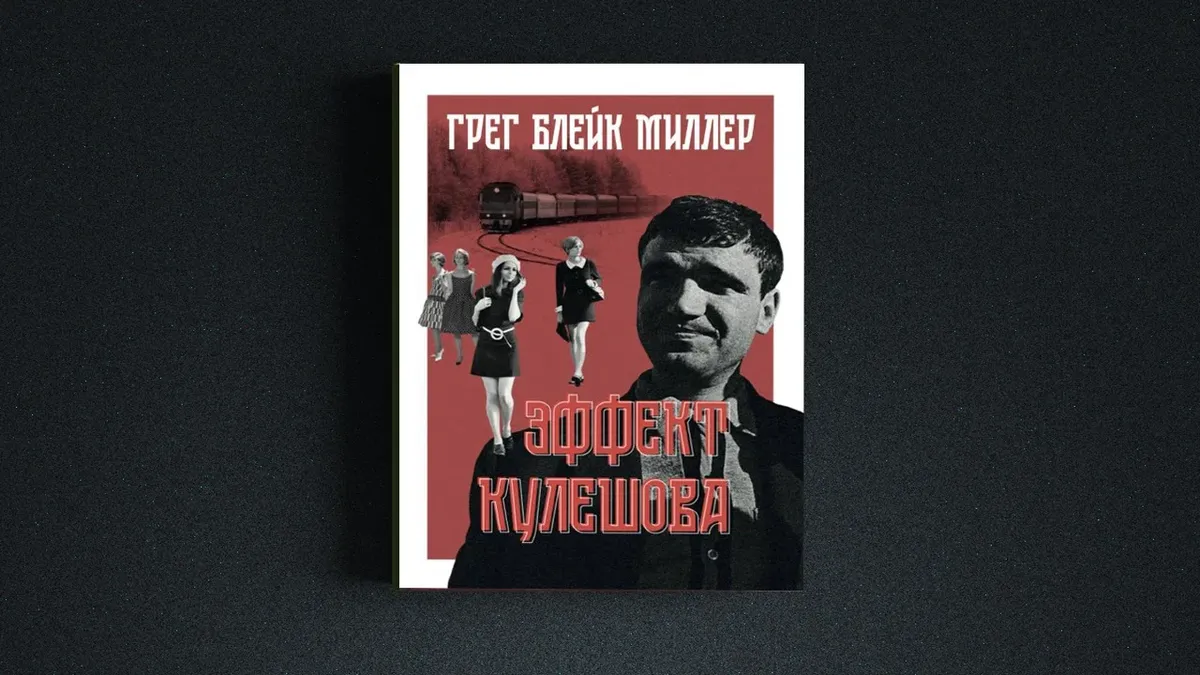
Cover of Greg Miller's novel The Kuleshov Effect
“Dear Reader! Now you will read something that no one has read before. Because no one has ever written anything like this before,” Jean-Jacques Rousseau begins his “Confession” with approximately this appeal to the reader. In fact, every artist should address his reader (viewer, listener) with these words, because if the work does not contain a discovery, then it has no right to claim our attention. But I don’t remember such requests. Perhaps due to the modesty and self-critical approach of current creators.
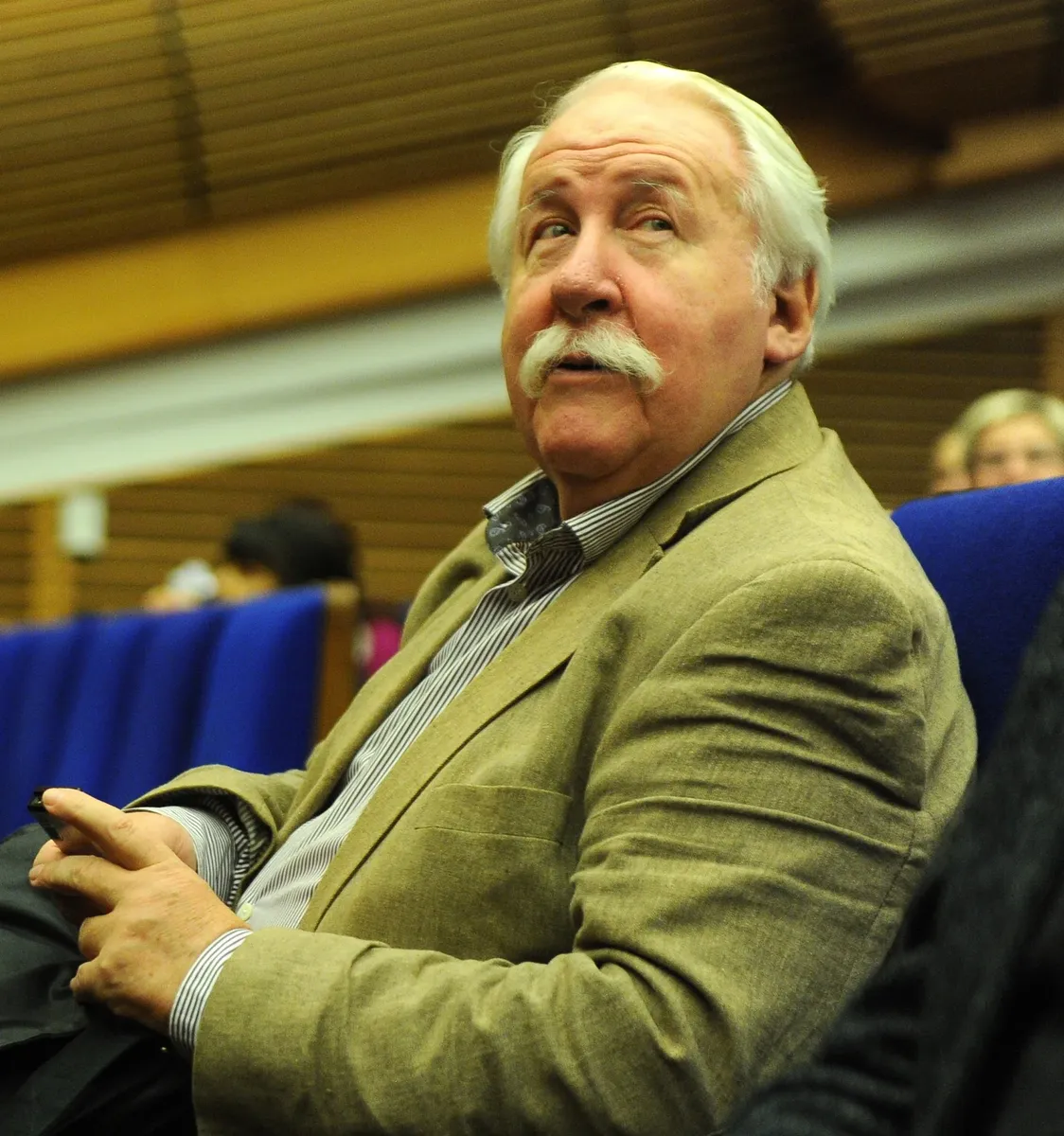
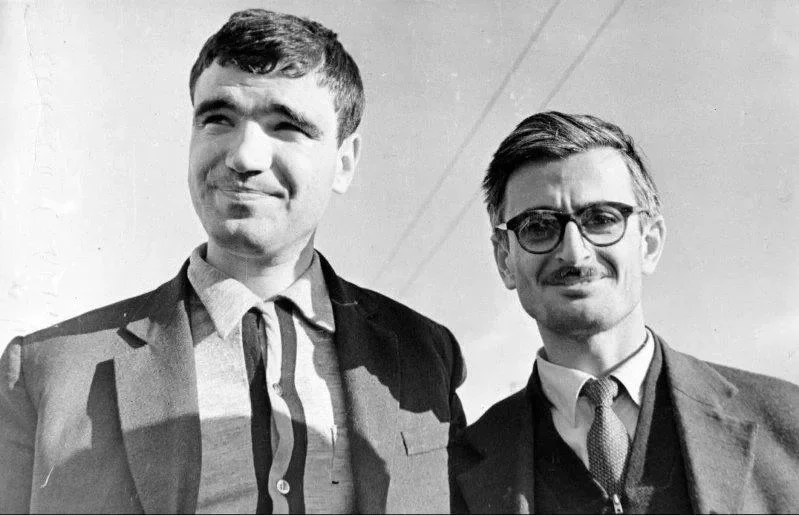
However, in one case such words at the beginning of the text would seem to me to be highly justified. We are talking about a work by a non-Russian author. I mean the novel by the American writer Greg Blake Miller “The Kuleshov Effect”, published in the beautiful Russian translation by Ekaterina Kevkhishvili (Freedom Letters, 2024). Having barely picked up the novel, preceded by an epigraph from the work of L.V. himself. Kuleshova, I was already intrigued. I graduated from the workshop of Lev Vladimirovich Kuleshov in 1962. Just that year, in the building of the film studio named after M. Gorky next to VGIK, Marlen Khutsiev was finishing the film “Ilyich's Outpost” according to the script he wrote together with my institute friend Gennady Shpalikov. The intrigue increased as I read the novel, the heroes of which are Shpalikov and Khutsiev. But it’s not just their presence in Miller’s novel, but the incredible, almost mystical interpenetration of the poetics of their film, and everything that came from the pen of Gennady Shpalikov, including his unfinished novel, and the work that was born 60 years later on another continent.
The more clearly the “airy bulk” of Miller’s novel loomed in my mind, the more clearly I remembered the details related to Shpalikovsky’s novel, starting with his — the novel — birth literally before my eyes, in the early spring of 1967, and ending with the summer day of 1968, when Gena suddenly appeared at the studio where I was working at the time and handed me a string bag (do you know, reader, what this is? string bag?), in which, like a catch in a fisherman’s net, a whole heap of pages covered with typewritten text glowed. “This is the novel “Thunderball.” Read it, it’s all written there!” — with these words Gena disappeared as unexpectedly as he had appeared. Among the pile of pages, I found a note: “The pages here are tangled - because this, as it turned out, is the only working copy. But you can read it without taking it apart, although page rank is also important - read it with courage! G."
And now, before my eyes, is the text of Miller’s novel, which seems to have been sent from somewhere in the noosphere, where the spirit of my friend Gennady Shpalikov lives. It’s as if someone responded to the call of another poet, voiced by Pushkin: “...Keep the manuscript, oh friends, for yourself!..
With a superstitious crowd / Gather sometimes to read my faithful scroll...”
Where does this feeling, close to mystical, come from?
Well, yes: the imagination of both authors populated their novels with historical figures unknown to the authors personally. (In Miller’s case, these are L.V. Kuleshov, M.I. Romm, M. Khutsiev, G. Shpalikov, A. Tarkovsky... For Shpalikov, this is not only M. Bulgakov, B. Pasternak, M. Tsvetaeva, but also V .A. Mozart, who decided to deal with Salieri, and there were two of them, so that the revenge was convincing: by hitting one in the face and throwing him into the open mouth of potassium cyanide, he arranges for another to be publicly executed by hanging in front of a huge crowd of people.)
All these characters are included in the life contemporary to the authors. And the authors do this with an absolutely charming, intoxicating sense of freedom. (As for Shpalikov, I can only confirm what I said about him many years ago:
Shpalikov was not just the freest of all the people I knew - he was the only absolutely free person.
By this, by the way, I explain G. Shpalikov’s refusal to participate in the alterations of Ilyich’s Outpost, which was condemned by many contemporaries, primarily M. Khutsiev himself, on which the authorities insisted.)
The author of “The Kuleshov Effect” demonstrates the same freedom. This freedom is in everything: in handling material, in free and artistic play with time and space. Nabokov assessed the level of the reader (meaning, of course, primarily the level of the writer) by the number of details that he was able to retain in his mind, and in this regard Miller is completely incomparable in both the description of American and Soviet realities. But even in conveying the most difficult, most intimate essence, namely the atmosphere of time, right down to the smells, Miller’s skill is beyond praise. The level of detail in the descriptions, sometimes reaching a level close to hallucination, sometimes inspires the feeling that what we are seeing is a recording of what we saw and reproduced on the screen, that is, either a masterfully written script, or a subsequent description of the finished film - the so-called editing sheet. And if a future reader ever wants to know what Leningrad looked like during the collapse of the socialist economy, I could give no better advice than reading that chapter by Miller, which describes the visit of an American student to Russia in the nineties.

However, the author does not hide the closeness of his method to cinema, and even organizes the form of presentation according to the model adopted in cinema: “Reel one...”, “Reel two...”, that is, a roll of film taken out of a tin box (each reel is 10 minutes screen time). The hero “unwound and rewinded the days like a film”... “Time works like a film: you cut it here, glue it here...” You have to constantly “reassemble time and space...”. And if you open the door of the Kunstkamera and find yourself in another country and in another century, you will immediately understand that in front of you is not a book, but screen space. There is no point in retelling this book - you will see this for yourself now.
In short, there is a girl named Kira (not Muratova, although she is very similar). She lives in the twenties and thirties, participates in the work of Kozintsev, Romm, Kapler, then she is arrested, then she dies. She has the ability to be reborn and is resurrected immediately after death in Leningrad, survives the blockade there, enters VGIK, meets Romm again, already a master, and marries an American student. Both of them are friends with Shpalikov, Khutsiev, Ryazantseva - so alive and recognizable that the thought of hallucination again comes to mind. And again she is arrested, and her husband is sent to a psychiatric hospital. And she dies under the wheels of a car, leaving the Novodevichy necropolis exactly on the day of the opening of the monument at Romm’s grave. And again she rises with the only task - to find her son, who on the day of her death remained with her closest friend. It looks like an adaptation of Akhmatova’s later poems: “Lord, you see, I’m tired of resurrecting, and dying, and living.” Why does Miller use this technique? Is it because at similar historical stages the same type is incarnated again? The explanation is flat, and most importantly -
There is no point in reinterpreting this magical book. What is "Ilyich's Outpost" about? About the air. This is the ideal novel, an “airy mass.”
In the multi-story structure of the book, the reader from time to time finds himself on that floor where, together with the heroes of the novel, real excitement awaits him because of the fate of a small gray fluffy ball - a kitten named Aelita - the daughter of Pushkin's cat. And this lyrical line illuminates the pages of the novel with a special heartfelt light. This is not to mention the fact that this book is at times cruel, mocking and terribly accurate. Here is our “hopeless optimism”, and “the faces of Soviet hypocrites, inflated by loud-boiling patriotism” (I’m sure F.I. Tyutchev will not be offended by the translator). And our country, which “loves its fairy tales almost as much as its lies.” And Yuri Gagarin, “who showed us, the Russians and the rest of humanity, what we are capable of when we take a short break from bloodshed...”.
Such images, like the entire content, the entire structure of the novel, paint us a portrait of the author, whose deep and sympathetic understanding of our history and our culture the Russian-speaking reader can only be proud of. Why does he love us so much? This is a secret, without which, as we know, there is no good art.