
Translated material
Diplomacy with Geography
After almost three years of war, how do Ukraine and Russia look at the “territorial issue”? We talk about the positions of the warring parties and an important factor in information warfare
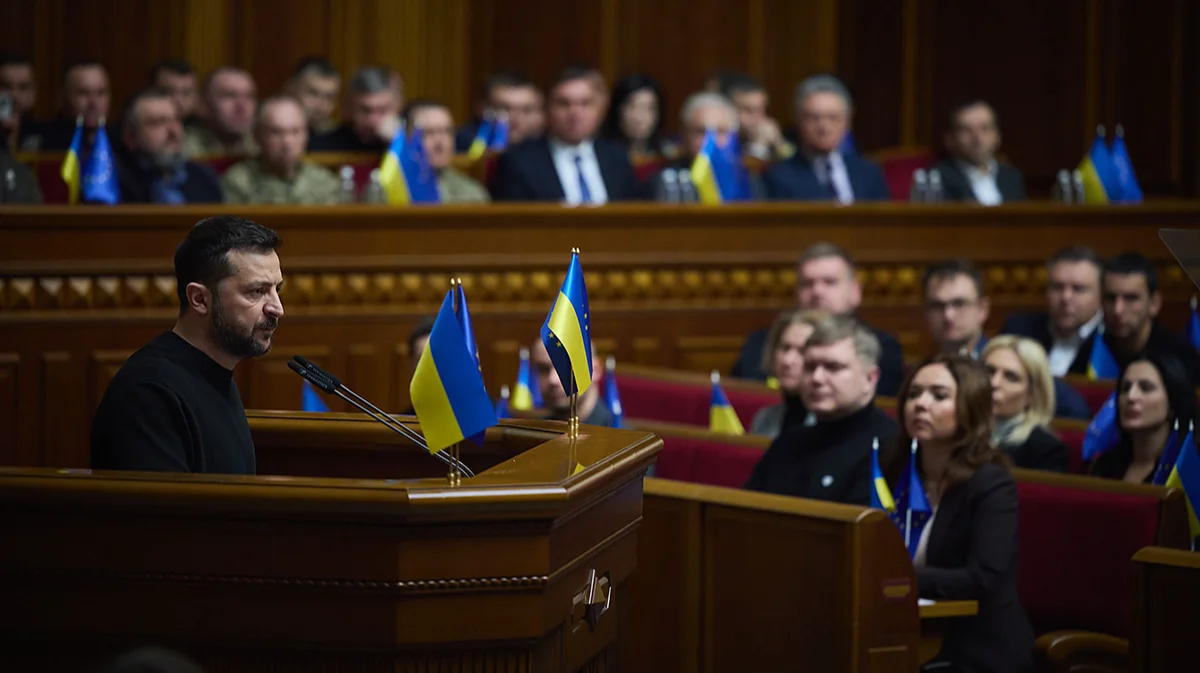
Ukrainian President Vladimir Zelensky presents his plan to the Ukrainian parliament in Kyiv, Ukraine, November 19, 2024. Photo: Press Service of the President of Ukraine / EPA-EFE
Last week, Ukrainian President Vladimir Zelensky, in an interview with Fox News , said that Ukraine would seek the return of Crimea “diplomatically” because Ukraine does not have sufficient military forces to “throw Putin back to the 1991 line.” Thus, for the first time, the rejection of one of Ukraine’s a priori goals in its confrontation with the Russian Federation, which had not even been discussed before, was announced: a return to the 1991 borders by military-diplomatic or exclusively military means. Since this context assumed (although Zelensky did not directly mention this) other Ukrainian territories that were occupied before February 24, 2022 (parts of the Donetsk and Lugansk regions), one would expect that this statement would cause a strong reaction in Ukraine.
However, this did not happen; which is surprising only at first glance. If you look more broadly at the entire socio-political and media context of recent weeks or even months in and around Ukraine, it becomes clear: Zelensky did not say anything unexpected. Ukrainian society was ready for such a formulation of the issue, no matter how painful and unfair it may seem. And there are a number of reasons for this.
Reason one: geopolitical. Trump's victory in the American elections made serious adjustments to Ukrainian politics. For which, however, Kiev was already preparing, taking into account the bitter experience of 2016, when the Ukrainian establishment, openly making an open bet on Hillary Clinton’s victory. Therefore, not only this statement, but also the very fact of his appearance on the pro-Trump TV channel became a clear message: Ukraine is ready to accept the position that Trump is guided by on the issue of the Russian-Ukrainian war. Although this position itself is still rather vaguely articulated, some of its general contours seem to be clear:
stop the war, bring the parties to the negotiating table, while recognition of the territorial integrity of Ukraine as its indispensable condition for participation in them, obviously, does not seem indisputable to Trump.
Zelensky’s words should be taken as an attempt to fit the Ukrainian position into these contours and play along with Trump in this intention, while simultaneously leaving room for maneuver for Ukraine. After all, the very idea of Ukrainian ownership of Crimea and other occupied territories is not called into question by this statement of the Ukrainian president. The fact that Kiev does not accept any compromises regarding territorial integrity was confirmed by Ukrainian Foreign Minister Andrei Sibiga at the Helsinki Commission of the US Congress, indirectly making it clear that Zelensky’s statement refers only to ways to restore it.
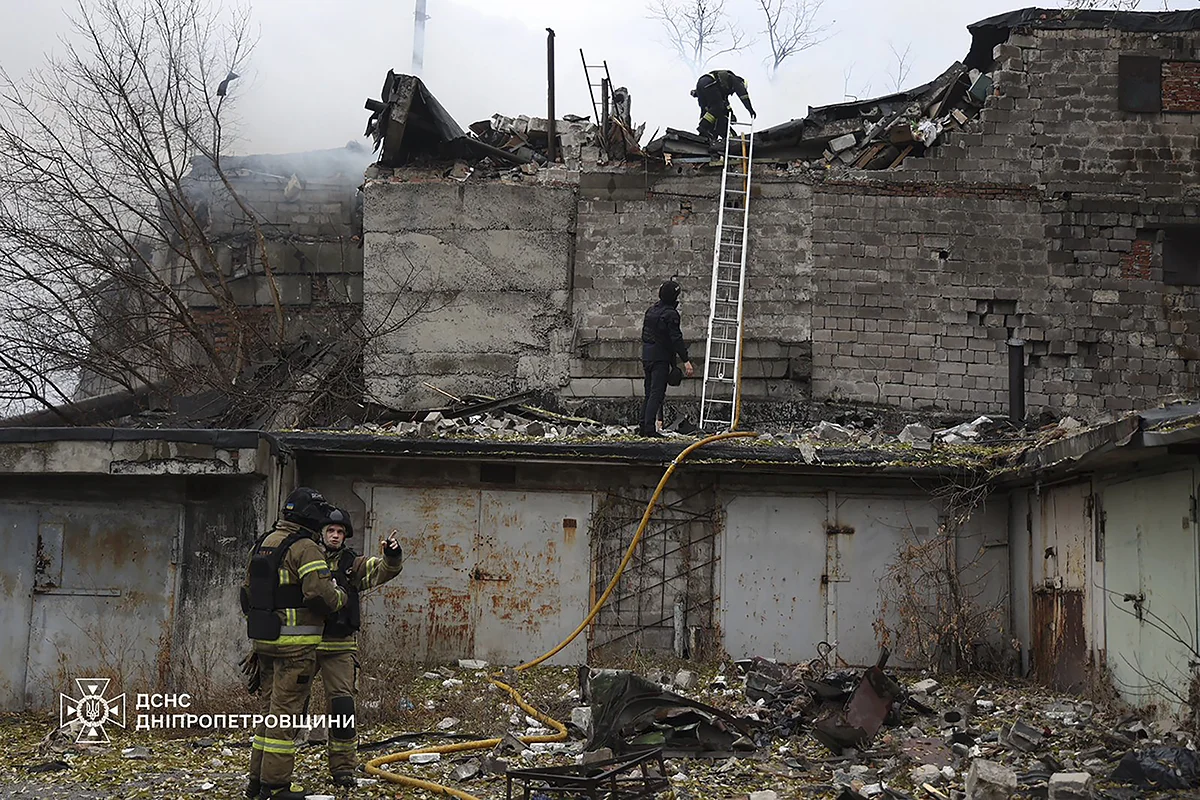
Reason two: military-strategic. Fierce fighting in the Donetsk , Zaporozhye and Kursk regions does not bring success to the Ukrainian army, which, while heroically holding back the Russian offensive, nevertheless loses some positions. The Russians are preparing an offensive in the Zaporozhye direction. In such conditions, by the time Trump officially took office, Kyiv should have, at least on a verbal level, recorded its readiness to soften its positions, clearly realizing that those “territorial realities” on the basis of which negotiations could take place in the future could turn out to be much worse for Ukraine.
Reason three: informational. Influential Western media and politicians have repeatedly launched “trial balloons” about the non-obviousness of keeping Ukraine within the 1991 borders - at least as an essential condition for starting negotiations, which New Europe has already written about. And despite the rather sharp negative reaction to this from Zelensky, this topic was present in the Ukrainian information space, performing the function of a kind of “preparing expectations.”
In addition to all this, an important role in the fact that Zelensky’s interview went unnoticed was played by a subsequent event, which became a much more pressing and relevant news story : the strike on the Dnieper by an intercontinental ballistic missile. This, as well as the updated nuclear doctrine of the Russian Federation and permission to hit targets on Russian territory with Western weapons, became top topics and definitely overshadowed Zelensky’s words about the diplomatic settlement of some territorial issues.
Nevertheless, there was still a certain reaction to these words. Thus, opposition MP, representative of the European Solidarity faction Alexei Goncharenko was perplexed why Ukrainians were again learning about such a turn towards a diplomatic solution to the Crimean issue from foreign media: “We hear a bunch of plans. And then from foreign media we learn such sensational news that we should be the first to know.” Although this message from Zelensky was addressed primarily to Trump, once again this communication with priority to a foreign audience is not perceived very positively in Ukraine.
On the other hand, Goncharenko did not fail to again reproach the authorities for the previous increase in positive expectations for the rapid return of the occupied territories. The words of the head of the Main Intelligence Directorate of Ukraine, spoken in 2023, that soon “we will drink coffee in Yalta,” have become in Ukraine not only a common reason for criticizing such mischievous statements, but also a meme.
And yet, Goncharenko’s opinion should be considered primarily in the context of his opposition to the authorities. This explains his emphasis on the supposed “sensationalism” of the president’s statements and his critical reference to those super-positive forecasts that previously came from the Ukrainian leadership. Experts who are not burdened with a political background reacted to Zelensky’s “territorial” statements with great restraint.
Member of the Mejlis of the Crimean Tatar people Eskender Bariev is ready to understand the change in the president’s rhetoric, although he recalls that “from 2014 to 2023 there was an experience when they tried to resolve the issue of de-occupation diplomatically. Only Russia still considers Crimea Russian..." In this regard, Bariev is confident that a diplomatic solution to the issue will become possible only when there are military prerequisites for this: "When Ukraine can demonstrate that it has the strength, that it can do this and by military means, then Russia can make concessions. Otherwise, I don’t think Russia will make concessions. And what concessions might we consider? This is a big question." At the same time, he recalled the statement of the representative body of the Crimean Tatars about the inadmissibility of compromises for Ukraine through concessions of part of its territory and sovereignty, including at the expense of Crimea.
Political scientist Evgenia Goryunova does not see anything new in this statement by President Zelensky and does not at all consider it sensational. She notes that the Ukrainian position regarding the de-occupation of Crimea varied before, only the position regarding the Ukrainian ownership of Crimea remained unchanged.
It is noteworthy that the “Donbass” context of “return through diplomatic means,” which was implicitly, but still traced in the interview, did not attract the attention of the expert community.
Perhaps because of this very “implicitness”, in contrast to the accentuated Crimea.
The “territorial” topic reappeared in the Ukrainian information space after a triad of events: permission to use Western missiles to hit targets on the territory of the Russian Federation, a change in the nuclear doctrine of the Russian Federation, an attack on the Dnieper with weapons that had not previously been used.
At the instigation of the Main Intelligence Directorate of Ukraine, the media published excerpts of a certain document, which, according to this Ukrainian department, is a forecast of the Ministry of Defense of the Russian Federation regarding the military-political development of the situation in the world until 2045. The GUR also suggested that with the help of this document Russia will try to promote to Trump the idea of eliminating the political subjectivity of Ukraine and dividing its territory into three parts . Allegedly, the Russian Federation will insist on recognition by Ukraine and the international community of Russian affiliation as one of them. These are fully and partially occupied regions of Ukraine: Crimea, Donetsk, Lugansk, Zaporozhye and Kherson regions.
The second , which in the document is called a “pro-Russian state entity,” includes Kiev, Kiev, Chernigov, Sumy, Kharkov, Poltava, Kirovograd, Dnepropetrovsk, Odessa, Cherkassy, Vinnytsia and Zhytomyr regions. This puppet state must abandon European and Euro-Atlantic integration and allow the Russian military presence (location of military bases, as is happening in Transnistria, South Ossetia and Abkhazia).
The third in the document appears under the name “disputed territories” and includes the western regions of Ukraine: Volyn, Rivne, Khmelnitsky, Lviv, Ivano-Frankivsk, Ternopil, Chernivtsi and Transcarpathian. The Kremlin believes that their future can be decided between Russia and other neighboring states: Hungary, Poland, Romania.
The very idea of such a division of Ukraine is also far from new. Moreover, this is a long-standing dream of Russian neo-imperialists.
Putin has not publicly voiced such plans, although his “historical” (and other) articles and statements openly hinted at a sincere acceptance of such a view of Ukrainian statehood and territorial borders. Well, the Kremlin’s actions since 2014 generally marked the beginning of the practical implementation of this idea. Even 10 years ago, Novaya Gazeta published a detailed plan, which was at the disposal of the editors, for seizing the eastern and southern regions from Ukraine, which began to be implemented just then, having received an ideological wrapper in the form of the toponym “Novorossiya”.
According to the current Minister of Foreign Affairs of Poland Radoslaw Sikorski, Putin back in 2008 proposed to the then (and current) Prime Minister of Poland Donald Tusk to take away the western regions of Ukraine. And the recently released memoirs of former Polish President Alexander Kwasniewski claim that the Kremlin is sincerely confident in Poland’s hidden desires to annex the western Ukrainian regions. Kwasniewski refers to his conversation with Putin during the Orange Revolution in Ukraine in 2004: “This is his way of thinking about this, and I’ll say more: he’s not doing it for show.
Putin’s entire thinking about history is so based on books for KGB officers that it’s even difficult to imagine... Putin himself later told me: “This is a dispute between two empires about whose Ukraine will be.”
Reacting to Trump’s victory in the American elections, Putin again spoke unequivocally about the territorial borders of Ukraine, confirming that Russia’s ownership of those Ukrainian territories that are already included in its composition, according to the Constitution of the Russian Federation he rewrote, is not even discussed, and regarding the rest he noted , that the new borders of Ukraine will depend on the “dynamics of ongoing events” and the opinions of residents of Ukrainian regions, which Putin, as before, called “historical territories of Russia.”
That is why the publication of the “partition plan” of Ukraine also did not become a sensation for Ukrainians. A more interesting question is: why and on whose initiative this topic has resurfaced right now. Ukrainian media and experts actively seized on it and for the most part agree on the following. The “Partition Plan” is a Russian information and psychological operation aimed at putting pressure on the West and the United States and part of a game to “raise the stakes.” Thus, according to political analyst Yaroslav Makitra, the Russian Federation has in mind the upcoming negotiations with the United States regarding Ukraine and by “throwing in” this document it shows its strategic framework, or rather, a certain scenario of what will happen if Russia’s conditions are not accepted. “Therefore, this document can be considered a look into the future from Russia: if they don’t negotiate with it now, listen to its proposals, they threaten that Ukraine will look like this,” the analyst believes.
International affairs expert Maxim Nesvitaylov calls the “plan” completely unrealistic, and its dissemination as an element of pressure from the Russian Federation, a deliberate exaggeration of demands so that during the negotiations other, less radical conditions of Russia would be perceived as acceptable.
However, we should not forget that it was the Ukrainian side that was the first to publish information about this document. Whether this was a deliberate leak on the part of the Russian Federation or whether the initiative for the “stuffing” originally belonged to Ukrainian intelligence, which deliberately chose the moment for this, is difficult to say. If the latter (and according to the Main Intelligence Directorate, the plan was prepared a year ago), then this can be considered precisely a Ukrainian information and psychological operation in order to strengthen Kiev’s position in the eyes of the United States and, above all, its new president. Then the publication of the “plan” can serve as a negative contrast for Russia, because according to this information, it is preparing the complete destruction of Ukrainian statehood, while Zelensky (and he demonstrated this in an interview with Fox News) is inclined to diplomatic solutions to a number of territorial issues. That is, he is ready for a possible compromise, which is so expected in the West.
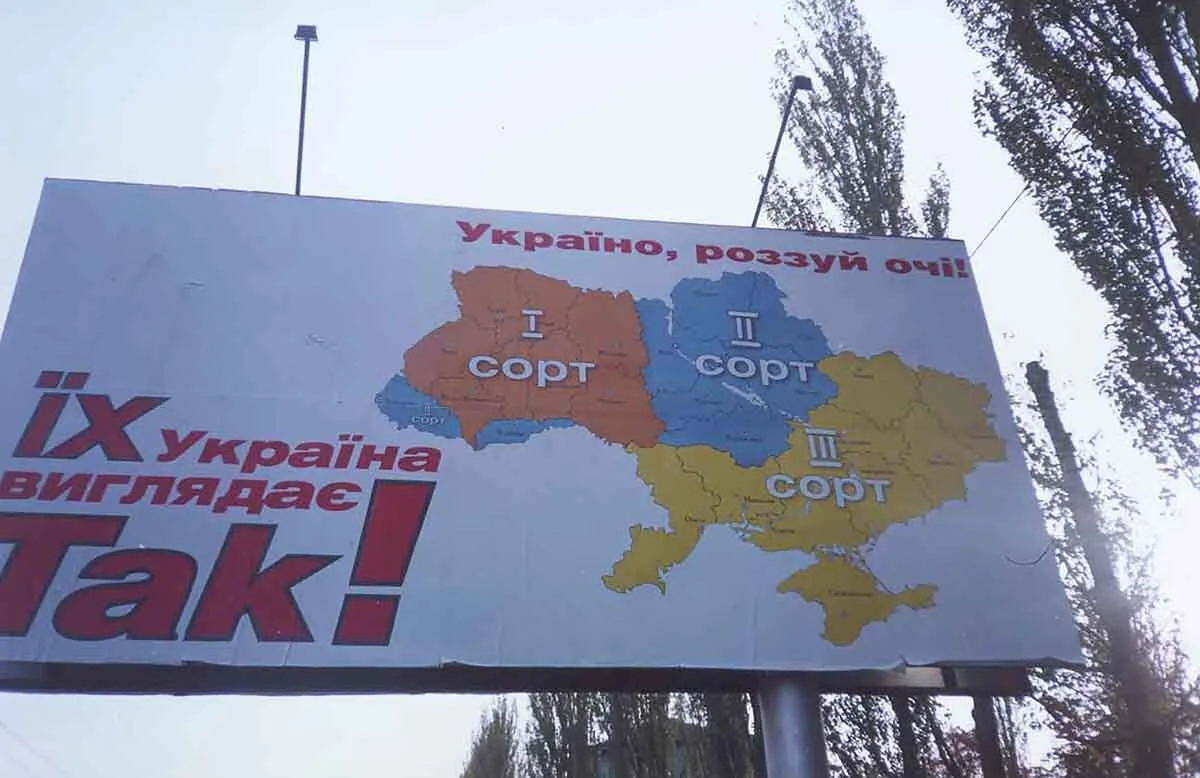
It is also significant that the publication of the “plan” occurred on the eve of the 20th anniversary of the Orange Revolution in Ukraine. And the Ukrainian media actively seized on visual analogies of the image of the map of the “partition” of Ukraine with the notorious “black” political advertising of Viktor Yanukovych’s headquarters in the 2004 elections. Then the image of a similar map dividing Ukrainians into three classes was provocatively presented as the political position of Viktor Yushchenko, who considers Western Ukrainians to be the first class, and Eastern Ukrainians the third.
This advertisement was invented by Russian political technologists led by Gleb Pavlovsky, who worked with Yanukovych’s team, and from that moment on became a symbol in Ukraine of Russian destructive influence with the aim of splitting the country.
And now, comparing the two maps precisely in the context of the anniversary of the events of 2004, the Ukrainian media emphasized the immutability of these Russian plans, stimulating very sensitive memories and reactions of the Ukrainian audience.
Be that as it may, only one thing can be said with certainty. The territorial issue has become one of the factors in the information war, the actualization of which is associated both with the desire to clearly define its positions on the eve of Trump’s assumption of office and possible negotiations, and in connection with the memorable events of Ukrainian recent history, which marked the beginning of Ukraine’s exit from the zone of Russian influence .